

Is This the End of Vibe Coding?
 Michael Willson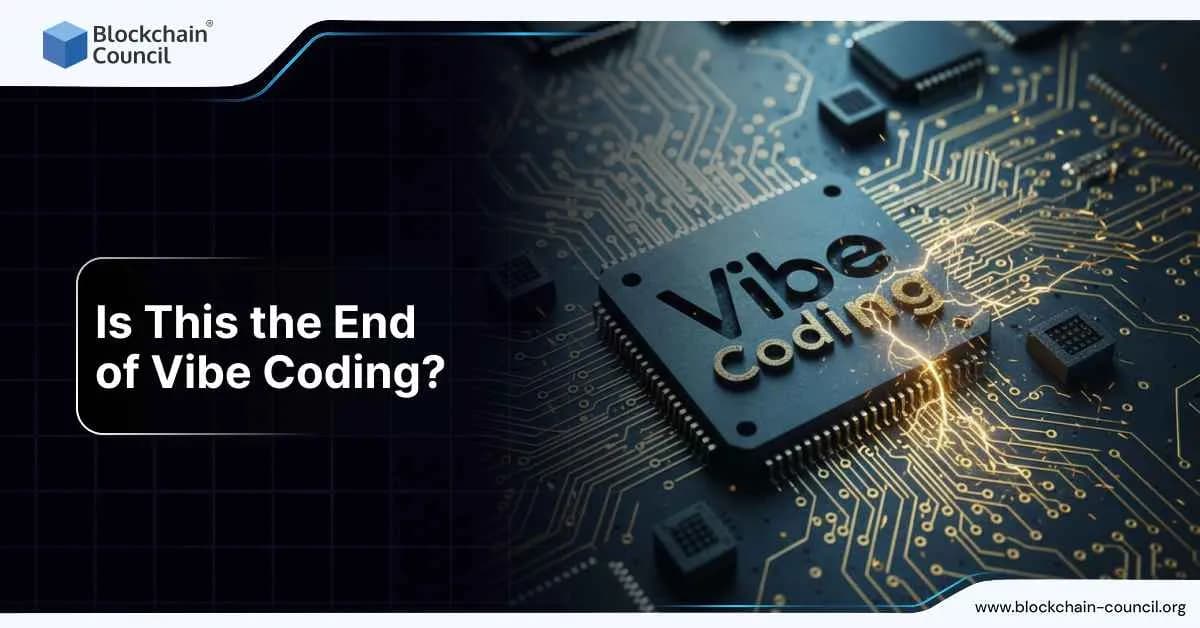
When Amar, Product and Design Lead at Google DeepMind, introduced Gemini’s Vibe Coding experience inside AI Studio, it felt like the beginning of a new era. The concept was captivating — describe an app in simple words, and Gemini would automatically connect the models and APIs needed to bring it to life.
It was the promise of creativity without complexity. Non-developers suddenly had the chance to build software the way they imagined it. For a brief period, vibe coding was everywhere. From startups to solo creators, people believed they could “just vibe” their way to working apps.

But today, only months later, developers and AI engineers are asking a new question: has vibe coding run its course, or has it simply evolved into something more mature?
The Moment Vibe Coding Changed Everything
At the start of 2025, vibe coding exploded across the tech world. It felt like the democratization of software creation. Users no longer needed deep programming expertise; they could simply tell an AI what they wanted, and the system did the heavy lifting.
Platforms like Lovable and Bolt allowed entrepreneurs to create apps conversationally. Cognition and Cursor became trusted companions for developers who wanted an AI that understood their workflow. When Cloud Code hit a valuation of more than 600 million dollars in just a few months, the world realized something big was happening.
The excitement was real. Designers, product managers, and even marketers began building full digital products. Vibe coding became the Canva of app development — fast, fun, and accessible. But this simplicity came at a cost.
The Growing Discomfort Among Developers
As vibe-coded prototypes landed on developers’ desks, many realized how fragile they were. The interfaces were attractive, but the structure underneath often lacked strength. Missing data models, poor version control, and limited security testing made these creations difficult to scale.
One engineer described it perfectly: “It looks like a car, but there’s no engine inside.”
Engineering teams spent more time rebuilding vibe-coded apps than improving them. Soon, a gap appeared between non-technical builders and experienced developers. The former worked in flexible, visual environments, while the latter stuck to traditional stacks.
Some companies, like Superbase, tried to merge both worlds. Their platform attracted both casual creators and engineers, nearly quadrupling in valuation. But most tools kept to their niche, creating a divide that led to the next evolution in AI-assisted development.
A Shift Toward Structure and Collaboration
By mid-2025, the industry began to mature. The focus moved from effortless creativity to responsible collaboration. Developers sought AI systems that could support creativity while maintaining software integrity.
This new phase gave rise to spectrum development — an approach that blends human logic with AI-generated output. Instead of relying entirely on AI “vibes,” developers started using AI to co-design and co-review their code.
Major companies noticed this shift. Amazon began testing spectrum workflows for faster releases. OpenAI introduced model alignment specifications to make code generation more predictable.
Professionals realized that future-ready skills required both technical grounding and AI literacy. Earning a Tech Certification from Global Tech Council has become a smart way to build those hybrid capabilities.
The Sync and Async Spectrum
Another transformation came from how developers interacted with AI tools. Experts started describing it as the sync-async spectrum — two styles of building with AI.
Sync tools, like Cursor’s IDE extension, let developers work alongside AI in real time. This hands-on approach boosts flow and focus for complex coding tasks.
Async systems, such as Claude Code or Cognition, take a different route. They work in the background, completing projects autonomously. Once seen as slower, these agents have become far more efficient. Cognition’s acquisition of Windsurf IDE marked a turning point — proving that the future of AI development is about merging both styles seamlessly.
Sync tools amplify human creativity. Async agents automate routine tasks. Together, they create a balanced ecosystem for modern AI coding.
How AI Coding Tools Are Evolving
Claude Code is now part of Anthropic’s agent ecosystem, moving beyond code to manage documentation and automation.
Cursor has rolled out Composer 2.0, enabling collaborative real-time coding.
Cognition strengthened its enterprise presence after integrating Windsurf IDE.
Cloud Code grew into a major web-based terminal company, surpassing 600 million in revenue within months.
Lovable and Bolt continued empowering creators to build fully functional sites without prior coding experience.
Each platform reflects the same message: vibe coding isn’t disappearing — it’s refining.
The Age of Agent Labs
Underneath these changes lies a broader industry split. The AI landscape now revolves around two powerful categories — Model Labs and Agent Labs.
Model Labs focus on foundational research. Organizations like OpenAI, Anthropic, and Mistral build massive models and infrastructure that others rely on.
Agent Labs, on the other hand, design products first and improve their intelligence later. Cognition, Cursor, and Harvey are prime examples. They deliver practical solutions that evolve with real-world feedback.
This balance between infrastructure and usability is shaping the Product Era of AI. Companies that connect these layers will dominate. To understand these systems deeply, many professionals now pursue an AI Certification from Blockchain Council. It helps them bridge innovation with responsible deployment.
Agentic AI and the 80/20 Code AGI Theory
Developer and thinker Sean “Swix” Wang introduced a concept that perfectly captures this transition — the 80/20 rule of Code AGI. He believes that code-based AGI will emerge in just 20% of the time it takes to build full AGI, while generating 80% of its economic impact.
Why? Because code is the ideal training ground. It’s measurable, logical, and instantly verifiable. AI can learn faster here than in any other domain.
This theory also connects closely with the rise of agentic AI, where autonomous agents reason, plan, and execute tasks independently. Platforms like Cognition are already using these intelligent agents to automate workflows beyond programming — from business analysis to creative content generation.
Professionals who understand agentic systems and automation will lead the next wave of digital innovation. Enrolling in the Agentic AI certification by Blockchain Council is becoming a clear path to mastering these advanced AI dynamics.
Context Engineering and Measuring Real ROI
As the AI industry matures, one field is quickly gaining importance — context engineering.
It’s about giving AI systems the right data and structure to make their responses accurate and useful. Technically, it’s tied to prompt design and memory optimization. Strategically, it’s about preparing organizations to work seamlessly with intelligent systems.
This maturity brings a new focus — measurable outcomes. Businesses are done experimenting; now, they want proof of performance.
In recent benchmarking studies, over 250 AI-driven projects were analyzed across consulting, finance, and healthcare. The findings show that companies are prioritizing ROI through automation, cost reduction, and improved decision-making.
To align innovation with measurable business value, professionals are increasingly pursuing Marketing and Business Certification from Universal Business Council. It helps leaders connect AI adoption with long-term strategic impact.
So, Is Vibe Coding Really Dead?
Not quite. It’s not gone — it’s evolved.
Vibe coding opened the door to creativity and accessibility. What’s happening now is the second chapter — one built on structure, collaboration, and measurable value.
AI-assisted development is moving from hype to maturity. The goal is no longer to “just vibe” but to build sustainably, securely, and smartly.
Vibe coding was never about writing perfect code. It was about imagination — about turning ideas into something tangible. Today, that same imagination is evolving into disciplined, agentic, and intelligent creation.
Vibe coding hasn’t died. It’s simply grown up — and it’s taking the AI industry with it.
Related Articles
View All
AI & ML
Google Playground: Create AI Games Without Coding
Learn what Google Playground is, how it uses generative AI to turn text prompts into browser games, how to create your first game, what it costs, how it compares with other no-code tools, and what limits to expect.

AI & ML
Built to Catch AI Cheating: Rethinking Pre-Employment Assessments with HireValid
Explore how HireValid is rethinking pre-employment assessments with AI-resistant test design, integrity signals, candidate evidence, and human review to address AI-assisted cheating.
AI & ML
AI-Era Hiring Needs AI-Proof Tests: How HireValid Is Redefining Talent Assessment
Explore how HireValid is rethinking talent assessment for the AI era with job-relevant tests, anti-cheating design, integrity signals, and human-reviewed evidence of candidate ability.
Trending Articles
AWS Career Roadmap
A step-by-step guide to building a successful career in Amazon Web Services cloud computing.

Top 5 DeFi Platforms
Explore the leading decentralized finance platforms and what makes each one unique in the evolving DeFi landscape.
How Blockchain Secures AI Data
Understand how blockchain technology is being applied to protect the integrity and security of AI training data.