Edge AI Engineer Jobs

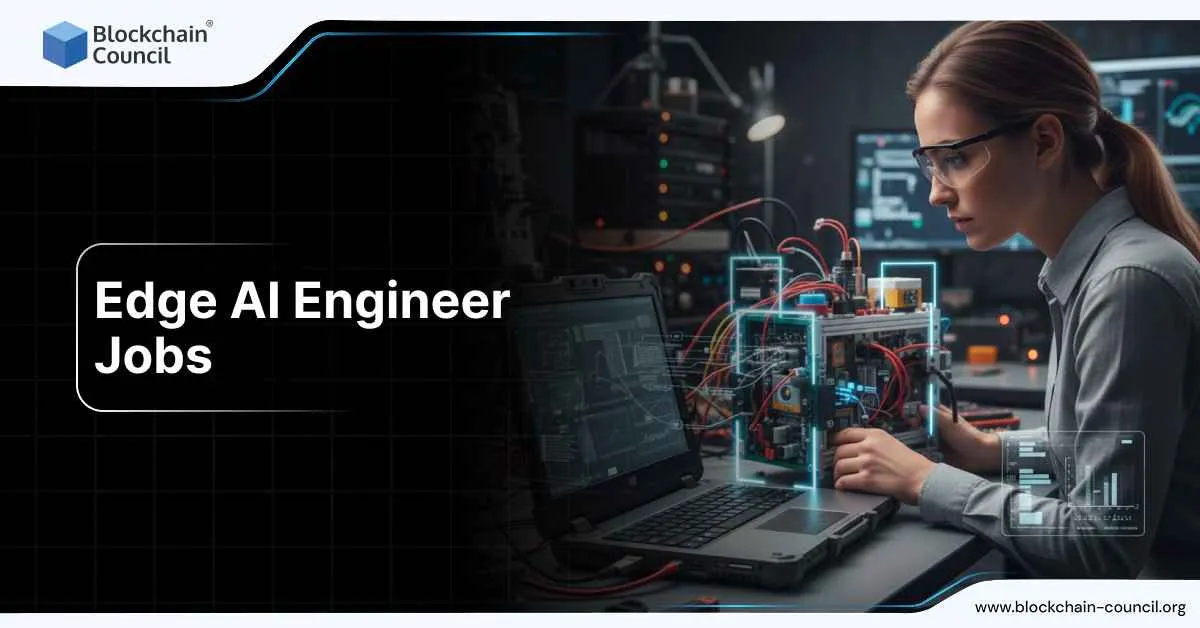
Edge AI engineer jobs exist because modern AI does not live only in the cloud anymore. It lives inside cameras, machines, vehicles, robots, kiosks, phones, and factory floors. These systems cannot wait for a remote server to respond. They must see, hear, decide, and act instantly.
That is why companies hire Edge AI engineers. They need people who can take AI models and make them work reliably on real devices with limited power, memory, heat, and network access.

For anyone exploring this career path, starting with a strong foundation such as an AI Certification helps build the core understanding of how models behave before learning how to run them at the edge.
Edge AI engineer
When employers say “Edge AI engineer,” they are not talking about someone who only trains models.
They are looking for engineers who can:
- Run AI directly on devices instead of the cloud
- Make models fast enough for real-time decisions
- Keep systems stable in unpredictable environments
- Ship updates safely across many deployed devices
This role sits between machine learning, embedded systems, and production engineering. That overlap is exactly why demand keeps growing.
Job titles
Many companies hire Edge AI engineers without using that exact title. Common titles include:
- Edge AI Engineer
- Senior Edge AI Engineer
- Embedded AI Engineer
- Embedded Machine Learning Engineer
- Computer Vision Engineer (with on-device deployment)
- Edge AI Principal Engineer
- IoT and Edge AI Engineer
When scanning job boards, phrases like on-device inference, embedded ML, real-time perception, and AI on SoC often signal an edge role even if “Edge AI” is not in the title.
What Edge AI engineers do
Across industries, the responsibilities are surprisingly consistent.
Most roles expect engineers to:
- Turn trained models into fast, reliable on-device systems
- Optimize AI models for latency, memory, and power constraints
- Integrate models into embedded applications and pipelines
- Own the full lifecycle from deployment to monitoring
- Debug failures that only happen in real environments
This is not research work. It is execution work. Employers want systems that run every day without breaking.
Model optimization
Model optimization is not optional in edge jobs. It is a core requirement.
Companies expect Edge AI engineers to:
- Reduce model size without destroying accuracy
- Choose the right precision and runtime for each device
- Tune pre-processing and post-processing pipelines
- Profile performance across different hardware
This is why many job descriptions explicitly mention optimization toolchains and inference runtimes. Engineers who can show real benchmarks stand out immediately.
Hardware familiarity
Edge AI jobs almost always reference hardware.
Common platforms include:
- Edge GPU systems used for real-time vision and robotics
- Embedded SoCs used in cameras and industrial devices
- MCU-class devices for low-power inference
- Automotive and mobility-focused compute platforms
Companies do not expect engineers to design chips, but they do expect comfort working within hardware limits.
Where Edge AI engineer jobs are most common
Edge AI roles appear wherever decisions must be fast and local.
The strongest hiring clusters are:
- Robotics and autonomous systems
- Automotive and mobility technology
- Manufacturing and industrial automation
- Smart cameras and security systems
- Retail analytics and interactive kiosks
- Healthcare devices and medical imaging
If a system interacts with the physical world, Edge AI engineers are usually involved.
Entry-level vs senior roles
Edge AI roles scale quickly in responsibility.
Entry-level or mid-level roles typically involve:
- Deploying existing models to devices
- Integrating inference into applications
- Hitting baseline performance targets
- Following established deployment pipelines
Senior and lead roles usually involve:
- Designing the entire on-device architecture
- Owning optimization strategy and tradeoffs
- Defining rollout and rollback processes
- Reviewing reliability, safety, and security decisions
This distinction matters when applying. Employers expect proof of ownership at senior levels, not just model knowledge.
Skills
Across job descriptions, the same skill signals appear repeatedly.
Core skills:
- Real-time computer vision or on-device ML
- Performance profiling and debugging
- End-to-end system integration
- Production-grade software development
Tooling and platforms:
- Inference optimization stacks
- Edge runtimes and deployment tooling
- Device-level logging and monitoring
This is where a structured Tech Certification helps many engineers fill gaps in systems, deployment, and infrastructure fundamentals.
Salary expectations
There is no single global salary number for Edge AI engineers.
What can be said safely:
- Compensation is higher than general software roles because of specialized skills
- Pay varies widely by region and industry
- Senior edge roles command strong premiums due to scarcity
More important than salary numbers is this reality: companies struggle to hire engineers who can actually ship edge systems. That keeps demand high.
Certifications
Certifications matter most when they prove capability, not when they are collected randomly.
Hiring managers respond well to certifications that map directly to job tasks:
- AI and Machine Learning certification for model fundamentals
- Edge or Embedded AI certification for on-device inference
- Computer vision certification for real-time perception roles
- MLOps certification for deployment and monitoring discipline
- IoT and security certification for device-level safety
Pairing technical skills with a Marketing and Business Certification also helps engineers explain value, ROI, and system impact to non-technical stakeholders.
How to search for Edge AI jobs?
Using the right keywords saves time.
Effective search terms include:
- on-device inference
- embedded ML
- real-time computer vision
- model optimization
- edge deployment
- hardware-accelerated inference
These phrases surface genuine edge roles instead of cloud-only AI jobs.
Conclusion
Edge AI is not a trend. It is a shift.
As AI moves closer to users, machines, and environments, companies need engineers who can make AI reliable outside perfect lab conditions. That need is growing across industries, not shrinking.
For people who enjoy building systems that actually work in the real world, Edge AI engineering is one of the most durable and meaningful AI career paths available today.