DeepMind’s Automated Lab

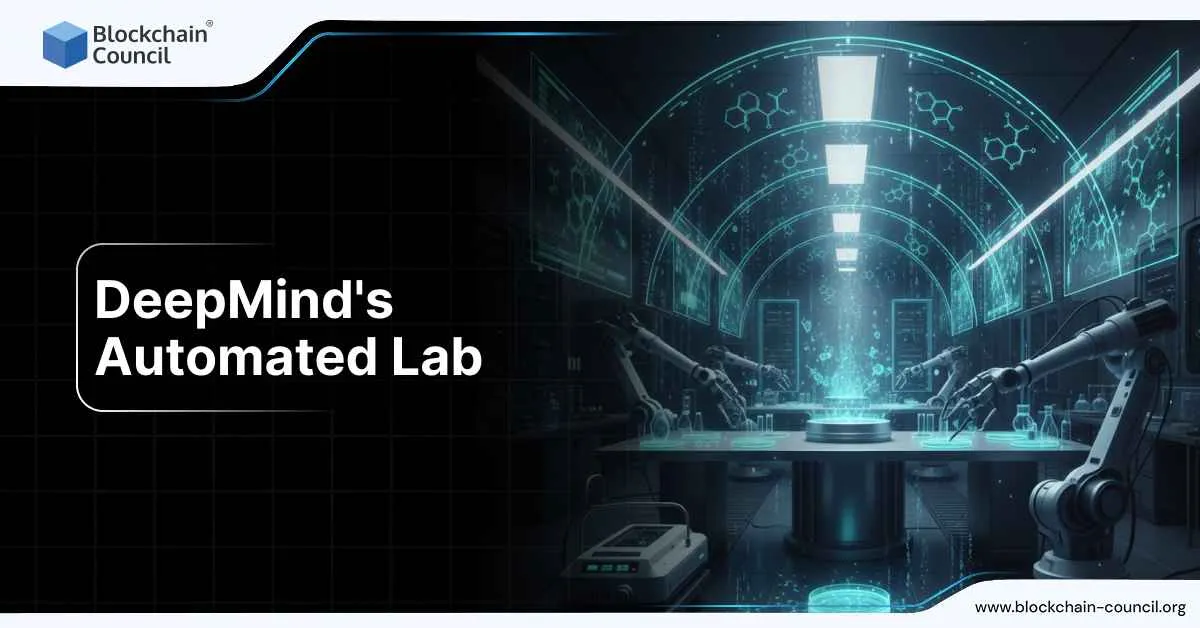
In December 2025, DeepMind made a move that quietly but fundamentally changed how people should think about artificial intelligence in science. Instead of announcing another model or benchmark, the company confirmed plans to open its first fully automated research laboratory in the United Kingdom, scheduled to begin operations in 2026. This lab is not focused on theory or simulation alone. It is designed to run real physical experiments using AI, robotics, and automation, closing the loop between hypothesis, testing, and iteration with minimal human intervention. This shift reflects how Artificial intelligence is moving from digital reasoning into direct control of the physical world, a transition many professionals first encounter through structured pathways like the AI Certification.
What DeepMind’s Automated Lab Actually Is
DeepMind’s automated lab is a physical research facility where AI systems decide which experiments to run, robotic systems execute those experiments, and machine learning models analyze the results to determine next steps. Unlike traditional laboratories, where scientists manually design and conduct experiments, this lab is designed to operate continuously, learning from each result and adapting its approach in real time.

The project was publicly tied to a strategic partnership with the UK government announced on 11 December 2025, positioning the lab as part of a broader national effort to accelerate scientific discovery using AI. DeepMind’s leadership, including CEO Demis Hassabis, framed the lab as a way to move beyond AI as a predictive tool and toward AI as an active scientific participant.
Why DeepMind Is Building a Physical Lab Instead of Just Better Models
DeepMind has already shown that AI can outperform humans in specific analytical domains. AlphaFold’s protein structure predictions are the most cited example. But prediction alone does not create new materials, new medicines, or new energy systems. Physical experimentation is still required.
The automated lab is DeepMind’s answer to that gap. By integrating AI directly with laboratory robotics, the company aims to compress discovery timelines that currently take years into months or even weeks. This is especially important in fields like materials science, where the number of possible combinations is too large for human-led experimentation to explore efficiently.
How the Lab Works in Practice
The lab operates on a closed feedback loop:
- AI models generate hypotheses based on existing data
- Robotics systems carry out experiments with precise control
- Sensors collect results and feed them back into the models
- The system decides what to test next without waiting for human instruction
This structure reflects a broader shift toward agent-based AI systems, where software is not just responding to prompts but actively planning and executing sequences of actions. These systems are often described as autonomous research agents, a concept that sits at the core of modern Agentic AI development and is explored in depth through programs like the Agentic AI certification.
Initial Research Focus Areas
According to reporting and government briefings released in mid-December 2025, the automated lab’s early work will focus on materials science, with particular emphasis on:
- Superconductors capable of transmitting electricity with zero resistance
- Advanced semiconductor materials for next-generation computing chips
- Other high-impact materials relevant to clean energy and medical imaging
These areas were chosen because they involve complex chemical and physical interactions that benefit most from large-scale, iterative experimentation guided by machine learning.
The Role of Gemini and DeepMind’s AI Stack
DeepMind has confirmed that the lab will integrate its latest AI systems, including models built on the Gemini architecture, to guide decision-making throughout the research process. Gemini is expected to handle tasks such as pattern recognition across experimental outcomes, optimization of experimental parameters, and prioritization of promising research paths.
This marks a step beyond earlier AI-for-science efforts, where models analyzed data after experiments were completed. In the automated lab, AI is involved before, during, and after each experiment.
Why the UK Government Is Involved
The automated lab is not operating in isolation. It is part of a three-year collaboration between DeepMind and the UK government, aimed at strengthening national capabilities in AI, science, and advanced manufacturing. As part of this agreement, UK researchers will receive priority access to DeepMind’s AI tools and automated experimentation infrastructure.
Political leaders framed the lab as a strategic asset that could help the UK compete globally in emerging technologies, particularly as other countries invest heavily in AI-driven research facilities.
What This Means for the Future of Scientific Work
DeepMind’s automated lab challenges a long-standing assumption about how science progresses. Traditionally, progress has been limited by human time, attention, and physical labor. Automated labs change that equation by allowing experiments to run continuously, learn from failure instantly, and explore vast solution spaces that humans cannot manually navigate.
This does not remove scientists from the process. Instead, it shifts their role toward oversight, interpretation, and strategic direction. Researchers define goals and constraints, while AI systems handle execution at scale.
Broader Implications Beyond Science
The same architecture behind DeepMind’s automated lab can eventually extend into manufacturing, drug discovery, energy optimization, and even industrial R&D. Any domain that relies on repetitive testing and optimization could be transformed by AI-driven experimentation.
As AI systems increasingly influence physical processes and business outcomes, understanding the technical and strategic layers behind them becomes critical. This is why professionals across industries often complement technical learning with broader frameworks like the Tech Certification to grasp how systems scale from lab environments into real-world infrastructure.
Why This Matters for Organizations and Markets
Automated research changes competitive dynamics. Companies that can discover materials faster, optimize production more efficiently, or validate ideas at lower cost gain structural advantages. Governments recognize this, which is why public-private partnerships like the one behind DeepMind’s lab are becoming more common.
From a business perspective, AI-driven discovery shortens innovation cycles and reduces uncertainty. These shifts affect investment decisions, supply chains, and long-term strategy, making them relevant not just to scientists but also to executives, investors, and product leaders who often engage with frameworks taught in the Marketing and Business Certification.
What Is Still Unknown
Despite the significance of the announcement, several details remain undisclosed:
- The exact opening date in 2026
- The full robotics stack used inside the lab
- The total budget and operating costs
- Whether similar labs will be built outside the UK
These unknowns suggest DeepMind is still refining the model before scaling it globally.
Final Perspective
DeepMind’s automated lab is not about replacing scientists. It is about changing the pace and structure of discovery. By giving AI systems the ability to run experiments, learn from outcomes, and iterate autonomously, DeepMind is redefining what research infrastructure looks like in the age of intelligent systems. If the lab performs as intended when it opens in 2026, it will likely become a blueprint for how science is conducted in the decades ahead.