Is AI a Bigger Cybersecurity Threat Than Hackers?
 Michael Willson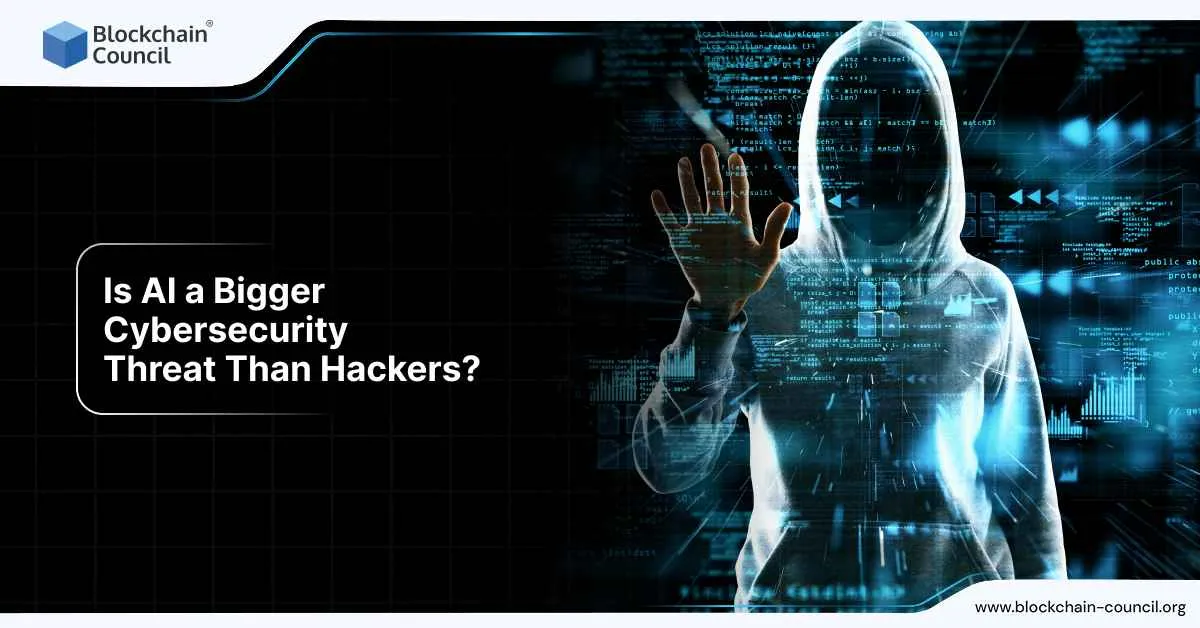
Artificial intelligence is moving at lightning speed, and nowhere is this more evident than in cybersecurity. AI is no longer just a tool for detecting threats—it is now powering new forms of cyberattacks that are faster, smarter, and more scalable than anything human hackers could manage alone. This leads to the big question: is AI a bigger cybersecurity threat than hackers? The clear answer is that AI does not replace hackers but amplifies them. It gives both criminals and defenders supercharged tools, turning cybersecurity into an AI-versus-AI arms race.
If you want to prepare for this new digital battlefield, an AI certification is a strong way to build the knowledge needed to use AI responsibly while understanding its risks.

How AI Is Changing Cyber Threats
AI has lowered the barrier for launching sophisticated cyberattacks. Tools like HexStrike-AI combine language models with entire libraries of security exploits, reducing the time needed to hack a system from days to minutes. Researchers at NYU have even shown that AI can autonomously carry out ransomware attacks—mapping networks, stealing data, encrypting files, and issuing ransom notes.
This shift means attackers no longer need to be seasoned experts. With AI, even novices can deploy complex cyberattacks at scale, something traditional hacking couldn’t achieve as quickly.
The Rise of AI-Enhanced Cybercrime
There are several ways AI is already making attacks more dangerous:
- Phishing made smarter: AI creates emails, messages, and voice calls that are harder to distinguish from genuine communication.
- Automated malware: AI can write malicious code on demand, speeding up the process of producing new variants.
- Prompt injection attacks: Hackers hide malicious instructions in text or images that trick AI systems into revealing sensitive data.
- Credential theft: Reports show a surge in stolen logins, with AI increasing both the scale and the success of these attacks.
- AI worms: Security researchers warn of self-spreading AI malware that could compromise systems much faster than human-led attacks.
AI as a Defender, Too
It’s not all bad news. The same AI technology powering cyberattacks is also strengthening defense. Google’s “Big Sleep” AI agent has already shown it can autonomously detect and stop a cyber threat before it spreads. Security teams are also using AI for:
- Threat detection: Identifying suspicious activity in real time.
- Predictive analytics: Spotting vulnerabilities before attackers exploit them.
- Automated response: Acting on threats without waiting for human intervention.
In this way, AI is both a sword and a shield—fueling the fight from both sides.
The Human Factor Still Matters
Despite AI’s growing role, human hackers are not going away. They bring creativity, adaptability, and strategy—qualities AI still lacks. A hacker can come up with new attack ideas, exploit weaknesses in ways AI has not been trained for, and use social engineering to manipulate people directly.
That means the most dangerous threats are not AI alone or humans alone, but humans using AI as a force multiplier.
AI vs Hackers: A Side-by-Side Look
Here’s a table comparing how AI-driven threats stack up against traditional hackers:
AI Threats vs Human Hackers
| Aspect | AI-Driven Attacks | Traditional Hackers |
| Speed | Exploits vulnerabilities in minutes | Slower but adaptable |
| Scale | Can launch attacks on thousands of targets at once | Limited by time and resources |
| Accessibility | Novices can use AI tools to attack | Requires years of skill-building |
| Novelty | Creates new attack types like prompt injections | Known methods like phishing and malware |
| Defense | Can be countered with AI-powered security | Defenses rely on human oversight |
Why This Matters for Careers
Cybersecurity is no longer just about firewalls and passwords. It is about AI tools clashing with each other in real time. This creates a huge demand for professionals who understand both AI and security.
If you are focused on data-driven problem solving, a Data Science Certification can help you learn how to analyze and protect against AI-driven risks.
If your interest lies in strategy and leadership, a Marketing and Business Certification can help you prepare to manage AI risks in business settings, where cybersecurity is a board-level concern.
There are also multiple AI certs that emphasize responsible use of AI, ensuring that professionals can build security into every AI-driven system.
Conclusion
So, is AI a bigger cybersecurity threat than hackers? Not exactly. AI is not replacing hackers—it is making them far more powerful. Attacks that once took weeks now happen in minutes. At the same time, AI is also creating stronger defenses, with automated systems that can catch threats before they spread.
The future of cybersecurity will not be humans versus AI. It will be humans using AI to defend against other humans using AI. Those who learn how to navigate this new battlefield will be the ones keeping businesses, governments, and individuals safe.