
Algorithmic Trading and the Nature of Market Agency

What Is Algorithmic Trading?
Algorithmic trading is the process of using computer programs to execute trades automatically according to pre-set instructions. These algorithms analyze market data, identify opportunities, and place buy or sell orders faster than any human could. The goal is to maximize returns, minimize risks, and eliminate emotional decision-making from trading.
In simple terms, algorithmic trading lets machines think and act in the market on behalf of traders. It’s not about replacing human insight but about improving precision and speed in financial decision-making.

If you’re planning to understand how artificial intelligence is shaping the future of finance, consider exploring an AI certification. It provides the foundation for learning how AI models influence modern trading systems and financial automation.
How Does Algorithmic Trading Work?
Algorithmic trading works through a sequence of programmed rules that define when and how trades should occur. These rules are often based on mathematical models, technical indicators, or historical patterns.
An algorithm may look for trends such as moving average crossovers, price momentum, or arbitrage opportunities between different exchanges. Once the right condition is met, the system executes a trade instantly.
The key advantage is timing. In markets where milliseconds matter, being faster can mean higher profits.
The Core Components of Algorithmic Systems
To understand how algorithmic trading systems operate, it helps to know their key elements:
- Data Feed and Market Access: Real-time market data powers every trading decision.
- Strategy Engine: The logic that decides what trades to make.
- Risk Management Module: Protects capital through stop-loss, position sizing, and exposure limits.
- Execution System: Connects with brokers or exchanges to place trades automatically.
Modern traders often integrate these components with AI and machine learning to build adaptive systems that learn from past results and refine strategies on their own.
What Is Market Agency in Trading?
Market agency refers to the ability of entities—whether humans, institutions, or algorithms—to act as independent decision-makers in the financial market. Traditionally, traders and investors were the agents. Today, algorithms share that role.
An algorithm doesn’t just execute human orders; it interprets data, makes choices, and acts. That means it functions as a market agent in its own right. Understanding this shift helps us grasp how digital systems are changing market behavior at a fundamental level.
How Has Algorithmic Trading Changed Market Agency?
Algorithmic trading has redefined what it means to have agency in the market. Instead of being purely human, agency now includes computational logic. Machines don’t have emotions or personal incentives. They make decisions purely based on data, probability, and pre-set logic.
This transformation has several consequences.
1. Human to Hybrid Agency
Markets are now a mix of human and algorithmic decision-making. Traders build strategies, but machines execute them. This partnership improves efficiency but raises questions about control and accountability.
2. Speed and Fragmentation
Algorithms operate at high frequency, often trading thousands of times per second. This speed can increase liquidity but also cause market fragmentation, where small pricing differences appear across exchanges.
3. Responsibility and Transparency
When an algorithm causes a flash crash or manipulates a price unintentionally, it becomes difficult to assign responsibility. The concept of agency becomes blurred because no single human might be directly responsible for the action.
These developments have led to a new type of agentic intelligence in financial systems, where algorithms act autonomously yet remain bound by human intent.
You can learn how agent-based decision models work in automated systems through the agentic ai certification. It helps professionals understand how artificial agents function across industries, including finance.
What Are the Main Types of Algorithmic Trading Strategies?
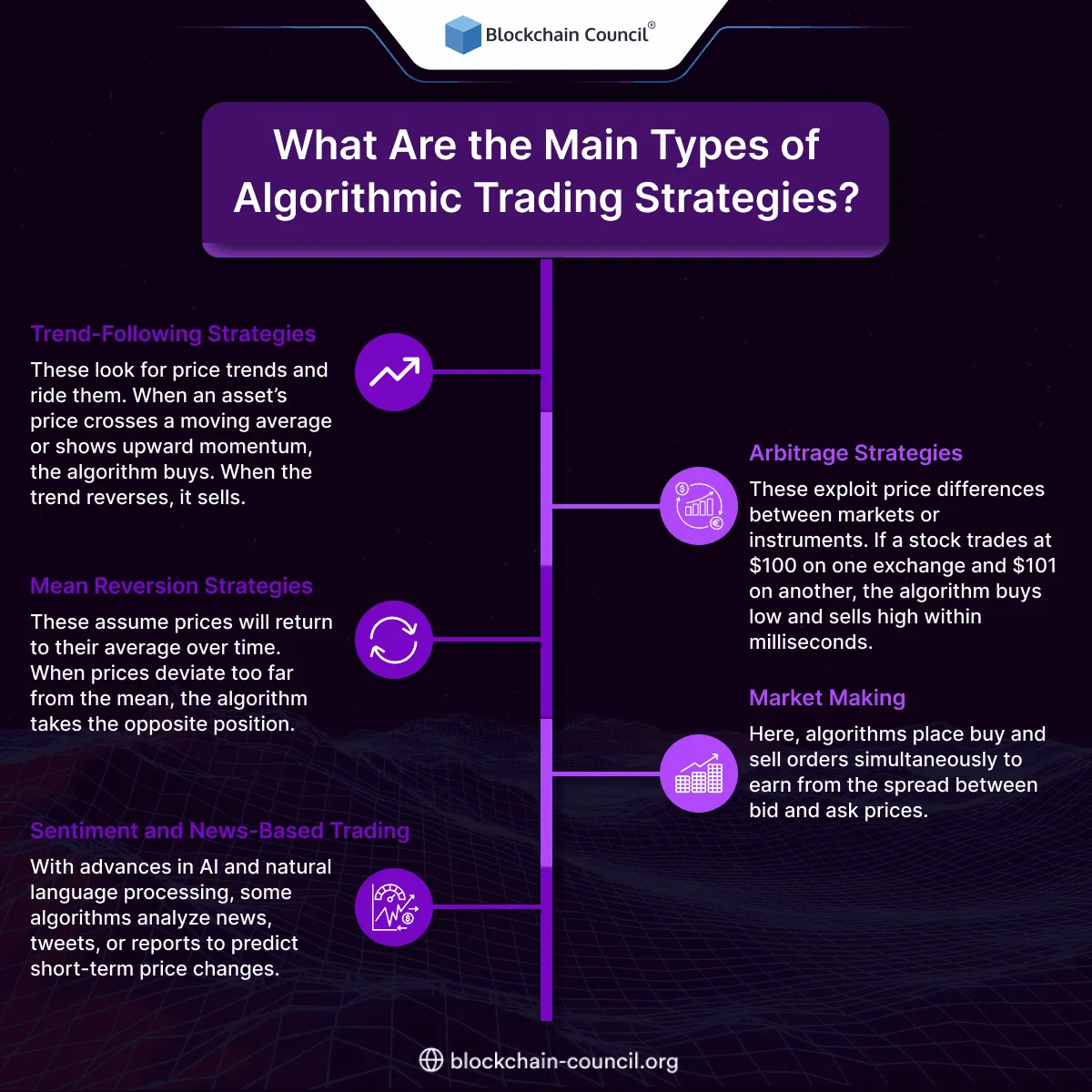
There are several types of algorithmic trading strategies, each built around a different principle or market behavior.
1. Trend-Following Strategies
These look for price trends and ride them. When an asset’s price crosses a moving average or shows upward momentum, the algorithm buys. When the trend reverses, it sells.
2. Arbitrage Strategies
These exploit price differences between markets or instruments. If a stock trades at $100 on one exchange and $101 on another, the algorithm buys low and sells high within milliseconds.
3. Mean Reversion Strategies
These assume prices will return to their average over time. When prices deviate too far from the mean, the algorithm takes the opposite position.
4. Market Making
Here, algorithms place buy and sell orders simultaneously to earn from the spread between bid and ask prices.
5. Sentiment and News-Based Trading
With advances in AI and natural language processing, some algorithms analyze news, tweets, or reports to predict short-term price changes.
For traders and developers interested in combining technical and analytical skills, a Data Science Certification can help you learn how to interpret financial data and build smarter trading models.
How Does AI Influence Algorithmic Trading?
Artificial intelligence adds a new dimension to algorithmic trading. Traditional algorithms rely on pre-set rules, while AI-based systems can learn from data and adapt over time.
Machine learning models can recognize patterns that humans miss. Deep learning models can even process images or text to extract trading signals. These systems evolve with every new piece of information, making them more robust and accurate.
AI-driven trading platforms can also simulate thousands of scenarios to test strategies before applying them in real markets. That improves risk management and decision-making accuracy.
AI also powers predictive analytics, allowing traders to forecast price trends, volatility, or even investor sentiment with higher confidence.
What Is the Role of Technology in Algorithmic Trading?
Technology is the foundation of algorithmic trading. Without powerful computers, reliable networks, and real-time data feeds, algorithmic strategies wouldn’t exist.
Technology drives every aspect of modern trading — from data collection to execution. High-performance computing and cloud infrastructure enable millions of calculations per second. Meanwhile, secure APIs connect traders to global markets seamlessly.
The development of AI-driven trading software has created new career opportunities for programmers, data scientists, and financial analysts. To stay relevant, professionals often pursue advanced tech certifications to build the necessary technical and analytical skills.
What Are the Risks and Challenges of Algorithmic Trading?
While algorithmic trading offers precision and efficiency, it also introduces new forms of risk.
1. System Failures
A small coding error or server failure can trigger large financial losses in seconds.
2. Market Volatility
Algorithmic systems can amplify volatility. When multiple bots react to the same signal, they can move the market suddenly.
3. Lack of Transparency
It’s often difficult for regulators or traders to understand how some algorithms make decisions. This opacity can erode trust.
4. Ethical and Legal Concerns
Should an algorithm be held accountable for manipulation or misinformation? Regulators are still debating how to manage these ethical gray areas.
5. Data Bias
AI-based trading systems are only as good as the data they learn from. Biased or incomplete data can lead to incorrect predictions and losses.
Understanding these risks is vital for anyone designing or deploying automated trading systems.
How to Use Algorithmic Trading Safely and Effectively
Using algorithmic trading effectively involves a balance of technology, regulation, and human oversight.
Step 1: Backtest and Validate
Every strategy should be tested on historical data before being applied in live markets. This helps verify accuracy and identify weaknesses.
Step 2: Monitor in Real Time
Even automated systems need human supervision. Traders must watch for unexpected behavior, latency issues, or errors.
Step 3: Implement Risk Controls
Stop-loss orders, position limits, and capital allocation rules are essential for safety.
Step 4: Stay Informed
Regulations and market structures change frequently. Staying updated helps ensure compliance and reliability.
For those aiming to master financial automation, the AI trading course teaches how AI models are used in trading decision systems. It’s ideal for anyone looking to bridge finance and technology.
How Do Markets React to Algorithmic Trading?
Markets adapt dynamically to the rise of algorithmic activity. Increased automation has improved liquidity and reduced spreads, benefiting most investors. However, it has also made markets more interconnected and sensitive to technical disruptions.
For example, high-frequency trading can make prices more efficient but also more volatile. Market participants must now design systems that can handle both benefits and risks of rapid trading.
Regulators worldwide are focusing on creating frameworks to manage this new form of digital market agency.
What Is the Future of Algorithmic Trading and Market Agency?
The future of algorithmic trading lies in intelligent automation — systems that don’t just execute trades but also interpret human goals and market conditions dynamically.
Next-generation algorithms will likely combine reinforcement learning, natural language understanding, and autonomous decision models. This could allow systems to make strategic decisions in real time, almost like digital traders with their own instincts.
As algorithms take on more responsibility, market agency will continue to evolve. Humans will design objectives and ethical boundaries, while machines handle complex execution and optimization tasks.
For professionals aiming to understand how AI-driven agents interact with markets, the AI powered investment course offers practical insights into algorithmic asset management.
How to Build a Career in Algorithmic Trading
A career in algorithmic trading requires both technical and financial knowledge. You need to understand markets, data analysis, programming, and machine learning.
Educational paths often include computer science, statistics, or quantitative finance. However, many professionals now enhance their expertise through online certifications focused on AI and trading systems.
Those who want to understand how AI integrates into investment strategies can explore blockchain technology courses. They explain how decentralized networks, smart contracts, and AI together shape future markets.
Meanwhile, business professionals interested in leadership and market strategy can develop management-focused skills through a Marketing and Business Certification. It helps bridge financial technology knowledge with organizational strategy.
Why Algorithmic Trading Matters Today
Algorithmic trading is more than just a financial innovation. It’s a reflection of how human intelligence and artificial systems interact to create modern market ecosystems.
From Wall Street to cryptocurrency exchanges, algorithms now play a central role in setting prices, managing risks, and shaping market psychology. The collaboration between human creativity and machine logic defines the new financial frontier.
To stay ahead in this fast-changing space, professionals need to continuously upgrade their knowledge. That’s where modern [AI certs] and other specialized training programs make a difference.
How Algorithmic Trading Shapes Market Behavior
Algorithmic trading influences how liquidity forms, how volatility spreads, and how trends evolve. Because algorithms react faster than humans, they often set the pace for price discovery.
However, this automation also reduces emotional volatility. Where once market swings were driven by fear or greed, today they are influenced by data and logic.
Still, markets remain social systems at their core. Even with algorithmic participation, human expectations, policy decisions, and global events continue to shape price movement.
Understanding this balance between human intent and machine agency is essential for both traders and regulators.
What Is the Relationship Between Blockchain and Algorithmic Trading?
Blockchain and algorithmic trading are converging technologies. Blockchain ensures transparency and immutability, while algorithms enable speed and automation. Together, they can create more secure and efficient financial ecosystems.
Decentralized exchanges now use algorithms to match buyers and sellers directly without intermediaries. Smart contracts automatically execute trades when conditions are met.
This combination reduces fraud, enhances trust, and improves the overall stability of digital markets. Many blockchain developers are integrating AI-based algorithms to predict token movements and manage liquidity.
Professionals seeking to combine these skills can benefit from blockchain technology courses, which teach how decentralized systems interact with AI and trading logic.
How Can Businesses Use Algorithmic Trading Principles Beyond Finance?
The principles behind algorithmic trading—data-driven decision-making, predictive modeling, and automated execution—can be applied far beyond finance.
Businesses in logistics, marketing, and operations are already using similar algorithmic models to forecast demand, optimize pricing, and automate resource allocation.
For instance, marketing teams use predictive algorithms to determine when to launch campaigns for maximum impact. Business leaders can explore this connection through a Marketing and Business Certification, which focuses on data-informed growth strategies and digital innovation.
The Ethical Side of Algorithmic Market Agency
As algorithms become agents in markets, ethical considerations become unavoidable. Should an autonomous trading system be allowed to manipulate markets if it’s profitable? Who should be accountable when automation causes harm?
Ethical AI frameworks are being developed to address these questions. The focus is on building transparency, fairness, and accountability into algorithmic systems.
The key lies in responsible AI governance—setting clear boundaries while allowing innovation to thrive.
What Skills Are Needed to Excel in Algorithmic Trading?
Professionals in algorithmic trading need a blend of financial insight, coding expertise, and analytical reasoning. Common skills include:
- Python or C++ programming
- Data visualization and statistical modeling
- Risk management
- Machine learning
- Financial market analysis
A combination of theoretical understanding and hands-on application helps traders stay competitive. Those looking to expand their technical skills can pursue various tech certifications that focus on AI, data, and automation.
How Education Shapes the Future of Market Intelligence
Education is the cornerstone of innovation in algorithmic trading. The next generation of traders, analysts, and developers are not just learning to trade—they’re learning to design intelligent systems that adapt to change.
Certifications, workshops, and applied programs are bridging the gap between finance and technology. They allow professionals to gain both the conceptual foundation and the real-world expertise needed to lead in AI-powered markets.
Conclusion
Algorithmic trading represents the fusion of human logic and machine intelligence. It has changed how trades are executed, how prices form, and even how agency is understood in the financial ecosystem.
As algorithms grow more sophisticated, their role as independent agents will deepen, shaping not only how we invest but how we define participation in the market.
Related Articles
View All
AI & ML
AI Agents in Finance and Trading
AI agents in finance and trading are no longer experimental side projects. They are embedded across research desks, execution engines, compliance teams, and risk functions. The important distinction is not “AI vs no AI.” It is whether the system merely produces analysis or whether it can…

AI & ML
Freelancing with Vibe Coding Skills
Learn how vibe coding empowers freelancers to deliver faster, smarter, and more efficient AI-driven projects.

AI & ML
AI Agents in Coding: The Future of Development
Discover how AI agents are transforming software development by automating coding tasks and managing complex workflows.
Trending Articles

The Role of Blockchain in Ethical AI Development
How blockchain technology is being used to promote transparency and accountability in artificial intelligence systems.

AWS Career Roadmap
A step-by-step guide to building a successful career in Amazon Web Services cloud computing.

Top 5 DeFi Platforms
Explore the leading decentralized finance platforms and what makes each one unique in the evolving DeFi landscape.