Can AI Replace Traditional Financial Advisors?
 Michael Willson
Money management has always been equal parts numbers and nuance. While algorithms can crunch data faster than any human, building a solid financial plan isn’t just about analytics — it’s about understanding goals, fears, and trade-offs. Yet artificial intelligence is getting frighteningly good at tasks once thought uniquely human. So, could AI truly replace traditional financial advisors?
The short answer: not yet — but it’s closing in on the edges of their profession. AI can already create diversified portfolios, forecast market risks, automate rebalancing, and even chat about investment goals with clients. Robo-advisors and generative AI tools are transforming wealth management into a digital-first service that’s faster, cheaper, and always on. But while efficiency is impressive, it’s still missing something critical — trust, empathy, and accountability.

For those eager to understand how this transformation works from the inside, the AI Certification offers a foundational path. It helps professionals grasp how algorithms interpret data, detect patterns, and support financial decisions — a must-know skill in this fast-evolving field.
How AI Is Redefining the Financial Advisory Landscape
AI has already revolutionised parts of the advisory process that depend on mathematics and prediction. Portfolio construction, asset allocation, and risk profiling are all areas where algorithms excel. Platforms powered by machine learning can assess an investor’s risk appetite through behavioural data — such as transaction history or spending patterns — and recommend an optimised portfolio within seconds.
Traditional advisors used to spend hours gathering and analysing data before building a client profile. Now, AI can synthesise that same information across multiple sources — bank accounts, market feeds, tax databases — in moments. This allows advisors, or even the clients themselves, to focus on bigger strategic questions instead of routine calculations.
Many firms now integrate AI into their back-end systems for tasks like compliance monitoring, document verification, and reporting. This streamlines operations while maintaining accuracy, enabling advisors to serve more clients without compromising quality.
What AI Does Exceptionally Well
The strengths of AI are clear: speed, scalability, and consistency. Unlike humans, algorithms don’t fatigue or get distracted. They analyse data 24/7, scanning global markets and adjusting strategies in real time.
For example, if inflation data or interest rates shift suddenly, an AI-driven platform can rebalance a portfolio instantly — selling overexposed assets and reallocating funds to defensive sectors. That kind of agility gives investors a competitive edge.
AI also personalises financial planning at scale. Using natural language processing and machine learning, systems can tailor recommendations based on unique life goals, income streams, and spending patterns. In essence, it offers a concierge-level service that never sleeps.
These developments are the foundation of the new generation of intelligent investing platforms explored in the AI Powered Investor Program. Such programs teach how AI integrates financial logic with adaptive models that evolve with market behaviour — skills once reserved for institutional analysts.
Why AI Still Struggles to Replace Human Advisors
For all its precision, AI lacks emotional intelligence. It can identify when your retirement fund is underperforming, but it can’t tell when you’re losing sleep over it. Humans don’t just seek financial performance; they seek reassurance and empathy.
A financial advisor’s role often extends beyond numbers — helping clients stay calm during market downturns or make responsible decisions after life-changing events. AI, however advanced, can’t yet replicate that human presence.
There’s also the matter of context. AI can forecast probabilities, but it doesn’t understand intentions or family dynamics. A human advisor can interpret non-verbal cues, recognise conflicting goals between spouses, or anticipate emotional biases before they affect a decision. AI simply interprets data at face value.
Moreover, accountability remains a grey area. Financial advisors operate under fiduciary duty — a legal and ethical standard that binds them to act in clients’ best interests. AI systems, by contrast, have no such moral or legal responsibility. If an algorithm’s advice leads to losses, who’s liable — the developer, the platform, or the investor who followed it? These questions remain unresolved.
The Rise of the Hybrid Advisory Model
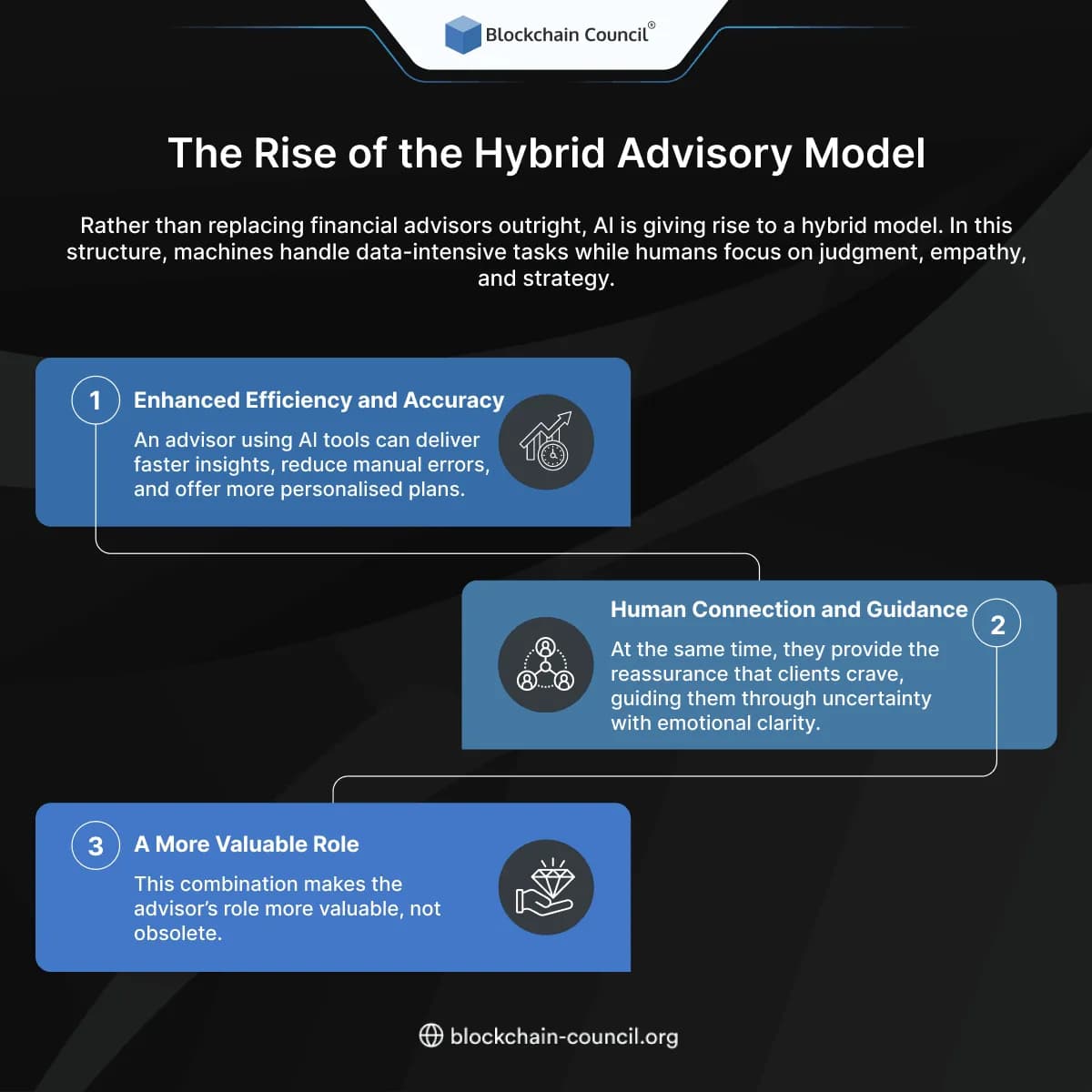
Rather than replacing financial advisors outright, AI is giving rise to a hybrid model. In this structure, machines handle data-intensive tasks while humans focus on judgment, empathy, and strategy.
An advisor using AI tools can deliver faster insights, reduce manual errors, and offer more personalised plans. At the same time, they provide the reassurance that clients crave — guiding them through uncertainty with emotional clarity. This combination makes the advisor’s role more valuable, not obsolete.
For professionals who want to build this hybrid edge, programs like the AI Powered Trading Program offer a strong foundation. They teach how algorithmic systems operate, how to interpret AI-driven market signals, and how to combine automation with human expertise — an essential mix for the financial advisor of the future.
How AI Improves Accuracy but Not Wisdom
AI’s forecasting accuracy often outperforms human intuition in the short term, but long-term financial planning requires wisdom, patience, and adaptability. For instance, while an AI might recommend aggressive equity exposure to maximise returns, a seasoned advisor knows that a client nearing retirement might prioritise stability over performance.
AI can optimise portfolios mathematically, but humans understand emotional thresholds. They know when to advise against the perfect statistical choice because it conflicts with a client’s psychological comfort. This is where financial advice transforms from data to trust — something machines can assist with but not own.
How Clients Perceive AI Advice
Trust is the cornerstone of financial relationships. Even the most accurate model won’t matter if clients don’t believe in it. Surveys show that while investors appreciate AI for data insights and cost efficiency, most still prefer a human voice when it comes to major life decisions like retirement or inheritance planning.
Interestingly, younger investors — digital natives — show more openness to AI-led platforms. They appreciate the transparency, low fees, and speed that automated advisors provide. Yet even they seek human validation before acting on significant advice. This shows that AI’s future in finance isn’t about replacement but cooperation.
Why Empathy Still Matters in Financial Advice
Money decisions are deeply personal. They involve identity, family, and legacy — subjects where algorithms fall short. When markets crash or when life changes dramatically, investors don’t want statistics; they want reassurance.
Advisors play the role of behavioural coach, preventing clients from panic-selling during downturns or chasing risky trends during booms. They provide the calm that AI cannot. In this sense, empathy isn’t just an advantage — it’s a safeguard against emotional error.
Developing this human-centric skillset alongside technical literacy is key. Professionals who pair emotional intelligence with AI understanding will lead the next phase of financial advising. Courses such as the Marketing and Business Certification help bridge that gap, teaching communication strategies that make complex financial data relatable and actionable.
Why the Future of Financial Advice Is Human-Led, AI-Powered
AI has already proven its ability to handle the quantitative side of investing. But financial advice isn’t just a math problem — it’s a life problem. The best outcomes arise when machines do what they do best (analyse, optimise, automate) and humans do what they do best (listen, empathise, advise).
The future of wealth management will likely belong to professionals who embrace technology without surrendering humanity. As AI evolves, advisors who upskill through tech certifications will stay ahead — not by competing with algorithms, but by mastering how to collaborate with them.
How AI Reimagines Financial Goal Setting
Traditional goal setting in finance usually starts with predictable milestones — retirement, home ownership, or saving for education. Advisors use static models to calculate how much a client should invest or save over time. AI, however, turns this into a living process.
By analysing behavioural and economic data together, AI tools can simulate multiple future scenarios in seconds. Suppose a client is considering an early retirement or a major career shift — AI can immediately model how these decisions impact long-term wealth, cash flow, and tax exposure. It no longer takes hours of spreadsheet work; insights arrive in moments.
This real-time adaptability helps clients make decisions with clarity and confidence. The advisor’s role becomes interpretive: helping the client understand the trade-offs that AI surfaces. Instead of spending hours running numbers, advisors spend time guiding values-based decisions — focusing on why the goal matters, not just how to achieve it.
Such intelligent modelling systems form the backbone of advanced AI training programs like the AI Powered Investor Program. Professionals learn how to apply predictive logic to personal finance — using algorithms to serve human priorities rather than just optimise returns.
How AI Democratizes Complex Investment Strategies
Institutional-grade strategies like factor investing, dynamic hedging, and thematic rotation were once reserved for elite wealth clients. AI makes them accessible to everyone.
Machine learning can identify how specific assets behave under various economic conditions, letting even smaller investors benefit from institutional precision. For example, AI might detect that a client’s portfolio is overly exposed to tech innovation cycles and automatically rebalance it with commodities or dividend stocks for stability.
This “smart allocation” means that retail investors no longer rely solely on static index tracking. Their portfolios can adjust dynamically as markets evolve.
However, the human advisor remains the interpreter of this complexity. While AI suggests, humans explain. Advisors clarify the reasoning behind the model’s decisions and help clients stay comfortable during sudden shifts.
To work effectively with these tools, advisors are now upgrading their analytical capabilities through Data Science Certification. It helps them understand how models reach conclusions and when those conclusions require human correction.
How AI Detects Financial Blind Spots Humans Miss
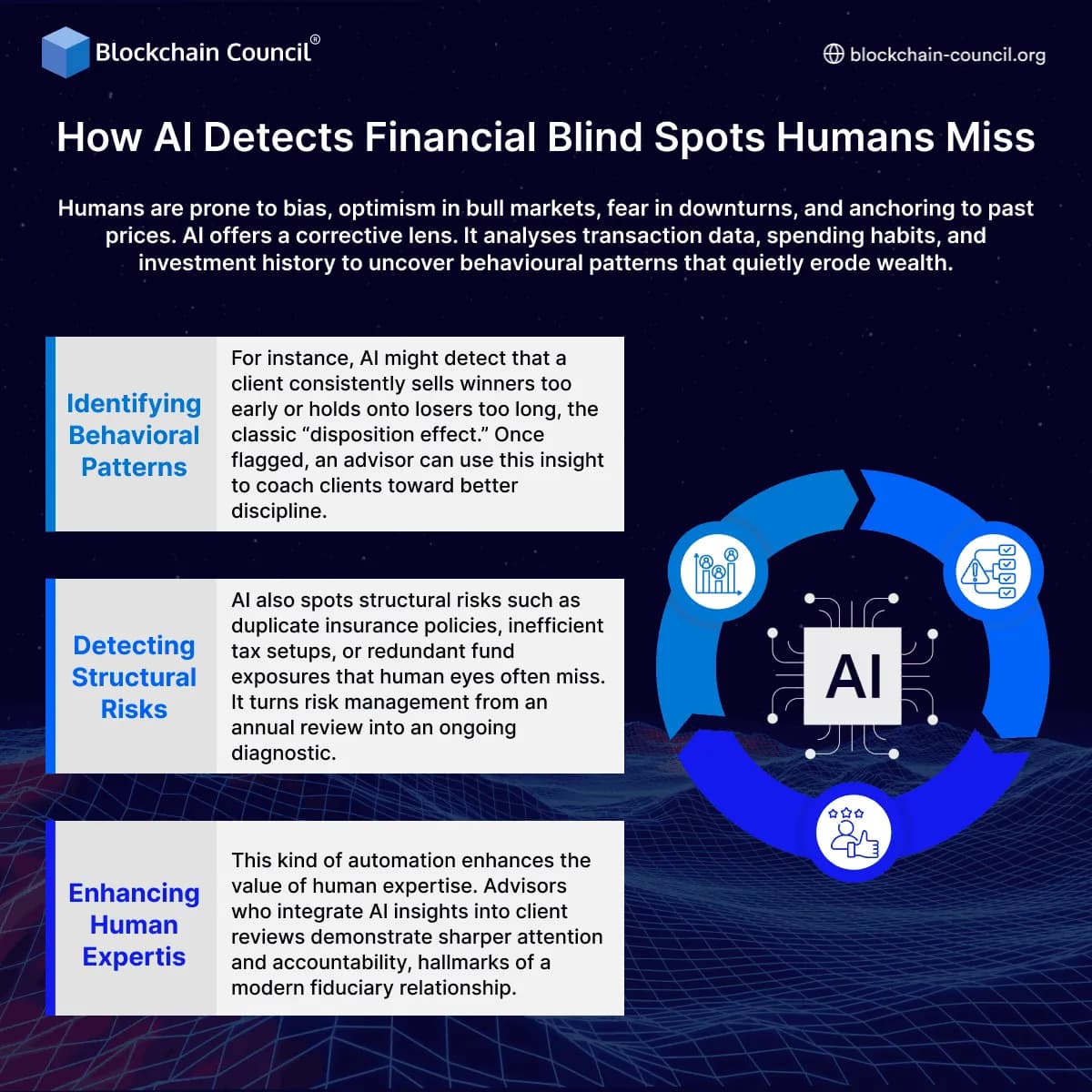
Humans are prone to bias — optimism in bull markets, fear in downturns, and anchoring to past prices. AI offers a corrective lens. It analyses transaction data, spending habits, and investment history to uncover behavioural patterns that quietly erode wealth.
For instance, AI might detect that a client consistently sells winners too early or holds onto losers too long — the classic “disposition effect.” Once flagged, an advisor can use this insight to coach clients toward better discipline.
AI also spots structural risks: duplicate insurance policies, inefficient tax setups, or redundant fund exposures that human eyes often miss. It turns risk management from an annual review into an ongoing diagnostic.
This kind of automation enhances the value of human expertise. Advisors who integrate AI insights into client reviews demonstrate sharper attention and accountability — hallmarks of a modern fiduciary relationship.
How AI Strengthens Ethical Decision-Making
Financial advice isn’t purely quantitative; it carries moral weight. Advisors must balance performance with integrity, ensuring that recommendations align with a client’s values. AI supports this by improving transparency.
Explainable AI frameworks allow advisors to show clients exactly why a recommendation was made — which factors were considered and how the model weighed each one. This clarity builds confidence and discourages hidden conflicts of interest.
In addition, some systems can be trained to incorporate ESG (Environmental, Social, and Governance) factors, matching investment decisions to ethical or sustainability goals. It allows clients to pursue profit with purpose.
Understanding how to design ethical AI systems responsibly is central to the Agentic AI Certification. It teaches how to ensure fairness, transparency, and alignment — principles that are rapidly becoming the standard in financial technology governance.
How AI Changes the Value of Human Trust
Trust remains the single most valuable asset in the financial industry. While AI can process information faster, it cannot replicate trust earned through relationships. A human advisor listens, remembers personal stories, and understands how clients define success beyond their portfolio.
That emotional connection keeps clients grounded during uncertainty — when data alone feels cold or overwhelming. AI can simulate empathy through words, but it cannot feel genuine concern. It can advise logically, but not compassionately.
The advisors of the future will build trust in two ways: by mastering human connection and by demonstrating technological fluency. Clients will seek advisors who can interpret AI’s findings, not fear them. Those equipped with AI certs and interpersonal skills will sit at the heart of this new balance.
How AI Transforms Financial Literacy
AI isn’t just reshaping professionals; it’s educating clients. Personal finance apps powered by machine learning now explain budgeting, investing, and saving through interactive simulations. Users can test “what if” scenarios — what happens if they invest earlier, change tax brackets, or refinance debt.
This self-directed learning fosters smarter conversations with advisors. Clients arrive informed and curious rather than anxious or uninformed. That shifts the advisor’s role from explainer to strategist, deepening the quality of engagement.
As AI continues to democratise knowledge, the best advisors will embrace education as part of their service. They’ll use AI not to distance themselves from clients, but to bring them closer to understanding their own finances.
How Blockchain and AI Together Secure Client Data
Privacy is one of the biggest concerns in digital finance. Clients entrust advisors with intimate details of their financial lives — and breaches can destroy relationships overnight. Here, blockchain and AI form a powerful defence.
Blockchain provides the immutable record-keeping and encryption backbone, while AI monitors for anomalies and potential intrusions. Together, they ensure data integrity and early detection of fraud or unauthorised access.
This pairing is already shaping next-generation wealth management systems that promise both speed and security. For those designing or managing these systems, blockchain technology courses explain how decentralisation complements AI’s data-driven intelligence.
How AI Encourages Continuous Financial Health Monitoring
Traditionally, financial planning has been episodic — annual reviews, mid-year check-ins, and periodic reports. AI changes that to a continuous process. It monitors account balances, credit health, and market exposure in real time, alerting both clients and advisors when something drifts out of alignment.
This proactive model allows interventions before small issues grow into major problems. It’s like having a financial pulse monitor that never sleeps. For advisors, this means less firefighting and more forward planning.
Clients benefit from peace of mind, knowing their plan is always under watchful intelligence — human and artificial alike.
How AI Makes the Industry More Adaptive
The financial industry evolves faster than regulation or tradition can keep up. AI introduces flexibility into this rigid ecosystem. When new asset classes like digital securities or green bonds emerge, AI can learn their risk-return characteristics quickly and update portfolio logic accordingly.
Advisors no longer need to wait for institutional guidance; they can rely on machine learning insights to stay current. This adaptability gives smaller firms the ability to compete with large institutions.
To remain agile in this changing landscape, advisors are increasingly pursuing multi-domain credentials such as the AI Certification and Marketing and Business Certification. Together, they combine data science proficiency with client engagement skills — the dual advantage of modern finance.
The Human Edge in an AI-Driven World
In the end, financial advising is as much about relationships as returns. AI can project the future, but humans guide the present — especially when emotions and life transitions enter the picture.
The best advisors of tomorrow will not compete with AI but collaborate with it. They’ll interpret, contextualise, and personalise what algorithms reveal, transforming data into wisdom.
The profession isn’t vanishing; it’s evolving — from calculators of wealth to architects of meaning. And that’s something no machine can replace.