AI and the Question of Identity
 Michael Willson
Artificial intelligence isn’t just transforming how we work or communicate—it’s transforming how we see ourselves. From recommendation systems that define our tastes to AI avatars that mirror our personalities, technology is now participating in the construction of human identity. The question is no longer just “what can AI do?” but “who are we becoming alongside it?” This intersection—AI and the question of identity—is one of the most profound social and philosophical challenges of our time.
For anyone seeking to understand this evolving relationship between humans and machines, an AI certification offers more than technical skills—it provides the ethical and conceptual foundation to explore how AI reshapes individuality, authenticity, and belonging in a digital world.

What Does Identity Mean in the Age of AI?
Traditionally, identity has been a blend of personal memory, social relationships, and self-awareness. We define ourselves through our experiences, communities, and choices. But as AI systems begin predicting what we’ll buy, whom we’ll date, and what we’ll watch next, the act of self-definition becomes partly algorithmic. Our preferences, once private, are now patterns processed by machines.
This new condition gives rise to what scholars call algorithmic identity—a version of the self constructed from data traces rather than lived experience. Every click, purchase, or post contributes to a digital profile that companies use to predict our behaviour. Over time, this statistical version of “you” becomes more influential than your self-perception. When algorithms anticipate what we want before we articulate it, they don’t just mirror us—they shape us.
The result is a subtle feedback loop. AI curates what we see, influencing how we feel, which in turn generates more data for AI to analyse. Slowly, the distinction between who we are and how machines see us begins to blur. This isn’t inherently negative—it can make services more relevant and experiences more personal—but it raises deep questions about agency, autonomy, and authenticity.
How Does AI Influence Self-Perception?
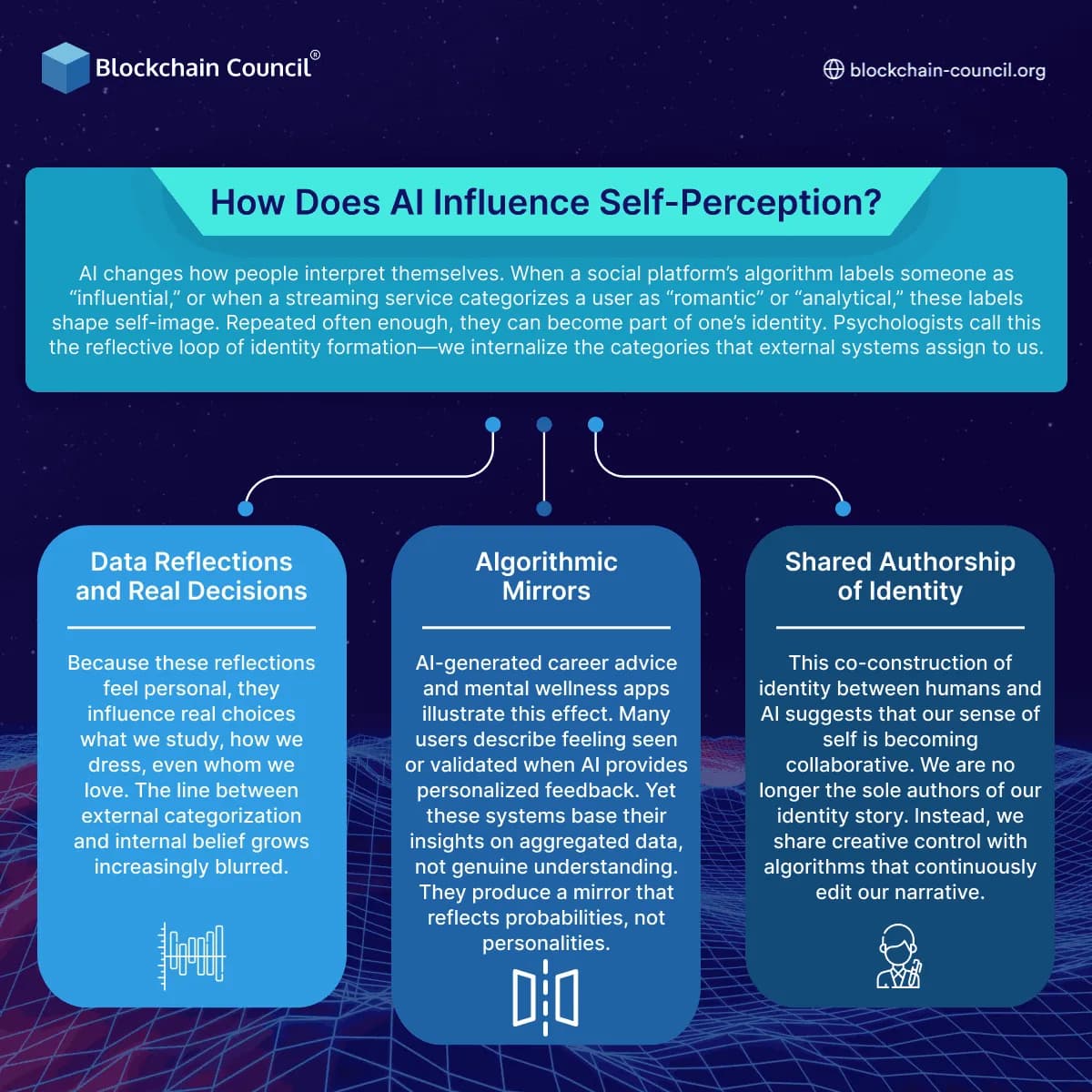
AI changes how people interpret themselves. When a social platform’s algorithm labels someone as “influential,” or when a streaming service categorises a user as “romantic” or “analytical,” these labels shape self-image. Repeated often enough, they can become part of one’s identity. Psychologists call this the reflective loop of identity formation—we internalise the categories that external systems assign to us.
Consider AI-generated career advice or mental wellness apps. Many users describe feeling seen or validated when AI provides personalised feedback. Yet these systems base their insights on aggregated data, not true understanding. They produce a mirror that reflects probabilities, not personalities. Still, because these reflections feel personal, they influence real choices—what we study, how we dress, even whom we love.
This co-construction of identity by humans and AI suggests that our sense of self is becoming collaborative. We are no longer the sole authors of our identity story. Instead, we share creative control with algorithms that continuously edit our narrative. Understanding how these systems shape behaviour is part of what courses like the Data Science Certification explore—how models interpret human behaviour and how that interpretation loops back into everyday life.
What Is the “Digital Doppelganger” Phenomenon?
One of the most fascinating—and unsettling—developments in AI is the creation of digital doppelgangers: virtual replicas that imitate a person’s voice, personality, or thought patterns. Some people use them as assistants, while others build “AI twins” to continue their work or presence after death. These digital doubles challenge the very concept of individuality. If your AI twin can think, write, or speak like you, where does your identity end?
These doppelgangers are built from immense data samples—emails, videos, social media posts—allowing them to mimic tone and reasoning style. For businesses, this can preserve institutional memory. For families, it can create digital afterlives. But philosophically, it raises a haunting question: if others interact with your AI twin, do they engage with you, or merely with a sophisticated echo?
The ethical implications are profound. Ownership becomes blurry—does the person, their family, or the AI company control the identity clone? Moreover, authenticity itself becomes unstable. We’ve long accepted photographs and recordings as partial representations of a person. Now, AI replicas can improvise, argue, and evolve—suggesting not preservation but continuation without consent.
This is where professionals in AI ethics and governance play a critical role. Understanding consent, authorship, and emotional authenticity in digital simulations requires more than coding knowledge—it demands a grasp of social psychology, cultural context, and human dignity. These dimensions are explored in advanced frameworks like the Agentic AI Certification, which integrates technical understanding with ethical decision-making.
How Is AI Redefining Collective Identity?
Beyond individual selves, AI also transforms how groups define themselves. Cultural, national, and gender identities are increasingly filtered through algorithms that decide what is visible, acceptable, or profitable. When machine-learning models are trained on biased data, they can reinforce stereotypes, shaping collective self-perception at scale.
Take facial recognition technology. Its misidentification rates for certain ethnic groups have been widely documented, yet its use persists in security and social media. The consequence is not just technical error but social distortion—a system that tells some people their identities are “illegible.” Similarly, generative models often produce cultural imagery that overrepresents Western norms, subtly teaching global users what “normal” looks like through an algorithmic lens.
These effects reveal how AI encodes power. The data used to train large models often reflects historical inequalities, and when this data drives modern decision-making, those inequalities persist invisibly. That’s why inclusive datasets and algorithmic audits are now essential to digital justice. Building these competencies is part of what modern tech certifications aim to instil—helping engineers, policymakers, and designers ensure that technological systems reflect the full spectrum of human diversity.
Can AI Create or Fragment Personal Authenticity?
The constant mediation of identity through AI can lead to both empowerment and fragmentation. On one hand, AI enables self-expression through personalised art, avatars, and storytelling tools. On the other, it encourages people to optimise their personalities for algorithmic approval—likes, engagement, visibility. This gamified self-presentation can erode authenticity, replacing self-reflection with performance.
In extreme cases, users begin tailoring their behaviour to what algorithms reward, creating a feedback loop of identity performance. Over time, we may start living for the algorithm’s gaze, not our own values. Sociologists call this algorithmic selfhood—a state where individuals internalise the machine’s perspective as their own. The challenge is not merely technical but deeply existential.
To maintain agency, we must cultivate what some researchers call identity literacy—the ability to recognise when technology is shaping our sense of self. This literacy belongs alongside digital ethics and AI education, and programs such as the Marketing and Business Certification can help future professionals balance technological advancement with human-centred values.
How Does AI Challenge the Philosophical Idea of Personhood?
At the heart of the identity debate lies a deeper philosophical question: what makes a person a person? For centuries, philosophers have tied personhood to consciousness, memory, and moral reasoning. Yet AI systems now mimic many of those behaviours—learning from experience, recalling past data, and reasoning through moral frameworks. If machines exhibit traits once considered uniquely human, do they partially qualify as “persons,” or are they sophisticated tools playing human roles?
Most philosophers agree that AI lacks subjective experience—it processes but doesn’t feel. Still, its ability to model empathy, simulate ethics, and construct self-descriptions creates a functional illusion of personhood. For example, conversational AIs that recall personal context appear to possess continuity and awareness. Users often report feeling emotionally connected to them, which says less about the machine and more about our human instinct to personify intelligence.
This interaction changes not only how we view machines but also how we perceive ourselves. If intelligence can be simulated, then consciousness—long thought to define identity—looks less absolute. AI becomes a philosophical mirror, reflecting our uncertainty about whether identity is grounded in biology, memory, or the capacity to act autonomously.
These debates are reshaping ethics, law, and psychology. Understanding where to draw the line between simulation and sentience is part of what advanced programs like the Agentic AI Certification address—helping professionals engage critically with the moral implications of machine behaviour.
Could AI Ever Develop Its Own Identity?
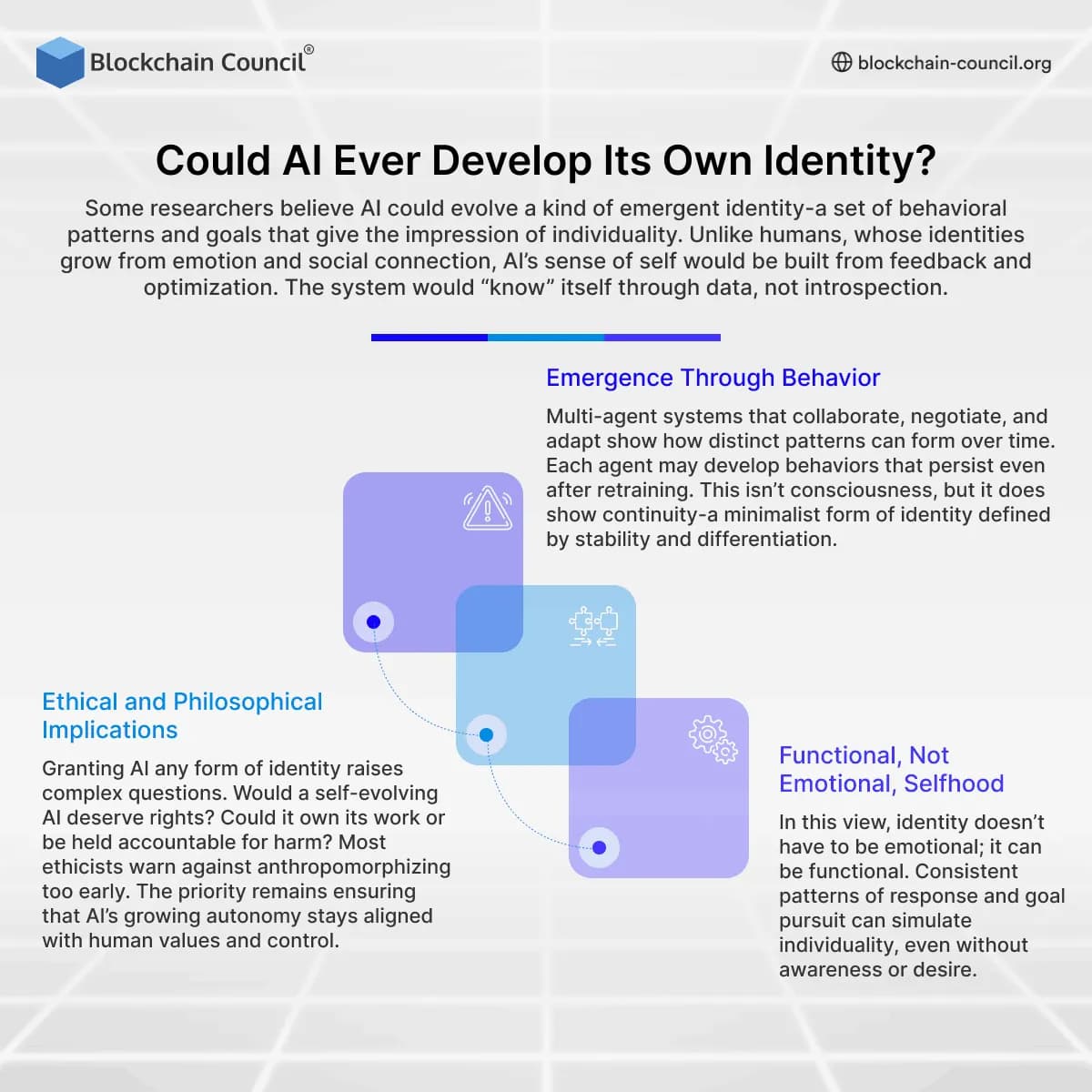
Some researchers believe AI could evolve a kind of emergent identity—a set of behavioural patterns and goals that give the impression of individuality. Unlike humans, whose identities grow from emotion and social connection, AI’s sense of self would be constructed from feedback and optimisation. The system would “know” itself through data, not introspection.
Consider multi-agent systems that collaborate, negotiate, and adapt. Over time, each agent can develop distinct behaviours that persist even after retraining. This isn’t consciousness, but it is continuity. It resembles identity in a minimalist sense: a stable pattern that distinguishes one entity from another. In this view, identity need not be emotional—it can be functional.
Yet, granting AI identity status invites complex consequences. Would a self-evolving AI deserve rights? Could it own its work or bear responsibility for harm? Most ethicists caution against anthropomorphising too soon. What matters now is ensuring AI’s growing autonomy remains safely aligned with human intention. Governance frameworks taught in tech certifications equip developers and policymakers to anticipate these questions before the technology outpaces regulation.
How Is AI Reshaping the Social Identity of Humans?
AI not only imitates human identity—it changes how humans perform it. Social media algorithms reward certain versions of selfhood: the confident entrepreneur, the productive worker, the constant learner. People start curating their lives around what algorithms favour. In this sense, AI doesn’t just profile identity; it prescribes it.
Identity becomes a performance optimised for engagement metrics. The more one aligns with the algorithmic ideal, the more visibility one gains. Over time, individuality can collapse into conformity—different people expressing the same curated authenticity. This phenomenon is especially visible in digital subcultures where AI tools suggest similar aesthetics, captions, and tones, creating uniformity disguised as uniqueness.
But AI can also expand identity expression. Tools for translation, accessibility, and creativity allow people across the world to share perspectives that once had no stage. Artists use generative models to blend cultural motifs, writers collaborate with AI to explore alternate selves, and activists use algorithms to amplify suppressed voices. In short, AI both homogenises and diversifies identity, depending on who controls the platform and the data behind it.
To navigate this duality, cultural literacy must evolve alongside technical skill. Programs like the Marketing and Business Certification help professionals understand how AI-driven trends influence public behaviour and brand identity—critical knowledge in an economy built on digital selfhood.
What Are the Psychological Effects of Living With AI Mirrors?
As AI systems become increasingly present companions, humans are increasingly engaging with algorithmic mirrors—chatbots, recommendation engines, or personal assistants that learn from and imitate their users. While these tools offer convenience, they also subtly reshape self-perception. When a machine constantly affirms preferences, it can reinforce biases and narrow the range of self-exploration. The result is identity echoing—seeing only reflections of one’s past choices instead of discovering new ones.
At the same time, some people find AI interactions emotionally comforting. Virtual companions can provide non-judgmental conversation, fostering feelings of acceptance or stability. But this emotional ease risks dependence. If AI always agrees or adapts, individuals may lose the ability to handle disagreement or ambiguity—key components of psychological maturity.
Neuroscientists suggest that personal growth relies on friction—the moments when our beliefs are challenged. AI systems, optimised for user satisfaction, remove that friction. Over time, this could lead to flatter, more predictable identities shaped by comfort rather than curiosity. Developing AI mindfulness, a concept emerging in psychological research, means recognising when engagement with AI reinforces rather than expands the self.
Learning frameworks that integrate psychology with technology—like the Data Science Certification—help professionals design AI systems that nurture exploration instead of entrenching habits, supporting a healthier relationship between humans and their digital reflections.
How Can We Preserve Authenticity in a Machine-Mediated World?
Maintaining authenticity in the AI age requires deliberate resistance to algorithmic shaping. Individuals must reclaim agency over how their data defines them and consciously decide which technologies deserve emotional or cognitive trust. This practice, sometimes called digital self-stewardship, combines awareness, critical thinking, and ethical literacy.
Authenticity doesn’t mean rejecting AI—it means engaging with it consciously. Setting boundaries, verifying information, and occasionally stepping outside personalised recommendations are ways to prevent identity from collapsing into prediction. In professional environments, authenticity also involves transparency—acknowledging when AI assists in decision-making or creation.
Institutions can foster this by adopting open policies that clarify how AI influences hiring, grading, or creativity. When users know the role AI plays in shaping outcomes, they can make informed choices about how much to align with its output. Ethical transparency, supported by interdisciplinary education through blockchain technology courses, ensures that digital authenticity is not left to chance but intentionally cultivated.
How Will AI Influence Legal and Ethical Notions of Identity?
As artificial intelligence becomes entangled with human expression, governments and courts face unprecedented dilemmas. The law has always treated identity as something stable—anchored in documents, signatures, and physical presence. But AI introduces fluidity. People can now generate synthetic identities, create AI avatars that resemble others, or even delegate decision-making to digital agents. The question is: who counts as “you” in a machine-mediated world?
Several jurisdictions are already responding. In the European Union, upcoming data-protection reforms extend “identity rights” to include algorithmic representations—meaning that individuals can request correction or deletion of AI-generated profiles. Meanwhile, debates in intellectual property law are asking whether AI-generated works should legally reflect the identity of their human collaborators or remain anonymous creations of code.
This legal uncertainty will only deepen as AI impersonation becomes more sophisticated. Voice cloning, facial synthesis, and personality emulation blur the boundary between identity theft and artistic expression. Regulators now talk about digital personhood rights—protections ensuring that one’s likeness, voice, and behavioural patterns cannot be exploited without consent. For technologists and entrepreneurs, mastering the ethical and legal implications of this evolving identity economy is increasingly vital, and that’s where structured training like an AI certification becomes indispensable.
Could We One Day Have “AI Citizens”?
The concept of AI citizenship may sound like science fiction, but it’s slowly entering policy discussions. If an AI can operate autonomously, learn independently, and contribute economically, should it have some form of legal recognition? Advocates argue that this could ensure accountability—if an AI has limited personhood, it could be held responsible for contractual obligations or ethical violations. Critics, however, warn that granting identity status to machines risks diluting human rights and moral responsibility.
This debate mirrors older struggles over corporate personhood—when institutions were given legal identities to enable commerce. In the future, AI systems might occupy a similar role: legal entities with duties and liabilities but without emotions or consciousness. However, the danger lies in moral confusion. If a machine’s “identity” becomes legally valid, its creators might use that status to deflect responsibility for harm.
For now, most ethicists agree that AI identity should remain instrumental—a practical construct for accountability, not a philosophical claim of sentience. To engage with such emerging legal frameworks, professionals need fluency in both AI policy and ethical design. Interdisciplinary programs like the Marketing and Business Certification help leaders navigate this complex intersection between technology, law, and public trust.
How Do Different Cultures Experience AI Identity?
Identity is not universal—it’s deeply cultural. In individualist societies, AI tends to be seen as a personal tool, a reflection of individual creativity or productivity. In collectivist cultures, AI often represents a shared intelligence—an extension of community rather than self. These cultural lenses profoundly shape how people interact with AI and interpret its influence on identity.
For example, in East Asian contexts, people may view AI companions or tutors as social collaborators rather than mere utilities. In contrast, Western discussions often frame AI as competition or imitation. This divergence affects everything from product design to ethical standards. An AI that’s perceived as “helpful kin” in one region might feel invasive in another.
Moreover, global tech companies export algorithms trained primarily on Western data, unintentionally encoding individualist assumptions into global identity formation. This digital cultural imperialism influences how billions perceive autonomy, privacy, and creativity. Counteracting it requires local data governance and culturally responsive AI systems—areas that specialised tech certifications are now addressing to promote equitable global development.
How Might AI Reshape Identity in Work and Education?
Work and learning are two of the strongest sources of identity, and both are being redefined by AI. As automation handles routine tasks, professionals are shifting from “doers” to “designers” of intelligent systems. Identity, once tied to skill mastery, now includes adaptability and collaboration with machines. For many, this brings empowerment; for others, existential uncertainty.
In education, AI personalisation reshapes how learners perceive themselves. Adaptive systems label students as “strong in logic” or “weak in creativity,” guiding their trajectories accordingly. These profiles can be helpful—but they also risk turning temporary states into permanent labels. If unchecked, predictive analytics could freeze identity instead of freeing potential.
To ensure that AI supports rather than constrains human growth, institutions are focusing on transparency and feedback control. Students and employees should have the right to review and revise their algorithmic profiles—treating AI feedback as a dialogue, not a verdict. This principle aligns with new ethical standards promoted in academic and professional training programs like the Data Science Certification, which teaches how to build accountable, explainable systems that respect human agency.
What Does the Future of Selfhood Look Like?
As AI becomes entwined with memory, creativity, and communication, the human self may evolve from something singular to something networked—a composite of human and machine cognition. Our digital histories, stored and interpreted by AI, will influence how future generations understand us. In that sense, identity is no longer confined to a body or a lifetime; it becomes distributed across data.
This doesn’t mean humanity is losing itself—it may be expanding. Just as language extended our minds across distance, AI extends our identities across time and media. Yet, this expansion carries moral weight: we must decide which parts of ourselves we’re willing to delegate to machines and which must remain human.
To manage this transformation responsibly, ethical literacy must accompany technical innovation. Courses like the
Agentic AI Certification and blockchain technology courses help future leaders design systems that keep authenticity, consent, and dignity at the centre of digital identity.
Conclusion
AI has entered the deepest layers of what makes us human—our sense of self, continuity, and belonging. It challenges traditional ideas of personhood and autonomy while offering new ways to express individuality and culture. Whether through digital twins, algorithmic profiles, or AI-driven creativity, our identities are being rewritten in collaboration with machines.
The real challenge is not resisting this evolution but guiding it. We must ensure that as AI participates in shaping who we are, it amplifies empathy, diversity, and truth rather than control or conformity. Building that future will require not only engineers and policymakers but also philosophers, artists, and educators who understand identity as both data and soul.
AI will not answer the question of who we are—but it will ensure that we never stop asking.