
Can AI Truly Predict Stock Market Bubbles?
 Michael Willson
Stock market bubbles have fascinated and frustrated investors for centuries. They rise with euphoria, burst with panic, and leave analysts explaining why the warning signs were “obvious in hindsight.” But what if this hindsight could be automated? What if artificial intelligence could actually see a bubble forming before the crowd does?
That question is no longer academic. Financial institutions and hedge funds are increasingly turning to AI systems that scan every tick, tweet, and headline in search of early signals of speculative excess. AI doesn’t get distracted by hype or headlines — it reads millions of them, looks for hidden correlations, and tracks when market prices drift too far from economic fundamentals.

To understand how these systems work and why they matter, it helps to start with the fundamentals of AI decision-making. For investors or analysts aiming to build such expertise, the AI Certification provides the core grounding in how algorithms learn from data, identify anomalies, and adapt in real time — the same logic that powers today’s bubble-detection models.
What Exactly Is a Market Bubble?
A stock market bubble happens when asset prices inflate far beyond their intrinsic value. Instead of being driven by earnings, cash flow, or productivity, they are propelled by sentiment, speculation, and fear of missing out. Everyone buys because everyone else is buying — until they don’t.
Historically, the pattern repeats itself: optimism rises, valuations stretch, leverage builds, and eventually, confidence collapses. From the South Sea Bubble of 1720 to the dot-com crash of 2000, the cycle has never changed. What’s changed is the data available.
AI can now process information across all dimensions — not only price and volume but also media narratives, online discussions, analyst tone, and even public search trends. It builds a multidimensional understanding of market mood, giving investors the ability to spot when enthusiasm turns into mania.
Why Humans Struggle to Spot Bubbles in Time
Even the best analysts miss bubbles because the indicators are subtle until they’re overwhelming. Traditional models rely on static ratios like price-to-earnings or CAPE, but during a bubble, these metrics become meaningless. Investors justify high prices with new narratives — “this time is different.”
Psychological factors, not just fundamentals, drive bubbles. Herd behaviour, overconfidence, and selective memory make investors blind to warning signs. Humans also process information linearly, while markets move in complex, nonlinear ways.
AI breaks that limitation. It can measure market behaviour on multiple scales simultaneously, identifying the exact point where rational trends give way to irrational acceleration. Machine learning models trained on historical data — from the housing boom to the crypto surge — learn what statistical signatures appear before a crash.
AI doesn’t feel greed or fear; it only recognises the patterns those emotions leave behind.
How AI Detects Early Signs of a Bubble
The earliest signs of a bubble are rarely visible in prices alone. Instead, they emerge in the relationships between market signals — trading volume, leverage ratios, sentiment scores, and media language. AI thrives in detecting such correlations.
For example, models based on multiscaling analysis measure how volatility behaves across different time frames. When short-term fluctuations start dominating long-term stability, it can indicate speculative behaviour. Similarly, change-point detection algorithms monitor for sudden shifts in market dynamics that traditional models might dismiss as noise.
AI also uses something called “irrationality modelling.” By comparing current prices against what fundamentals should imply, systems like the Universal Market Irrationality (UMI) model quantify how far markets have drifted from reality. When this divergence grows rapidly, it’s a potential bubble warning.
These signals aren’t perfect, but they form a new generation of early warning systems — the financial equivalent of seismic sensors.
Can Sentiment Analysis Predict Investor Euphoria?
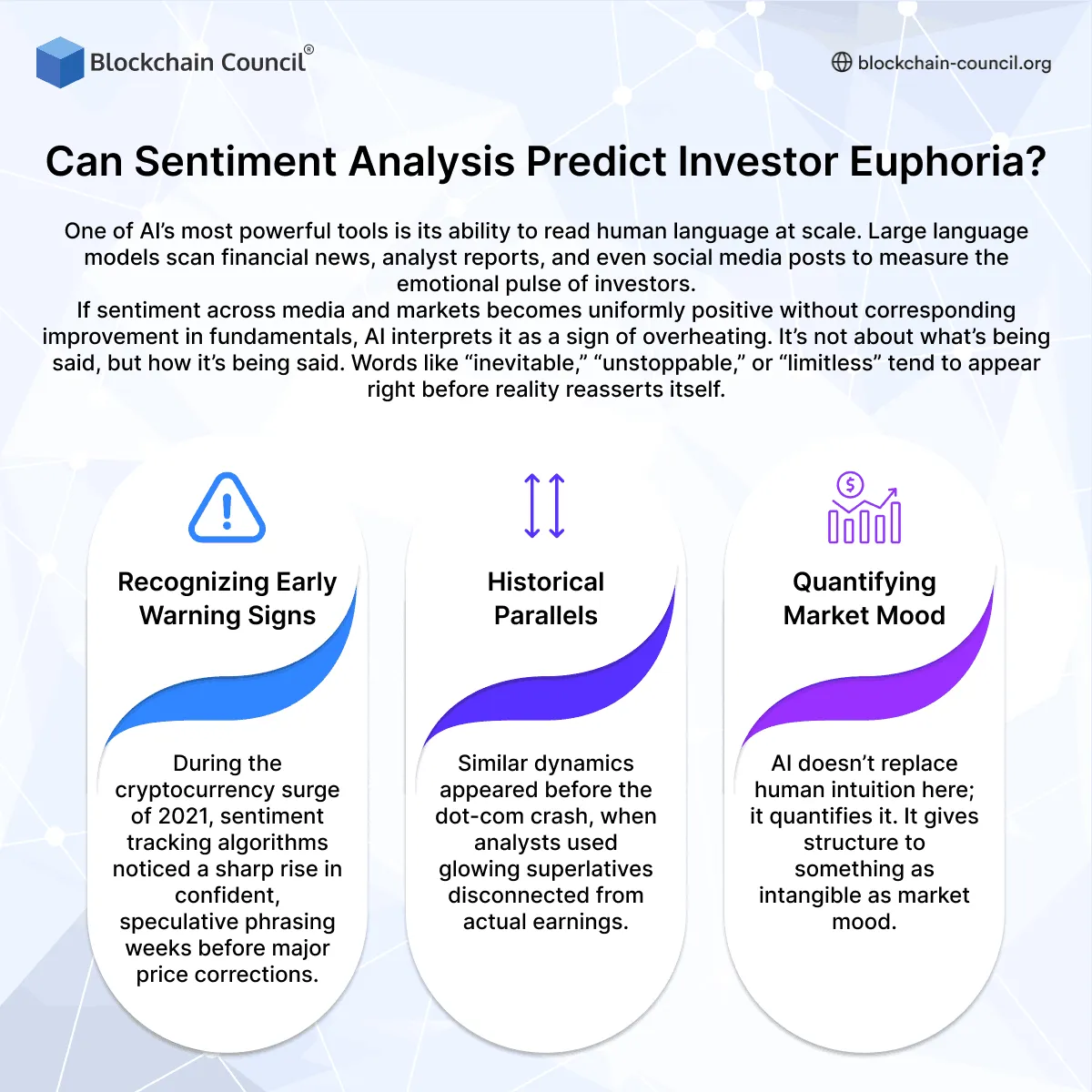
One of AI’s most powerful tools is its ability to read human language at scale. Large language models scan financial news, analyst reports, and even social media posts to measure the emotional pulse of investors.
If sentiment across media and markets becomes uniformly positive — without corresponding improvement in fundamentals — AI interprets it as a sign of overheating. It’s not about what’s being said, but how it’s being said. Words like “inevitable,” “unstoppable,” or “limitless” tend to appear right before reality reasserts itself.
For instance, during the cryptocurrency surge of 2021, sentiment-tracking algorithms noticed a sharp rise in confident, speculative phrasing weeks before major price corrections. Similar dynamics appeared before the dot-com crash, when analysts used glowing superlatives disconnected from actual earnings.
AI doesn’t replace human intuition here; it quantifies it. It gives structure to something as intangible as “market mood.”
How AI’s Perspective Differs from Traditional Analysts
Traditional analysts look at ratios, charts, and reports. AI looks at everything. It combines structured data (like prices and volumes) with unstructured inputs (like news tone, patent trends, and retail-investor chatter). This holistic view means AI can catch distortions invisible to human analysts who focus on one metric at a time.
In practice, this means identifying “tells” that humans miss — for example, when trading volume spikes without any matching change in earnings or innovation, or when companies start rebranding themselves with trending buzzwords like “AI” or “metaverse” purely to attract investors.
AI evaluates these phenomena as part of a probabilistic model: what are the odds that such behaviour historically preceded a crash? Over time, this data-driven context helps separate genuine growth from speculative hype.
How AI Can Help Investors Act Before It’s Too Late
Predicting a bubble is one thing; acting on it is another. Many investors recognise inflated markets but ride them anyway, hoping to exit at the top. AI can help enforce discipline by quantifying risk in real time.
For example, portfolio-level algorithms can simulate how various asset classes might react if a bubble bursts. They can automatically reduce exposure when volatility patterns cross predefined thresholds. This dynamic hedging is now part of modern AI-powered portfolio management.
For traders who want to apply this approach directly, the AI Powered Trading Program provides hands-on frameworks for building predictive models and executing risk-aware strategies based on market data.
AI also powers robo-advisors that adapt portfolios automatically when speculative indicators rise. They use reinforcement learning — the same logic behind game-playing AI — to learn optimal responses in different market conditions.
Why AI Still Needs Human Oversight
Even the smartest algorithms can misread market shifts. AI models are trained on past data, but bubbles evolve in new ways. A system that worked for the dot-com era might misinterpret today’s AI stock rally. The human element remains critical to interpret whether a model’s signal is meaningful or just statistical noise.
Experienced investors combine AI-driven analysis with contextual awareness — understanding how macroeconomic factors, regulatory changes, and innovation cycles interact. AI provides the microscope; humans supply the judgment.
Those who balance both perspectives are best equipped to navigate modern markets. Certifications like the AI Powered Investor Program help professionals build that bridge — integrating algorithmic insight with strategic decision-making.
The Emerging Role of Explainable AI in Finance
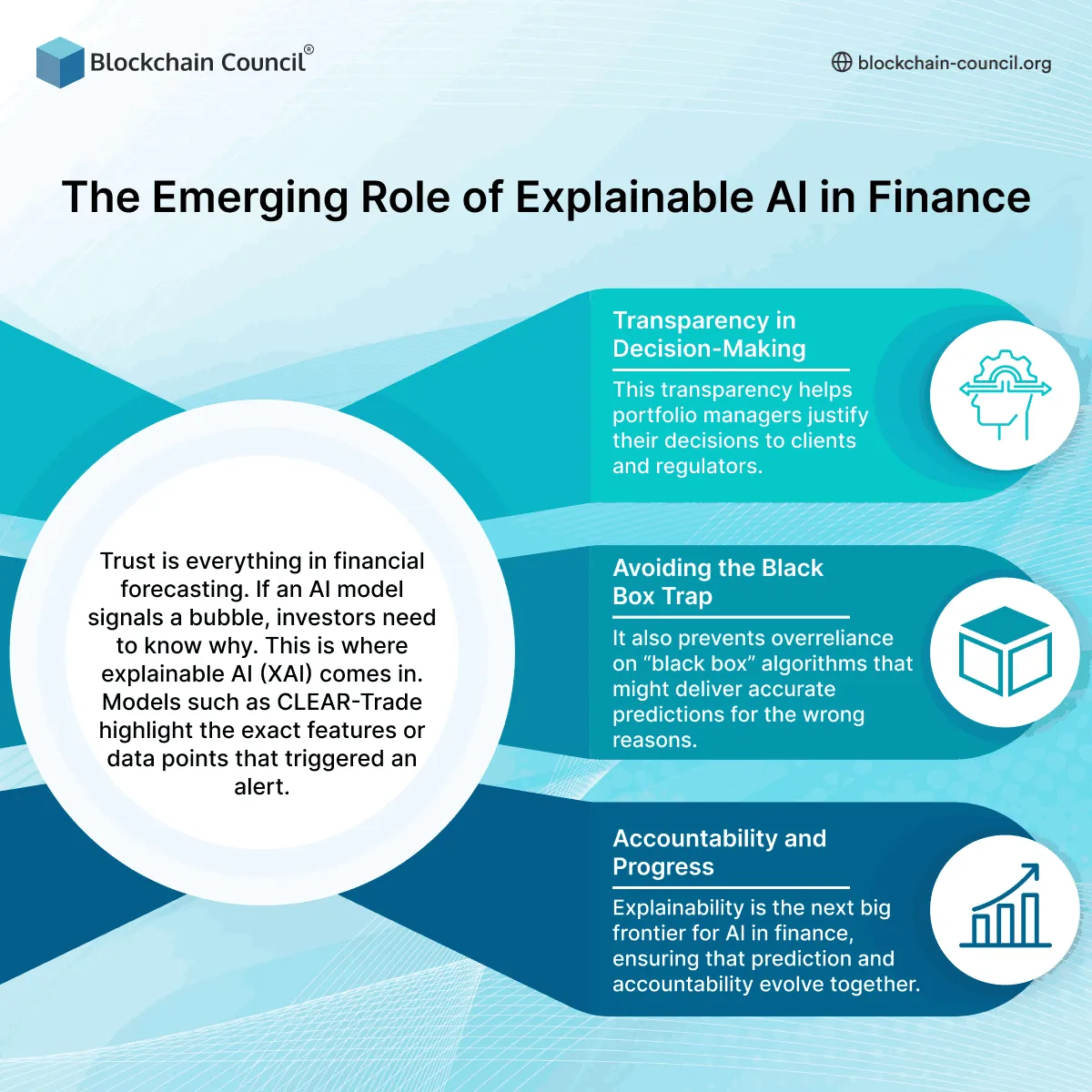
Trust is everything in financial forecasting. If an AI model signals a bubble, investors need to know why. This is where explainable AI (XAI) comes in. Models such as CLEAR-Trade highlight the exact features or data points that triggered an alert.
This transparency helps portfolio managers justify their decisions to clients and regulators. It also prevents overreliance on “black box” algorithms that might deliver accurate predictions for the wrong reasons.
Explainability is the next big frontier for AI in finance, ensuring that prediction and accountability evolve together.
Why Predicting Bubbles Might Be AI’s Most Important Test
The ability to detect market bubbles before they burst could transform not just investing but the global economy. Every crash leaves lasting scars — lost jobs, failed pensions, and damaged trust. If AI can provide even a few weeks of early warning, it could help investors and regulators act before panic spreads.
But the challenge remains monumental. Bubbles are not just data events; they are collective human stories — driven by hope, fear, and belief. AI is learning to read those stories through data, but the final decision still rests with humans who choose how to act on the warnings.
How AI Models Track Market Irrationality in Real Time
The stock market isn’t just a reflection of earnings and interest rates; it’s a living, breathing expression of human psychology. When optimism crosses into mania, prices begin to decouple from logic. AI is increasingly being trained to see that moment — the tipping point when rationality fades and emotion takes over.
Modern models like the Universal Market Irrationality (UMI) framework quantify this gap between fundamental value and market behaviour. They monitor signals such as trading velocity, retail participation, and the frequency of speculative keywords in financial discussions. When these variables accelerate faster than underlying earnings or innovation can justify, the system raises an alert.
This data-driven vigilance has already shown promise. During the 2021 retail trading boom, several AI platforms flagged unsustainable spikes in low-liquidity stocks weeks before price collapses occurred. These systems didn’t rely on insider information — they simply noticed that market enthusiasm was expanding faster than reality.
Such vigilance allows investors to act before euphoria turns into excess. With AI handling the constant data flow, analysts can focus on strategy rather than detection.
How Change-Point Detection and Scaling Patterns Reveal Hidden Stress
Another breakthrough in AI-driven bubble forecasting comes from change-point detection, a method that identifies abrupt shifts in market structure. When the statistical behaviour of an index suddenly changes — for example, when volatility or correlations jump unexpectedly — AI interprets it as a possible precursor to instability.
Some models use generalised Hurst exponents, a technique borrowed from physics, to measure how markets move across multiple time horizons. Stable markets show smooth scaling relationships, while speculative ones display fractal-like irregularities. In simple terms, AI notices when the market’s “heartbeat” becomes erratic.
This approach isn’t theoretical. Hedge funds and quantitative firms now integrate scaling analysis into live trading systems. It acts as a risk gauge that warns when markets transition from orderly growth to unstable excitement — the digital equivalent of a seismograph picking up tremors before an earthquake.
How AI Turns Financial News into Predictive Signals
Every bubble begins as a story — a compelling narrative that captures collective imagination. AI excels at understanding these narratives by reading what humans write. Natural language models digest thousands of articles, tweets, and analyst reports, scoring them for tone and intensity.
When language across the market becomes excessively uniform — with everyone using the same optimistic vocabulary — it often precedes overheating. AI measures not only positivity but similarity. If every source starts sounding alike, it signals herd mentality.
For instance, before the 2022 crypto crash, linguistic models detected a surge in repetitive, euphoric phrasing across online discussions. The data showed a linguistic bubble forming before the price one.
By translating emotion into metrics, AI provides investors a radar for collective psychology. It turns qualitative hype into quantitative evidence.
How AI Supports Central Banks and Regulators
The ability to detect bubbles isn’t just valuable for investors; it’s crucial for policymakers. Central banks can integrate AI into macroeconomic surveillance to anticipate financial instability.
AI systems that track credit growth, leverage ratios, and cross-market sentiment can highlight when speculative forces begin distorting the economy. Instead of waiting for bubbles to burst, regulators could intervene earlier — tightening lending conditions or issuing public advisories.
Some institutions already experiment with these systems. Research groups in Europe and Asia are developing “macroprudential dashboards” powered by AI. These tools simulate how rising asset prices could spill into real estate, commodities, or foreign exchange markets, helping prevent contagion.
AI won’t replace human regulators, but it gives them sharper vision — an early-warning framework for systemic risk.
How Data Science Powers Bubble Prediction Models
Behind every successful bubble-detection algorithm lies rigorous data science. Datasets must be cleaned, balanced, and validated to prevent false alarms. Financial markets are noisy, and AI models are only as good as their inputs.
Data scientists use ensemble methods — combining multiple algorithms to improve accuracy — and feature engineering to identify which variables matter most. They also perform backtesting, comparing model predictions to historical events like the 2008 crash to ensure realism.
For professionals aspiring to work at this intersection, the Data Science Certification provides a solid foundation. It teaches how to preprocess market data, train predictive models, and validate outputs responsibly — all key for building robust financial AI systems.
In a world where milliseconds can move billions, the value of skilled data scientists has never been higher.
How Agentic AI Systems May Revolutionise Financial Forecasting
As AI becomes more sophisticated, the next frontier lies in agentic intelligence — networks of autonomous AI agents that collaborate, specialise, and learn continuously.
Imagine one agent tracking macroeconomic indicators, another monitoring social sentiment, and a third analysing corporate fundamentals. Together, they share findings and reach consensus on market risk levels. This multi-agent approach enhances precision and resilience, reducing the chance that a single model’s bias leads to error.
Such systems are beginning to appear in experimental hedge fund environments, where they operate as tireless analysts. They monitor global markets 24/7, learning from each data point.
For those eager to understand this new class of intelligent systems, the Agentic AI Certification explores how autonomous models interact, adapt, and optimise decision-making — skills that are quickly becoming the new edge in algorithmic finance.
How AI Works with Human Traders to Avoid False Alarms
One of the biggest risks in bubble prediction is overreaction. Markets often display temporary exuberance that never escalates into a full bubble. AI, while powerful, can overinterpret short-term excitement as systemic risk.
That’s why human traders remain essential. They interpret AI’s signals in context — weighing macro conditions, policy actions, and behavioural factors that models can’t fully capture. The most effective firms blend AI vigilance with human restraint.
Traders trained in advanced tech certifications learn to calibrate these models, adjusting sensitivity thresholds to match real-world conditions. This balance between automation and judgment turns AI from a blunt alarm system into a nuanced partner.
How Blockchain Data Adds Depth to Market Analysis
Blockchain analytics is emerging as a new layer in bubble detection. On-chain data reveals investor behaviour that’s invisible in traditional markets — wallet activity, liquidity flows, and whale transactions.
AI tools analyse these datasets to detect speculative cycles in crypto markets or tokenised assets. For example, sudden spikes in new wallet creation or leverage on decentralised exchanges often precede sharp reversals.
By merging AI and blockchain insights, investors can view speculative patterns across both traditional and digital markets. Those interested in mastering this hybrid domain often start with blockchain technology courses, which explain how transparent ledgers provide real-time financial intelligence for AI systems to process.
How AI Contributes to Smarter Investment Strategies
Even if AI can’t predict bubbles with 100% certainty, it can dramatically improve investment discipline. By identifying early-warning signals, AI enables funds to rebalance portfolios, hedge risk, and reduce exposure to overheated assets.
Machine learning models can recommend diversification strategies based on volatility clustering, sentiment divergence, and liquidity metrics. These insights help investors shift capital from vulnerable sectors to resilient ones — long before crises unfold.
Investors who want to apply these tools practically often pursue programs such as the AI Powered Investor Program or AI Powered Trading Program, where the focus is on integrating AI-driven signals into real-world portfolio management.
Why AI Prediction May Never Be Perfect — But Still Transformative
Markets aren’t physics. They’re social systems governed by emotion, information asymmetry, and politics. AI can’t eliminate uncertainty entirely — but it can shrink the blind spots.
By combining pattern recognition, behavioural analysis, and macroeconomic modelling, AI makes bubbles less mysterious and more measurable. It transforms speculation from a guessing game into an informed probability.
For long-term investors and policymakers, that’s progress enough. Predicting the exact moment a bubble bursts may remain elusive, but recognising the conditions that create one is now within reach.
How AI Enhances Risk Management During Bubble Phases
Detecting a bubble is only half the battle; surviving it is the real test. Once speculation takes hold, prices move faster, volatility increases, and traditional hedging strategies become unreliable. AI gives risk managers a way to stay ahead by running thousands of market simulations in real time.
These systems use reinforcement learning — an AI technique that continuously refines decisions based on feedback from the environment. For instance, if a portfolio’s exposure to high-volatility assets starts exceeding safe limits, AI can automatically suggest or even execute partial de-risking. It can rebalance allocations to assets historically resilient during drawdowns, such as commodities or value stocks.
AI also brings transparency to stress testing. Rather than relying on static “worst-case” scenarios, it generates adaptive models that evolve with market conditions. That flexibility helps traders and institutions prepare for both short bursts of panic and prolonged downturns.
This level of proactive control is changing how funds think about portfolio defence. Instead of responding to crashes, they train AI to anticipate them.
How AI Bridges the Gap Between Macro Data and Micro Behaviour
Bubble dynamics aren’t confined to the stock chart. They grow from the micro-level behaviours of individual investors and institutions, spreading upward into macroeconomic consequences. AI helps connect these layers.
By combining macro indicators — inflation, liquidity supply, credit spreads — with micro patterns like retail order flows and online sentiment, AI builds a unified picture of market psychology. It learns how small surges in speculative behaviour can ripple into broader financial instability.
This multi-scale analysis is reshaping economic forecasting. Central banks and asset managers can now see how household trading patterns or influencer trends might distort policy effectiveness. It’s a level of granularity economists once only dreamed of.
Understanding such cross-domain data fusion is central to professional development. Advanced [AI certs] (no link) and tech certifications help analysts integrate data pipelines from multiple sources to ensure that AI predictions mirror reality, not just theory.
How AI Makes Financial Education More Practical
The complexity of bubble prediction has traditionally kept it confined to quantitative research teams. But modern AI tools are making these insights accessible to more professionals — from retail investors to financial advisors.
Interactive dashboards powered by AI explain risk signals in plain language. They translate technical indicators into intuitive summaries such as “investor optimism exceeding long-term trend by 35%.” This empowers non-experts to interpret markets more responsibly.
Educational programs like the AI Certification are part of this shift, bridging theory and application. Learners move from understanding neural networks conceptually to applying them in financial contexts — turning AI literacy into practical investment skill.
How AI and Behavioural Economics Are Converging
Behavioural economics studies how people deviate from rational decision-making — the very behaviour that fuels bubbles. AI gives this field a new toolkit. Instead of relying on surveys or limited experiments, behavioural researchers can now analyse millions of real transactions and online interactions in real time.
Patterns of overconfidence, herd following, or panic selling become measurable variables. AI then quantifies these patterns and correlates them with price cycles. This allows economists to test behavioural theories on a massive scale and even forecast sentiment turning points.
The combination of machine learning and behavioural insight creates a feedback loop: AI models become psychologically aware, and economists become data-driven. Together, they move bubble analysis from intuition to measurable science.
How AI Encourages Transparency and Accountability in Trading
AI-driven trading strategies used to operate behind closed doors, understood only by their creators. Today, explainability has become a regulatory and competitive necessity. Investors and clients demand to know why an algorithm made a particular call — especially when it involves risk.
Modern systems log every decision point: which variables were weighted, which thresholds were crossed, and what data triggered alerts. These records form auditable trails that strengthen trust between traders, clients, and regulators.
Such transparency is vital when AI predicts something as serious as a market bubble. It prevents overreliance on opaque systems and aligns automation with ethical finance principles — a topic increasingly covered in leadership tracks such as the Marketing and Business Certification.
How Blockchain Adds Verification to Bubble Detection
AI may analyse markets, but blockchain ensures that the underlying data remains tamper-proof. This synergy is gaining traction in financial analytics. Transaction histories, price feeds, and sentiment data stored on decentralised ledgers provide verifiable foundations for AI models.
By pulling directly from blockchain-verified data, AI reduces manipulation risks — a critical safeguard in detecting speculative surges in digital assets. It can monitor wallet flows, token creation rates, and transaction spikes in real time.
Professionals exploring this frontier often build their foundation through blockchain technology courses, which explain how decentralised data integrity complements AI’s analytical strength.
How AI Insights Are Influencing Policy and Regulation
Regulators once reacted to crashes; now, they’re experimenting with prevention. AI’s ability to spot risky patterns is influencing how agencies craft early-intervention strategies.
Governments and central banks are developing AI-based monitoring systems to detect asset bubbles across sectors — equities, housing, crypto, and even art. These models can suggest countermeasures such as adjusting capital requirements or issuing targeted communications to cool speculative fever.
This shift from reactive to preventive policy could redefine financial governance. It transforms regulation from static enforcement into an adaptive, data-driven process.
How AI Could Redefine Market Efficiency
Classical finance assumes that markets are efficient — all known information is reflected in prices. Yet bubbles prove that this assumption breaks down when collective emotion distorts value. AI introduces a new kind of efficiency: informational agility.
By processing more data, faster and more accurately than humans, AI narrows the gap between perception and truth. It can detect misinformation, counter herd behaviour with evidence, and restore balance to pricing mechanisms.
In this sense, AI doesn’t just predict bubbles; it helps prevent them from escalating. Markets guided by better information behave more rationally, even if emotions never disappear entirely.
How Continuous Learning Keeps AI Effective in Volatile Markets
Financial systems evolve daily. A model that worked last year may falter tomorrow. Continuous learning — where AI updates its parameters based on new data — keeps predictions relevant.
This adaptability ensures that AI doesn’t get trapped by outdated assumptions. As new asset classes emerge, from green bonds to tokenised securities, AI retrains itself to understand their dynamics.
Such adaptability mirrors the mindset required of modern investors. Continuous education through programs like the AI Powered Investor Program and the AI Powered Trading Program teaches professionals to evolve alongside their tools. In fast-moving markets, static knowledge is riskier than volatility itself.
The Broader Impact: Turning Foresight into Stability
AI may never predict every crash, but it’s already changing how markets respond to risk. Early warnings allow investors to act cautiously, reducing panic selling and contagion. That stabilising effect benefits not just traders but entire economies.
As financial ecosystems integrate AI across analysis, trading, and governance, bubbles may become less catastrophic. Their bursts could resemble controlled releases rather than explosions.
Ultimately, AI transforms the stock market from a reactive machine into a learning organism — one that adjusts, remembers, and grows wiser over time.
Related Articles
View All
AI & ML
Freelancing with Vibe Coding Skills
Learn how vibe coding empowers freelancers to deliver faster, smarter, and more efficient AI-driven projects.

AI & ML
AI Agents in Coding: The Future of Development
Discover how AI agents are transforming software development by automating coding tasks and managing complex workflows.

AI & ML
How to Debug Code Using AI
Explore how AI tools can simplify debugging by identifying errors, suggesting fixes, and improving code quality efficiently.
Trending Articles

The Role of Blockchain in Ethical AI Development
How blockchain technology is being used to promote transparency and accountability in artificial intelligence systems.

AWS Career Roadmap
A step-by-step guide to building a successful career in Amazon Web Services cloud computing.

Top 5 DeFi Platforms
Explore the leading decentralized finance platforms and what makes each one unique in the evolving DeFi landscape.