
Can Artificial Intelligence Predict the Next Crypto Winter?
 Michael Willson
Can AI Really Predict Crypto Winters?
The idea of a “crypto winter” refers to long periods when digital asset prices fall sharply and stay low. Investors want to know if artificial intelligence can really predict when the next downturn will happen. The short answer is yes, AI can provide early warnings by analyzing data patterns, but it cannot predict with complete certainty. What it offers is a probability-based signal that helps investors prepare rather than a perfect forecast.
For anyone who wants to build the skills needed to understand how AI is shaping finance and investing, the AI powered investor program provides direct training on using intelligent systems to make better market decisions.

Role of AI in Predicting the Next Crypto Winter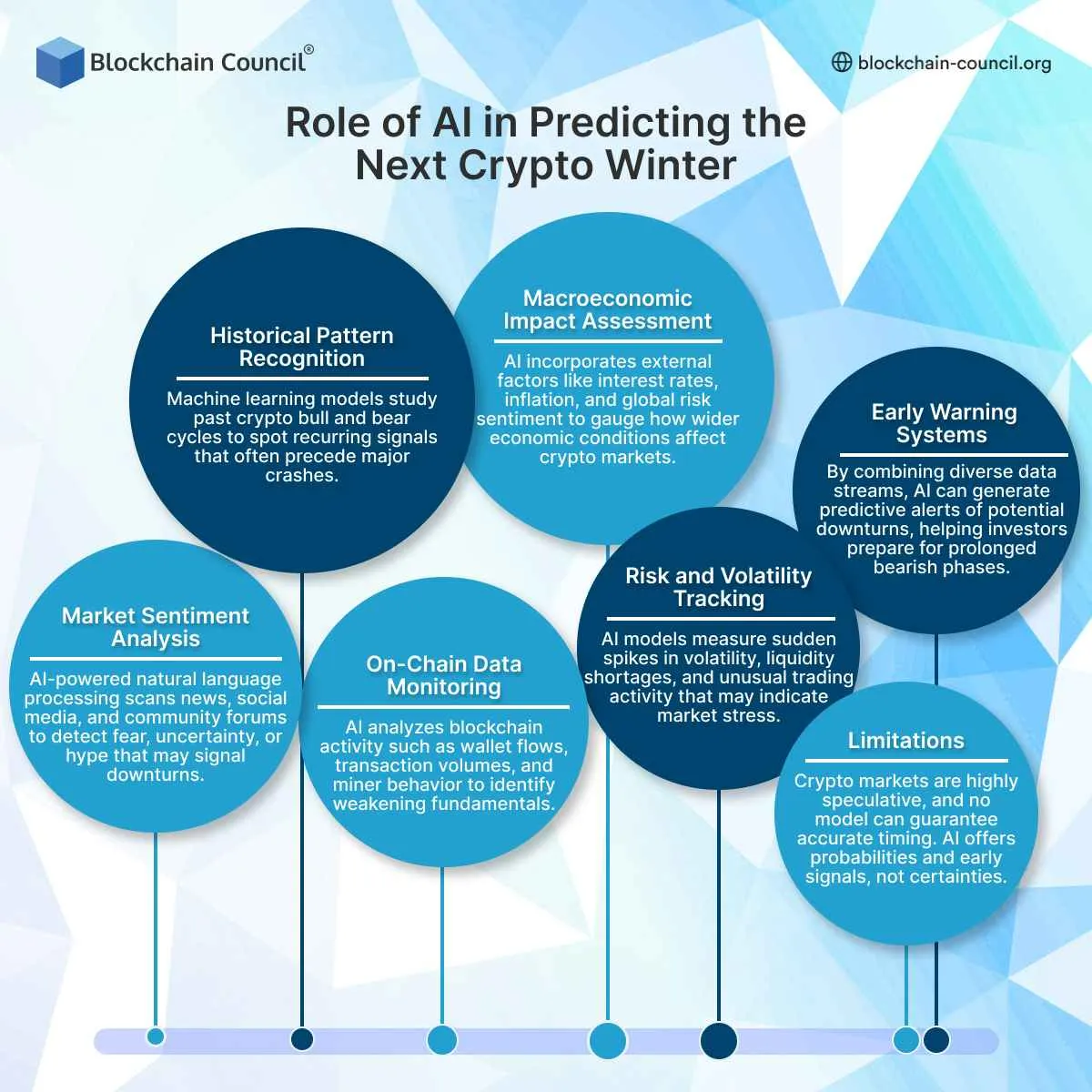
- Market Sentiment Analysis
AI-powered natural language processing scans news, social media, and community forums to detect fear, uncertainty, or hype that may signal downturns. - Historical Pattern Recognition
Machine learning models study past crypto bull and bear cycles to spot recurring signals that often precede major crashes. - On-Chain Data Monitoring
AI analyzes blockchain activity such as wallet flows, transaction volumes, and miner behavior to identify weakening fundamentals. - Macroeconomic Impact Assessment
AI incorporates external factors like interest rates, inflation, and global risk sentiment to gauge how wider economic conditions affect crypto markets. - Risk and Volatility Tracking
AI models measure sudden spikes in volatility, liquidity shortages, and unusual trading activity that may indicate market stress. - Early Warning Systems
By combining diverse data streams, AI can generate predictive alerts of potential downturns, helping investors prepare for prolonged bearish phases. - Limitations
Crypto markets are highly speculative, and no model can guarantee accurate timing. AI offers probabilities and early signals, not certainties.
What Is a Crypto Winter?
A crypto winter is not just a temporary dip in prices. It is a prolonged bear market where enthusiasm drops, trading volumes shrink, and many projects collapse. Past examples include the 2018 decline after the ICO bubble and the 2022 crash following high leverage and failed exchanges.
AI systems can help detect these long downturns by looking at signals across price data, blockchain activity, and investor sentiment. They analyze when optimism turns to caution and when profit-taking turns into broad sell-offs.
How Do AI Models Analyze Market Cycles?
AI thrives on large datasets. In crypto, these datasets include prices, trading volumes, derivatives activity, and on-chain information. Machine learning models can combine all these signals to spot hidden patterns.
For example, an AI model might find that high unrealized profits across many wallets, combined with declining inflows to exchanges, often comes before a market reversal. While humans can track a few indicators, AI can monitor hundreds at once and update forecasts in real time.
This is why many learners explore structured programs like an AI certification, which teaches how to connect technical AI knowledge with practical market applications.
Which On-Chain Indicators Do AI Models Track?
One key metric is the MVRV Z-score, which measures how far market value is above realized value. High readings often suggest that holders are sitting on large profits, raising the chance of sell pressure.
Another is NUPL, which shows the net unrealized profit or loss across the network. When most investors are in profit, risk rises that they may take those profits, leading to correction or winter phases.
SOPR, exchange reserves, and miner revenue trends are also tracked. AI models do not rely on one signal. Instead, they build composite scores from dozens of these indicators.
How Do ETFs and Regulation Influence AI Predictions?
The crypto market is shaped not only by blockchain activity but also by external forces like exchange-traded funds (ETFs) and regulatory changes. When ETFs see heavy inflows, it signals strong institutional demand. Outflows suggest weakening confidence.
AI systems can track these flows and integrate them with price and sentiment data. For example, if ETFs show net redemptions while on-chain profits remain high, the model may raise the probability of a downturn.
Investors who want to understand these links often pursue a Crypto certification, which explains how trading products and regulation shape market cycles.
Can AI Detect Risks From Hacks and Security Events?
Security events are another key signal. When a major exchange or service suffers a hack, confidence drops, liquidity shrinks, and sell pressure rises. In 2025, thefts from services have already exceeded the total for 2024, showing how disruptive these shocks can be.
AI models can include binary event markers for hacks, enforcement actions, or exchange collapses. By analyzing past data, they can show how much these events typically increase the chance of a winter scenario.
How Do AI Models Handle Regime Shifts?
One of the biggest challenges for AI is regime change. The launch of Bitcoin and Ethereum ETFs, new global rules, and institutional adoption all create market structures that did not exist before. Historical patterns may not fully apply.
To adjust, AI models must use adaptive learning. Instead of relying only on old data, they learn from recent events and reweight features. This keeps their forecasts relevant even as the market evolves. Traders are exploring how a Prompt Engineering Course can sharpen their skills in applying AI to crypto market forecasts.
What Features Do AI Systems Use for Early Warnings?
Features AI Systems Use for Early Warnings in the Crypto Market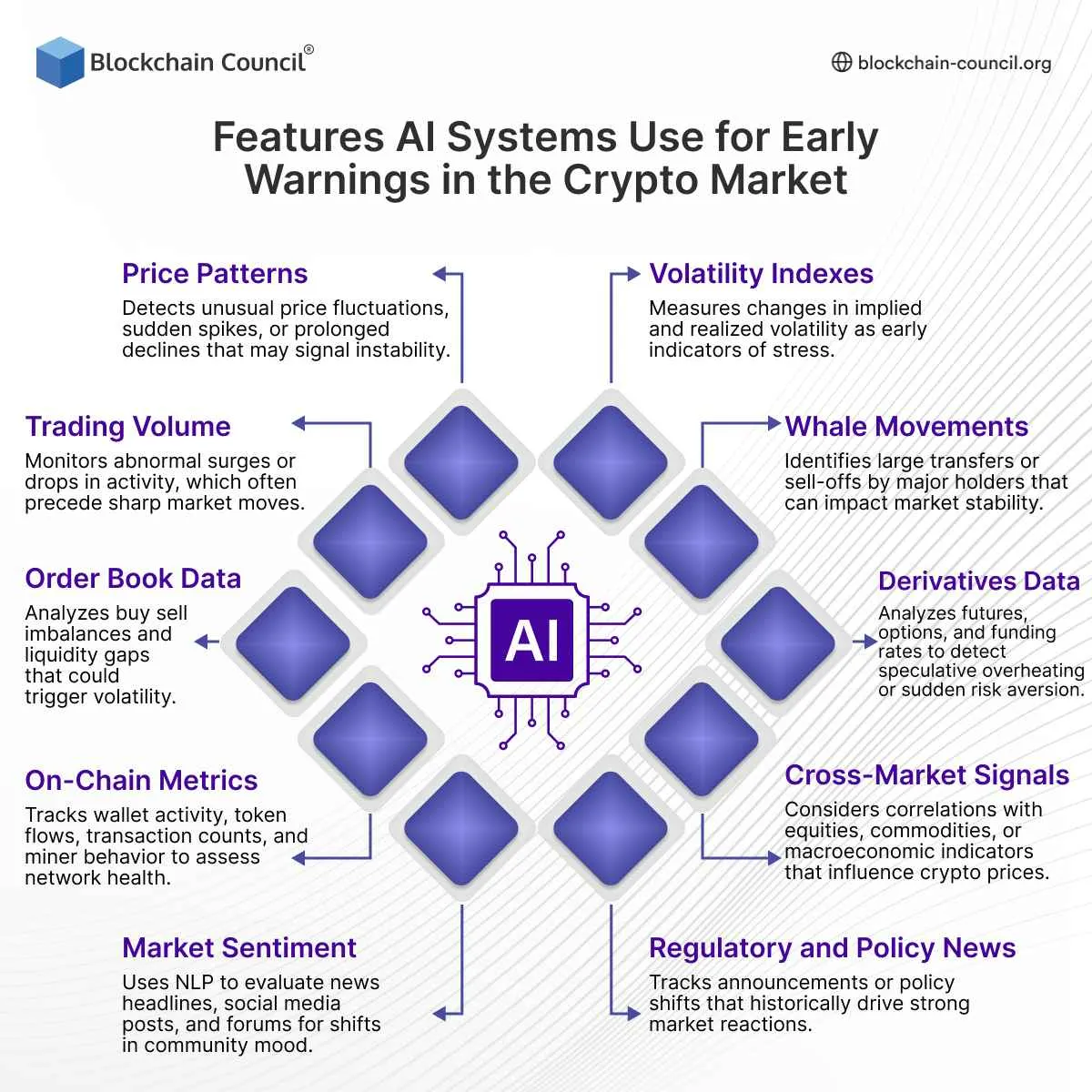
- Price Patterns
Detects unusual price fluctuations, sudden spikes, or prolonged declines that may signal instability. - Trading Volume
Monitors abnormal surges or drops in activity, which often precede sharp market moves. - Order Book Data
Analyzes buy-sell imbalances and liquidity gaps that could trigger volatility. - On-Chain Metrics
Tracks wallet activity, token flows, transaction counts, and miner behavior to assess network health. - Market Sentiment
Uses NLP to evaluate news headlines, social media posts, and forums for shifts in community mood. - Volatility Indexes
Measures changes in implied and realized volatility as early indicators of stress. - Whale Movements
Identifies large transfers or sell-offs by major holders that can impact market stability. - Cross-Market Signals
Considers correlations with equities, commodities, or macroeconomic indicators that influence crypto prices. - Derivatives Data
Analyzes futures, options, and funding rates to detect speculative overheating or sudden risk aversion. - Regulatory and Policy News
Tracks announcements or policy shifts that historically drive strong market reactions.
An AI “winter risk detector” often looks at several layers of data:
- Price and derivatives: realized volatility, open interest, liquidation events, and option skews.
- On-chain activity: MVRV, NUPL, SOPR, exchange inflows and outflows, miner revenues, and stablecoin supply.
- Flows and liquidity: ETF creations and redemptions, stablecoin issuance, and cross-exchange order book balance.
- External events: hacks, lawsuits, and macroeconomic shocks.
Combining these signals allows AI to assign probabilities, giving investors a risk score rather than a binary yes or no answer.
Can AI Outperform Human Analysts?
Humans bring context and judgment, but they cannot track all signals at once. AI outperforms by analyzing high-dimensional data. For example, it can detect correlations between stablecoin supply, ETF outflows, and leverage build-up that would take humans much longer to see.
Still, AI does not replace human insight. Instead, it provides a probabilistic framework. Analysts can use these scores to adjust strategies, hedge positions, or reduce exposure when risks rise.
Professionals preparing for this field often build expertise with a Data Science Certification, since data pipelines and feature engineering are critical for financial AI models.
Why Is Communication About Predictions So Important?
Even when AI gives a strong warning, communication matters. If investors misunderstand the signal, they may panic too early or ignore it. Transparency in how models work helps build trust.
Businesses that lead in this space must connect AI insights with clear strategies. Leaders often study through programs like the Marketing and Business Certification, which helps align technical insights with public communication and trust building.
How Does Technology Training Support Crypto Forecasting?
AI-driven forecasting requires strong foundations in technology. Understanding neural networks, blockchain structures, and risk modeling makes it easier to use AI responsibly. Without this knowledge, predictions can be misused or misunderstood.
This is why professionals across finance and blockchain are encouraged to upskill continuously. Technology evolves quickly, and crypto markets move even faster.
Can Blockchain Itself Help Predict Winters?
Blockchain is not only the subject of predictions. It can also be part of the solution. By providing transparent and tamper-proof records, blockchain helps ensure that the data feeding AI systems is reliable.
Some researchers suggest creating registries of AI forecasts on blockchain, so predictions cannot be altered after the fact. This increases accountability and improves trust in the process. Professionals who want to explore this area often pursue blockchain technology courses.
How Does Agentic AI Contribute to Predicting Market Downturns?
Agentic AI is a type of artificial intelligence designed to act with a degree of autonomy. In financial markets, this means the system can analyze multiple data streams, generate scenarios, and adapt strategies without waiting for constant human input. When applied to crypto, agentic AI can scan on-chain metrics, ETF flows, derivatives markets, and news headlines all at once.
This ability matters because crypto winters often develop from a combination of factors rather than one single trigger. An autonomous system can pick up on early signals such as declining stablecoin supply or large miner sell-offs while also adjusting its models in real time when new data, like ETF outflows, appears.
Professionals who want to gain skills in this area often turn to the agentic AI certification, which explains how to design and evaluate agentic systems responsibly in sensitive sectors like finance.
Can AI Trading Programs Predict Market Cycles?
AI trading program design is already widely used in crypto markets. These programs rely on algorithmic strategies to manage trades, measure risk, and identify opportunities. When tied to cycle forecasting, they can be used not only to place short-term trades but also to detect when a broader bearish phase is forming.
For instance, an AI trading program can identify when open interest in futures is climbing while funding rates remain high, signaling overheated conditions. Combined with on-chain data like NUPL readings, the system can issue a warning that a winter-like correction is more probable.
These systems are not infallible, but their strength lies in integrating information from many sources. Unlike human traders who may focus on one or two signals, AI trading programs take a holistic view.
How Do Global Policies Affect AI Predictions in Crypto?
Crypto markets are deeply influenced by policy. New laws, ETF approvals, or restrictions can change liquidity flows overnight. In 2025, regulators streamlined ETF approvals, which created new sources of demand but also added volatility. AI systems can track these regulatory shifts by monitoring policy announcements, compliance actions, and changes in exchange volumes.
By encoding these events as features, AI can identify when regulation is acting as a driver of stability or when it may trigger exits. This is important because previous winters often coincided with policy tightening, such as bans on certain trading practices.
Policy awareness is also why investors and analysts pursue tech certifications. They cover not only the technical side of AI but also how governance, compliance, and regulatory change affect adoption.
What Role Does Human Psychology Play in Crypto Winters?
Market cycles are not driven only by numbers. Human behavior and psychology play a major role. AI models can integrate sentiment analysis from social media, news, and forums to capture how investors feel.
For example, sharp increases in overly optimistic language often coincide with market tops. AI systems trained on natural language processing can detect when the tone of discussion shifts from cautious optimism to reckless enthusiasm.
The reverse is also true. When fear dominates headlines and trading volumes collapse, the conditions of a crypto winter are often in place.
By combining behavioral signals with quantitative ones, AI creates a fuller picture of the market environment.
Can AI Learn From Past Crypto Winters?
Yes, but with limitations. AI models can be trained on historical data from past winters such as 2018 and 2022. These datasets include price declines, trading volumes, leverage washouts, and on-chain capitulations. By recognizing the common patterns, models can assign probabilities to current conditions.
The limitation is that each cycle is unique. The presence of ETFs in 2025, for example, creates new dynamics not seen in 2018. Models must be adaptive, weighting past knowledge while updating for new structures.
This balance between learning history and adjusting to novelty is why many professionals continue to build expertise through AI certs. They ensure analysts and developers can design systems that evolve rather than lock into outdated assumptions.
How Can Data Science Strengthen Winter Predictions?
Data science is the backbone of AI forecasting. Without strong pipelines, feature engineering, and model evaluation, predictions are unreliable. A Data Science Certification prepares learners to clean raw blockchain data, integrate it with exchange metrics, and build features that capture risk signals.
This foundation is what makes AI predictions more than guesswork. It ensures that models are trained on reliable, transparent inputs, reducing the risk of biased or misleading outputs.
Why Is Marketing and Communication Crucial in AI Predictions?
Even the best AI model is useless if investors cannot understand or trust its output. Clear communication is essential, especially when predictions involve something as serious as a potential market winter.
Organizations that rely on AI forecasts need to present them in simple, transparent ways. They must also avoid overstating certainty, since AI offers probabilities rather than guarantees. The Marketing and Business Certification helps professionals connect technical insights with strategies for clear public communication.
When investors understand the basis of predictions, they are more likely to use them responsibly.
How Does Technology Training Prepare Analysts for the Future?
Predicting crypto winters requires a solid background in technology. Analysts need to understand neural networks, time-series forecasting, and blockchain mechanics. Without this knowledge, even advanced models may be misunderstood or misapplied.
Technology training ensures that professionals can design, audit, and adapt AI models effectively. It also helps them stay updated as new architectures and methods, like hybrid reasoning and rule-induction systems, emerge.
Can Blockchain Improve Transparency in Forecasting?
Blockchain itself can help solve the problem of trust in predictions. By recording AI forecasts on-chain, researchers can prove they made a prediction before an event happened. This prevents retroactive changes or cherry-picking.
Such accountability increases credibility in a field often criticized for hype. Professionals who want to explore these connections often enroll in blockchain technology courses, which explain how decentralized systems support trust in data and models.
How Does Investor Education Shape AI Adoption?
Investor education is critical. AI forecasts only help when investors understand how to interpret them. Training programs like the AI certification build confidence in applying AI responsibly in finance.
For traders, exposure to structured learning such as the Crypto certification gives them the tools to combine technical trading with AI signals.
Business leaders, on the other hand, need certifications that align AI with growth strategies. This is where the Marketing and Business Certification comes in.
The overall picture is clear: without education, AI predictions risk being misunderstood. With education, they become part of responsible decision-making.
How Do Shocks Like Hacks and Exchange Collapses Affect Predictions?
Crypto winters are not driven by price action alone. They are often accelerated by sudden shocks such as major hacks, exchange failures, or unexpected enforcement actions. In 2025, for example, thefts from services already surpassed the total for the previous year. A single incident can spark panic, drain liquidity, and trigger liquidation cascades.
AI models can capture these shocks by adding event markers into their data pipelines. A binary variable indicating the occurrence of a hack or enforcement event can be combined with other features like trading volume and derivatives activity. This allows the model to see how similar shocks affected prices in the past and update its probability of a downturn.
While these signals do not guarantee prediction of every crash, they improve risk assessment. By integrating external shocks into forecasts, AI makes winter detection more realistic and less reliant on purely technical indicators.
Why Can’t AI Guarantee the Exact Timing of Crypto Winters?
Even with advanced data pipelines and adaptive learning, AI cannot give exact timing for when a crypto winter will begin. Markets are complex systems influenced by human psychology, policy shifts, global liquidity, and unpredictable events.
For example, models may show rising risk scores based on high unrealized profits and declining stablecoin supply. But a sudden positive policy announcement, such as an ETF approval, could delay the downturn. Conversely, a hack or corporate collapse could trigger a winter earlier than expected.
This uncertainty means AI should be used as a guide rather than an oracle. It can provide early warnings and probabilities, but investors must combine its output with judgment and diversification.
What Are the Best Practices for Using AI Predictions in Crypto?
Investors who use AI forecasts should follow certain practices to avoid misinterpretation:
- Treat predictions as probabilities, not certainties. A high-risk score signals caution, not automatic collapse.
- Combine AI signals with human judgment. Market context and news interpretation are areas where humans excel.
- Use AI for risk management. Rather than chasing perfect timing, AI predictions are most useful for adjusting position sizes and hedging strategies.
- Review predictions transparently. Keeping forecasts on record ensures accountability and helps refine models over time.
These practices prevent overreliance and ensure AI enhances decision-making rather than replacing it.
How Do Education and Training Shape Responsible AI Use?
AI tools are powerful, but their value depends on how well investors understand them. Education ensures that predictions are interpreted correctly and applied responsibly. Structured programs like the AI powered investor program prepare learners to apply AI forecasting tools directly in finance and crypto.
For those focused on the technical side, an AI certification builds strong foundations in how AI works and how it can be adapted to market cycles.
Traders who want to connect AI insights with practical strategies often benefit from a Crypto certification, which explains both market mechanics and how intelligent systems fit in.
Business leaders looking to align AI insights with organizational goals turn to the Marketing and Business Certification, which helps translate technical forecasts into strategic actions.
For those pursuing advanced governance and system design, the agentic AI certification offers skills in building autonomous AI tools responsibly.
Across industries, tech certifications remain central, as they demonstrate a readiness to engage with the technical, ethical, and regulatory aspects of AI adoption.
How Does Technology Support Advanced AI Forecasting?
Advanced forecasting requires strong foundations in technology. From neural networks to blockchain analytics, professionals must understand both the technical mechanics and the domain context.
Technology training helps ensure that AI models are not only accurate but also explainable. Investors and regulators alike demand transparency in how predictions are made. Training builds the skills needed to audit models, detect bias, and ensure accountability.
Without this foundation, even the best models risk being misused or misunderstood. With it, AI forecasts can become reliable tools for market stability.
Can Blockchain Increase Trust in AI Forecasts?
Trust is essential when predictions involve investor capital. Blockchain technology offers one way to increase that trust. By recording forecasts on a tamper-proof ledger, AI developers can prove they issued predictions before an event happened.
This prevents after-the-fact adjustments and increases accountability. For investors, it builds confidence that the forecasts are genuine.
Professionals interested in this area often pursue blockchain technology courses. These courses explain how decentralized systems can strengthen transparency in AI research and finance.
How Do AI Trading Programs Fit Into This Future?
AI trading program design will continue to evolve alongside forecasting. These programs already automate short-term trading, but when combined with winter prediction, they can create adaptive strategies.
For example, if the forecast risk score crosses a certain threshold, the trading program might automatically reduce exposure or increase hedging. This makes AI not only a prediction tool but also an execution tool.
Investors must still monitor these systems closely. Automated trading linked with winter forecasts can reduce losses but also create feedback loops if many programs act the same way. Responsible oversight ensures balance between efficiency and stability.
Why Does Investor Confidence Depend on Certifications?
As AI becomes more central to fintech, certifications build trust. Investors want to know that the professionals designing and using AI systems are qualified. Certifications act as proof of knowledge, ethics, and responsibility.
This is why AI certs are becoming more important. They reassure markets that forecasts are not based on hype but on structured, recognized expertise. In a space as volatile as crypto, that trust is essential.
What Is the Final Takeaway on AI and Crypto Winters?
AI cannot perfectly predict the next crypto winter, but it can provide powerful early warnings. By analyzing on-chain data, market flows, and external shocks, AI offers probability-based insights that investors can use to manage risk.
Its strength lies in combining signals humans cannot track alone. Its weakness is that markets remain unpredictable and subject to sudden shocks. Used wisely, AI forecasting can reduce losses and increase preparedness. Used poorly, it can mislead and create panic.
Crypto winters may never be avoidable, but with AI, they may no longer come as a surprise.
Related Articles
View All
AI & ML
20 Most Trending Artificial Intelligence Jobs
Artificial intelligence (AI) is rapidly changing the world, and the demand for AI talent is growing exponentially. According to the World Economic Forum, AI will create 97 million new jobs by 2025.

AI & ML
Freelancing with Vibe Coding Skills
Learn how vibe coding empowers freelancers to deliver faster, smarter, and more efficient AI-driven projects.

AI & ML
AI Agents in Coding: The Future of Development
Discover how AI agents are transforming software development by automating coding tasks and managing complex workflows.
Trending Articles

The Role of Blockchain in Ethical AI Development
How blockchain technology is being used to promote transparency and accountability in artificial intelligence systems.

AWS Career Roadmap
A step-by-step guide to building a successful career in Amazon Web Services cloud computing.

Top 5 DeFi Platforms
Explore the leading decentralized finance platforms and what makes each one unique in the evolving DeFi landscape.