

Are Institutional Players Fueling the Next Crypto Bull Market?
 Michael Willson
Yes, they are. Institutional players are now driving the momentum of the crypto market more than retail investors ever did. With record inflows into Bitcoin and Ethereum ETFs, big banks restarting custody services, and hedge funds scaling their exposure, the evidence points to a market powered by institutions. This is not just a repeat of past retail-driven cycles; it is a structural shift that could set the stage for a sustained bull run.
For anyone looking to understand these trends and navigate them effectively, building a foundation of knowledge is essential. A Crypto certification equips you with the skills to evaluate market shifts, understand institutional behaviour, and make informed investment choices.

The Scale of Institutional Inflows
The numbers are striking. By the first quarter of 2025, U.S. spot Bitcoin ETFs attracted over $50 billion in institutional money. By the third quarter, this figure climbed to $134.6 billion in assets under management. These inflows signal long-term confidence rather than short-term speculation. At the same time, supply is shrinking due to Bitcoin halving events and large institutions holding coins off the market. This scarcity effect adds upward pressure to prices.
Beyond Bitcoin: Ethereum and Tokenization
Institutions are not stopping with Bitcoin. Ethereum has become a central focus, especially with the rise of Ethereum staking and spot ETFs. By locking up large amounts of ETH, institutions are helping to reduce circulating supply and increase scarcity. This supply squeeze, combined with bullish sentiment, has helped Ethereum prices surge.
Meanwhile, tokenization is becoming an institutional keyword. Major firms are experimenting with tokenized securities and money market funds, seeing blockchain not just as an asset class but as infrastructure for future markets.
Custody and Hedge Fund Growth
Another sign of institutional commitment is custody. U.S. Bancorp has revived its Bitcoin custody service, showing that traditional finance firms see value in servicing institutional clients. This adds legitimacy and makes it easier for pension funds, hedge funds, and corporations to participate.
Crypto hedge funds are also benefiting from the new wave. Firms such as Wincent and Nickel Digital have reported strong returns from the market rally, proving that institutional strategies are paying off in this cycle.
Market Sentiment: Bullish and Confident
Surveys show that 83% of institutional investors plan to increase their crypto allocation in 2025, while 93% hold a bullish long-term view of blockchain as transformative technology. This level of confidence stands in sharp contrast to the scepticism that defined earlier cycles.
The launch and success of Bitcoin ETFs have been the main catalyst. With regulatory approval now in place, institutions no longer need to navigate grey areas. Clear custody solutions and compliance frameworks are making crypto adoption less risky.
Macro Trends Adding Fuel
Another important driver is liquidity. Large pools of cash—more than $4.29 trillion in U.S. money market funds—are sitting on the sidelines. As interest rates begin to ease, a portion of this capital is expected to flow into risk assets like crypto. This could trigger a significant rally in late 2025.
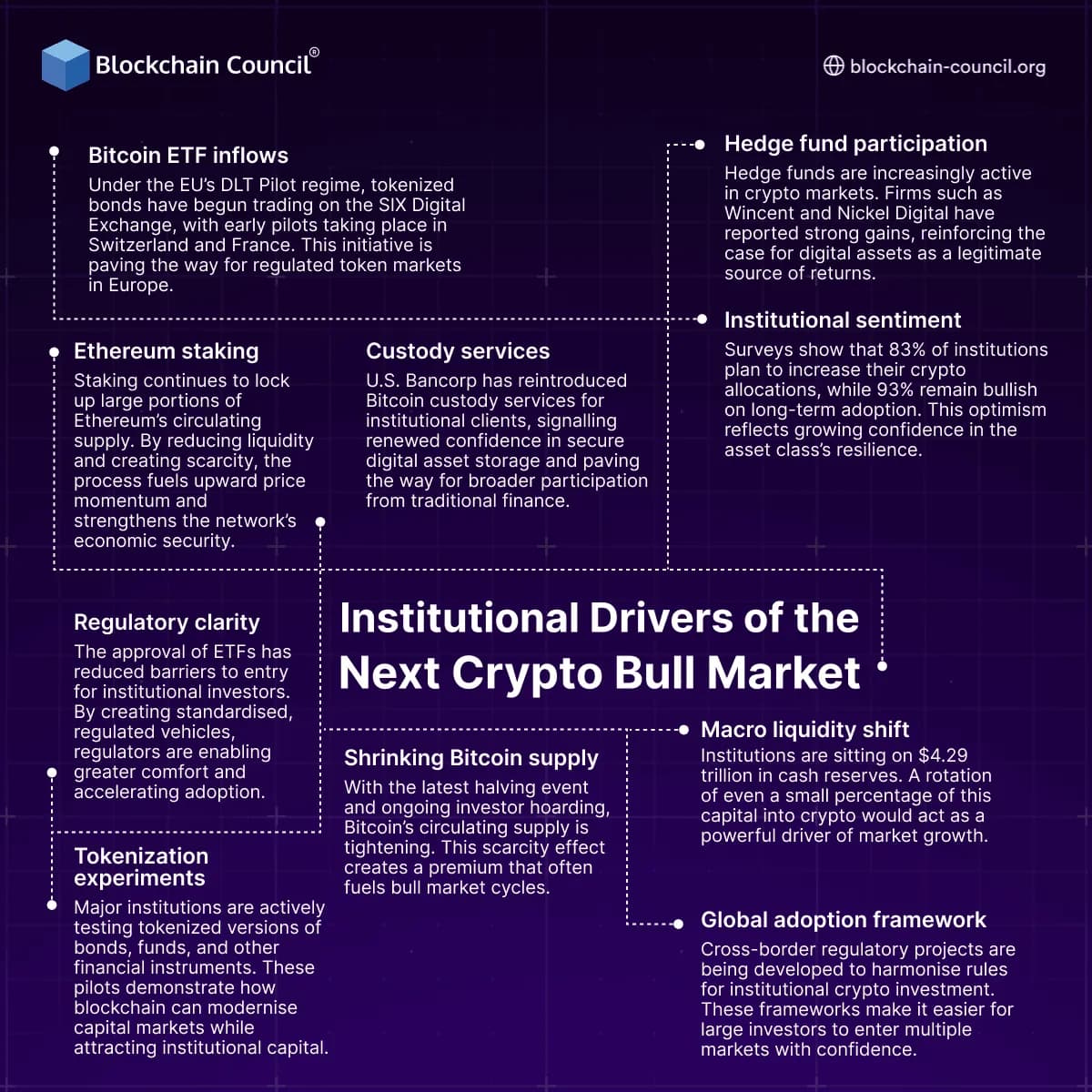
Institutional Drivers of the Next Crypto Bull Market
Bitcoin ETF inflows
In the first quarter of 2025 alone, Bitcoin ETFs attracted $50 billion, with inflows surging to $134.6 billion by Q3. These unprecedented levels of institutional participation are cementing Bitcoin’s role as a long-term asset class.
Ethereum staking
Staking continues to lock up large portions of Ethereum’s circulating supply. By reducing liquidity and creating scarcity, the process fuels upward price momentum and strengthens the network’s economic security.
Custody services
U.S. Bancorp has reintroduced Bitcoin custody services for institutional clients, signalling renewed confidence in secure digital asset storage and paving the way for broader participation from traditional finance.
Hedge fund participation
Hedge funds are increasingly active in crypto markets. Firms such as Wincent and Nickel Digital have reported strong gains, reinforcing the case for digital assets as a legitimate source of returns.
Institutional sentiment
Surveys show that 83% of institutions plan to increase their crypto allocations, while 93% remain bullish on long-term adoption. This optimism reflects growing confidence in the asset class’s resilience.
Regulatory clarity
The approval of ETFs has reduced barriers to entry for institutional investors. By creating standardised, regulated vehicles, regulators are enabling greater comfort and accelerating adoption.
Tokenization experiments
Major institutions are actively testing tokenized versions of bonds, funds, and other financial instruments. These pilots demonstrate how blockchain can modernise capital markets while attracting institutional capital.
Shrinking Bitcoin supply
With the latest halving event and ongoing investor hoarding, Bitcoin’s circulating supply is tightening. This scarcity effect creates a premium that often fuels bull market cycles.
Macro liquidity shift
Institutions are sitting on $4.29 trillion in cash reserves. A rotation of even a small percentage of this capital into crypto would act as a powerful driver of market growth.
Global adoption framework
Cross-border regulatory projects are being developed to harmonise rules for institutional crypto investment. These frameworks make it easier for large investors to enter multiple markets with confidence.
Why This Cycle Feels Different
Past bull markets were driven largely by retail investors, meme coins, and speculative frenzies. This cycle has a very different tone. Institutional players bring deep pockets, longer time horizons, and professional strategies. They are not looking for overnight gains but for structural positioning. This gives the market more stability and credibility, even if volatility remains.
What It Means for Investors
If institutions are leading the way, retail investors have both opportunity and responsibility. The opportunity lies in joining a market that is now backed by deeper capital pools. The responsibility lies in understanding the risks and strategies at play.
For those who want to sharpen their analytical edge, a Data Science Certification can help you interpret market data, institutional flows, and technical patterns. For business leaders, a Marketing and Business Certification can show how institutional adoption fits into broader economic and strategic frameworks.
Final Takeaway
Are institutional players fueling the next crypto bull market? All signs point to yes. From massive ETF inflows to the revival of custody services and hedge fund profits, institutions are not just testing the waters—they are leading the charge.
The difference between this cycle and past ones is that institutional adoption creates more structure, trust, and long-term focus. While risks remain, the foundation being built is stronger than ever. For anyone involved in crypto, this is the moment to stay informed, invest wisely, and understand that the market is maturing before our eyes.
Related Articles
View All
Cryptocurrency
Spot Trading in Crypto Explained: How Immediate Market Trades Work
Spot trading in crypto means buying or selling actual digital assets at current market prices with near immediate settlement and ownership transfer.

Cryptocurrency
The Future of AI Tokens: Opportunities, Risks, and Market Trends in Crypto
AI tokens link crypto assets with AI compute, model access, data markets, and agents. Learn the opportunities, risks, trends, and evaluation steps.

Cryptocurrency
AI-Powered Crypto Market Prediction: Can Machine Learning Forecast Bitcoin Prices?
AI-powered crypto market prediction can support short-term Bitcoin forecasts, but evidence shows it works best as a probabilistic tool, not a price oracle.
Trending Articles
How Blockchain Secures AI Data
Understand how blockchain technology is being applied to protect the integrity and security of AI training data.
What is AWS? A Beginner's Guide to Cloud Computing
Everything you need to know about Amazon Web Services, cloud computing fundamentals, and career opportunities.

Can DeFi 2.0 Bridge the Gap Between Traditional and Decentralized Finance?
The next generation of DeFi protocols aims to connect traditional banking with decentralized finance ecosystems.