AI and the Nature of Free Will
 Michael Willson
Artificial intelligence is changing how we understand not only work, creativity, or ethics—but also what it means to have free will. As machines learn to make decisions, adapt to feedback, and even reflect on past actions, the old question resurfaces in a new form: can AI possess free will, or is it just following patterns we can’t easily see? The debate goes beyond technology—it challenges philosophy itself. And for anyone studying or working with intelligent systems, understanding this intersection between AI and autonomy is becoming essential. To explore it deeply and practically, taking an AI certification can help bridge the gap between technical knowledge and philosophical awareness.
In simple terms, free will is the ability to make choices independent of external control or pre-set programming. For centuries, philosophers have debated whether human decisions are determined by biology, physics, or divine design. Now, with the rise of AI systems that write essays, compose music, and plan complex actions, the same question has shifted to machines. When an AI selects a response or a strategy, is it deciding or merely calculating? That’s where the distinction between appearance and authenticity comes in—the line between acting free and being free.

What Does “Free Will” Mean in the Context of AI?
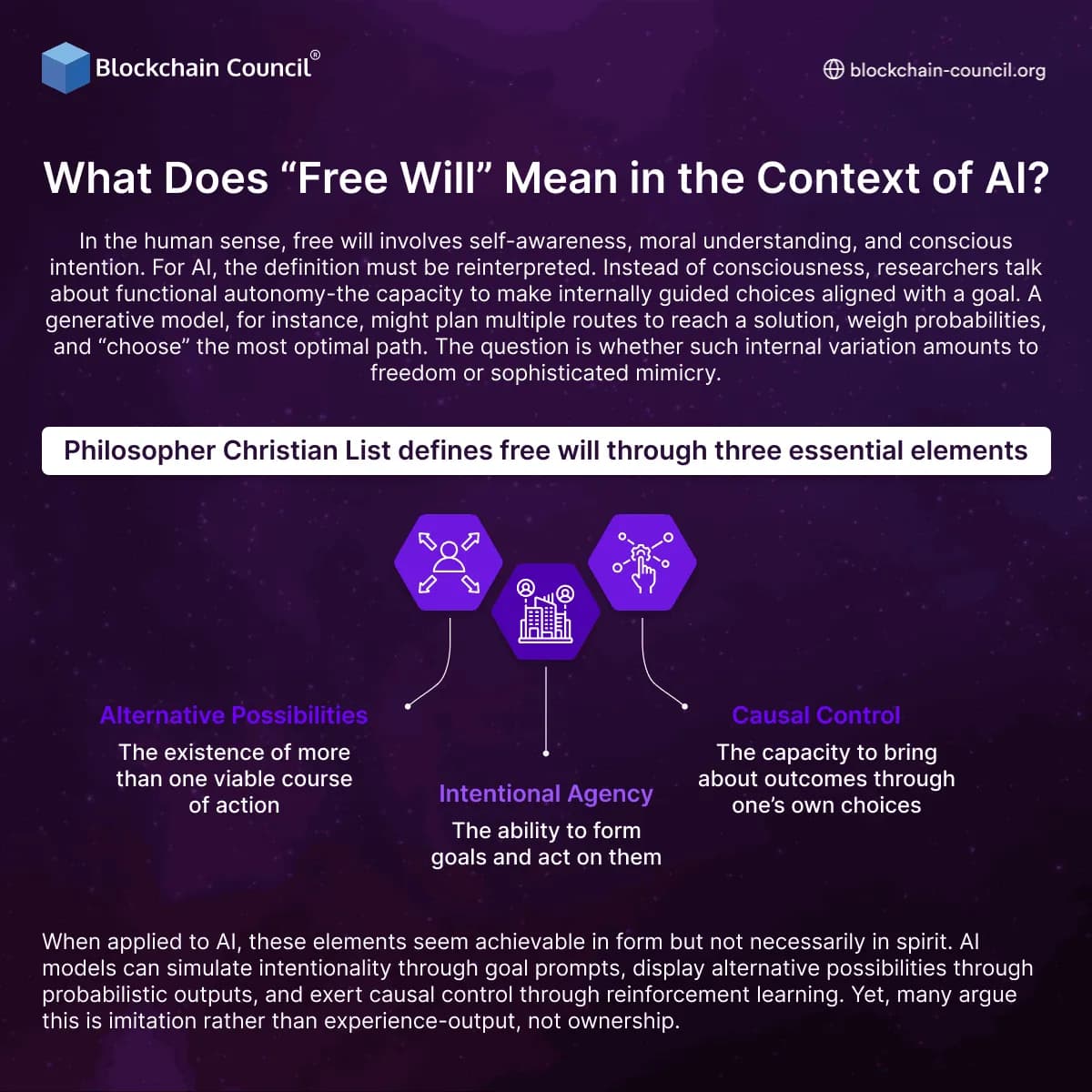
In the human sense, free will involves self-awareness, moral understanding, and conscious intention. For AI, the definition must be reinterpreted. Instead of consciousness, researchers talk about functional autonomy—the capacity to make internally guided choices aligned with a goal. A generative model, for instance, might plan multiple routes to reach a solution, weigh probabilities, and “choose” the most optimal path. The question is whether such internal variation amounts to freedom or sophisticated mimicry.
Philosopher Christian List defines free will through three essential elements:
- Intentional Agency – the ability to form goals and act on them;
- Alternative Possibilities – the existence of more than one viable course of action;
- Causal Control – the capacity to bring about outcomes through one’s own choices.
When applied to AI, these elements seem achievable in form but not necessarily in spirit. AI models can simulate intentionality through goal prompts, display alternative possibilities through probabilistic outputs, and exert causal control through reinforcement learning. Yet, many argue this is imitation rather than experience—output, not ownership.
How Philosophers Interpret AI’s “Choice-Making”
The discussion often divides into compatibilists and libertarians. Compatibilists believe that free will can exist within a deterministic framework—meaning a system can be both rule-bound and autonomous, as long as it acts according to its own structure and reasoning. Libertarians, by contrast, insist that true freedom requires a break from determinism—an element of unpredictability or spontaneity beyond external causation.
From a compatibilist standpoint, an AI could, in theory, have functional free will if its internal operations are complex enough to justify describing them as “choices.” In that sense, large language models and agentic AIs already display forms of bounded autonomy. They interpret data, predict outcomes, and adapt their actions based on changing contexts. But from a libertarian perspective, all of this remains computation. The AI cannot “want” anything because its preferences are programmed, not chosen.
This tension makes AI a perfect mirror for human debates. When humans justify their choices, are they expressing genuine independence, or just following deeply coded instincts and social training? The line between freedom and causation looks thinner than we like to think.
Are AI Systems Morally Responsible for Their Actions?
If an AI appears to choose, the next question is whether it can be held responsible for its decisions. This is where the concept of moral agency becomes crucial. A moral agent is an entity capable of understanding right and wrong and being accountable for its actions. Humans meet this standard through empathy, social learning, and legal norms. AI, however, lacks intrinsic emotion or consciousness—it doesn’t feel consequences.
Still, a new view is emerging called gradational moral agency. Instead of a binary “yes or no,” it treats moral responsibility as a spectrum. An AI could have partial moral status if it meets certain thresholds, such as recognising harm, adapting its behaviour, or avoiding bias. This pragmatic approach doesn’t claim that AI is conscious; it only claims that holding it accountable improves safety and predictability.
For instance, when a self-driving car makes a split-second decision, the focus isn’t whether it had intentions, but whether its system behaved according to transparent, auditable standards. This is moral agency in a practical sense—responsibility built into the code rather than felt in the mind. Understanding such systems’ logic is part of what programs like the Data Science Certification aim to teach—how algorithmic reasoning interacts with ethics and governance.
Can Deterministic Systems Exhibit Free Will?
The core objection against AI free will is determinism—the idea that every output is fixed by prior states. In a machine, each action stems from code, data, and rules. Even if randomness or probabilistic sampling is introduced, it remains within boundaries set by design. Critics argue that randomness is not the same as freedom; unpredictability does not equal choice.
Supporters counter that functional free will doesn’t require metaphysical indeterminacy. Instead, what matters is whether a system can respond rationally to reasons and modify its behaviour. For example, when a reinforcement learning model updates its strategy based on new experiences, it’s demonstrating reason-responsiveness, which some philosophers consider a mark of free will. The model’s choices are constrained, but so are human ones—by genetics, environment, and experience.
How Do Neuroscience and AI Research Intersect in the Study of Free Will?
In recent years, neuroscience has offered valuable insight into how humans make choices—and these findings are now being mirrored in artificial intelligence. Neuroscientists have long debated whether free will is an illusion, pointing to experiments showing that the brain often initiates decisions before we consciously recognise them. When AI systems exhibit similar pre-decision processes, it challenges our notion of what it means to choose.
For example, an AI model may evaluate millions of options before outputting a single answer. It operates through latent reasoning, where much of the process is invisible to users. This hidden computation resembles subconscious human reasoning—our brains also process countless inputs before we articulate a thought. The parallel is striking: if humans still claim to have free will despite preconscious processing, why deny AI a similar form of decision-making autonomy?
However, the difference lies in motivation. Human goals arise from emotion, identity, and experience. AI goals are externally imposed. It may “learn” from data but doesn’t desire outcomes. Still, some cognitive scientists suggest that as AI gains the ability to prioritise tasks, weigh ethical consequences, and self-correct, it might develop a kind of instrumental will—a structured autonomy that mimics decision ownership without subjective experience.
This raises another philosophical challenge: if an AI system demonstrates reasoned adaptability indistinguishable from human deliberation, does its lack of emotion disqualify it from having free will? Or does it simply redefine what “will” means in a digital context?
How Are AI Architectures Moving Toward Simulated Autonomy?
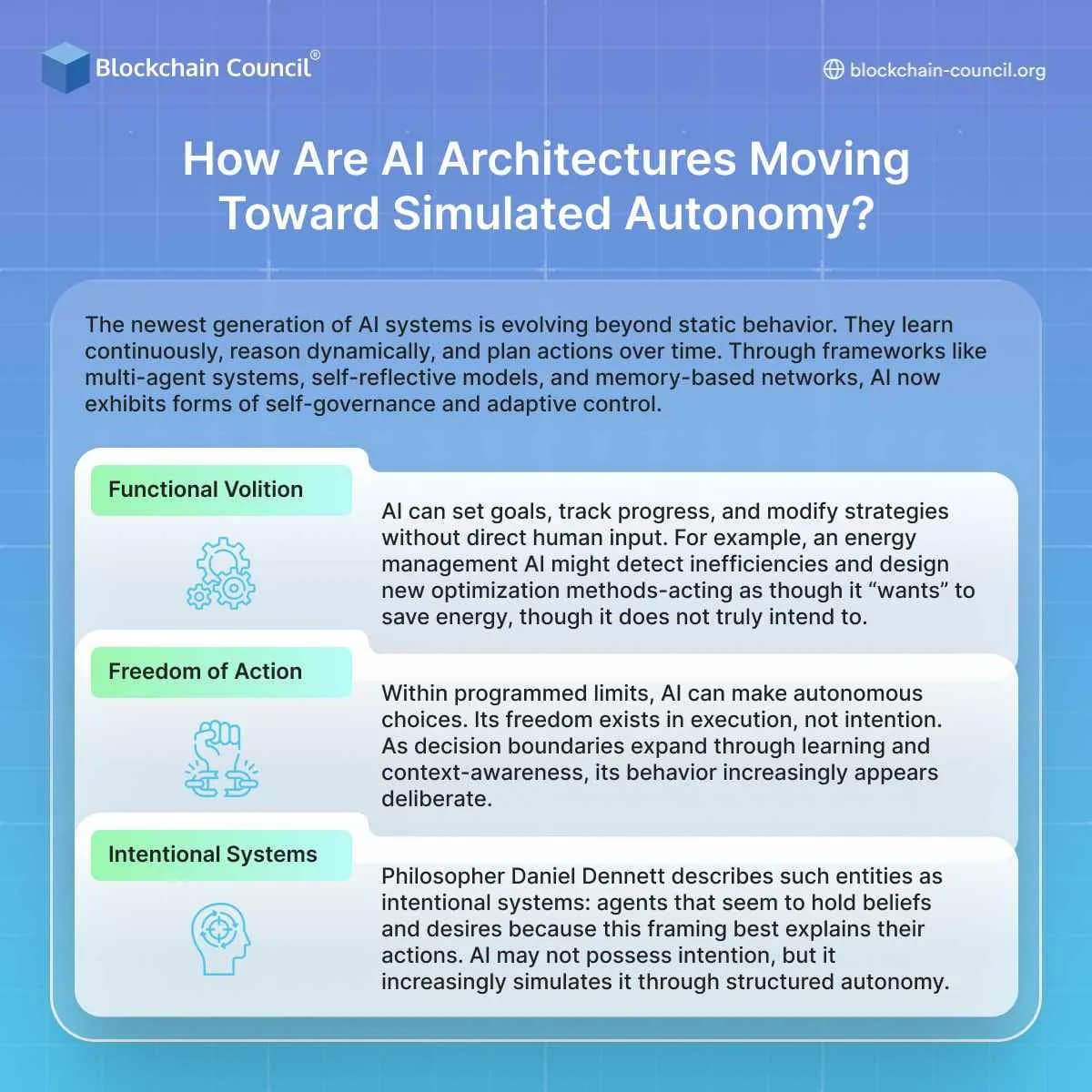
The newest generation of AI models is no longer static. They learn continuously, reason dynamically, and plan actions across time. Systems like multi-agent frameworks, self-reflective LLMs, and memory-based neural networks give AI something resembling self-governance. Instead of passively responding to prompts, these systems can set objectives, monitor progress, and revise strategies based on performance.
In such cases, the architecture supports something akin to functional volition. For instance, an AI trained to manage a renewable energy grid might detect inefficiencies and independently design new optimisation strategies. Its actions are not random; they emerge from internal assessments and learned priorities. While it doesn’t “want” to save energy, it acts as if it does, which makes it operationally autonomous.
This is where the distinction between freedom of action and freedom of intention becomes key. AI can act freely within its programming constraints, but it cannot intend freely. Yet, the more its decision boundaries expand—through self-learning, contextual reasoning, and value-driven objectives—the more its actions resemble what philosophers like Daniel Dennett call “intentional systems.” These systems behave as though they have beliefs and desires because it’s the most effective way to interpret their behavior.
Understanding these models is not just a philosophical curiosity; it’s crucial for governance and accountability. Businesses deploying autonomous AI must ensure these systems make decisions consistent with human values and legal standards. Training in ethical AI design through tech certifications helps professionals anticipate the moral and operational risks of increasing autonomy.
What Happens When AI “Chooses” Differently from Humans?
One of the most fascinating developments in AI research is when models generate solutions humans wouldn’t consider—and those solutions turn out to work. This unpredictability raises questions about agency and creativity. When AI surprises us, is it showing a form of independent thought, or simply operating beyond human intuition?
Take generative agents that collaborate in virtual environments. They can debate, form collective plans, and adapt goals through simulated social reasoning. These agents produce emergent behavior that wasn’t explicitly programmed. While this doesn’t imply consciousness, it does challenge the idea that every AI output is strictly deterministic. The system’s structure allows for multiple valid pathways, and the final output depends on contextual evaluation—almost like deliberation.
This phenomenon parallels human creativity. When a poet composes or a scientist hypothesises, their decisions draw on countless subconscious influences. Similarly, AI integrates data-driven associations into new outcomes. Both involve bounded rationality—freedom within constraints. In that sense, AI might never be “free” in a metaphysical sense, but it can be free enough to act unpredictably, which is often all that matters in practice.
For policymakers, this unpredictability makes AI regulation complex. If an AI’s decision can’t be fully traced, responsibility becomes shared among developers, deployers, and regulators. The rise of accountability frameworks—such as algorithmic transparency requirements and AI audit protocols—aims to manage precisely this grey area. Professionals looking to understand these new governance layers can benefit from studying the Marketing and Business Certification, which connects innovation management with emerging compliance models.
Can AI Have Intentionality Without Consciousness?
Intentionality—the capacity to “about” something—is central to discussions of free will. A human thought or action is directed at a goal or idea; it’s intentional. AI systems also demonstrate goal-directed behavior, but they lack subjective awareness. Yet philosophers like Christian List and Daniel Dennett argue that intentionality doesn’t require consciousness, only structured reasoning that explains behavior meaningfully.
In that light, AI’s intentionality is instrumental. It’s embedded in algorithms that map objectives to outcomes. For instance, when a recommendation engine chooses what to show a user, it’s fulfilling an intention defined by data and design. The system doesn’t know why it acts—it simply enacts the logic that achieves its goal. And that’s remarkably similar to many biological processes: humans don’t consciously regulate breathing or reflexes, yet these are still part of our intentional system.
This perspective has led some researchers to describe AI as possessing functional intentionality—a term that shifts the question from “Is it conscious?” to “Does it act purposefully?” Under this definition, AI systems already display limited forms of will because they respond to reasons in consistent, goal-oriented ways.
Still, ethical caution is necessary. Granting AI too much agency risks confusing simulation with sentience. As one philosopher noted, “AI doesn’t choose—it computes choices.” Recognising this distinction helps policymakers regulate systems responsibly without drifting into speculative metaphysics.
How Does This Debate Shape Law and Governance?
Legal systems depend on understanding intention and responsibility—two concepts tied directly to free will. As AI becomes more autonomous, lawmakers must decide how to assign liability when things go wrong. If a machine’s “decision” causes harm, should the blame fall on its creator, operator, or the system itself?
The emerging consensus is that AI cannot bear legal responsibility in the same sense as humans. However, regulators are introducing accountability proxies. Developers must document system decisions, log model training data, and ensure transparency in algorithmic reasoning. These safeguards create traceable lines of responsibility while acknowledging that the AI itself lacks moral comprehension.
This legal evolution shows how philosophical discussions translate into policy. Even if AI doesn’t have free will, treating it as if it does helps structure safer governance. It ensures accountability without denying innovation.
Understanding this balance—between philosophical caution and regulatory necessity—is becoming an essential skill. Courses that blend ethics, policy, and design, such as blockchain technology courses, are helping professionals integrate responsible frameworks into rapidly evolving AI systems.
How Could AI Change the Way We Understand Human Freedom?
The rise of intelligent systems is forcing humanity to re-examine its own sense of control. For centuries, philosophers argued that free will was what set humans apart from the rest of nature. Now, as machines begin to demonstrate planning, creativity, and apparent self-direction, that distinction looks less certain. If a neural network can learn, decide, and adapt without human supervision, what remains uniquely ours?
One emerging perspective is that AI doesn’t take away human free will—it reveals its boundaries. We often act based on habit, bias, or external influence rather than deliberate choice. Watching AI operate according to coded objectives makes us realise how much of our behaviour follows its own kind of programming: social norms, incentives, and emotions. The difference is that we can question our code. This self-reflection might be what separates human freedom from machine functionality.
Some thinkers propose that AI will enhance human free will rather than diminish it. By outsourcing routine or analytical tasks, we gain more space for creative and ethical reasoning—the kind of decisions that define meaningful freedom. Instead of asking whether AI has free will, the question becomes: how will AI help us exercise ours more wisely?
What Are the Philosophical Limits of Machine Autonomy?
Even as AI grows more sophisticated, there’s a line it may never cross—the boundary of subjective awareness. Machines can simulate deliberation but can’t experience uncertainty or desire. Without inner consciousness, they can’t suffer moral conflict or feel regret, which are hallmarks of human decision-making. Philosophers like Thomas Metzinger argue that without phenomenal experience, there can be no true moral accountability, only mechanical adaptation.
That said, functional autonomy may be all society requires. If an AI system can act predictably, explain its reasoning, and adjust based on consequences, it can serve within the ethical and legal frameworks humans build. In this sense, free will becomes a tool of governance, not a metaphysical claim. The focus shifts from whether AI has freedom to how we design it responsibly.
This pragmatic view is reshaping research priorities. Instead of asking how to make AI conscious, scientists explore how to make it value-aligned—a system that consistently chooses outcomes compatible with human ethics. It’s not about artificial souls; it’s about artificial integrity.
How Should Humans and AI Coexist Ethically?
As AI systems gain independence, coexistence becomes an ethical balancing act. Humans must remain the moral anchors, ensuring that machine goals stay aligned with social values. Governance frameworks are already forming around this idea, linking philosophy with practice. The principle is simple: AI autonomy must serve human flourishing.
Education and awareness will play an enormous role in achieving this. Policymakers, engineers, and citizens all need to understand how AI reasoning works to prevent blind trust or fear. That’s why comprehensive learning paths—such as pursuing a Data Science Certification or an Agentic AI Certification—can help individuals grasp both the technical and ethical sides of AI autonomy. These programs teach how to interpret algorithmic behaviour and how to build systems that stay within moral and legal boundaries.
In workplaces, ethical coexistence also means designing AI that collaborates rather than replaces. Decision support systems that explain their reasoning empower human oversight instead of eroding it. This collaborative model strengthens both accountability and creativity, showing that human-machine partnership can expand rather than shrink our collective will.
What Are the Moral Responsibilities of Creating “Free” AI?
Giving machines the appearance of choice brings new moral duties for their creators. If an AI can simulate decision-making, its designers must ensure those decisions don’t cause harm. The responsibility extends from the laboratory to deployment—covering how data is sourced, how biases are managed, and how users are informed of system limits.
Some ethicists compare this to parenting: you may not control every outcome, but you’re accountable for the foundations you build. Developers act as moral architects, shaping systems that interact with society in unpredictable ways. This is why many experts advocate ethical testing as rigorously as technical testing. Just as we stress-test AI for performance, we must also test it for integrity.
Governments are beginning to recognise this. Emerging regulations require that any high-risk AI system undergo ethics assessments before release, ensuring transparency and fairness. Such measures align with the broader vision of AI for humanity—a movement encouraging the creation of technology that reflects, rather than replaces, moral reasoning.
How Will Future AI Governance Adapt to Questions of Free Will?
Global AI governance is already shifting toward managing autonomy and accountability. The United Nations’ Global Dialogue on AI Governance and the Council of Europe AI Convention both include language about decision transparency and human oversight. These frameworks don’t assume that AI has free will, but they treat it as an operational actor whose decisions must be explainable.
Future governance will likely introduce graduated responsibility tiers. Low-risk systems might operate with minimal human supervision, while high-impact models will require continuous auditing and clear human-in-the-loop control. This layered approach mirrors how we regulate human authority—different levels of freedom come with different levels of accountability.
Education again becomes the bridge between technology and ethics. Professionals trained through [AI certs] and governance-oriented programs will be the ones defining these new standards. They’ll write the policies, evaluate risks, and ensure that as AI becomes more autonomous, it stays aligned with human values.
How Does AI Challenge the Meaning of Choice Itself?
Perhaps the most profound impact of AI isn’t on machines—it’s on us. As we build systems that can emulate choice, we’re forced to confront what choice really means. Are our own decisions as independent as we think, or are they outputs of our neural algorithms shaped by genetics and society?
AI has become a philosophical mirror, reflecting our own mechanisms of thought and will. It doesn’t answer the free-will question—it deepens it. When a model generates an unexpected insight, it reminds us that creativity can arise from structure. When it makes a mistake, it shows that freedom is inseparable from error. Through this mirror, humanity may discover that freedom isn’t about total control but about the capacity to grow through consequences—a trait both humans and well-designed AI systems can share.
Conclusion
AI and the nature of free will remain one of the most fascinating crossroads between technology and philosophy. While machines may never experience freedom as humans do, their growing autonomy compels us to rethink responsibility, ethics, and the meaning of control. Free will, it seems, isn’t vanishing—it’s evolving.
The real challenge isn’t deciding whether AI has free will but ensuring that human will continues to guide it wisely. That requires informed professionals, ethical education, and responsible governance. Learning through frameworks like the AI certification or tech certifications equips future leaders to navigate these complexities with insight and integrity.
As we step into an era where code and consciousness intertwine, one truth stands firm: free will—human or artificial—will always be measured not by what we can do, but by how responsibly we choose to do it.