AI in Predicting Economic Trends
 Michael Willson
Artificial intelligence is transforming how we understand and forecast the economy. For decades, economists relied on traditional models that used historical data and linear equations. Today, AI systems can scan huge amounts of information, including text, numbers, and even news updates, to spot patterns and predict economic changes faster and often more accurately than older methods. This shift matters for everyone, from policymakers and banks to businesses and individuals trying to make financial decisions. If you want to prepare for this AI-driven future, you can explore an AI certification that helps you learn how these tools work in practice.
Why AI Matters in Economic Forecasting
AI is important in predicting economic trends because it can handle complexity better than traditional forecasting methods. Economic data is messy. It is updated, revised, delayed, and influenced by countless global factors. Older models struggle when unexpected shocks or non-linear changes appear. AI models, on the other hand, can process different kinds of data at once. For example, they can mix time-series data like inflation rates with unstructured sources such as financial news articles or CEO statements. This ability gives AI a clear edge in spotting signals early.

Faster, Richer Predictions
One major strength of AI is speed. AI models update quickly when new information arrives. Instead of waiting for quarterly reports, central banks and businesses can adjust decisions using fresh inputs like consumer sentiment or real-time supply chain signals. This makes forecasts more responsive and useful in fast-moving markets.
From Global to Local Insights
AI tools can scale across levels. They are used to project global growth, but they can also zoom in to forecast trends for a single sector or region. This flexibility helps governments prepare policies for specific industries and allows businesses to plan with more precision.
How AI Is Used in Economic Trend Prediction
AI is not one single tool. It covers many approaches and models, each suited to different tasks. Let’s look at the main ways AI is applied in forecasting economic trends today.
Macroeconomic Indicators
AI is used to forecast classic indicators such as GDP growth, inflation, and unemployment. Machine learning models like gradient boosting or random forests learn from decades of data, but unlike older econometric models, they can adapt to unexpected changes. For example, an AI model can adjust when supply chains are disrupted or when global energy prices spike.
Sentiment and Expectations
Generative AI systems can read thousands of corporate disclosures, news reports, or even social media posts. From this, they extract what managers, investors, and consumers are expecting. A study introduced something called an “AI Economy Score” by parsing transcripts and linking them to future economic activity. These insights are valuable because sentiment often moves markets before hard data catches up.
Commodity Prices and Shocks
AI also helps predict price movements in oil, gas, and other commodities. A recent model combined structured time-series data with semantic embeddings from news articles. The result was better performance in predicting shocks, such as sudden jumps or drops in commodity prices. These improvements are vital for countries and industries that rely heavily on imports or exports.
Financial Forecasting
Businesses use AI to predict their own financial futures. This includes forecasting revenue, cash flow, and liquidity. By detecting unusual patterns in payments or expenses, AI can act as an early warning system against risks. Finance teams no longer just look at spreadsheets; they also use AI to run scenarios and prepare for different outcomes.
Policy and Central Banks
Central banks need accurate forecasts to set interest rates and guide monetary policy. AI models help them refine projections by incorporating larger datasets and real-time updates. For example, inflation projections can improve when models include online retail prices or high-frequency transaction data.
Recent Advances in AI for Forecasting
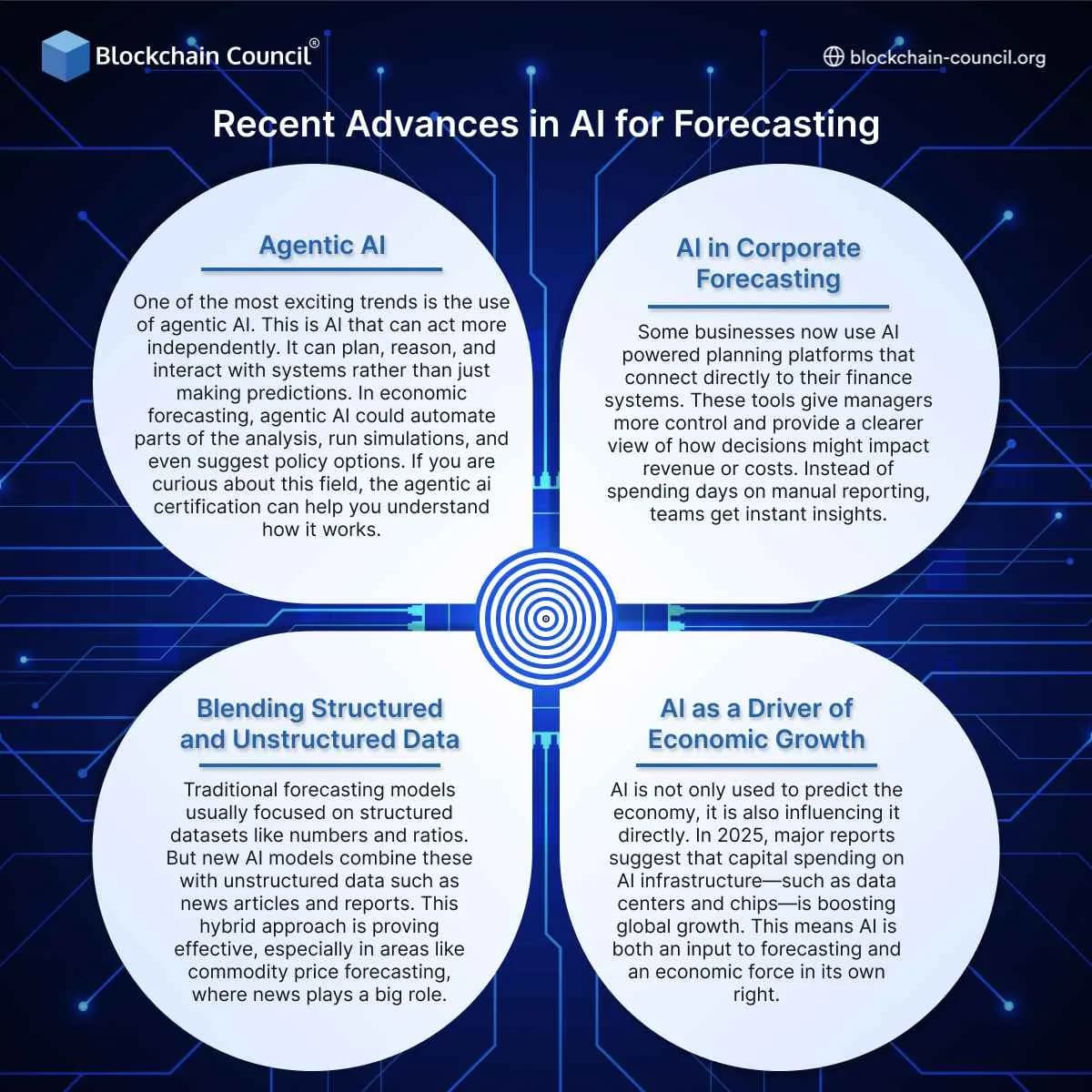
AI’s role in forecasting is evolving quickly. Several new advances stand out and are shaping the next wave of adoption.
Agentic AI
One of the most exciting trends is the use of agentic AI. This is AI that can act more independently. It can plan, reason, and interact with systems rather than just making predictions. In economic forecasting, agentic AI could automate parts of the analysis, run simulations, and even suggest policy options. If you are curious about this field, the agentic ai certification can help you understand how it works.
Blending Structured and Unstructured Data
Traditional forecasting models usually focused on structured datasets like numbers and ratios. But new AI models combine these with unstructured data such as news articles and reports. This hybrid approach is proving effective, especially in areas like commodity price forecasting, where news plays a big role.
AI in Corporate Forecasting
Some businesses now use AI-powered planning platforms that connect directly to their finance systems. These tools give managers more control and provide a clearer view of how decisions might impact revenue or costs. Instead of spending days on manual reporting, teams get instant insights.
AI as a Driver of Economic Growth
AI is not only used to predict the economy, it is also influencing it directly. In 2025, major reports suggest that capital spending on AI infrastructure—such as data centers and chips—is boosting global growth. This means AI is both an input to forecasting and an economic force in its own right.
Benefits of Using AI for Economic Trends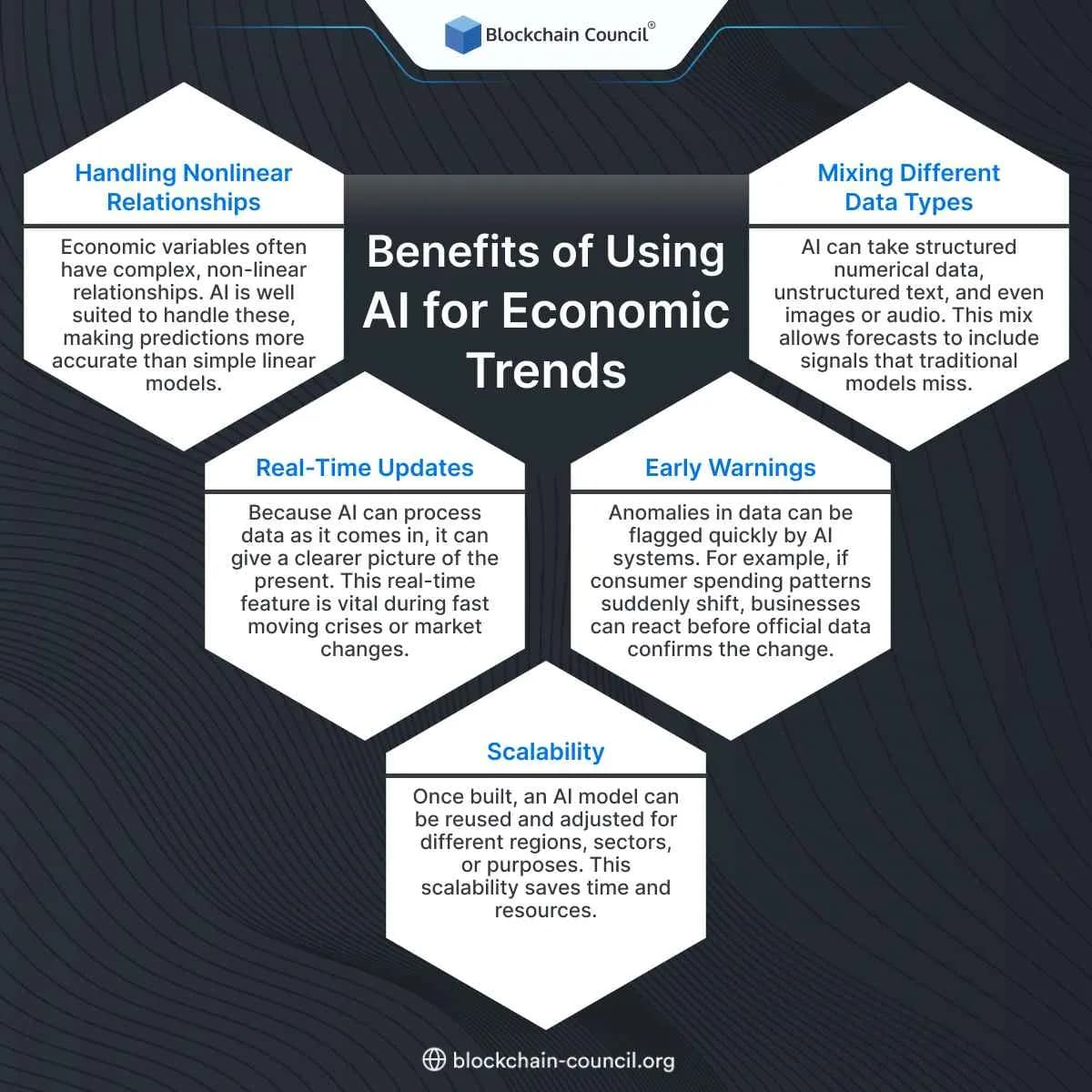
The advantages of AI in forecasting extend across multiple areas.
Handling Nonlinear Relationships
Economic variables often have complex, non-linear relationships. AI is well-suited to handle these, making predictions more accurate than simple linear models.
Real-Time Updates
Because AI can process data as it comes in, it can give a clearer picture of the present. This real-time feature is vital during fast-moving crises or market changes.
Mixing Different Data Types
AI can take structured numerical data, unstructured text, and even images or audio. This mix allows forecasts to include signals that traditional models miss.
Early Warnings
Anomalies in data can be flagged quickly by AI systems. For example, if consumer spending patterns suddenly shift, businesses can react before official data confirms the change.
Scalability
Once built, an AI model can be reused and adjusted for different regions, sectors, or purposes. This scalability saves time and resources.
Challenges and Risks of Using AI in Economic Forecasting
While the benefits are clear, AI in predicting economic trends is not without challenges. Understanding these limits is just as important as celebrating the progress, especially when forecasts are used to make decisions that affect millions of people.
Data Quality and Bias
Economic data is often messy. Numbers are revised months later, surveys are incomplete, and international statistics are sometimes inconsistent. AI models are only as good as the data they are trained on. If the data contains gaps or errors, the predictions will too. Bias also creeps in when certain countries or industries have richer data than others. This can skew forecasts toward developed economies while underestimating the reality of emerging markets.
Overfitting and Model Drift
AI models excel at finding patterns, but they can also become too focused on historical quirks that may not repeat. This is called overfitting. Another issue is model drift, where the relationships between variables change over time. For example, consumer spending habits before the pandemic looked very different from those during and after. A model that fails to adjust may deliver outdated forecasts.
Interpretability and Trust
One of the biggest criticisms of AI in economics is that many models are black boxes. Policymakers, investors, and the public often need to know why a forecast is pointing in a certain direction. Without clear explanations, trust in AI predictions can drop, even if the model is statistically accurate. This is why explainability tools are gaining importance in AI forecasting.
Causal Inference
AI models are great at spotting correlations, but correlation does not always mean causation. For example, an AI model may notice that search engine activity for vacation bookings rises before GDP growth in certain regions. While the link is useful, it does not prove that one causes the other. Economists and policymakers need to be careful not to base decisions on correlations alone.
Costs and Infrastructure
Building and maintaining advanced AI models requires strong computing infrastructure. Training models on massive datasets can be expensive, and the costs of storing and processing this data add up. Smaller governments or organizations may not have the resources to compete with large institutions or corporations.
Regulation and Governance
When AI models influence policy or financial decisions, regulation becomes essential. There is a need for guidelines on how forecasts are built, audited, and used. Without clear governance, the risk of misuse or over-reliance on flawed models increases.
Gaps in Current AI Forecasting Approaches
Even with recent progress, there are gaps that present opportunities for improvement.
Regional and Local Forecasting
Much of the AI work in forecasting is focused on national or global data. Yet, economic shifts often start locally. A sudden downturn in a city’s housing market, for example, can ripple outward. More work is needed to build accurate models at local and regional levels.
Sector-Specific Insights
AI models often generalize across the whole economy. But industries like manufacturing, retail, and healthcare each follow their own patterns. Developing sector-specific forecasting models could provide businesses with more actionable insights.
Climate and Sustainability
The link between the economy and climate change is becoming stronger, but many AI forecasting models ignore environmental factors. Integrating climate signals, such as carbon emissions data or renewable energy growth, could create more realistic long-term predictions.
Black Swan Events
Extreme events like financial crises or global pandemics remain a weak spot. AI models trained on historical data may not handle these rare shocks well. Building resilience into forecasting systems remains a key challenge.
Ensemble Approaches
Evidence from international forecasting competitions shows that ensembles—combinations of models—often outperform single models. However, this approach is not yet fully mainstream in economic forecasting with AI.
Opportunities for Professionals and Businesses
The rise of AI in forecasting creates opportunities for individuals and organizations to upskill and adapt.
Learning and Certifications
If you want to build a career in this space, structured learning can help. An AI certification equips professionals with the skills needed to apply AI models in forecasting and decision-making. For those working with broader analytics, a Data Science Certification gives the foundation for handling datasets, algorithms, and machine learning workflows.
Business Growth and Strategy
Leaders looking to integrate AI into their planning can benefit from a Marketing and Business Certification. This provides guidance on how to apply AI in growth strategies, including understanding customer demand and adjusting campaigns based on predicted economic conditions.
Specialized Tech Pathways
AI is only part of the bigger landscape of tech certifications. For those focusing on AI forecasting, pairing knowledge with other domains such as cloud systems or cybersecurity makes professionals more versatile. Similarly, as financial institutions use AI alongside blockchain for transparency and security, professionals can explore blockchain technology courses to widen their scope.
Understanding New Tools
Agentic AI is one of the fastest-growing areas. It promises more autonomy, reasoning, and real-world application. Getting hands-on experience through training such as the agentic ai certification will prepare professionals to work with the next generation of forecasting tools.
How Businesses Are Applying AI Forecasting
Organizations across industries are already embedding AI forecasting in their workflows.
Retail
Retailers use AI to predict consumer spending patterns and adjust supply chains. Real-time insights into what customers want help reduce excess inventory and improve profit margins.
Banking and Finance
Banks deploy AI to detect anomalies in payments and forecast liquidity risks. Investment firms also use it to project market shifts and to guide portfolio management.
Government and Policy
Central banks and finance ministries are turning to AI to refine their inflation and employment forecasts. More accurate data helps them avoid mistakes in setting interest rates or designing stimulus packages.
Energy and Commodities
Energy companies use AI to forecast oil and gas demand. When combined with news analysis, the forecasts improve resilience against shocks like sudden price drops.
The Role of Technology and Education
As AI becomes more central to forecasting, education is key. Learning platforms such as technology academies and specialized councils offer training paths for professionals. They not only cover AI but also the systems that support it, such as data engineering, analytics, and blockchain integration. This ensures that professionals stay updated with both technical and economic skills.
The Future of AI in Predicting Economic Trends
The use of AI in forecasting is still developing, and the next few years will bring new directions that make predictions even more reliable and accessible. Looking ahead, it is clear that AI will not only support economists but also reshape how ordinary people and businesses interact with data.
Integration with Everyday Tools
One of the most likely changes is that AI forecasting will become part of everyday software. Just as we now use AI in emails, search engines, and virtual assistants, forecasting models will be built into financial dashboards, business planning apps, and even government portals. This will make economic forecasting less of a specialist tool and more of a standard feature that decision-makers can access without advanced training.
Combining AI with Human Expertise
Although AI models are powerful, they cannot replace the need for human judgment. Economists provide context, historical understanding, and caution that machines alone cannot deliver. The future will likely focus on human-AI collaboration, where experts use AI to handle the heavy lifting of data processing while they focus on interpretation and decision-making.
Ethical and Social Questions
As AI predictions begin to shape policies, investments, and even public expectations, the ethical side will become more important. Questions such as who owns the models, who ensures fairness, and how transparency is guaranteed will grow louder. Without clear answers, trust in AI systems may decline. The role of regulators will be crucial in setting boundaries that keep forecasting both useful and fair.
Expanding to Climate and ESG Forecasting
Economic forecasting is closely tied to environmental and social issues. The coming years will see stronger connections between climate data and economic predictions. AI will likely forecast how climate risks, such as rising sea levels or extreme weather, impact supply chains, housing markets, and long-term growth. At the same time, environmental, social, and governance (ESG) metrics will enter mainstream forecasting models.
Robustness in Crisis Scenarios
The pandemic highlighted that black swan events can break traditional forecasting systems. Future AI forecasting must be tested against extreme events to ensure that models can adapt rather than collapse. Advances in simulation, scenario modeling, and reinforcement learning may provide resilience in these moments.
Case Studies Highlighting AI’s Impact
To make these ideas more concrete, it helps to see examples where AI forecasting has already shown measurable benefits.
Central Bank Forecasting
Some central banks have begun experimenting with AI-driven models to improve inflation forecasts. By adding online retail price data and consumer behavior signals, these banks have managed to improve the timeliness and accuracy of their predictions, allowing better adjustments to interest rates.
Commodity Markets
AI systems have been deployed to forecast sudden oil price shocks. Models that combine historical pricing with news sentiment have correctly flagged upcoming volatility, helping energy companies and governments adjust stockpiles in advance.
Corporate Planning
Large multinational firms use AI-powered planning platforms to forecast revenue streams across countries. Instead of static reports, these platforms continuously update projections as new sales and market data arrive. This dynamic approach gives executives a clearer view of risks and opportunities.
Public Policy
In some countries, AI models analyze employment data alongside online job postings and training programs. The goal is to forecast skills shortages before they appear, giving policymakers the chance to design better education and training programs.
Learning Opportunities in AI Forecasting
As AI forecasting spreads, professionals from finance, business, and policy will need skills to understand and apply these tools.
- An AI certification is a strong starting point for anyone wanting to learn how to build and use predictive models.
- For those focusing on analytics more broadly, the Data Science Certification provides the background needed to manage data pipelines and machine learning workflows.
- Business leaders looking to integrate AI into growth strategies will find the Marketing and Business Certification useful for linking forecasts to customer demand and strategic planning.
- As AI tools overlap with blockchain in areas like secure data handling and transparency, blockchain technology courses open paths for professionals who want to combine both fields.
- More specialized tech certifications also help build a broad base of knowledge, covering not only AI but also the systems needed to make it work at scale.
- For professionals focused on the cutting edge, the agentic ai certification is key to understanding how autonomous AI agents will reshape forecasting and planning.
Together, these pathways help individuals stay ahead as AI transforms economic forecasting.
Final Takeaway
AI in predicting economic trends is no longer a research experiment. It is shaping the way central banks set policy, how businesses plan their strategies, and how markets respond to shocks. While challenges like bias, data quality, and interpretability remain, the benefits of speed, scalability, and deeper insights are already clear. For professionals, this shift means learning new skills and exploring structured pathways such as AI certs to stay ahead. For society, it means that decisions shaping the economy will increasingly be informed by models that are faster, smarter, and more adaptive than anything we have used before.
By combining structured and unstructured data, preparing for extreme events, and ensuring transparency, AI forecasting will become a trusted partner in guiding economies through uncertain times. For those ready to adapt, opportunities are wide open to build careers, businesses, and policies that thrive in an AI-powered world.