

AI in Conflict Resolution and Peacebuilding
 Michael Willson
What Is AI in Conflict Resolution and Peacebuilding?
AI in conflict resolution and peacebuilding means using artificial intelligence tools to predict, prevent, and reduce violence while also helping communities build long-term peace. From early warning systems to digital dialogue platforms, AI is now entering spaces that were once only handled by human negotiators, diplomats, and peacebuilders. The reason is simple: AI can analyze large amounts of data faster than people, spot trends that signal potential violence, and even help mediators manage complex discussions.
For professionals looking to understand and apply these tools responsibly, one starting point is pursuing an AI certification. It not only builds technical knowledge but also helps connect technology with real-world governance and peacebuilding needs.

AI in Conflict Resolution
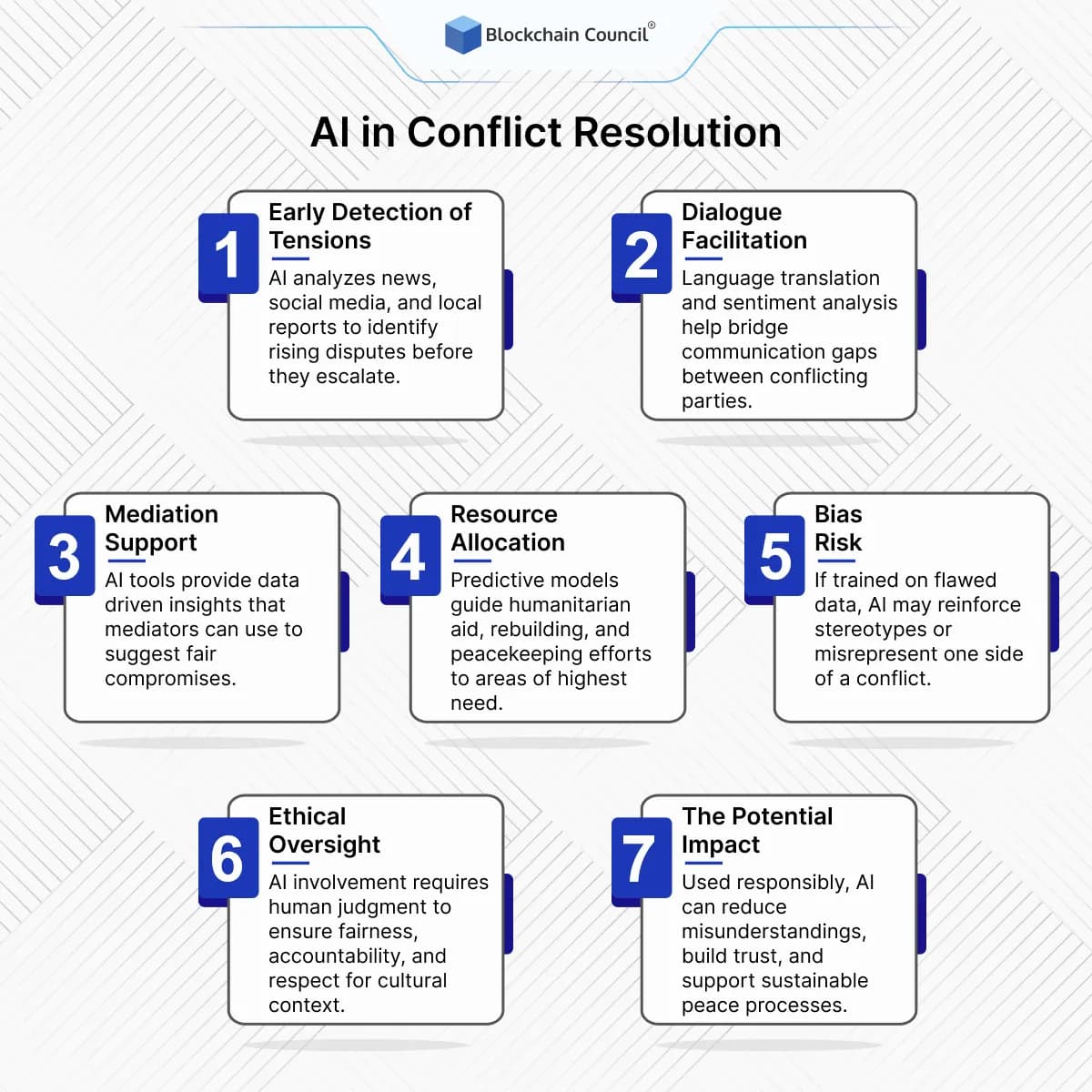
Early Detection of Tensions
AI analyzes news, social media, and local reports to identify rising disputes before they escalate.
Dialogue Facilitation
Language translation and sentiment analysis help bridge communication gaps between conflicting parties.
Mediation Support
AI tools provide data-driven insights that mediators can use to suggest fair compromises.
Resource Allocation
Predictive models guide humanitarian aid, rebuilding, and peacekeeping efforts to areas of highest need.
Bias Risk
If trained on flawed data, AI may reinforce stereotypes or misrepresent one side of a conflict.
Ethical Oversight
AI involvement requires human judgment to ensure fairness, accountability, and respect for cultural context.
The Potential Impact
Used responsibly, AI can reduce misunderstandings, build trust, and support sustainable peace processes.
How Does AI Help in Predicting Conflict?
One of the most promising uses of AI in peacebuilding is conflict prediction. By analyzing huge datasets that include economic indicators, political tensions, and even social media trends, AI models can identify areas where violence is likely to erupt.
Projects like predictive peacebuilding show how spatiotemporal neural networks can forecast conflict risk months or even years in advance. Some models claim to predict patterns of violence up to 36 months ahead. This allows policymakers and aid organizations to act before violence begins, potentially saving lives and resources.
But prediction is not perfect. Data gaps, political bias, and false alarms remain big challenges. If a system predicts violence that does not happen, resources could be wasted. If it misses a real threat, the results could be deadly.
Can AI Support Dialogue Between Communities?
Beyond prediction, AI is also being used in dialogue and mediation. Digital dialogue systems combine human facilitation with AI-driven tools to manage discussions at scale. A Cambridge framework outlines how AI can help structure peace dialogues, support inclusivity, and provide real-time analysis.
One striking case involved peacebuilders from Israel and Palestine. AI-supported dialogue was used to surface common ground and suggest areas of compromise. The technology helped highlight patterns in conversation that humans might overlook, making it easier to move past stalemates.
Of course, risks exist. If AI tools are biased or poorly designed, they can exclude voices, especially from groups with lower digital literacy. Peacebuilding depends heavily on trust, and any sign of manipulation could undermine the entire process.
What Is the Role of Large Language Models in Peacebuilding?
Large language models (LLMs) like ChatGPT, Claude, and Gemini are now being tested for their ability to provide advice in conflict situations. The IFIT Initiative in 2025 gave these systems real-world conflict prompts from Syria, Sudan, and Mexico. The results were underwhelming. Average advice quality scored just 27 out of 100.
This shows that while LLMs can be useful for summarizing information, creating situation reports, or suggesting general ideas, they are not yet reliable for direct mediation or policy advice. Still, researchers see potential in combining LLMs with retrieval-augmented generation (RAG) systems, which pull data from verified conflict databases and news sources. These hybrid models could improve situational awareness while keeping human experts in control.
How Can AI Fight Disinformation in Conflict Zones?
Disinformation is a powerful weapon in fragile states. False stories spread quickly online and can inflame tensions between groups. AI can both worsen and fight this problem. On one hand, AI tools can generate convincing fake content. On the other hand, AI can detect and flag disinformation campaigns, reducing their impact.
Studies by the United Nations University show that AI-driven monitoring tools are already being used in parts of Sub-Saharan Africa to identify harmful online narratives before they spread widely. This helps peacebuilders and governments respond quickly to prevent violence.
Yet there is a thin line. The same monitoring tools can also be misused for surveillance and repression. If governments use AI to silence opposition under the excuse of fighting disinformation, it can damage trust and escalate conflict.
How Is AI Used in Mediation and Negotiation?
In mediation settings, AI is becoming a support tool for professionals. Natural language processing can analyze tone, detect emotions, and identify hidden biases in dialogue. Virtual coaches can help mediators prepare for sessions by testing different scenarios.
For example, peacebuilding organizations are experimenting with AI systems that highlight when a conversation is escalating or when a party is repeating arguments without progress. This allows mediators to adjust their approach in real time.
Still, AI cannot replace human intuition, empathy, or cultural understanding. The best models are those that support mediators without taking over the human role.
What Are the Ethical Risks of AI in Peacebuilding?
AI in peacebuilding is a double-edged sword. While it offers powerful tools, it also creates risks. One of the biggest is bias. If the training data reflects discrimination or unequal power dynamics, the AI will reproduce those patterns. This can silence minority voices and strengthen dominant ones.
Surveillance is another danger. In conflict zones, governments or armed groups could use AI tools meant for peace to instead monitor citizens, track opponents, or justify repression.
Finally, accountability is unclear. If AI-guided mediation fails and leads to harm, who takes responsibility? The developer, the mediator, or the organization deploying the tool? These questions remain unanswered.
This is why experts stress the importance of human rights-centered design. Peace AI must be built with transparency, accountability, and inclusivity at its core. Mediators are exploring tools introduced in a Prompt Engineering Course to apply AI for peacebuilding efforts.
What Frameworks Exist for Responsible AI Peacebuilding?
Frameworks for Responsible AI Peacebuilding
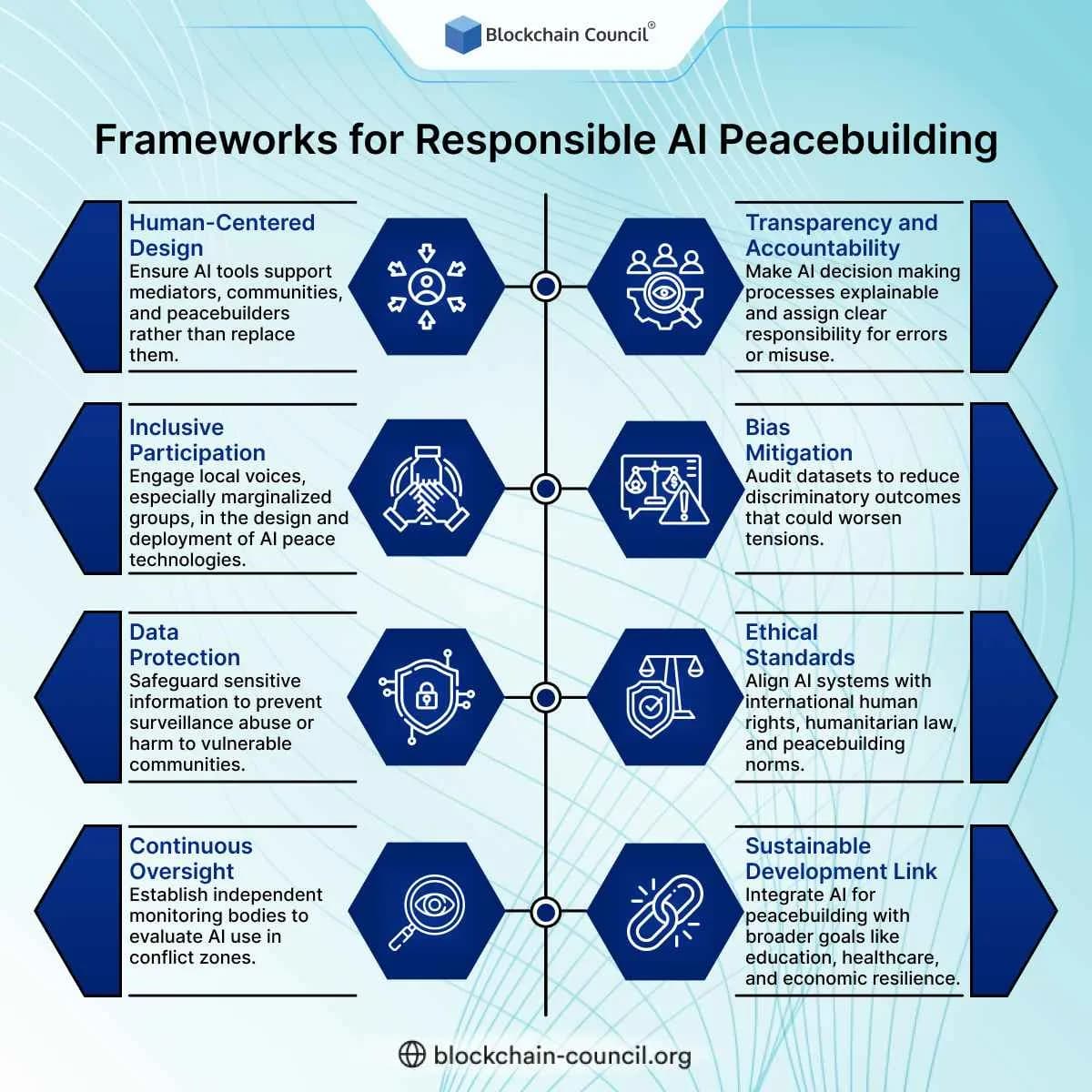
- Human-Centered Design
Ensure AI tools support mediators, communities, and peacebuilders rather than replace them. - Transparency and Accountability
Make AI decision-making processes explainable and assign clear responsibility for errors or misuse. - Inclusive Participation
Engage local voices, especially marginalized groups, in the design and deployment of AI peace technologies. - Bias Mitigation
Audit datasets to reduce discriminatory outcomes that could worsen tensions. - Data Protection
Safeguard sensitive information to prevent surveillance abuse or harm to vulnerable communities. - Ethical Standards
Align AI systems with international human rights, humanitarian law, and peacebuilding norms. - Continuous Oversight
Establish independent monitoring bodies to evaluate AI use in conflict zones. - Sustainable Development Link
Integrate AI for peacebuilding with broader goals like education, healthcare, and economic resilience.
The Goal
AI in peacebuilding must strengthen trust, fairness, and stability, ensuring technology serves peace rather than conflict.
Several frameworks are emerging to guide responsible use. The Cambridge framework proposes context-sensitive taxonomies that match AI tools to the level of digital literacy, scale of dialogue, and inclusivity required. This prevents a one-size-fits-all approach.
Human rights-centered frameworks recommend embedding principles of privacy, non-discrimination, and freedom of expression directly into the design process. Transparency and auditability are emphasized, ensuring that systems can be reviewed and corrected.
Finally, hybrid models are gaining traction. These combine human facilitators with AI tools, letting technology handle data-heavy tasks while humans provide trust, cultural knowledge, and emotional intelligence.
How Do Capacity Gaps Affect Peace AI?
Conflict zones often suffer from weak infrastructure and limited data. This creates a major obstacle for AI-driven peacebuilding. Without reliable internet, digital literacy, or quality datasets, AI tools cannot perform effectively.
This digital divide risks creating a system where only well-resourced actors benefit. To counter this, global initiatives are working on capacity building. Programs to train local peacebuilders in AI tools are growing. For individuals, earning a Data Science Certification is one way to build practical skills that directly support conflict monitoring and prevention.
How Does AI Connect With Business and Development in Peacebuilding?
Peacebuilding is not just about stopping wars. It also involves creating stable conditions for growth. Businesses are central to this process, and AI tools are increasingly being used to understand economic risks in fragile states.
For professionals, this intersection of business, development, and AI governance is where programs like the Marketing and Business Certification become valuable. They prepare leaders to apply AI responsibly while also encouraging sustainable growth in post-conflict environments.
How Do Cultural Perspectives Influence AI in Peacebuilding?
Peacebuilding is never just technical. Culture plays a major role in how people view fairness, trust, and resolution. In some communities, traditional elders or religious leaders are the main mediators. In others, formal courts and negotiations are the norm. AI tools that ignore these differences risk being rejected.
For example, a system trained mainly on Western dialogue practices may not capture the subtle respect-based exchanges common in African or Asian contexts. If people feel their traditions are ignored, they may see AI as an outsider tool. This is why cultural adaptation is critical.
Researchers highlight the need for context-sensitive taxonomies that guide how AI is used depending on local customs, digital literacy, and inclusivity needs. Without this, AI risks creating more division instead of peace.
Why Is Transparency and Accountability Important in Peace AI?
Trust is central to peacebuilding. People in conflict zones are often suspicious of authority, surveillance, and external actors. If AI is introduced without transparency, it can raise suspicion rather than build peace.
Transparency means showing clearly how AI systems work, what data they use, and what their limitations are. Accountability means defining responsibility when things go wrong. If an AI prediction turns out false, or if a digital dialogue excludes a group, someone must take ownership.
Mechanisms like audits, open-source models, and independent evaluations are being proposed. These help build legitimacy, especially in fragile environments where mistakes can have life-or-death consequences.
How Do Humans and AI Work Together in Mediation?
AI cannot replace human mediators. What it can do is support them. Hybrid models are proving most effective: humans bring empathy, cultural understanding, and trust, while AI handles large-scale data analysis, bias detection, and scenario testing.
For example, AI can highlight patterns in dialogue that show when a conversation is escalating. The mediator can then step in with calming strategies. AI can also test “what-if” scenarios to prepare mediators before a session, showing possible outcomes of different approaches.
This partnership ensures efficiency without losing the human touch. The key is designing systems that enhance, not replace, human facilitation.
How Can Blockchain Help in Conflict Resolution?
Blockchain is gaining attention as a supporting technology in peacebuilding. Because blockchain is transparent and tamper-proof, it can be used to track peace agreements, monitor aid delivery, and verify conflict data.
Imagine a peace agreement stored on blockchain. Every party can see the same version, and changes cannot be hidden. This creates accountability and reduces disputes over what was agreed. Similarly, blockchain can be used to track funds or aid in conflict zones, ensuring resources reach the right people.
For anyone interested in applying this, blockchain technology courses offer practical knowledge on how blockchain can link with peacebuilding and AI governance.
What Role Does Technology Training Play in Peacebuilding?
AI systems in conflict resolution require skilled professionals who understand both the technical and the social side of peace. Without proper training, tools may be misused or misunderstood.
This is where education in technology becomes vital. Learning how AI works, how to audit systems, and how to adapt them to local needs helps peacebuilders deploy AI responsibly. It ensures that the benefits of AI reach conflict zones instead of staying limited to well-funded labs or global organizations.
Why Is Agentic AI Important in Conflict Resolution?
Agentic AI — systems designed to act with more autonomy and decision-making power — is starting to enter discussions in peacebuilding. While this is still an emerging field, experts warn that such systems must be carefully controlled.
Used responsibly, agentic AI could support decision-making in crisis response, coordinate humanitarian aid, or monitor ceasefires in real time. But without safeguards, it could also act in ways that escalate conflict.
For professionals preparing to work in this field, the agentic AI certification is a way to gain the skills needed to design and manage these systems responsibly.
How Do Tech Certifications Support Peacebuilders?
Peacebuilding requires cross-disciplinary skills. Mediators may not be data experts, and data scientists may not understand conflict dynamics. Tech certifications help bridge this gap by equipping professionals with both technical knowledge and practical frameworks.
By completing certifications in AI, blockchain, or related areas, peacebuilders show they are ready to use technology responsibly. This strengthens their role in international projects, where proof of expertise is increasingly important.
Can AI Certifications Build Trust in Fragile Contexts?
Certifications do not just build skills. They also build trust. When peacebuilders in conflict zones can show they are trained in global standards, communities may feel more comfortable engaging with AI systems.
This is where AI certs play a role. They provide assurance that the people deploying AI are not experimenting blindly but have real, recognized knowledge. Over time, this can help overcome fears and build acceptance of digital tools in peace processes.
What Are the Risks of Surveillance and Misuse of AI in Peacebuilding?
AI is not only a tool for peace. It can also be misused. In conflict zones, the same systems that track violence or misinformation can be turned into tools of repression. Governments or armed groups might use AI surveillance to monitor communities, silence opposition, or even target specific populations.
The risk is especially high in fragile states where there are weak protections for human rights. Peace tools like facial recognition or predictive policing can quickly cross the line from protecting communities to controlling them. This is why experts argue that any AI used for peacebuilding must be designed with strong safeguards for privacy and accountability.
International principles already highlight this. Human rights organizations insist that peace AI should never be used for mass surveillance or political manipulation. But enforcement is difficult, especially when powerful actors control the tools.
How Do Data Gaps Affect AI in Peacebuilding?
AI needs data to work. But many conflict-affected regions have poor data quality. Records may be missing, incomplete, or manipulated. Internet coverage is often limited. This creates blind spots for AI models.
For example, predictive systems that rely on social media activity may misjudge risk in regions where few people use social platforms. Likewise, economic or political data may not be collected consistently. These gaps reduce the reliability of forecasts and recommendations.
Closing this gap requires investment in digital infrastructure and training. It also means building local capacity so that communities can collect and use their own data responsibly. Without this, AI in peacebuilding will remain uneven, benefiting some regions while leaving others behind.
How Is the Digital Divide Shaping Peacebuilding with AI?
The digital divide is not only about access to the internet. It is also about skills. Communities with higher digital literacy can engage with AI tools more effectively. Those without these skills may be excluded from peace dialogues or conflict monitoring systems.
This exclusion can deepen inequalities. If only certain groups can use or influence AI systems, the results may favor their interests. Peacebuilding requires inclusivity, and AI systems must be designed to work even for communities with limited access or education.
Capacity building programs are essential here. Training local peacebuilders in AI methods ensures that technology is not just imported but adapted to local contexts.
What Does the Future of AI in Peacebuilding Look Like?
The future of AI in peacebuilding is likely to be hybrid, adaptive, and global. Hybrid because humans will remain central to trust and mediation, while AI provides support through analysis and prediction. Adaptive because conflict dynamics change quickly, and AI tools must evolve with them. Global because conflict today crosses borders, and peacebuilding requires international cooperation.
We may see international agencies setting guidelines for how AI can be used responsibly in peace contexts. Similar to climate agreements, these frameworks could define shared goals while leaving space for local adaptation.
Some experts even suggest a dedicated global body for peace AI. Such an agency could oversee the development, testing, and deployment of systems, ensuring that they respect human rights and do not fuel violence.
How Can Professionals Prepare for AI in Peacebuilding?
For individuals, preparing for this future means gaining both technical and social skills. Peacebuilders need to understand how AI systems work, what their limits are, and how to explain them clearly to communities. They also need to know how to adapt AI tools to local contexts.
Certifications are one way to build this readiness. Whether it is an AI certification, a Data Science Certification, or a Marketing and Business Certification, these programs provide structured learning and recognized credentials.
Those interested in advanced governance or mediation systems can explore the agentic AI certification, which focuses on designing and managing autonomous AI responsibly. For technical foundations, tech certifications and blockchain technology courses offer skills that connect directly with transparency, accountability, and trust in conflict resolution.
Why Does AI Governance Matter for Peacebuilding?
AI in peacebuilding does not exist in isolation. It connects directly with global governance. Without international standards, there is a risk that AI tools are used unevenly or even dangerously. Governance frameworks ensure that systems follow ethical guidelines, protect human rights, and include diverse voices.
This is why many global initiatives now highlight peacebuilding as a core area for AI governance. Peace cannot be built on unstable or unfair technology. Governance, ethics, and certification must go hand in hand with innovation.
Conclusion: Can AI Truly Help Build Peace?
AI is not a magic solution to conflict. But it is a powerful support tool. From predicting violence to supporting dialogue, detecting disinformation, and ensuring accountability, AI can make peacebuilding more effective. At the same time, risks are real. Bias, surveillance, data gaps, and digital divides all threaten to undermine progress.
The way forward is careful balance. Hybrid models where AI supports but never replaces humans. Frameworks that embed human rights from design to deployment. Education and certifications that prepare professionals for responsible use. And global cooperation that ensures fairness and trust.
For peacebuilders, policymakers, and technologists alike, AI in conflict resolution is both an opportunity and a responsibility. Used wisely, it can save lives and create lasting stability. Used poorly, it can deepen divisions. The choice rests with us — and the work to shape AI for peace must start today.
Related Articles
View All
AI & ML
Meet KIMI K3
KIMI K3 is the latest AI model in the Kimi family, designed to deliver stronger reasoning, coding, multilingual capabilities, and agentic workflows. Discover its key features, use cases, and how it compares with other leading AI models.

AI & ML
How to Use ChatGPT at Work: Practical Guide for Teams and Professionals
Learn how to use ChatGPT at work for reports, research, automation, coding, and team workflows while keeping data security and human review in place.
AI & ML
How to Use Loop Engineering in ChatGPT
Learn how Loop engineering turns ChatGPT into a repeatable AI workflow with goals, verifiers, memory, tools, budgets, and safe stop conditions.
Trending Articles
AWS Career Roadmap
A step-by-step guide to building a successful career in Amazon Web Services cloud computing.

Can DeFi 2.0 Bridge the Gap Between Traditional and Decentralized Finance?
The next generation of DeFi protocols aims to connect traditional banking with decentralized finance ecosystems.
Claude AI Tools for Productivity
Discover Claude AI tools for productivity to streamline tasks, manage workflows, and improve efficiency.