AI for Strategic People Analytics
 Michael Willson
AI for strategic people analytics helps organizations turn workforce data into business insights. Companies are no longer just tracking headcount or payroll. With AI, they can predict attrition, measure engagement, and link HR decisions directly to business outcomes. If you want to build a career in this growing field, start by learning the fundamentals and validating your skills through an AI Certification. This is often the first step to show employers you can connect AI with human capital strategies.
Why AI Matters in People Analytics
People analytics has been around for years, but many companies failed to use it strategically. Only a small percentage of organizations consistently link HR metrics to performance. AI is changing that by analyzing vast amounts of data faster and with more accuracy.

With AI-powered analytics, HR leaders can measure culture, track retention, and monitor workforce health. These insights go beyond reporting. They give executives the evidence they need to make better decisions about talent, growth, and risk management.
Making Predictive Talent Moves with AI
AI gives HR the power to look ahead. Instead of reacting to attrition after it happens, organizations can predict who is most likely to leave and why. This allows leaders to take action early, whether through career development, compensation adjustments, or culture initiatives.
Smaller companies are benefiting too. New platforms now predict hiring needs, suggest open headcount, and even benchmark salaries. This levels the playing field for startups and mid-sized businesses that cannot afford large HR teams.
Generative AI and HR Strategy
Generative AI is not just for creating text or images. In HR, it helps leaders simulate workforce scenarios. For example, it can forecast the impact of losing a specific team, or show how promoting certain employees affects long-term retention.
This adaptability makes organizations more resilient. When business conditions change, HR can respond with data-driven workforce strategies instead of guesswork.
Rethinking HR Operating Models
As AI adoption grows, HR functions need new ways of working. Generative AI use in HR has more than tripled in the past two years. This rise means companies must rethink roles and structures.
We are seeing new positions emerge, such as AI product leaders and HR technologists. These roles ensure that AI tools are integrated responsibly, with the right balance of efficiency and human judgment. The traditional HR model is shifting to a more technology-driven partnership with the business.
Key Insights for AI in People Analytics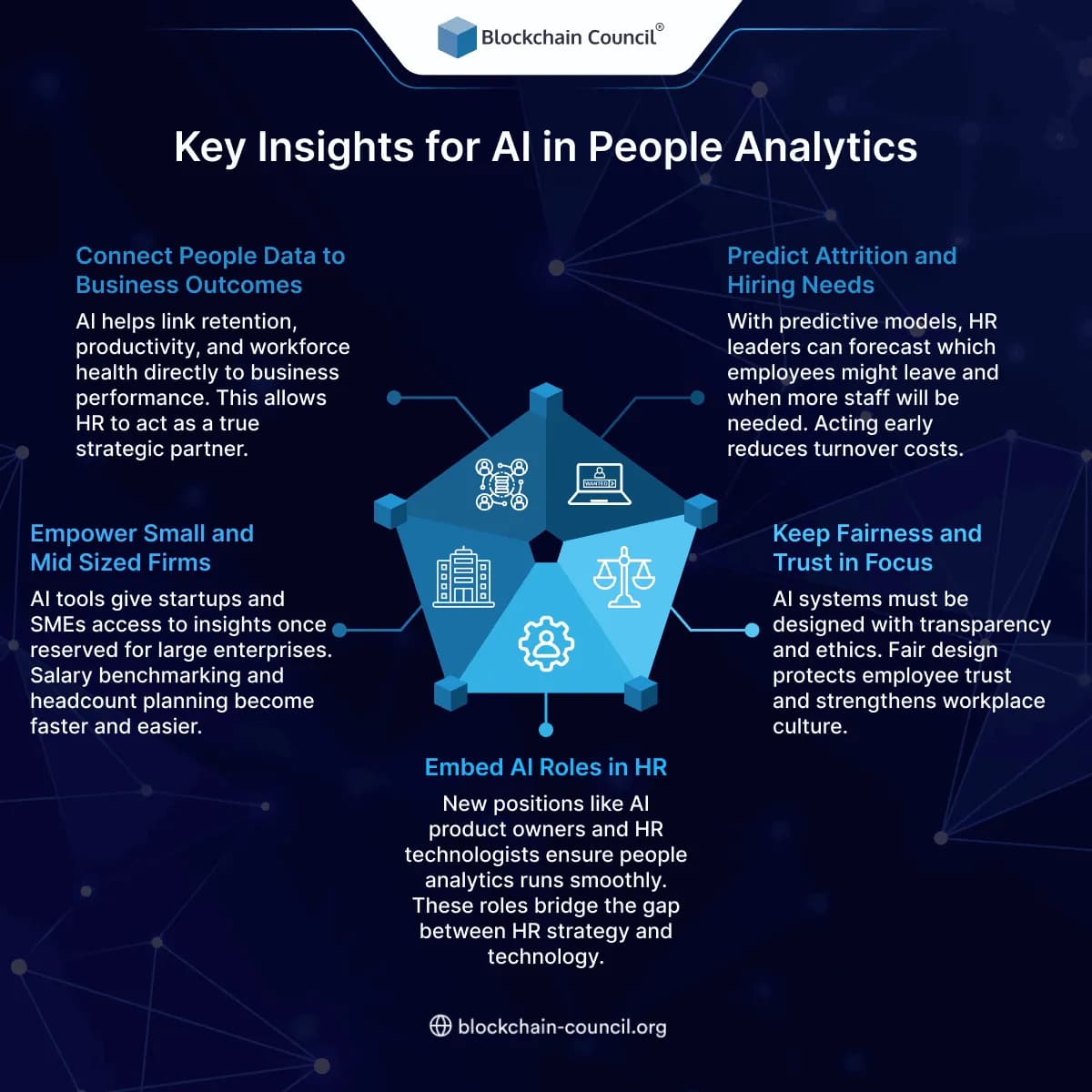
Connect People Data to Business Outcomes
AI helps link retention, productivity, and workforce health directly to business performance. This allows HR to act as a true strategic partner.
Predict Attrition and Hiring Needs
With predictive models, HR leaders can forecast which employees might leave and when more staff will be needed. Acting early reduces turnover costs.
Empower Small and Mid-Sized Firms
AI tools give startups and SMEs access to insights once reserved for large enterprises. Salary benchmarking and headcount planning become faster and easier.
Embed AI Roles in HR
New positions like AI product owners and HR technologists ensure people analytics runs smoothly. These roles bridge the gap between HR strategy and technology.
Keep Fairness and Trust in Focus
AI systems must be designed with transparency and ethics. Fair design protects employee trust and strengthens workplace culture.
This block captures the most practical and impactful lessons from AI-driven people analytics today.
Designing Fair and Trustworthy AI Analytics
AI in HR must be handled carefully. Poorly designed systems can harm trust and damage employee well-being. Workers are more likely to accept AI when they understand how decisions are made.
Transparency and fairness must guide every implementation. This includes testing algorithms for bias, explaining decisions clearly, and including human oversight. Without this, even the best tools can create more problems than they solve.
Real-World Applications
AI is already helping HR leaders and executives in many areas. It supports executive decisions by providing evidence-based insights in areas like forecasting and risk management. It improves culture tracking by analyzing engagement surveys, emails, and collaboration tools.
In hiring, AI helps predict staffing needs and identifies skill gaps. For smaller companies, this means faster decisions with fewer resources. The technology is no longer just for global corporations.
Balancing AI with Human Judgment
While AI provides speed and scale, human judgment remains critical. Leaders must interpret insights within context, taking into account culture, values, and long-term strategy. AI should support decision-making, not replace it.
The best results come from combining AI-driven insights with human experience. This balance ensures fairness, creativity, and accountability remain central to HR strategy.
Conclusion
AI for strategic people analytics is transforming HR into a true business partner. It connects workforce data to outcomes, predicts future challenges, and helps organizations adapt quickly. From large enterprises to small startups, companies are using AI to build healthier, more productive workplaces.
Success, however, requires more than technology. It needs transparent design, ethical use, and a commitment to employee trust. For professionals, continuous learning is key. If you are a data specialist, a Data Science Certification can expand your expertise. If you are leading teams, a Marketing and Business Certification can prepare you for strategy roles. Together, these AI certs make you ready for the future of people analytics.