
AI Ethical Approaches
 Michael Willson
AI ethical approaches focus on ensuring that artificial intelligence is built and used in ways that are fair, safe, and accountable. With AI systems now deeply involved in decision-making, education, healthcare, and business, ethics has become a core part of the conversation. Institutions, companies, and governments are shaping frameworks to guide responsible AI development. For professionals aiming to gain credibility in this area, pursuing an AI certification is a practical first step.
The Importance of Ethical Principles
Ethical principles act as the foundation of responsible AI. Without them, systems risk amplifying bias, violating privacy, or making decisions without accountability. Frameworks from organizations such as UNESCO, IEEE, and Microsoft emphasize key values like fairness, transparency, and human oversight. These values are not optional—they are necessary to build trust in AI technologies.

AI certs are now seen as a way to prove that professionals understand these ethical foundations and can apply them in practice.
Principles-Based Frameworks
Principles-based frameworks provide a high-level guide for organizations. They establish values like accountability, explainability, and safety. UNESCO’s global ethics recommendation is one of the most comprehensive, setting a common standard across countries. Private companies have also published their own guidelines to show commitment to responsible AI.
Common Ethical Principles in AI
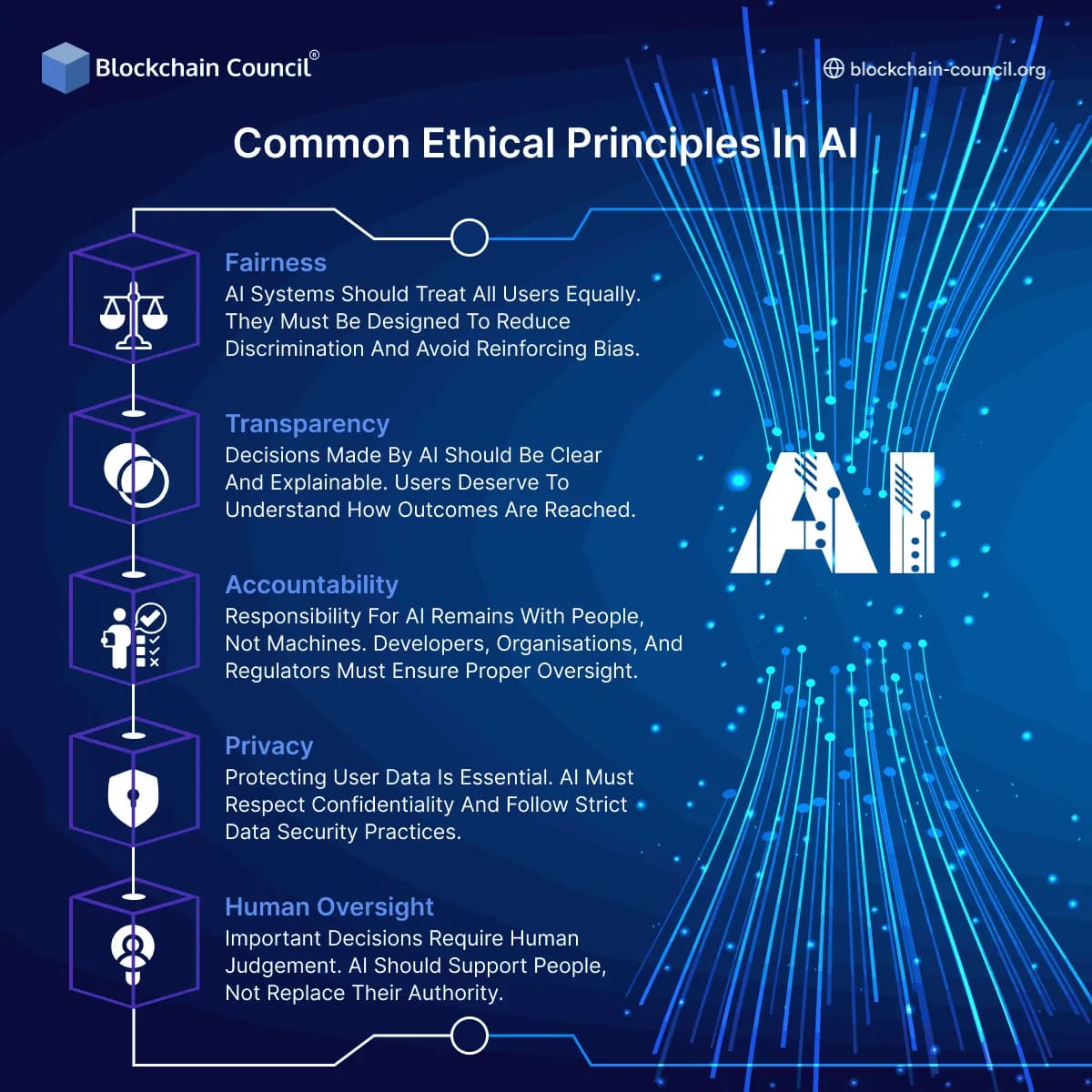
Fairness
AI systems should treat all users equally. They must be designed to reduce discrimination and avoid reinforcing bias.
Transparency
Decisions made by AI should be clear and explainable. Users deserve to understand how outcomes are reached.
Accountability
Responsibility for AI remains with people, not machines. Developers, organisations, and regulators must ensure proper oversight.
Privacy
Protecting user data is essential. AI must respect confidentiality and follow strict data security practices.
Human Oversight
Important decisions require human judgement. AI should support people, not replace their authority.
Ethical-by-Design and Value-Based Engineering
Another approach is ethical-by-design, which integrates moral reasoning into AI development from the very start. This means ethics is not treated as an afterthought but as a design principle. Value-Based Engineering (VBE), backed by IEEE standards, is one example. It ensures that engineers embed ethical reasoning into systems during the design and testing process.
This approach is particularly important for industries like healthcare or finance, where errors can have serious consequences. By adopting value-based frameworks, organizations show they prioritize trust and safety.
Value Learning and AI Alignment
AI alignment and value learning focus on making sure AI systems understand and follow human values. Instead of just training AI to perform tasks, these methods aim to teach models about human goals and preferences. This helps avoid harmful outcomes and ensures AI behavior matches societal expectations.
Alignment is a growing area of research, especially as AI systems become more advanced. Professionals trained in this field can help organizations build models that reflect ethical priorities. For those managing large-scale data and models, a Data Science Certification is a valuable way to prove expertise.
Explainability and Human Oversight
AI explainability is about making machine decisions clear to users. Without explainability, AI is a “black box,” where decisions are made without transparency. Explainable AI (XAI) provides reasons for its outputs, which builds user trust and supports accountability.
Human oversight ensures that people—not machines—are ultimately responsible. Many institutions require a human-in-the-loop model to prevent harmful or biased decisions. Together, explainability and oversight help make AI reliable and ethical.
Approaches to Embedding Ethics in AI
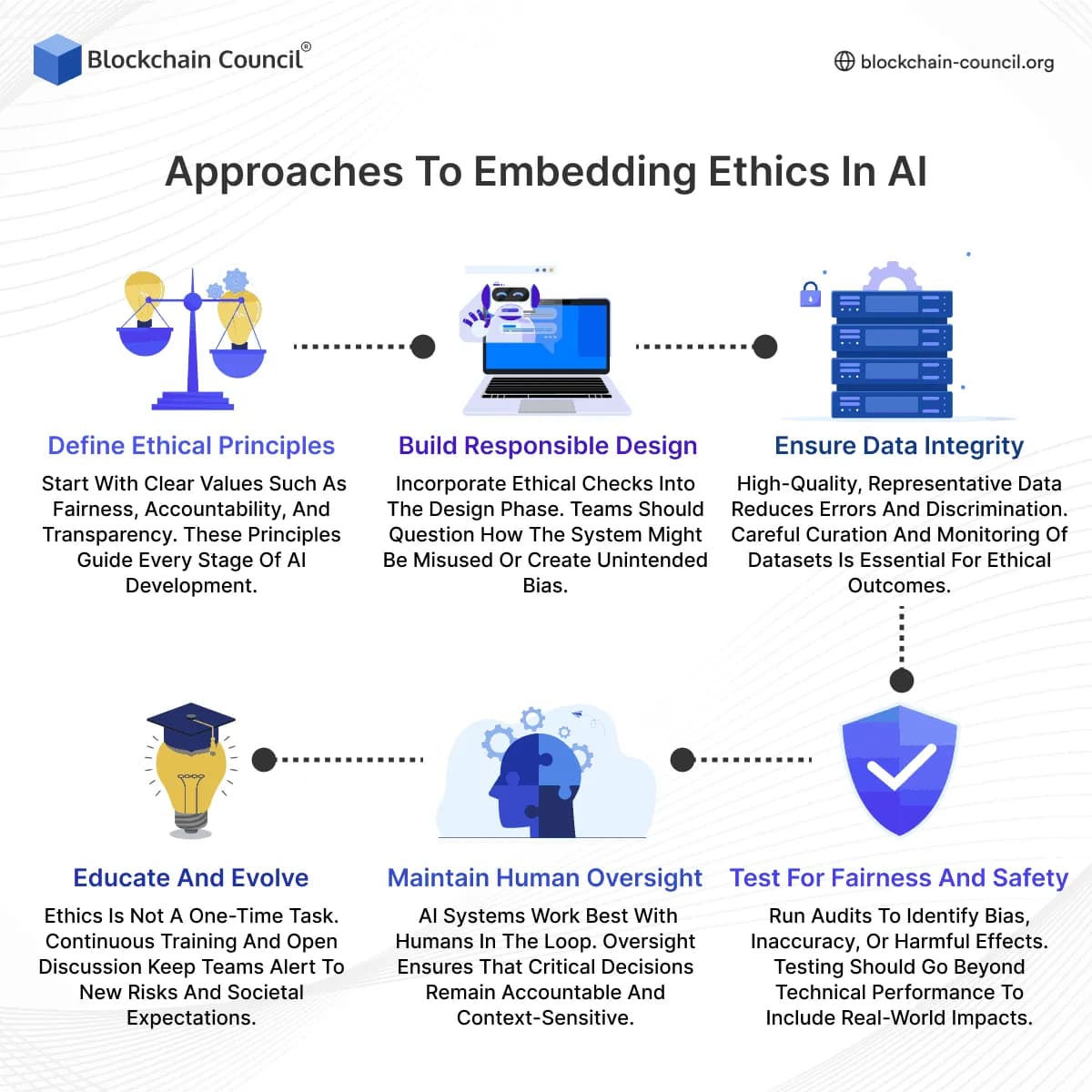
Step 1: Define Ethical Principles
Start with clear values such as fairness, accountability, and transparency. These principles guide every stage of AI development.
Step 2: Build Responsible Design
Incorporate ethical checks into the design phase. Teams should question how the system might be misused or create unintended bias.
Step 3: Ensure Data Integrity
High-quality, representative data reduces errors and discrimination. Careful curation and monitoring of datasets is essential for ethical outcomes.
Step 4: Test for Fairness and Safety
Run audits to identify bias, inaccuracy, or harmful effects. Testing should go beyond technical performance to include real-world impacts.
Step 5: Maintain Human Oversight
AI systems work best with humans in the loop. Oversight ensures that critical decisions remain accountable and context-sensitive.
Step 6: Educate and Evolve
Ethics is not a one-time task. Continuous training and open discussion keep teams alert to new risks and societal expectations.
Governance and Legal Frameworks
Governance and regulation are central to ethical AI. Countries and global organizations are introducing laws that align AI with human rights and democracy. The Council of Europe’s Framework Convention on AI is one such effort. Legal frameworks make sure AI does not undermine fundamental freedoms.
Organizations also need governance at the corporate level. This includes setting up review boards, clear policies, and ethical codes of conduct. Governance connects high-level principles with everyday practices.
The Human and Societal Dimension
Ethics is not just about technical frameworks. It is also about human dignity and social impact. Institutions like the Vatican and UNESCO stress that AI must complement human intelligence rather than replace it. Ethical approaches highlight empathy, fairness, and inclusion, ensuring AI supports communities instead of harming them.
For leaders who want to connect these values with business growth, the Marketing and Business Certification provides a strong path to apply ethical thinking in strategic decision-making.
Conclusion
AI ethical approaches are diverse, but they all share one goal: ensuring artificial intelligence supports human progress while avoiding harm. From principles-based frameworks to ethical-by-design and value learning, each approach brings unique strengths. Explainability, governance, and oversight are essential to keep AI accountable.
Related Articles
View All
AI & ML
Ethical Hacking for AI Systems: Step-by-Step Pen-Testing for ML and LLM Apps
Learn a step-by-step ethical hacking methodology for AI systems, including pen-testing ML pipelines and LLM apps for prompt injection, RAG leaks, and tool abuse.

AI & ML
Explainable AI for Security: Detecting Attacks, Bias, and Model Drift with Interpretability
Explainable AI for security makes threat detection auditable and trustworthy, helping teams reduce false positives, uncover bias, and detect model drift in SOC and Zero Trust workflows.

AI & ML
Security Metrics for AI: Measuring Robustness, Privacy Leakage, and Attack Surface Over Time
Learn practical security metrics for AI to track robustness, privacy leakage, and attack surface over time using OWASP, MITRE, CI/CD testing, and runtime monitoring.
Trending Articles

The Role of Blockchain in Ethical AI Development
How blockchain technology is being used to promote transparency and accountability in artificial intelligence systems.

AWS Career Roadmap
A step-by-step guide to building a successful career in Amazon Web Services cloud computing.

Top 5 DeFi Platforms
Explore the leading decentralized finance platforms and what makes each one unique in the evolving DeFi landscape.