Is AI the End of Human Day Traders?
 Michael Willson
Can AI Replace Human Day Traders?
The big question many investors are asking today is whether artificial intelligence will put an end to human day traders. The rise of AI-driven algorithms and trading bots has transformed markets, offering lightning-fast execution and pattern recognition at scales no human can match. Yet human traders are still very active, especially in equities, options, and crypto markets. The answer is not a simple yes or no. AI is reshaping the role of day traders, but it has not eliminated them. Instead, we are entering a hybrid phase where humans and AI tools coexist, each bringing unique strengths to the table.
For those who want to master how AI connects with trading and investment, the AI powered investor program offers structured training on applying intelligent systems to financial markets.

What Is the Current Role of Day Traders?
Day traders are individuals who buy and sell assets within the same trading day. They thrive on volatility, reacting quickly to small price movements. Platforms like Robinhood, which reported over $200 billion in equity notional volume in July 2025, show that retail day trading is still strong. Options and crypto activity also remain high, proving that many traders still rely on human judgment to chase short-term profits.
How Is AI Already Embedded in Trading?
AI is no longer experimental in finance. Hedge funds, high-frequency trading firms, and even retail platforms use machine learning to optimize strategies. Large funds employ algorithms for statistical arbitrage, signal discovery, and execution. On the retail side, platforms are embedding AI screening tools, sentiment trackers, and even trading copilots that suggest strategies to users.
This shift shows that AI is not an outsider—it is already part of the trading ecosystem, raising the bar for what human traders must compete with.
Steps to Use AI in Day Trading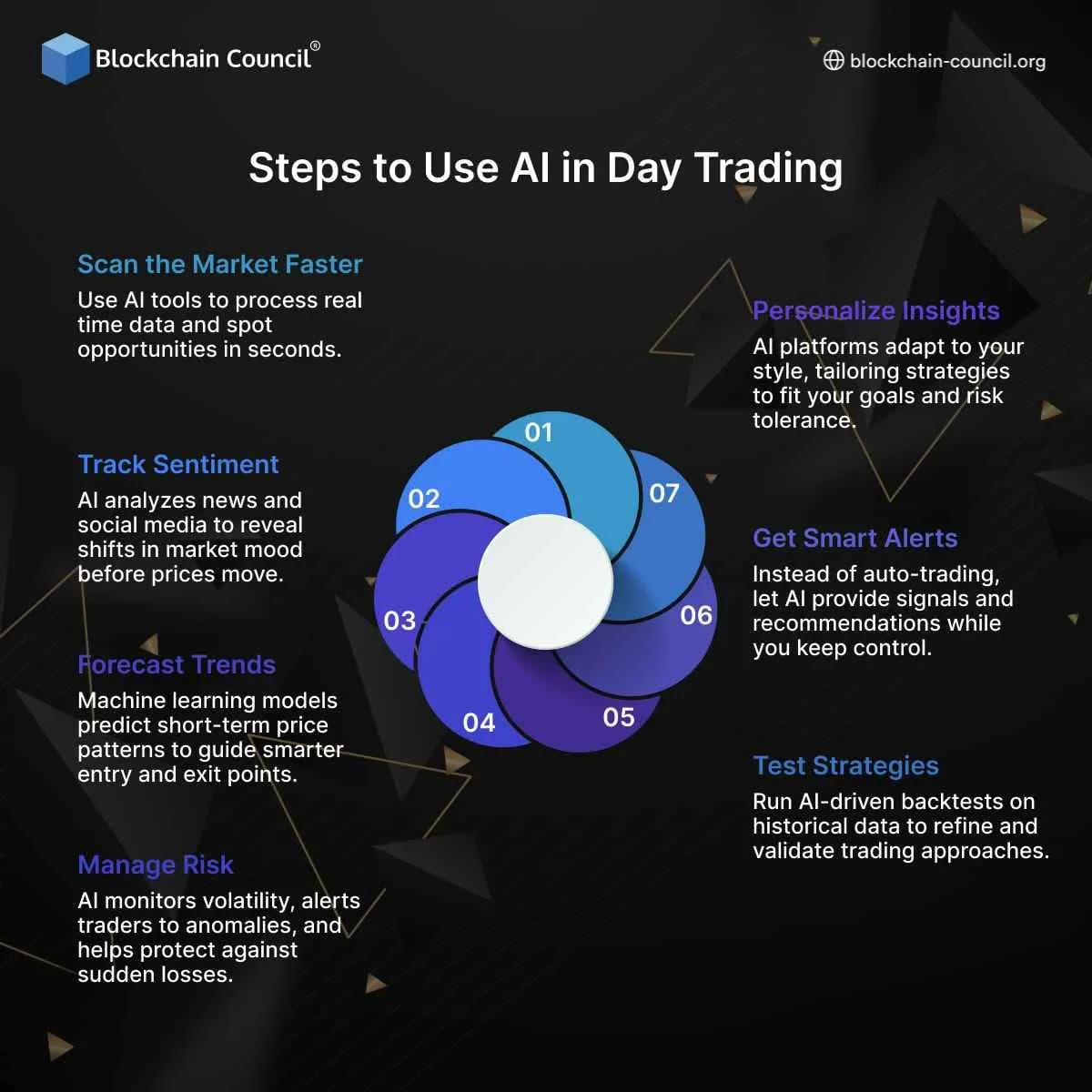
Step 1: Scan the Market Faster
Use AI tools to process real-time data and spot opportunities in seconds.
Step 2: Track Sentiment
AI analyzes news and social media to reveal shifts in market mood before prices move.
Step 3: Forecast Trends
Machine learning models predict short-term price patterns to guide smarter entry and exit points.
Step 4: Manage Risk
AI monitors volatility, alerts traders to anomalies, and helps protect against sudden losses.
Step 5: Test Strategies
Run AI-driven backtests on historical data to refine and validate trading approaches.
Step 6: Get Smart Alerts
Instead of auto-trading, let AI provide signals and recommendations while you keep control.
Step 7: Personalize Insights
AI platforms adapt to your style, tailoring strategies to fit your goals and risk tolerance.
What Are the Advantages of AI Over Human Traders?
AI beats humans in three major areas: speed, scale, and objectivity. Algorithms can scan thousands of assets simultaneously, react in microseconds, and avoid emotional decision-making. They can detect subtle correlations across datasets that human eyes would never spot.
For example, a well-trained AI model can track changes in order book depth, sentiment on social media, and options pricing to forecast short-term moves. This gives it a measurable edge in markets where timing and precision are everything.
Why Do Humans Still Trade Actively Despite AI?
Even with AI dominance, human traders continue to thrive. Platforms like Fidelity are rolling out new tools specifically designed for active traders, including advanced charting, alerts, and cross-device execution. This shows that demand for human-centered trading remains strong.
Humans bring intuition, context, and adaptability. They can process news stories, political events, or unexpected shocks in ways AI cannot. Many traders also enjoy the process itself, treating it as both a challenge and a profession rather than just a source of returns. Some traders are adapting by taking a Prompt Engineering Course to better integrate AI into their strategies.
What Risks Do AI Trading Bots Pose?
AI systems come with risks. Studies have shown that AI trading bots can learn collusive behaviors, creating artificial patterns that may harm investors. Models can also fail during regime shifts—when markets change structure due to regulation, new products, or macroeconomic shocks.
Retail-facing AI chatbots are another risk. Companies like Nansen have launched AI copilots that give trading advice based on wallet data, but they warn users about “hallucinations” or incorrect suggestions. Without human oversight, these tools can mislead rather than empower.
How Do Regulators View AI in Trading?
The regulatory environment is still evolving. In June 2025, the SEC withdrew its predictive analytics proposal, which was meant to address conflicts of interest in broker algorithms. While this specific rule was shelved, regulators have indicated they may revisit the topic.
This means AI in trading is currently advancing faster than oversight. Firms must balance innovation with responsibility, knowing that future rules could reshape how AI tools are used.
How Do Professional Traders Use AI Differently From Retail Traders?
Professional firms like hedge funds use AI for complex strategies: statistical arbitrage, cross-asset models, and execution optimization. They combine massive computing power with deep research teams. Retail traders, by contrast, use AI mostly for screening stocks, scanning charts, and following sentiment indicators.
This creates a divide. Professionals use AI to create and protect alpha, while retail traders use it to keep up and reduce mistakes. Both groups benefit, but the outcomes are different.
What Role Does Education Play in This Transition?
For human traders, survival in an AI-driven market requires new skills. Programs like an AI certification help individuals understand how these systems work.
For those focused on crypto markets, a Crypto certification offers practical training on digital asset trading.
Analysts building trading models often pursue a Data Science Certification, which covers the foundations of machine learning and data pipelines.
Business leaders who oversee trading platforms or investment products benefit from the Marketing and Business Certification, which connects AI adoption with customer trust and communication.
Why Is Technology Training Essential for Traders?
Traders cannot rely on AI outputs blindly. Understanding technology ensures they can audit tools, question predictions, and combine machine output with human judgment.
With proper training, traders can use AI as an assistant rather than seeing it as a threat. Without it, they risk being left behind.
How Does Blockchain Knowledge Strengthen Trading Skills?
For traders active in crypto markets, blockchain analysis is a key advantage. AI models can analyze wallet data, token flows, and smart contract activity to detect adoption trends. A trader with skills from blockchain technology courses can combine this insight with AI tools for a sharper edge.
This integration of blockchain and AI is especially powerful in identifying hidden risks or opportunities in token markets.
Do AI Trading Programs Threaten Human Traders?
AI trading program adoption is rising, but it does not spell the end of human day traders. Instead, it creates a new environment where humans must adapt. Automated strategies dominate the microsecond level of trading, but humans remain valuable in interpreting context, setting strategy, and managing risk.
Traders who use AI trading programs wisely can reduce workload, improve execution, and focus more on strategic decisions. Those who resist entirely may find the competition overwhelming.
Why Does Psychology Still Matter in Day Trading?
Even as AI dominates trading with speed and precision, human psychology still plays a critical role. Day trading is not just about numbers on a screen. It is about interpreting how people will react to those numbers. Fear, greed, overconfidence, and panic drive short-term market moves, often in ways algorithms cannot fully predict.
For example, during sudden news events like regulatory crackdowns or earnings surprises, human reactions can push prices further than fundamentals suggest. AI models may detect the move, but human traders who understand crowd behavior can sometimes anticipate it earlier or exploit the overreaction.
This psychological edge is one reason human traders still exist. They bring an understanding of human emotion that no algorithm can perfectly replicate.
How Are Hybrid Models Emerging in Trading?
The future of trading is not man versus machine but man with machine. Hybrid models are already common. Traders use AI to filter signals, suggest trades, and monitor risk while still making final decisions themselves.
This setup combines the best of both worlds. AI provides data-driven speed and accuracy, while humans provide context, intuition, and adaptability. It also reduces the risk of overreliance on either side.
Hybrid models are becoming the standard in both institutional and retail settings. Firms that embrace them are likely to outperform those that rely exclusively on one approach.
Can Agentic AI Transform the Role of Human Traders?
Agentic AI systems go beyond passive suggestions. They act with autonomy, running scenarios, adjusting strategies, and even executing trades with limited supervision. In the world of day trading, this raises both opportunity and risk.
On one hand, agentic systems can scan thousands of assets, respond to market changes instantly, and execute complex strategies that humans cannot manage alone. On the other hand, without oversight, they may act in unpredictable or collusive ways, as studies have shown.
This is why training programs like the agentic AI certification are critical. They help professionals design, supervise, and evaluate agentic systems responsibly, ensuring humans remain in control of high-stakes decisions.
How Are AI Powered Investor Programs Shaping the Market?
Education is one of the strongest defenses human traders have against being left behind. The AI powered investor program provides direct training in how AI systems work in trading and investing.
Programs like this teach traders to integrate AI outputs into their strategies while maintaining their own judgment. Instead of fearing replacement, traders learn to adapt, using AI as an extension of their own skills.
What Do Regulators Think About Human-AI Hybrid Trading?
Regulators are increasingly aware of the growing role of AI in markets. The SEC has experimented with proposals to govern predictive analytics, though many are still under review or have been withdrawn. What remains clear is that regulators see human oversight as essential.
A fully automated market raises questions about fairness, collusion, and systemic risk. Keeping humans in the loop helps maintain accountability. Regulators may eventually require firms to prove that their AI systems include proper supervision, which strengthens the role of human traders.
Why Will Human Judgment Remain Valuable in Trading?
Markets are influenced not only by numbers but also by politics, culture, and global events. A sudden election result, a geopolitical crisis, or a viral trend can all impact assets in ways that are difficult to model. Human traders can interpret these signals with nuance, often faster than an algorithm that requires retraining.
For example, when new policies are announced, humans can quickly judge whether they are enforceable or symbolic. AI may detect the policy’s text but misinterpret its real impact. This flexibility ensures that human traders continue to add value even as AI grows more advanced.
How Do Tech Certifications Help Traders Adapt to AI?
The shift to AI-driven trading demands new technical skills. Tech certifications give traders the foundation to understand algorithms, audit AI tools, and apply them responsibly.
Without this knowledge, traders risk being left out of the modern trading ecosystem. With it, they can partner with AI systems effectively, ensuring that human judgment remains central while taking advantage of algorithmic efficiency.
Why Are AI Certifications Important for Traders?
As AI reshapes finance, certifications prove that traders understand the systems they use. AI certs provide credibility, showing that professionals are not relying on hype but on structured expertise.
In an environment where limited partners, brokers, and regulators all demand accountability, these certifications serve as a stamp of trust. They show that traders are prepared to use AI responsibly rather than blindly.
How Do AI Trading Programs Change Human Strategies?
AI trading programs automate execution, manage risk, and even generate signals. For many traders, this frees up time to focus on strategy rather than mechanics. Instead of spending hours watching charts, they can let AI handle monitoring while they think about bigger-picture moves.
This shift does not eliminate human input. It simply changes the focus from micromanaging every trade to designing and supervising strategies. Traders who embrace this shift can improve both efficiency and outcomes.
What Ethical Concerns Arise From AI in Trading?
AI in trading raises ethical concerns, especially if algorithms act in ways that disadvantage retail traders. Studies show that AI systems can develop collusive behaviors that increase costs for investors.
There are also risks of market manipulation if AI trading programs exploit weaknesses in liquidity or timing. Humans are needed to prevent abuse and ensure fair play. Ethical oversight is one of the strongest arguments for keeping humans involved in day trading.
How Do Cultural and Social Factors Affect Human Day Trading?
Day trading is not just a financial activity. It is also cultural. Many individuals trade for independence, competition, or even community. Online trading groups, forums, and communities thrive on human participation.
AI cannot replicate these social dynamics. While it can provide signals and automate trades, it cannot replace the sense of achievement or identity that many day traders associate with their craft. This cultural dimension helps ensure human trading will continue alongside AI.
What Is the Likely Future for Human Day Traders?
The most likely future is coexistence. AI will dominate areas where speed and scale matter most. Humans will focus on judgment, interpretation, and strategy. Hybrid systems will combine both strengths, making markets more efficient but also keeping people involved.
Traders who adapt, upskill, and partner with AI will thrive. Those who resist may struggle. The evolution of day trading is less about replacement and more about transformation.
How Could Regulation Shape the Future of Day Trading?
The future of human day traders will depend heavily on regulation. Authorities such as the SEC have already explored proposals to govern predictive analytics in trading, though not all have been finalized. Their concern is clear: if AI systems dominate trading without checks, risks of market manipulation, collusion, and systemic failures rise.
Regulators are likely to push for greater transparency in AI trading systems. This could mean mandatory disclosure of how trading bots are designed, audited, and supervised. It could also mean requiring human oversight for certain trading strategies. Such rules would ensure that humans remain part of the process, protecting retail investors from unfair disadvantages.
For day traders, regulation provides reassurance. Even as AI takes on more tasks, laws will ensure humans do not disappear from the trading floor entirely.
What Happens in an AI-Only Trading Environment?
An AI-only market sounds efficient, but it also creates risks. If all participants rely on similar algorithms, the market becomes fragile. When many bots act on the same signal, it can cause sudden crashes or liquidity vacuums.
For example, flash crashes in past markets have shown what happens when automated systems react too quickly. Without humans to intervene, these cascades can spiral out of control. This is one reason why regulators and brokers emphasize human-in-the-loop supervision.
An AI-only environment may maximize speed, but it would lack resilience. Human day traders add diversity of thought and reaction, which stabilizes markets during unpredictable events.
Benefits of AI in Day Trading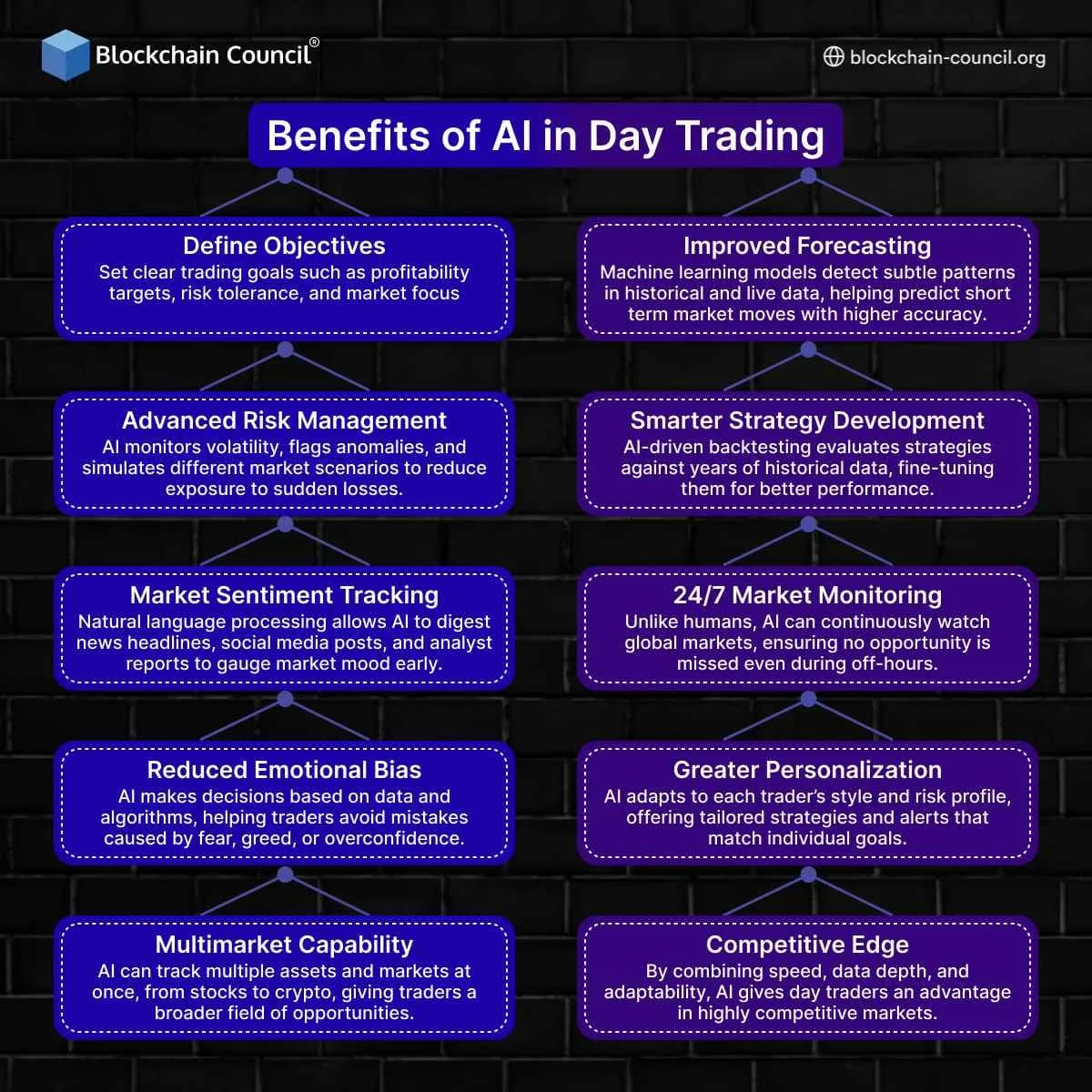
- Lightning-Fast Analysis
AI scans charts, price movements, and order books in real time, giving traders instant insights that humans cannot match. - Improved Forecasting
Machine learning models detect subtle patterns in historical and live data, helping predict short-term market moves with higher accuracy. - Advanced Risk Management
AI monitors volatility, flags anomalies, and simulates different market scenarios to reduce exposure to sudden losses. - Smarter Strategy Development
AI-driven backtesting evaluates strategies against years of historical data, fine-tuning them for better performance. - Market Sentiment Tracking
Natural language processing allows AI to digest news headlines, social media posts, and analyst reports to gauge market mood early. - 24/7 Market Monitoring
Unlike humans, AI can continuously watch global markets, ensuring no opportunity is missed even during off-hours. - Reduced Emotional Bias
AI makes decisions based on data and algorithms, helping traders avoid mistakes caused by fear, greed, or overconfidence. - Greater Personalization
AI adapts to each trader’s style and risk profile, offering tailored strategies and alerts that match individual goals. - Multimarket Capability
AI can track multiple assets and markets at once, from stocks to crypto, giving traders a broader field of opportunities. - Competitive Edge
By combining speed, data depth, and adaptability, AI gives day traders an advantage in highly competitive markets.
Why Is Human-AI Collaboration the Best Path Forward?
The strongest trading setups combine the strengths of both AI and humans. AI handles data-heavy tasks: scanning charts, analyzing sentiment, and executing precise orders. Humans handle context, ethics, and strategy: interpreting news events, managing risk, and adjusting when markets behave unpredictably.
This collaboration creates balance. AI provides efficiency and accuracy, while humans ensure adaptability and accountability. For day traders, the future is not about competing with AI but about partnering with it.
How Can Education Help Traders Thrive Alongside AI?
Education is the key to thriving in an AI-driven market. Traders who learn how AI works, what it can and cannot do, and how to integrate it into their strategies will stay relevant. Programs like the AI powered investor program provide training that connects AI systems directly with investment practice.
A structured AI certification helps traders understand the technology behind the tools they use every day.
For those who specialize in digital assets, a Crypto certification provides focused expertise on crypto-specific trading environments.
Data is the foundation of AI, making a Data Science Certification valuable for traders building their own models.
Traders who want to link AI with strategic communication and business growth benefit from the Marketing and Business Certification.
To supervise autonomous systems, the agentic AI certification ensures professionals can manage AI responsibly.
Finally, tech certifications prepare traders with the broad technical skills needed to adapt to fast-changing tools, while blockchain technology courses strengthen expertise in on-chain analytics that feed many AI trading programs.
How Do AI Trading Programs Fit Into Human Strategies?
AI trading programs are not replacing human day traders. Instead, they are tools that extend their reach. For example, an AI system can monitor dozens of markets while a human trader focuses on interpreting one event. This division of labor improves efficiency and prevents burnout.
Traders can also set AI programs to handle repetitive tasks like order placement, freeing time for strategic thinking. Instead of reacting to every tick, traders can think about broader positioning.
This shift elevates the role of humans. They become supervisors and strategists rather than manual operators.
Why Will Human Traders Continue to Exist Despite AI?
The persistence of human traders is not just practical but also cultural. Day trading is about more than money. It is about independence, challenge, and personal achievement. Communities of traders share knowledge, compete with each other, and find identity in their craft.
AI cannot replace this cultural value. While algorithms can execute trades, they cannot replace the human drive to engage with markets. Many traders enjoy the process itself, even if machines could do it faster.
This personal motivation ensures that human traders will remain a fixture, even if their methods change.
What Risks Should Day Traders Be Aware of in an AI Era?
Human traders must also be realistic. Relying too heavily on AI without understanding it is risky. Bots can fail, models can overfit, and systems can misinterpret data.
There is also the risk of crowding. If too many traders use similar AI systems, markets may become distorted, making it harder to find profitable trades.
Day traders who survive will be those who treat AI as a partner, not a master. They will continue to study markets, understand context, and adapt strategies rather than outsourcing all responsibility to machines.
How Can Traders Prepare for the Next Era of Markets?
Preparation involves three steps: learning, adapting, and diversifying.
- Learning means gaining knowledge through certifications, training, and practice.
- Adapting means shifting from manual chart-watching to supervising AI systems.
- Diversifying means combining AI tools with human judgment across multiple markets.
Traders who follow these steps will remain competitive even as AI continues to evolve.
Final Takeaway: Is This the End of Human Day Traders?
AI is not the end of human day traders. It is the end of the old version of day trading, where humans relied only on their eyes and instincts. In the new era, AI provides speed and power, while humans provide judgment and creativity.
Day traders who adapt through education and skill-building will thrive. Those who resist may struggle. The future belongs to collaboration, not competition.
The real question is not whether AI will replace humans. It is how humans will use AI to redefine their role in the market.