

Can AI End the Guesswork in Venture Capital?
 Michael Willson
Venture capital has always been a blend of science, intuition, and luck. Investors bet on founders, markets, and ideas long before the data exists to prove them right. For decades, that guesswork was considered part of the art — the reason some partners seemed to have golden instincts while others stumbled. But today, the art of venture investing is meeting its algorithmic match. Artificial intelligence is quietly reshaping how venture capitalists discover startups, evaluate potential, and manage risk.
AI doesn’t rely on gut feelings. It analyses patterns across billions of data points — founder backgrounds, patent filings, market growth rates, team structures, and even social signals. The result is a decision-making system that learns faster and sees further than any human analyst ever could. The big question now is whether AI can turn venture capital from educated gambling into precision investing.

Professionals looking to understand how these intelligent systems actually make predictions can start with the AI Certification. It provides the fundamentals of how models analyse data, learn correlations, and adapt over time — all critical skills for the investors of tomorrow.
What Makes Venture Capital So Dependent on Guesswork?
Venture capital is an inherently uncertain business. Early-stage startups rarely have stable cash flow or complete data. Investors must evaluate vision, leadership, and timing — none of which are easily measurable. Even with decades of experience, partners often admit that luck plays a huge role.
Traditional due diligence focuses on market size, competition, and founder track record, but these indicators can mislead. Many billion-dollar companies once appeared too risky on paper, while seemingly perfect ideas failed because of execution gaps. The absence of standardised data makes VC one of the few remaining industries where intuition outweighs evidence.
That’s the gap AI is now filling. By digesting information far beyond spreadsheets — such as code commits, hiring patterns, sentiment analysis, and news coverage — AI gives investors a multi-dimensional view of a startup’s real trajectory.
How Does AI Change the Way Venture Capital Works?
Instead of sifting through thousands of startup pitches manually, AI systems can filter them in minutes. Machine learning models rank opportunities based on objective criteria like market momentum, founder resilience, and customer engagement metrics.
These models learn what “success” looks like by analysing the historical data of previous winners and losers. For instance, they might discover that startups led by teams with prior exits or early revenue from recurring customers have a higher probability of scaling. Once trained, these algorithms can identify similar patterns in new founders almost instantly.
AI also helps uncover hidden gems — startups operating under the radar but showing promising data signals. That’s why major VC firms are integrating AI scouts that constantly monitor public and private data sources for early traction indicators. It’s a level of vigilance no human team could sustain.
Can AI Really Predict Which Startups Will Succeed?
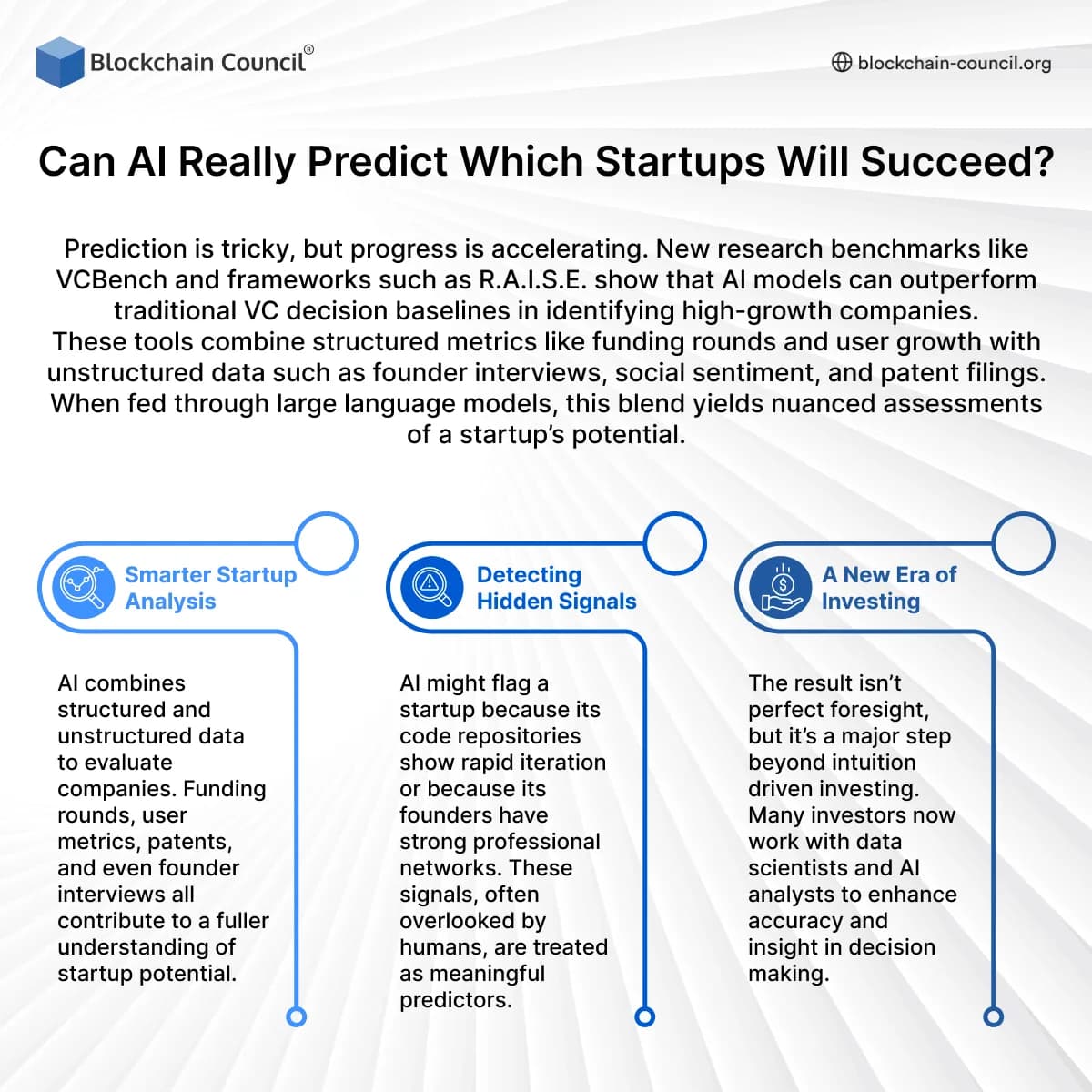
Prediction is tricky, but progress is accelerating. New research benchmarks like VCBench and frameworks such as R.A.I.S.E. show that AI models can outperform traditional VC decision baselines in identifying high-growth companies.
These tools combine structured metrics like funding rounds and user growth with unstructured data such as founder interviews, social sentiment, and patent filings. When fed through large language models, this blend yields nuanced assessments of a startup’s potential.
For instance, AI might flag a startup because its code repositories show rapid iteration or because its founders exhibit strong network connectivity on professional platforms. Humans might overlook these signals, but AI treats them as statistically significant predictors.
The result isn’t perfect foresight, but it’s a massive leap beyond intuition-driven investing. And it’s why many modern investors are now augmenting their teams with data scientists and AI analysts.
How AI Levels the Playing Field for Smaller Firms
In the past, only large venture firms could afford proprietary data and research infrastructure. Today, AI tools are democratising access to insights that once required entire analyst teams.
Even small funds can use cloud-based AI platforms to screen startups, automate initial evaluations, and run comparative analyses. This levels the playing field, allowing emerging managers to compete with well-established firms.
Smaller funds are also using AI-powered deal sourcing to discover startups outside major hubs like Silicon Valley or London. By removing geographic bias and focusing on digital footprints, AI expands access to promising founders in emerging markets.
For professionals seeking to leverage such tools directly, the AI Powered Investor Program offers practical training on using AI models for portfolio selection and timing — skills that were once the exclusive domain of elite investors.
What New Data Can AI Access That Humans Can’t?
AI’s biggest advantage isn’t just speed; it’s scope. It can process signals from millions of online interactions, technical documents, and even behavioural indicators.
For example, natural language models can scan thousands of startup pitch decks and identify linguistic markers that correlate with future success — confidence, clarity, and focus. Image recognition models can evaluate product designs and brand presence across digital platforms. AI also tracks recruitment data to see how quickly a startup attracts talent — often a key sign of momentum.
Such insights allow investors to assess a startup’s health holistically, long before formal metrics like revenue or profit emerge.
This deeper analysis is part of a broader evolution in financial intelligence, similar to what’s being taught in the AI Powered Trading Program. The principles of predictive modelling and risk optimisation apply across both trading and venture investing, reinforcing how AI is connecting once-separate branches of finance.
Can AI Reduce Bias in Venture Capital?
One of AI’s most promising — and controversial — contributions is bias reduction. Human investors, consciously or not, often favour founders who look or sound like past success stories. That perpetuates geographic, gender, and social inequities in startup funding.
AI can help neutralise those biases by evaluating founders on measurable performance signals rather than personal characteristics. For instance, an algorithm can weigh traction metrics or technical milestones more heavily than credentials or location.
However, bias can creep into AI too, especially if models are trained on historical data that already reflects human prejudice. The solution lies in transparency. Ethical AI frameworks, along with proper data validation and oversight, ensure fairness while preserving accuracy.
To maintain accountability, some firms are adopting explainable AI systems that show why a model favoured one company over another. These insights not only improve fairness but also build investor confidence in machine-assisted decision-making.
How AI Enhances Portfolio Monitoring and Exit Decisions
Once the investment is made, AI doesn’t go dormant. It continues to track performance across every portfolio company, identifying early warning signs of trouble.
Predictive algorithms analyse growth metrics, burn rates, and customer churn to signal when intervention may be needed. They can also forecast when a startup is ripe for follow-on investment or acquisition, helping investors time their exits for maximum return.
In an inflationary or volatile market, this precision matters. AI reduces the lag between trend detection and strategic action, which can be the difference between a successful exit and a costly miss.
How Data Science Strengthens AI-Driven Venture Investing
Behind every effective AI system in venture capital lies a robust data science operation. These teams collect, clean, and label diverse datasets, ensuring that AI models learn from reliable inputs rather than noise.
Professionals pursuing a Data Science Certification gain the technical foundation to manage these pipelines — from feature selection to model validation. Understanding how data behaves in sparse environments (like early-stage startups) is crucial for improving prediction accuracy.
Data science also bridges communication between technical teams and investment committees, turning algorithmic outputs into insights that drive confident decision-making.
Why Human Judgment Still Matters
AI can analyse data, but it doesn’t understand vision or passion — the intangibles that often define startup success. A founder’s grit or adaptability in crisis still requires human assessment.
The smartest investors don’t see AI as a replacement but as an enhancement. It amplifies insight, eliminates noise, and allows humans to focus on what machines can’t yet quantify: leadership, timing, and emotional intelligence.
This human-AI collaboration is shaping a new generation of venture professionals. Those combining analytical training with strategic thinking — such as through the Marketing and Business Certification — are best positioned to lead this hybrid future.
How AI Is Transforming Deal Sourcing in Venture Capital
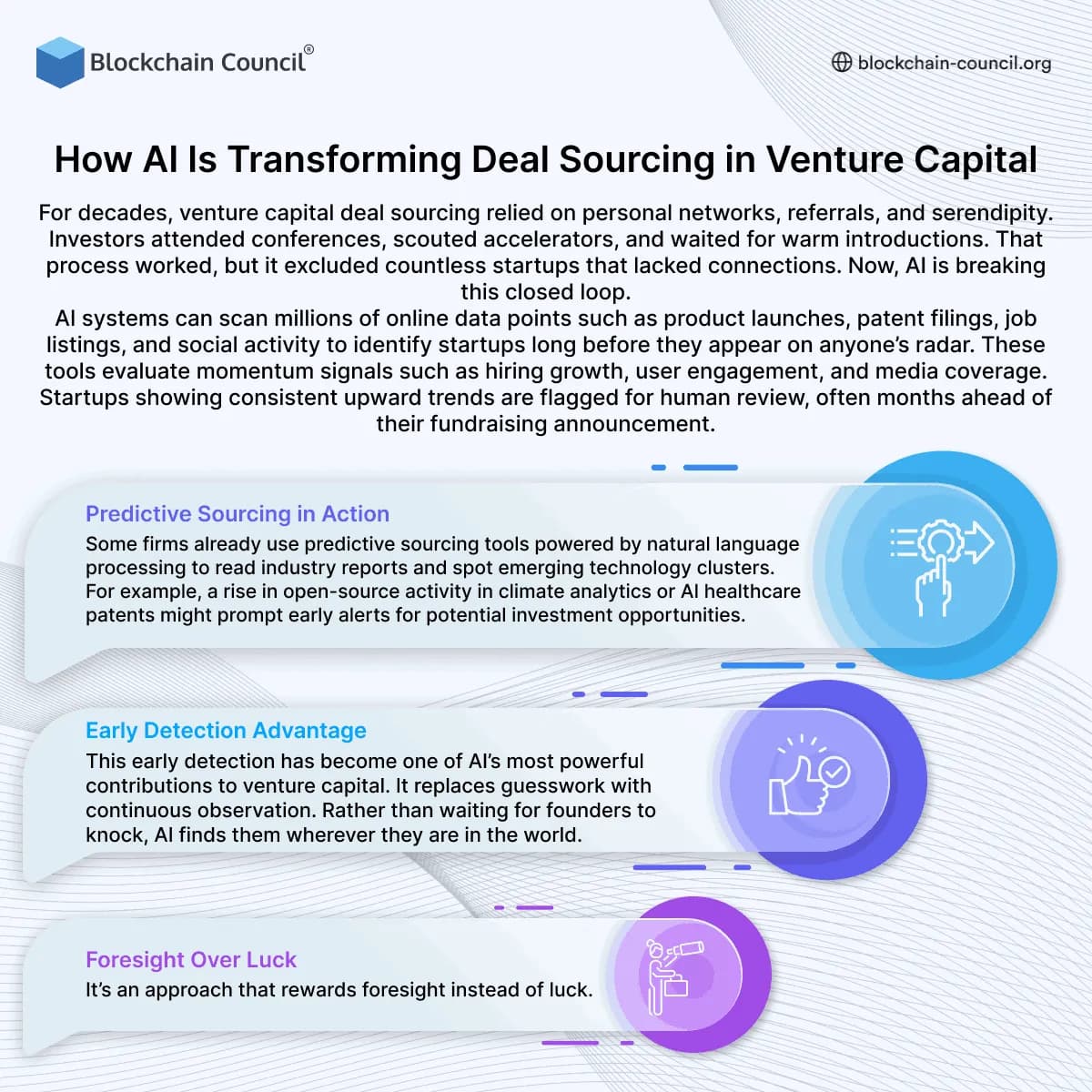
For decades, venture capital deal sourcing relied on personal networks, referrals, and serendipity. Investors attended conferences, scouted accelerators, and waited for warm introductions. That process worked, but it excluded countless startups that lacked connections. Now, AI is breaking this closed loop.
AI systems can scan millions of online data points — product launches, patent filings, job listings, and social activity — to identify startups long before they appear on anyone’s radar. These tools evaluate momentum signals such as hiring growth, user engagement, and media coverage. Startups showing consistent upward trends are flagged for human review, often months ahead of their fundraising announcement.
This early detection has become one of AI’s most powerful contributions to venture capital. It replaces guesswork with continuous observation. Rather than waiting for founders to knock, AI finds them — wherever they are in the world.
Some firms already use predictive sourcing tools powered by natural language processing to read industry reports and spot emerging technology clusters. For example, a rise in open-source activity in climate analytics or AI healthcare patents might prompt early alerts for potential investment opportunities. It’s an approach that rewards foresight instead of luck.
How AI Is Reinventing Due Diligence
Once a promising company is found, the real challenge begins: determining whether it’s worth the bet. Traditional due diligence is labour-intensive. Teams manually verify financials, market size, competition, and customer references — all prone to human error and bias.
AI simplifies this process. By aggregating public and private data, it produces comprehensive startup profiles in minutes. These profiles include sentiment analysis from online reviews, founder reputation metrics from professional networks, and even competitive heat maps.
AI also applies network theory to understand how connected a startup is within its ecosystem. Strong founder or customer networks often correlate with higher survival rates. AI can visualise these connections, showing investors how influence and collaboration patterns predict potential growth.
To understand this process technically, professionals often turn to AI certs and practical data-focused training. Learning how AI parses unstructured data gives investors confidence in what the models reveal — and what they might miss.
How AI Evaluates Founders Beyond the Pitch
Founders are the heartbeat of every startup, but evaluating their potential objectively has always been tough. Investors rely on charisma, storytelling, and track record, which can mislead. AI offers a more measured lens.
Using natural language understanding, AI analyses speech and writing patterns in interviews, pitch decks, and social media posts. It identifies traits like consistency, adaptability, and clarity — qualities linked to leadership effectiveness. Some models even compare communication styles to those of successful founders in similar industries.
This isn’t about replacing human intuition but reinforcing it with evidence. Investors can still trust their instincts while consulting AI-generated personality and credibility reports as a second opinion.
AI also tracks founder activity post-funding. If a CEO’s online engagement drops or hiring momentum slows sharply, the system flags it for review. This ongoing analysis helps investors provide timely support rather than react after a crisis.
How AI Measures Market Fit and Customer Traction
Understanding whether a product fits its market is critical — and notoriously hard to quantify. AI changes that by mapping real-time consumer behaviour and sentiment.
Large language models scan online forums, product reviews, and social channels to measure customer excitement and frustration. They pick up signals invisible in financial statements. For example, a startup might show modest revenue but high user satisfaction, signalling a strong long-term potential.
AI also compares startups against macroeconomic data. If inflation, policy changes, or demographic shifts favour a certain sector, algorithms can estimate future demand elasticity. That allows venture firms to prioritise markets with durable growth even in uncertain economic climates.
For analysts aiming to build this capability, the Data Science Certification provides the technical background for designing models that capture and interpret such patterns.
How Agentic Systems Streamline Portfolio Management
After investment, monitoring portfolio companies becomes a full-time job. Investors must track progress, detect red flags, and guide strategy. AI transforms this by turning monitoring into a predictive science.
Agentic AI systems — autonomous agents that specialise in distinct tasks — work together to track company performance. One agent monitors financial health, another follows hiring trends, while a third evaluates product sentiment. When one detects an anomaly, it triggers collaboration across the system for deeper analysis.
These multi-agent frameworks act like digital analysts operating around the clock. They alert investors early when performance deviates from expected trajectories, enabling swift action.
Training in such architectures is available through the Agentic AI Certification, which focuses on how distributed AI systems can collaborate in investment decision-making environments.
How AI Predicts Valuation Trends and Exit Opportunities
Valuation has always been the venture capitalist’s most difficult riddle. Startups often pivot multiple times, and traditional discounted cash-flow methods don’t apply. AI provides dynamic valuation models that evolve as new data arrives.
These systems learn from comparable startups — analysing funding rounds, market adoption, and team composition. When a startup’s metrics begin to resemble those of past unicorns, AI forecasts potential valuation ranges. This not only helps in negotiation but also assists funds in setting exit timelines.
Predictive analytics also uncover secondary exit opportunities. AI tracks acquisition behaviour across industries and identifies likely buyers based on technological compatibility, previous M&A history, and strategic positioning. That allows investors to plan exits proactively rather than waiting for offers.
How AI Prevents Cognitive Bias in Portfolio Decisions
Cognitive bias can be as costly as market volatility. Humans overvalue familiar sectors, underestimate risk, and stick with underperforming startups out of emotional loyalty. AI, however, assesses performance purely on evidence.
By continuously benchmarking portfolio metrics against industry standards, it removes emotional interference from decision-making. If a startup is falling behind peers on growth rate or customer retention, the system recommends strategic review or potential divestment.
AI can also simulate how portfolio adjustments might affect fund performance under different macroeconomic conditions. This level of foresight helps investors maintain discipline during volatile periods.
How AI and Human Investors Work Together
Despite the advances, AI isn’t a silver bullet. It can misinterpret ambiguous data, overfit patterns, or miss emerging human factors like team chemistry. That’s why the best results emerge from a balanced approach: AI identifies the data-driven opportunities, and humans provide contextual judgment.
In most modern funds, analysts use AI dashboards to prioritise deals while partners focus on relationship building and strategic guidance. This partnership makes investing both faster and smarter.
For professionals aspiring to manage or communicate such hybrid strategies, the Marketing and Business Certification offers training in articulating technical insights to investors and stakeholders — a skill critical in AI-assisted finance.
How AI Skills Are Becoming Core to the Venture Capital Profession
The modern VC is part financier, part technologist. Understanding how AI models work is now as important as knowing how term sheets function. Firms actively seek professionals who can evaluate algorithmic outputs and translate them into strategic decisions.
Many venture teams are hiring data scientists and training investment associates through tech certifications to build in-house AI expertise. This integration ensures that decision-making remains agile and evidence-based.
Educational initiatives like AI certs play a vital role in equipping investors with both technical literacy and ethical awareness. The goal isn’t to turn investors into coders but to help them interpret AI-generated intelligence responsibly.
How AI Links Venture Capital to the Broader Innovation Ecosystem
AI isn’t just improving VC performance; it’s connecting venture capital to the wider technology landscape. As AI-driven startups proliferate, VCs using AI gain an edge in spotting emerging domains — from generative media to biotech automation.
The shared data infrastructure that supports AI in venture capital also benefits other sectors, encouraging transparency and collaboration. This feedback loop between innovators and investors accelerates the entire startup ecosystem.
The strategic understanding of these relationships is best developed through specialised programs like AI Certification and Agentic AI Certification, which combine technical depth with business context.
How AI Is Redefining the Role of Venture Capital Partners
The traditional venture capitalist relied heavily on reputation, experience, and gut instinct. Those traits still matter, but AI is reshaping what it means to be a great investor. Today’s partners are expected to combine analytical understanding with empathy — using technology to amplify, not replace, their human insight.
With AI handling data collection and pattern recognition, partners can focus on high-value tasks such as mentoring founders, shaping business models, and aligning strategic goals. Instead of spending weeks verifying numbers, they interpret what the data means for long-term growth.
This shift is turning VCs into decision orchestrators. They don’t merely fund innovation; they guide it, armed with a continuous stream of real-time intelligence. The result is a new generation of investors who balance evidence with intuition more effectively than ever before.
How AI Enables Smarter Syndicate Building
Venture capital is often a team sport. Multiple funds co-invest in the same startups, sharing risk and amplifying network advantages. Historically, syndicate formation relied on personal connections and timing. Now, AI makes collaboration strategic rather than accidental.
By analysing deal histories, investment theses, and success correlations between firms, AI can recommend the most compatible co-investors for a given deal. It identifies partners with complementary portfolios or regional expertise, improving syndicate chemistry and deal outcomes.
AI also helps assess potential conflicts before collaboration begins. If two firms have overlapping interests in competing startups, the system highlights the issue early. This reduces friction and protects confidentiality.
Such intelligent matchmaking demonstrates that AI’s role in venture capital isn’t just analytical — it’s relational. It strengthens the fabric of collaboration that drives the entire startup ecosystem.
How AI Helps Manage Limited Partner Relations
Limited partners (LPs) — the investors who provide capital to venture funds — expect more transparency than ever. AI simplifies this by automating reporting and performance tracking.
Instead of static quarterly updates, LPs can access dashboards showing live portfolio metrics: revenue growth, valuations, burn rates, and even ESG indicators. These dashboards draw directly from the same data streams that analysts use internally, ensuring accuracy and consistency.
AI can also simulate fund performance under different macroeconomic scenarios. This helps partners communicate more confidently about strategy and risk management. It’s an approach that aligns with the strategic communication frameworks taught in the Marketing and Business Certification, where clarity and accountability are emphasised as competitive advantages.
How AI Is Making Global Venture Capital More Inclusive
For years, venture capital flowed primarily into the same geographies — Silicon Valley, London, Tel Aviv, and a few Asian tech hubs. Founders outside these regions struggled to attract attention, not because of weak ideas but because investors lacked visibility.
AI is erasing these boundaries. By evaluating startups through objective performance data rather than proximity or personal networks, AI makes it easier to discover talent anywhere in the world.
Emerging markets in Africa, Southeast Asia, and Latin America are now benefiting from this data-driven inclusion. Startups once invisible to major funds are being recognised for early traction or innovation potential. This redistribution of capital could create a more balanced global startup ecosystem.
Investors familiar with global datasets and analytics — often through AI Certification or related programs — are already capitalising on this shift, identifying undervalued markets before they reach mainstream attention.
How AI Is Shaping Startup Valuations and Term Sheet Negotiations
Negotiations in venture capital often hinge on perception: how much a company seems worth rather than its intrinsic value. AI brings discipline to that process by grounding discussions in data.
By comparing startups to similar companies across multiple dimensions — technology stack, revenue growth, user acquisition, and even sentiment — AI generates more realistic valuation ranges. This transparency reduces negotiation friction and helps both sides reach fairer terms.
AI also simulates how different funding structures affect future equity dilution or exit potential. Investors and founders can see in advance how a convertible note, for instance, might impact long-term ownership.
With tools like these, negotiations become less adversarial and more collaborative, aligning incentives between founders and investors.
How Blockchain and AI Together Bring Transparency to Venture Capital
The marriage of AI and blockchain is quietly transforming venture transparency. Blockchain ensures every transaction, funding round, and term sheet revision is securely recorded. AI analyses this data to detect irregularities, evaluate compliance, and predict liquidity outcomes.
For instance, AI can identify patterns in funding behaviour that hint at bubbles or unsustainable valuations. When combined with blockchain’s immutable records, this creates a powerful framework for trust and verification.
Professionals wanting to understand this convergence in depth often pursue blockchain technology courses. They explore how decentralised ledgers and intelligent analytics together enhance market accountability — an increasingly vital topic as private capital markets scale.
How AI Could Power the Next Generation of Venture Platforms
Venture capital is moving toward a platform model — where funding, mentoring, and analytics converge in one ecosystem. AI will likely be the core engine behind these integrated systems.
Imagine a platform that recommends startups, builds dynamic financial models, and connects investors, mentors, and customers automatically. AI could coordinate all of this, learning from every interaction to refine the matchmaking process.
In this environment, startups gain more than capital. They receive continuous operational guidance from AI agents that track market trends and product-market fit. Investors, meanwhile, receive performance updates that grow smarter over time.
Building and managing such intelligent systems requires cross-disciplinary skill — precisely what programs like Agentic AI Certification are designed to teach.
How AI Governance and Ethics Are Becoming a Priority in VC
As AI becomes more influential in investment decisions, questions of fairness and accountability are coming to the forefront. Regulators and LPs now ask not only what an AI model predicts but why it predicts it.
To address this, firms are creating internal AI ethics committees. These groups audit models for bias, ensure explainability, and align predictions with investment principles. Ethical governance isn’t just compliance — it’s brand protection.
Transparency builds trust with both founders and investors. Funds that openly communicate their AI methodology are more likely to attract institutional capital. They show responsibility and foresight in managing advanced technologies.
This ethical literacy is increasingly considered part of leadership skill. Courses like AI certs and tech certifications help professionals navigate complex intersections between innovation, governance, and reputation.
How AI Connects Venture Capital to Broader Economic Stability
Venture capital doesn’t operate in isolation. It influences job creation, innovation cycles, and even national competitiveness. By making VC more predictable, AI indirectly strengthens the broader economy.
When funds allocate capital more efficiently, fewer resources are wasted on unsustainable ventures. This reduces market bubbles and promotes steady growth across sectors. Governments benefit, too — policy decisions become more data-driven when investment patterns reflect genuine innovation rather than hype.
AI thus serves as a bridge between private ambition and public progress. The same analytics that help a fund choose startups can also inform regional development strategies.
The Road Ahead: From Instinct to Intelligence
The venture capital industry is entering a phase where intuition meets precision. Human investors will always matter for their creativity, empathy, and strategic perspective, but AI is bringing unprecedented clarity to what was once pure guesswork.
The next generation of VCs will blend financial acumen with digital fluency. They’ll interpret predictive dashboards, understand model limitations, and use insights to guide human judgment — not replace it.
Whether through structured learning such as AI Certification, Marketing and Business Certification, or advanced technology programs, staying relevant in this era requires continuous learning.
AI won’t end the art of venture capital, but it will make the art smarter, faster, and fairer — turning investment from intuition into informed foresight.
Related Articles
View All
AI & ML
Meet KIMI K3
KIMI K3 is the latest AI model in the Kimi family, designed to deliver stronger reasoning, coding, multilingual capabilities, and agentic workflows. Discover its key features, use cases, and how it compares with other leading AI models.

AI & ML
How to Use ChatGPT at Work: Practical Guide for Teams and Professionals
Learn how to use ChatGPT at work for reports, research, automation, coding, and team workflows while keeping data security and human review in place.
AI & ML
How to Use Loop Engineering in ChatGPT
Learn how Loop engineering turns ChatGPT into a repeatable AI workflow with goals, verifiers, memory, tools, budgets, and safe stop conditions.
Trending Articles

Can DeFi 2.0 Bridge the Gap Between Traditional and Decentralized Finance?
The next generation of DeFi protocols aims to connect traditional banking with decentralized finance ecosystems.
Claude AI Tools for Productivity
Discover Claude AI tools for productivity to streamline tasks, manage workflows, and improve efficiency.
How to Install Claude Code
Learn how to install Claude Code on macOS, Linux, and Windows using the native installer, plus verification, authentication, and troubleshooting tips.