AI and Cultural Preservation
 Michael Willson
Artificial intelligence is no longer just about automation, robotics, or business productivity. It is becoming a tool for something deeply human: preserving cultures, languages, and heritage. Around the world, AI is being applied to digitize ancient manuscripts, reconstruct damaged artifacts, revive endangered languages, and make cultural traditions accessible to younger generations. This article explores how AI is shaping cultural preservation, what opportunities it creates, and what ethical challenges we must confront. If you want to understand the intersection of technology and heritage while advancing your career, an AI certification is a strong way to build the right foundation.
Why Cultural Preservation Needs AI
Cultural preservation is about protecting the knowledge, traditions, and artifacts that define human identity. This includes tangible heritage such as monuments, manuscripts, and art, as well as intangible heritage such as oral traditions, languages, and rituals.

The challenge is that cultural heritage is under constant threat. Climate change, natural disasters, conflict, and neglect all damage cultural sites and artifacts. Languages are disappearing at an alarming rate; according to UNESCO, nearly half of the world’s 7,000 languages are at risk of extinction by the end of this century.
Traditional methods of preservation, while essential, are not enough. They require time, expertise, and resources that many communities do not have. AI offers a new set of tools that can complement human efforts by speeding up digitization, identifying patterns, and making archives accessible worldwide.
Stepwise Process: How AI Helps in Cultural Preservation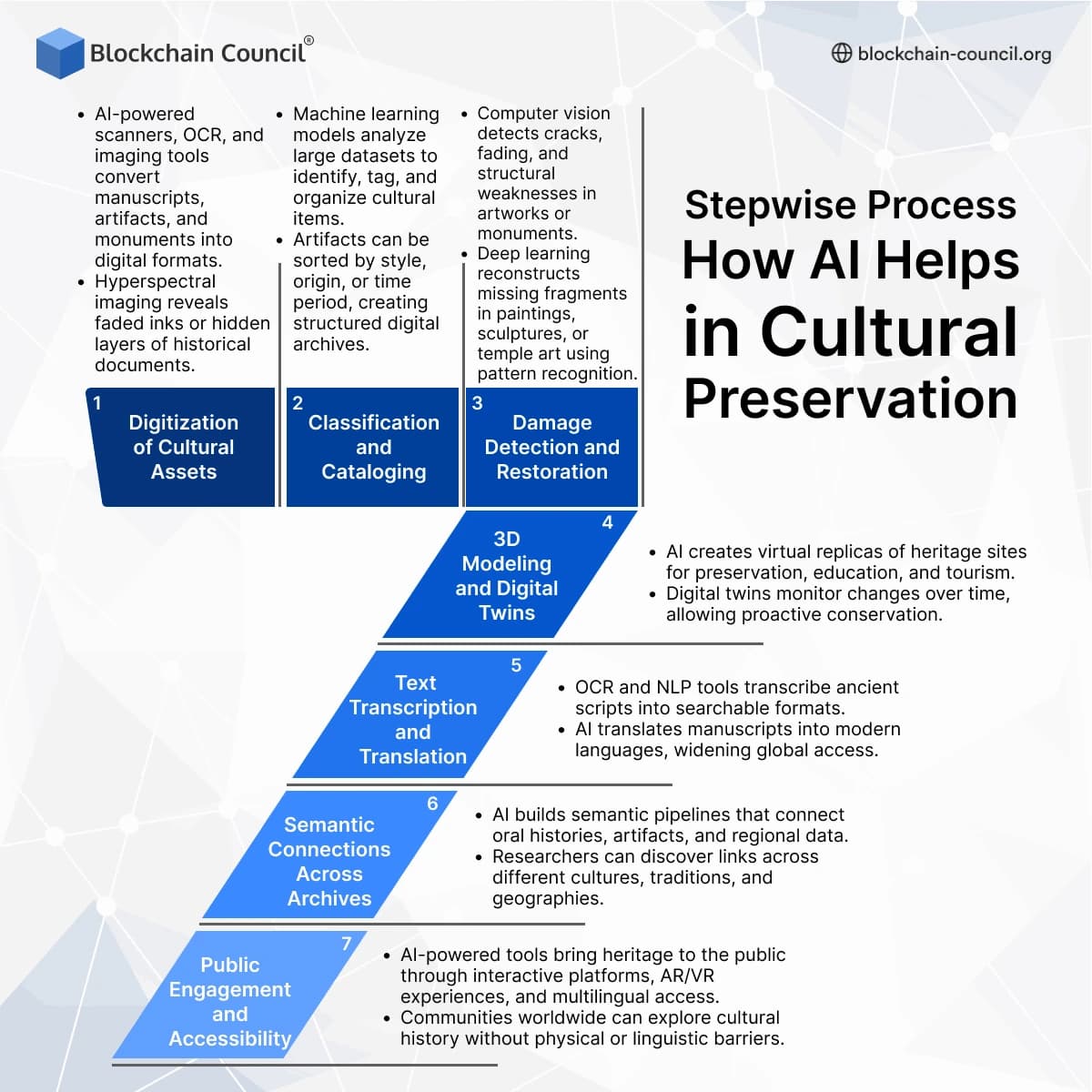
Step 1: Digitization of Cultural Assets
- AI-powered scanners, OCR, and imaging tools convert manuscripts, artifacts, and monuments into digital formats.
- Hyperspectral imaging reveals faded inks or hidden layers of historical documents.
Step 2: Classification and Cataloging
- Machine learning models analyze large datasets to identify, tag, and organize cultural items.
- Artifacts can be sorted by style, origin, or time period, creating structured digital archives.
Step 3: Damage Detection and Restoration
- Computer vision detects cracks, fading, and structural weaknesses in artworks or monuments.
- Deep learning reconstructs missing fragments in paintings, sculptures, or temple art using pattern recognition.
Step 4: 3D Modeling and Digital Twins
- AI creates virtual replicas of heritage sites for preservation, education, and tourism.
- Digital twins monitor changes over time, allowing proactive conservation.
Step 5: Text Transcription and Translation
- OCR and NLP tools transcribe ancient scripts into searchable formats.
- AI translates manuscripts into modern languages, widening global access.
Step 6: Semantic Connections Across Archives
- AI builds semantic pipelines that connect oral histories, artifacts, and regional data.
- Researchers can discover links across different cultures, traditions, and geographies.
Step 7: Public Engagement and Accessibility
- AI-powered tools bring heritage to the public through interactive platforms, AR/VR experiences, and multilingual access.
- Communities worldwide can explore cultural history without physical or linguistic barriers.
Digitization and Archival with AI
One of the most important uses of AI in cultural preservation is digitization. Ancient manuscripts, fragile records, and historical archives are often inaccessible due to language barriers or physical decay.
AI-driven optical character recognition (OCR) and machine learning models are transforming this space. For instance, the Asiatic Society in India has partnered with technical institutes to digitize over 50,000 manuscripts. By using hyperspectral imaging and AI-powered transcription tools, faded texts can be restored and made searchable.
Projects like SUCHO (Saving Ukrainian Cultural Heritage Online) show how AI and digital tools can preserve endangered cultural assets in times of crisis. Volunteers have used AI-assisted scraping and archiving to save websites and digital collections threatened by war.
In Europe, the AI4Culture project provides open-source datasets and tools to help cultural institutions digitize and connect their collections. This not only preserves history but also makes it accessible to researchers, students, and the public.
Digitization does not just mean storage. It means turning fragile cultural items into living resources that can be studied, taught, and celebrated long after the originals may be gone.
AI in Restoration and Reconstruction
Beyond digitization, AI helps restore and reconstruct heritage that has already been damaged or lost. Using computer vision and 3D reconstruction, researchers can create digital twins of monuments and artifacts.
For example, in Taiwan, AI-assisted 3D modeling has been used to restore temple art. Old photographs, combined with AI tools, allow experts to recreate structures with remarkable accuracy. In Rome, Microsoft worked with the Vatican to build a digital twin of St. Peter’s Basilica, creating both a preservation record and a tool for monitoring structural health.
Deep learning is also being applied to predict damage in heritage buildings, enabling early intervention before disasters strike. This proactive use of AI transforms preservation from reactive repair to predictive care.
Protecting Intangible Heritage
Intangible heritage—such as songs, dances, rituals, and languages—is harder to preserve than physical artifacts. AI is proving valuable here too.
One striking example is the NushuRescue project in China, which focuses on revitalizing the endangered Nushu script, a writing system used historically by women. With limited data available, AI models trained on minimal examples are helping reconstruct and promote the script.
Similarly, ICH-Qwen, a large language model dedicated to Chinese intangible cultural heritage, has been developed to preserve traditions and make them accessible. It allows researchers and communities to explore cultural practices that might otherwise be forgotten.
UNESCO has emphasized the importance of including local communities in these projects. AI can help preserve intangible heritage, but cultural sensitivity and consent are essential to avoid misrepresentation or appropriation.
Expanding Access and Engagement
Cultural preservation is not just about saving knowledge. It is also about sharing it. AI makes heritage more accessible to the public through interactive platforms, augmented reality (AR), and virtual reality (VR).
For example, the AI Remembers project uses AI to make World War II heritage more interactive. By overcoming language barriers and connecting archival material, the project creates immersive storytelling experiences that reach wider audiences.
In archives, AI helps generate metadata and transcriptions, turning static documents into searchable resources. This empowers teachers, researchers, and curious citizens to engage with history more directly.
When cultural heritage is made accessible in multiple languages, it ensures that communities across the globe can connect with and learn from traditions that are not their own. This strengthens global cultural exchange and understanding.
Technologies Driving Cultural Preservation with AI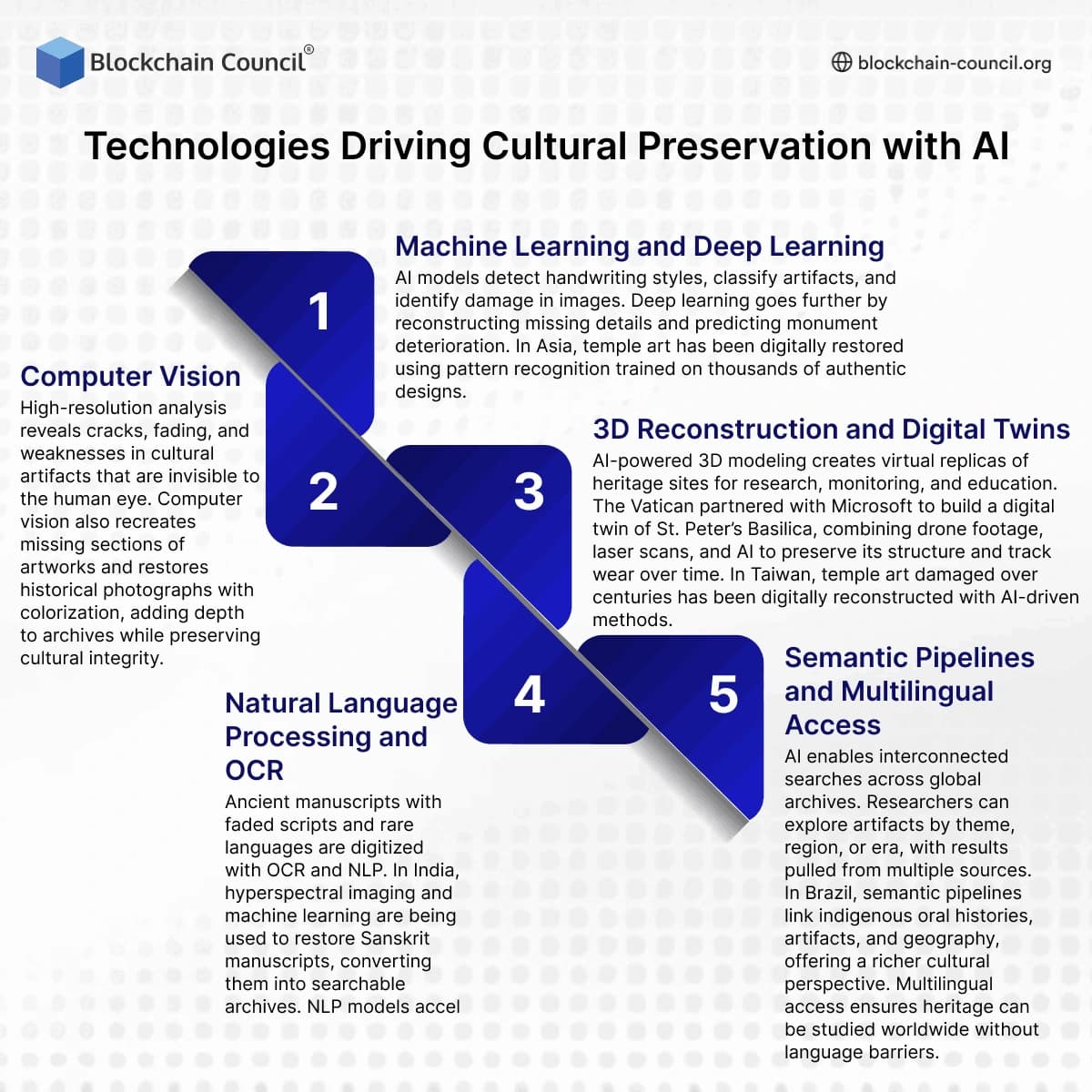
Machine Learning and Deep Learning
AI models detect handwriting styles, classify artifacts, and identify damage in images. Deep learning goes further by reconstructing missing details and predicting monument deterioration. In Asia, temple art has been digitally restored using pattern recognition trained on thousands of authentic designs.
Computer Vision
High-resolution analysis reveals cracks, fading, and weaknesses in cultural artifacts that are invisible to the human eye. Computer vision also recreates missing sections of artworks and restores historical photographs with colorization, adding depth to archives while preserving cultural integrity.
3D Reconstruction and Digital Twins
AI-powered 3D modeling creates virtual replicas of heritage sites for research, monitoring, and education. The Vatican partnered with Microsoft to build a digital twin of St. Peter’s Basilica, combining drone footage, laser scans, and AI to preserve its structure and track wear over time. In Taiwan, temple art damaged over centuries has been digitally reconstructed with AI-driven methods.
Natural Language Processing and OCR
Ancient manuscripts with faded scripts and rare languages are digitized with OCR and NLP. In India, hyperspectral imaging and machine learning are being used to restore Sanskrit manuscripts, converting them into searchable archives. NLP models accelerate translation into modern languages, making once-inaccessible texts widely available.
Semantic Pipelines and Multilingual Access
AI enables interconnected searches across global archives. Researchers can explore artifacts by theme, region, or era, with results pulled from multiple sources. In Brazil, semantic pipelines link indigenous oral histories, artifacts, and geography, offering a richer cultural perspective. Multilingual access ensures heritage can be studied worldwide without language barriers.
Artificial intelligence is not a single technology but a collection of methods that can be applied to different parts of cultural preservation. Each method contributes in unique ways, from digitization to engagement.
Machine Learning and Deep Learning
Machine learning models excel at finding patterns in large datasets. In cultural preservation, this means being able to recognize handwriting styles in manuscripts, detect damage in images of paintings, or classify artifacts in large museum collections. Deep learning models take this further by reconstructing missing details, predicting how a monument might deteriorate, and suggesting ways to restore it.
For example, deep learning algorithms have been applied to ancient temple art in Asia, where missing fragments were reconstructed using pattern recognition. Instead of guessing, the system learns from thousands of similar designs to propose authentic reconstructions.
Computer Vision
Computer vision is one of the most powerful tools in this field. By analyzing photographs of artifacts, AI can detect cracks, fading, or structural weaknesses that human eyes might miss. It can also recreate missing sections of an artwork or building by blending existing elements.
Color reconstruction is another area where computer vision shines. Old black-and-white photos can be colorized, giving a new dimension to historical archives. While purists worry that this alters authenticity, carefully applied computer vision can reveal hidden details without compromising cultural meaning.
3D Reconstruction and Digital Twins
AI-powered 3D modeling allows researchers to create digital twins of heritage sites and monuments. A digital twin is a virtual replica that can be used for monitoring, teaching, and even tourism.
The Vatican’s partnership with Microsoft to build a digital twin of St. Peter’s Basilica is a landmark example. The project combined drones, laser scans, and AI algorithms to produce a faithful digital version of the basilica. This not only preserves the structure in digital form but also enables monitoring of wear and tear over time.
In Taiwan, researchers used AI to reconstruct temple art that had suffered from centuries of damage. By combining photographs, point cloud data, and AI-driven restoration, they recreated detailed models that future generations can study.
Natural Language Processing and OCR
Ancient manuscripts often contain faded scripts, unusual symbols, and languages that are difficult to read. Optical Character Recognition (OCR) and natural language processing (NLP) tools help transcribe and translate these texts.
In India, universities and research institutions are using OCR combined with machine learning to digitize manuscripts in Sanskrit and other classical languages. Hyperspectral imaging is applied to reveal faded ink, and AI algorithms convert the text into searchable digital formats.
NLP models also help translate manuscripts into modern languages, opening up access for wider audiences. Without AI, such translation projects would take decades; with AI, progress accelerates dramatically.
Semantic Pipelines and Multilingual Access
Another critical technology is semantic search and embedding pipelines. These allow different archives to connect with one another. For example, a user could search for an artifact by theme, region, or time period, and the AI system would pull results from multiple sources.
In Brazil, researchers are applying semantic pipelines to indigenous heritage archives. This allows connections to be made across oral histories, artifacts, and geographical data. The result is a richer, more interconnected understanding of cultural traditions.
Multilingual access is another advantage. AI can allow users to explore heritage materials in their native languages, breaking down barriers that traditionally limited research to a few global languages.
Ethical and Cultural Challenges
While the promise of AI in cultural preservation is enormous, the ethical risks are equally significant.
Bias and Representation
AI reflects the data it is trained on. If training datasets overrepresent dominant cultures, minority voices may be overlooked. This can lead to the misrepresentation of traditions or the erasure of cultural nuances.
For example, if an AI translation system has been trained primarily on Western languages, it may mistranslate or oversimplify indigenous terms. The result is a distortion of meaning that weakens authenticity.
UNESCO has emphasized the importance of community participation in AI preservation projects. Without local voices, AI may unintentionally impose external perspectives on cultural practices.
Consent and Ownership
Who decides what gets digitized, how it is represented, and who owns the digital copies? These questions are central to cultural ethics.
Some heritage items are sacred or private, meant only for specific communities. Digitizing them without consent can be seen as cultural appropriation. Similarly, when international institutions digitize heritage from poorer nations, questions of ownership and control emerge. Does the community retain rights over its digital heritage, or do external institutions profit from it?
Loss of Context
AI excels at reconstructing artifacts, but it often struggles with cultural context. A digital reconstruction of a statue may be technically accurate but devoid of the rituals, stories, and traditions that give it meaning. Without expert oversight and community input, AI risks producing hollow replicas rather than living heritage.
Authenticity versus Enhancement
One of the most debated issues is authenticity. AI restorations may improve clarity, restore missing pieces, or even enhance colors. But where does restoration end and alteration begin?
For example, AI has been used to restore old films, such as Bruce Lee’s classics. While the enhanced versions are sharper and more colorful, some critics argue they lose the texture and atmosphere of the original. The same applies to art and monuments: enhancements may unintentionally replace authenticity with modern aesthetics.
Technological Gaps and Inequality
Not all communities have access to advanced AI tools. Many indigenous groups face technological and funding barriers that prevent them from digitizing their heritage. This creates a risk of cultural inequality, where wealthy nations preserve and showcase their heritage while marginalized groups fall further behind.
Infrastructure gaps also create sustainability issues. Digitized archives require long-term storage, regular updates, and stable internet access. Without investment, digital heritage itself risks becoming obsolete.
Sustainability and Environmental Costs
Digitization and AI are not free of environmental costs. Data centers require large amounts of electricity and water. Training AI models for cultural preservation, such as large language model for endangered languages, carries the same environmental burdens as other AI applications.
Balancing preservation with environmental sustainability is therefore another challenge. It is not enough to save heritage digitally if the process itself accelerates climate risks that threaten physical heritage sites.
Case Studies: AI in Action
Asiatic Society (India)
The Asiatic Society, in collaboration with IIT Kharagpur and IIT Delhi, has launched a project to digitize more than 50,000 manuscripts. Hyperspectral imaging is used to capture faded texts, while AI algorithms transcribe and translate them. This project is not only about preservation but also about unlocking knowledge from centuries-old documents.
Vatican Digital Twin
In Rome, the Vatican partnered with Microsoft to create a digital twin of St. Peter’s Basilica. This project involved drones, laser scans, and AI algorithms. The result is both a preservation archive and a monitoring tool for ongoing structural health. Citizens and tourists can also experience the basilica virtually.
NushuRescue (China)
The endangered Nushu script, used historically by women in parts of China, is being revitalized with the help of AI. With minimal data available, researchers trained models to generate translations and build resources for teaching. This project demonstrates how AI can help save languages on the brink of extinction.
ICH-Qwen Model
China has also developed ICH-Qwen, a large language model focused on intangible cultural heritage. By training on cultural datasets, it helps preserve and disseminate practices, rituals, and traditions. It is a clear example of how AI can be tailored to protect specific cultural domains.
AI Remembers (Europe)
The AI Remembers project integrates AI into World War II heritage preservation. By connecting multilingual archives and creating interactive storytelling tools, the project allows younger generations to engage with history in new ways.
Opportunities and Best Practices
The potential of AI in cultural preservation is undeniable. Yet to maximize its benefits while avoiding harm, projects must follow best practices.
Engaging Source Communities
Cultural heritage belongs to the communities that live it. When external institutions lead preservation projects without local voices, they risk misrepresentation or cultural appropriation. The best AI projects involve communities from the start—deciding what gets digitized, how it is represented, and how it is shared. This not only ensures authenticity but also builds trust.
Localized Training Data
AI models work best when they are trained on relevant data. For endangered languages or cultural practices, this means collecting examples directly from the communities. Local training data prevents AI from defaulting to global or dominant cultural patterns. It also ensures that outputs reflect the richness and uniqueness of each tradition.
Open Access and Collaboration
Cultural preservation thrives when knowledge is shared. Projects like AI4Culture in Europe demonstrate the power of open-source datasets and tools. By making resources freely available, institutions allow smaller museums, local libraries, and community groups to participate in preservation efforts.
Blending AI with Human Expertise
AI can reconstruct, digitize, and analyze. But historians, linguists, and cultural custodians provide the context. The most effective preservation projects combine AI’s scale with human expertise, ensuring that reconstructions are not only technically accurate but also culturally meaningful.
Long-Term Digital Preservation
Preserving culture digitally is not enough if archives are lost to obsolescence or poor storage. Best practices include using standardized metadata, regular backups, and migration to new formats as technology evolves. Digital heritage must be treated with the same care as physical artifacts.
Risks of Overreliance on Technology
While AI expands possibilities, there is a danger in depending on it too heavily.
One risk is loss of human skills. If communities rely only on AI to preserve or translate, younger generations may stop learning the traditions themselves. For example, if an endangered language is stored digitally but no one speaks it, the cultural experience is weakened.
Another risk is homogenization. If many communities use the same AI tools, outputs may start to look similar, losing the distinctive styles that define different cultures.
Finally, overreliance may create false security. Digital twins and reconstructions are valuable, but they are not substitutes for protecting physical heritage. If policymakers assume AI archives are enough, they may neglect the urgent task of preserving sites and artifacts in the real world.
Education and Building Skills
AI in cultural preservation requires skilled professionals who can bridge technology and heritage. This is where structured education and certifications play a key role.
Professionals in this field benefit from AI certs, which prepare them to understand both the technical and ethical dimensions of AI. These programs cover how AI works, how to guide its outputs, and how to evaluate its cultural impact.
For those who want to work at the intersection of heritage and data, a Data Science Certification builds expertise in handling large datasets, semantic pipelines, and multilingual search tools. This is vital for archives and heritage institutions.
Leaders in cultural institutions may also pursue a Marketing and Business Certification, which equips them to design outreach strategies that responsibly share cultural heritage with the public using AI tools.
Finally, blockchain technology courses are increasingly relevant. Blockchain offers ways to secure ownership rights, verify authenticity, and ensure transparent access to digital heritage. When combined with AI, it creates a system where preserved culture remains trustworthy and tamper-proof.
These certifications not only build technical competence but also strengthen ethical awareness, ensuring that cultural preservation remains respectful and inclusive.
The Balance Between Preservation and Innovation
AI opens doors to unprecedented preservation methods. But balance is essential. We must ensure that:
- Technology serves culture, not the other way around.
- Communities remain owners of their heritage.
- Authenticity is valued as much as accessibility.
- Physical preservation continues alongside digital efforts.
This balance is the only way to ensure that AI strengthens cultural preservation instead of unintentionally weakening it.
Conclusion: A Shared Responsibility
AI and cultural preservation are not opposites. When combined thoughtfully, they can reinforce one another. AI can safeguard endangered languages, reconstruct damaged heritage, and make archives accessible to people across the globe. It can breathe new life into traditions, giving them relevance in a digital age.
But these benefits come with responsibility. Bias, consent, authenticity, and sustainability must guide every project. Communities must be active participants, not passive subjects. Professionals must build skills to guide AI ethically. Policymakers must create frameworks that protect ownership and fairness.
Cultural preservation has always been about passing knowledge to future generations. With AI, that task can become faster, broader, and more resilient. Yet the heart of preservation remains human. AI can store our traditions, but only people can live them, teach them, and carry them forward.
The promise of AI in cultural preservation is clear. Used wisely, it can help us protect the richness of human heritage while making it accessible to all. The responsibility lies with us—to ensure that in our race to innovate, we never lose sight of the cultures we are trying to save.