AI Agents in Disaster Response

AI agents in disaster response have moved from theory into real-world operations because emergencies now generate more data than humans can process fast enough. Earthquakes, floods, hurricanes, wildfires, and health crises produce continuous streams of satellite imagery, sensor data, emergency calls, social media signals, hospital capacity updates, and logistics constraints. The role of AI agents is not to replace responders, but to help decision-makers see clearly, prioritize faster, and act with better information when minutes matter.
This shift did not happen overnight. It is the result of years of experimentation by governments, humanitarian organizations, and technology providers, followed by a clear realization that traditional dashboards and static analytics are too slow during large-scale crises.

At the core of AI agents in disaster response is artificial intelligence that can monitor signals, plan next steps, coordinate tools, and maintain context across hours or days of an unfolding emergency. Understanding how these systems work in practice requires more than surface-level familiarity, which is why many professionals exploring this space begin with structured foundations such as an AI certification that focuses on real-world deployment rather than theoretical models.
How AI agents operate during disasters
An AI agent in a disaster setting is not a chatbot. It is a system designed to observe, decide, and assist under strict constraints.
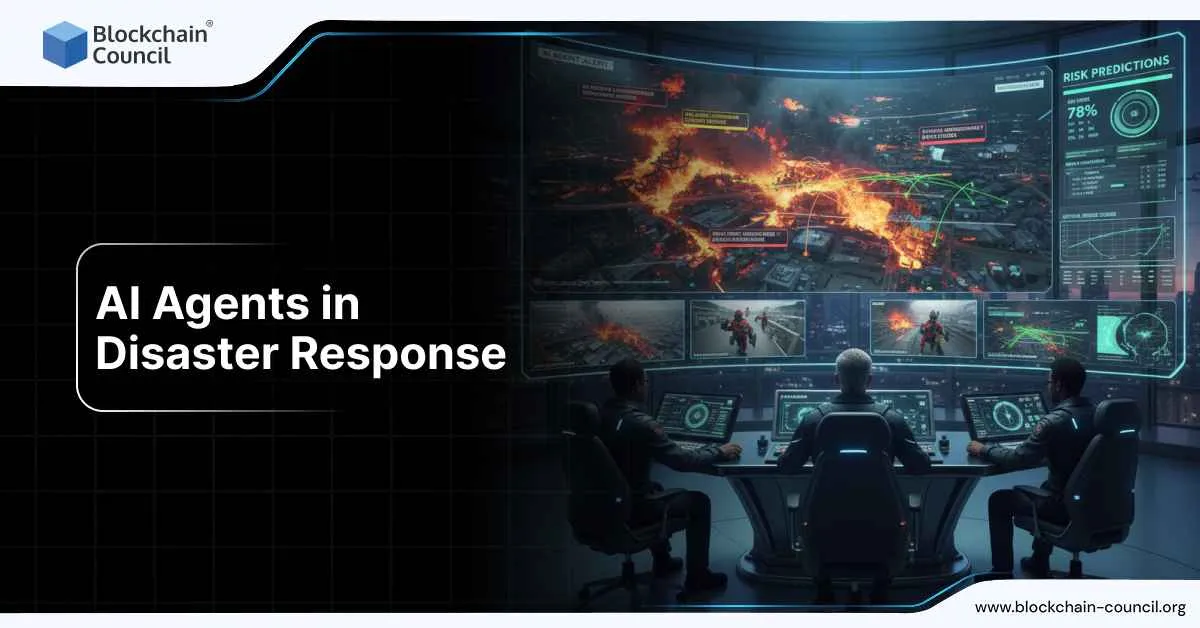
A typical operational loop includes continuous data intake from weather services, seismic sensors, satellites, drones, emergency hotlines, and public infrastructure systems. The agent then fuses this data, removes duplicates, assigns confidence scores, and flags anomalies. Based on predefined objectives and rules, it proposes actions such as prioritizing affected zones, allocating resources, or drafting public alerts.
Crucially, these actions are recommendations, not automatic commands. Human approval remains central, especially for decisions that affect public safety or resource deployment.
Real examples already in use
One of the most cited real-world uses of AI in disaster response comes from the United States Federal Emergency Management Agency. Following Hurricane Ian, FEMA used machine learning systems to analyze aerial imagery and assess structural damage at scale. The system reduced the number of buildings requiring manual review from more than one million to a fraction of that number, allowing teams to focus on the most severely affected areas within days rather than weeks.
This approach established a clear pattern that has since been repeated globally. AI agents handle scale and speed, while humans handle judgment and accountability.
In health emergencies, similar systems have been used to track hospital capacity, predict supply shortages, and prioritize medical response during outbreaks. The World Health Organization has also introduced AI-powered emergency toolkits aimed at improving coordination across regions during complex health crises.
From analytics to agentic coordination
Earlier disaster technologies focused on analytics and reporting. The current generation focuses on coordination.
Modern AI agents can:
- Track evolving situations across multiple regions simultaneously
- Recommend logistics routes based on real-time road and weather conditions
- Draft situation reports for command centers
- Assist call centers by categorizing and prioritizing incoming requests
Some experimental systems go further by simulating response scenarios before actions are taken. These simulations help commanders understand potential outcomes before committing limited resources.
Designing such systems requires deep integration across data sources, communications platforms, and operational tools. That integration challenge is one reason disaster-response AI increasingly overlaps with enterprise-grade system design, an area often covered in depth through a Tech Certification focused on scalable and reliable architectures.
Human-in-the-loop remains non-negotiable
One of the most important lessons learned is that autonomy without oversight is dangerous in crisis environments.
AI agents in disaster response are deliberately constrained. They operate with approval checkpoints, role-based permissions, and full audit logs. Any recommendation related to evacuation orders, public warnings, or resource diversion must be reviewed by trained officials.
This design philosophy reflects real incidents where automated systems produced technically correct but contextually inappropriate recommendations. Keeping humans in control is not a limitation. It is a requirement.
Challenges that still limit deployment
Despite clear benefits, AI agents in disaster response face serious challenges.
Data fragmentation is one of the biggest. Emergency data comes from incompatible systems owned by different agencies, often with inconsistent formats and update cycles. AI agents can help fuse this information, but they cannot fix poor data governance on their own.
Another challenge is trust. Responders must understand why an agent is recommending a specific action. Black-box suggestions are rarely accepted in high-stakes environments. This has driven a strong push toward explainable outputs and traceable decision paths.
Security is also critical. Disaster systems are potential targets for misinformation, manipulation, or cyberattacks. AI agents must be hardened against malicious inputs, especially during politically or economically sensitive events.
Why governments and organizations are investing now
The reason investment accelerated in the last few years is simple. Disasters are becoming more frequent, more complex, and more expensive.
Climate-related events alone have increased the scale and unpredictability of emergency response. At the same time, public expectations for timely information and coordinated action have risen sharply. AI agents help bridge the gap between limited human capacity and growing operational demands.
For organizations involved in humanitarian aid, infrastructure management, or public safety, these systems are no longer optional experiments. They are becoming part of standard preparedness planning.
Aligning technology decisions with public trust, accountability, and operational goals also requires strong leadership and strategy. This is where broader frameworks, such as those emphasized in a Marketing and Business Certification, become relevant even in emergency management contexts. Clear communication, stakeholder alignment, and ethical governance matter as much as technical performance.
Conclusion
AI agents in disaster response do not eliminate chaos. They reduce blind spots.
They allow responders to see patterns earlier, allocate resources more rationally, and update plans as situations evolve. They also create institutional memory by logging decisions and outcomes, which improves preparedness for future events.
The most effective deployments treat AI agents as disciplined partners. They are embedded into existing command structures, governed by clear rules, and continuously evaluated against real outcomes.
As disasters grow more complex, the question is no longer whether AI agents belong in disaster response. It is how responsibly and transparently they are designed, deployed, and governed.