

CoinDCX’s $16 Million Loss: What a Retired Wallet Failure Reveals About Crypto Security, Digital Asset Custody and Risk Management
 Michael Willson
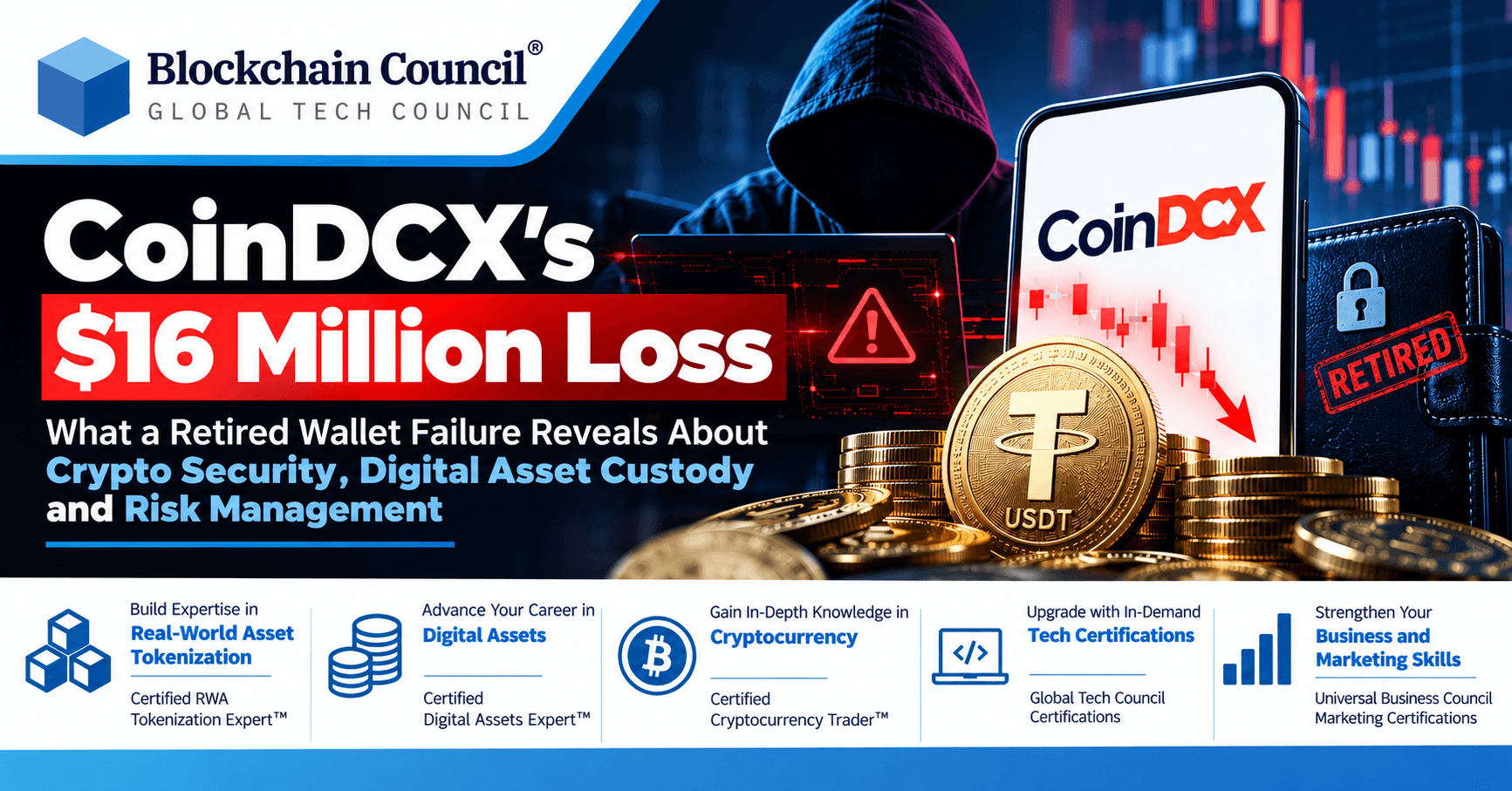
India’s cryptocurrency industry is facing renewed questions about operational security after CoinDCX disclosed a loss of 15.99 million USDT, approximately $16 million, linked to deposits accumulating in retired wallet infrastructure. The exchange said an automated process designed to move funds from older deposit addresses had failed for a period, allowing assets to remain in infrastructure previously compromised during a security incident in July 2025.
The incident highlights an important lesson for cryptocurrency exchanges, blockchain professionals, digital asset investors and technology leaders: digital asset security depends not only on protecting wallets but also on managing legacy systems, automated processes, internal controls and operational accountability.

According to CoinDCX’s October 25, 2026, disclosure, the company absorbed the reported loss and said customer balances, active wallets and trading systems were unaffected. The disclosure followed public scrutiny of suspicious blockchain transactions and an earlier response in which the exchange had characterised the initial reports as a false alarm. CoinDCX also acknowledged that it could have communicated more proactively.
The incident offers a valuable case study for understanding cryptocurrency security, blockchain transaction monitoring, digital asset custody, real-world asset tokenization and the growing importance of technical and business expertise in the digital economy.
What Happened to CoinDCX?
CoinDCX reported a loss of 15.99 million USDT after deposits accumulated in older wallet infrastructure that the exchange had retired following its July 2025 security incident.
The exchange explained that some customers continued sending cryptocurrency to outdated deposit addresses despite being instructed to use updated addresses. Its systems credited those deposits to customer accounts, while a separate automated service, commonly known as a wallet-sweeping process, was responsible for transferring the underlying funds to the exchange’s primary wallet infrastructure.
According to the exchange, this secondary process failed for a particular period. As a result, deposits remained in the older wallet infrastructure rather than being moved to the intended destination.
CoinDCX said it detected unusual activity on October 21, 2026, and subsequently identified irregular blockchain fund movements. Its later disclosure confirmed the $15.99 million loss.
The company stated that it absorbed the loss and that customer balances, active wallets and trading systems were unaffected.
However, several technical details remain undisclosed, including the exact duration of the sweeping failure, the precise method used to move the funds, and whether the October incident involved the same actors responsible for the earlier breach.
These distinctions matter. The reported loss is confirmed by the exchange, but the full technical explanation has not been independently established through the public information currently available.
How Can a Retired Crypto Wallet Still Receive Funds?
A cryptocurrency wallet address does not automatically stop functioning when an exchange stops using it.
Blockchain networks generally continue to recognise valid addresses even after a business has marked them as deprecated, replaced them in its application or instructed customers to stop using them.
For example, a customer might have saved an exchange deposit address months earlier. If that customer later sends cryptocurrency to the saved address, the blockchain can still process the transaction.
This creates an operational challenge for exchanges that continue recognising deposits sent to old addresses.
The exchange may maintain a recovery mechanism that identifies incoming funds, credits the customer’s account and transfers the actual cryptocurrency into its current custody infrastructure.
That arrangement can help customers who accidentally use outdated details. However, it also creates an ongoing responsibility to monitor those addresses and ensure that incoming funds are transferred securely.
In the CoinDCX case, the exchange said that the mechanism responsible for moving deposits from the older infrastructure failed for a period.
The key lesson is that retiring a wallet address is not the same as eliminating every operational dependency connected to it. Legacy addresses, background services, access permissions and recovery procedures must all be managed throughout their lifecycle.
What Is a Crypto Wallet-Sweeping Process?
A wallet-sweeping process automatically transfers cryptocurrency from one address to another, usually from a deposit address to a designated operational or custody wallet.
Cryptocurrency exchanges may use this approach to consolidate deposits, manage transaction costs, simplify monitoring and maintain their preferred custody arrangements.
A typical process involves five stages:
A customer sends cryptocurrency to a deposit address.
The exchange detects and validates the incoming blockchain transaction.
The customer’s account is credited according to the exchange’s deposit policy.
An automated service transfers the cryptocurrency to a designated wallet.
Monitoring systems verify that the transfer was completed and reconcile the resulting balances.
Each stage introduces potential failure points.
A blockchain event may not be detected correctly. A transfer may fail because of insufficient network fees. A service may stop running. An access credential may become compromised. An alert may be generated but not escalated to the appropriate team.
If the exchange credits the customer before the actual funds reach the intended custody wallet, it must also reconcile its customer liabilities with the assets it controls.
A robust wallet-sweeping system therefore needs more than automation. It requires transaction-level monitoring, exception handling, access controls, audit logs and procedures for responding when transfers do not complete.
The CoinDCX incident demonstrates why businesses must monitor the entire deposit lifecycle rather than treating successful customer crediting as proof that the underlying assets have reached their intended destination.
Why Legacy Infrastructure Creates Cybersecurity Risks
Legacy infrastructure refers to systems, services, applications and technical components that remain connected to business operations after newer systems have replaced their original functions.
Such infrastructure can become a security liability when organisations assume that a system is no longer relevant simply because it is no longer part of the main user-facing workflow.
In cryptocurrency operations, legacy infrastructure can include:
Older wallet addresses and associated signing mechanisms.
Background services that continue processing deposits.
Outdated API integrations and authentication credentials.
Automated scripts with excessive permissions.
Monitoring systems that no longer reflect current operational risks.
Recovery workflows that depend on previously compromised components.
These risks are not exclusive to cryptocurrency exchanges. Banks, payment processors, fintech platforms and other digital businesses face similar challenges when older systems remain connected to active workflows.
Effective legacy-system management should include a complete inventory of dependencies, a formal decommissioning process, revocation of unnecessary credentials, testing of recovery mechanisms and continuous monitoring of any remaining activity.
Where old addresses must remain under observation to recover customer deposits, organisations should treat them as restricted, high-risk infrastructure rather than assuming that retirement alone makes them safe.
What Does the CoinDCX Incident Teach Us About Crypto Security?
The incident highlights five important lessons for digital asset businesses.
1. Automated processes need independent monitoring
Automation can improve efficiency, but a process that fails silently can create a significant exposure.
Wallet-sweeping services should have independent health checks, transfer-completion monitoring, balance thresholds and alerts for unusual accumulation of funds.
2. Legacy systems require explicit ownership
Every system that continues to receive funds or perform security-sensitive operations should have an accountable owner, documented dependencies and a defined retirement or recovery policy.
A system should not remain operational merely because no team has formally taken responsibility for shutting it down.
3. Asset reconciliation must be continuous
Exchanges need to reconcile customer account balances, on-chain assets and internal accounting records.
A credited customer balance and a successfully secured blockchain asset are related but distinct operational events. Businesses must ensure that exceptions between these events are identified promptly.
4. Incident communication is part of risk management
When suspicious transactions become public, organisations must distinguish verified facts from preliminary assumptions.
Clear communication should explain what has been detected, which systems may be affected, what remains under investigation and when additional information will be provided.
CoinDCX acknowledged that its communication could have been more proactive. This illustrates how incident response includes both technical containment and timely stakeholder communication.
5. Security needs continuous improvement
A previous breach should trigger a review of related systems, credentials, monitoring rules and recovery processes.
Even if the original compromised component has been replaced, other services that interact with it may retain exposure.
Security programmes must therefore evaluate the entire operational environment rather than focusing exclusively on the system directly involved in an earlier incident.
What Does This Mean for Cryptocurrency Investors?
The CoinDCX disclosure is a reminder that cryptocurrency risk involves more than market volatility.
Investors and users of digital asset platforms should understand how an exchange handles custody, deposits, withdrawals, security incidents and customer balances.
Practical precautions include:
Always retrieve the latest deposit address from the official exchange application or website.
Verify the cryptocurrency and blockchain network before transferring funds.
Avoid relying on outdated screenshots, saved instructions or old deposit details.
Consider a small test transfer when appropriate, especially for unfamiliar addresses or networks.
Enable available account security features, including strong authentication.
Follow official incident updates and review the exchange’s explanations of any operational disruption.
Understand the difference between an exchange account balance and direct control of private keys.
These precautions reduce avoidable errors, but they cannot eliminate the risks associated with an exchange’s internal infrastructure.
An exchange may display a customer balance while managing the underlying assets through pooled wallets and internal accounting systems. Users should therefore evaluate custody arrangements, withdrawal reliability, security disclosures and applicable regulatory protections rather than relying on a single assurance.
Nothing in this incident alone establishes that all cryptocurrency exchanges have the same weaknesses or that CoinDCX customers experienced a loss of their recorded balances.
Digital Asset Custody and the Future of Blockchain Security
Digital asset custody is the process of securing and managing the cryptographic keys and operational controls required to access blockchain-based assets.
Modern custody arrangements can involve cold storage, hot wallets, multi-signature approvals, hardware security modules, transaction policies and continuous monitoring.
Cold wallets generally keep signing keys offline, reducing exposure to certain online attacks. Hot wallets support more immediate transactions but require strong access controls and monitoring because they interact with connected systems.
Neither approach eliminates every risk.
A secure custody architecture must also account for deposit addresses, transaction-processing services, operational accounts, key-management procedures, third-party integrations and recovery mechanisms.
The CoinDCX case is particularly relevant because the reported failure involved the path between a deposit address and the intended destination, rather than a publicly confirmed compromise of the exchange’s active wallets.
For digital asset businesses, security must be designed around the complete movement of assets, from deposit to custody, transfer, reconciliation and withdrawal.
As tokenization expands, these requirements will become increasingly important for businesses managing tokenized securities, real-world assets, stablecoins and other blockchain-based financial instruments.
Why Real-World Asset Tokenization Needs Strong Operational Controls
Real-world asset (RWA) tokenization involves representing ownership interests, economic rights or claims associated with physical or financial assets through blockchain-based tokens.
Examples may include tokenized government securities, real estate interests, commodities and other eligible financial assets.
RWA tokenization can improve transaction efficiency, facilitate digital recordkeeping and support new approaches to asset distribution. However, tokenization does not automatically eliminate custody, compliance or operational risks.
Businesses developing tokenized asset platforms must consider:
Smart contract security and independent code reviews.
Ownership records and the legal enforceability of token-holder rights.
Custody of the underlying assets and associated private keys.
Asset valuation, reconciliation and reporting.
Investor eligibility and applicable compliance requirements.
Transfer restrictions and controls over authorised transactions.
Incident response, governance and business continuity.
A failure in a connected wallet, transaction service or reconciliation process could undermine confidence in a tokenized asset platform even when its smart contracts operate as designed.
Professionals seeking to understand these challenges can explore the Certified RWA Tokenization Expert™ certification offered by Blockchain Council.
The programme is relevant to learners exploring tokenization concepts, digital asset infrastructure and the operational considerations involved in blockchain-based financial products.
Why Digital Asset and Cryptocurrency Certifications Matter
The digital asset industry requires professionals who can understand blockchain infrastructure, wallet security, transaction flows, cryptocurrency markets and operational risk.
A technical understanding of blockchain transactions helps professionals interpret on-chain activity, distinguish confirmed information from speculation and recognise potential weaknesses in digital asset systems.
A broader understanding of digital asset management is also valuable for product managers, compliance professionals, consultants, fintech teams and business leaders working with tokenized assets.
Blockchain Council offers learning pathways for individuals seeking to develop their knowledge of cryptocurrency, blockchain technology and digital assets. Professionals can explore the available Blockchain Council certifications to identify programmes aligned with their career objectives.
The wider technology ecosystem also requires complementary expertise in artificial intelligence, cybersecurity, software development, automation and data analysis.
Professionals interested in these areas can explore technology certification programmes from Global Tech Council.
For organisations operating in digital finance, technical expertise is only one part of the equation. Marketing strategy, customer communication, brand trust and responsible product positioning also matter when responding to incidents and building long-term customer relationships.
Professionals interested in business and marketing capabilities can explore Marketing Certifications from Universal Business Council.
Together, these learning pathways address complementary aspects of modern digital business: blockchain and digital assets, technology implementation, and commercial strategy.
Certifications can support structured learning and professional development, but they do not guarantee employment, investment returns or professional competence without practical experience.
The Importance of Governance, Transparency and Accountability
The CoinDCX incident also highlights the relationship between technology governance and business accountability.
A cybersecurity incident can originate in a technical component, but its consequences extend to finance, operations, customer support, communications and executive decision-making.
Effective governance should define who owns critical systems, who approves exceptions, how operational failures are escalated and what evidence is required before an incident is publicly described as contained.
For cryptocurrency exchanges, important governance measures include documented wallet policies, periodic access reviews, independent security assessments, transaction monitoring and clearly defined incident-response procedures.
Organisations should also establish measurable controls. These might include the maximum permitted balance in a legacy wallet, the expected time for deposits to be swept, the number of failed transfers allowed before escalation and the time required to disable a compromised service.
Such measures make operational risk more visible and help teams respond before a technical failure becomes a material financial loss.
Transparency is equally important. A useful post-incident report should distinguish confirmed losses, frozen assets, recovered funds and unresolved questions. It should explain which controls failed and how their effectiveness will be tested after remediation.
These practices are relevant to exchanges, custodians, tokenization platforms and any business that manages valuable digital assets.
Conclusion: Crypto Security Requires More Than Secure Wallets
CoinDCX’s reported $16 million loss demonstrates why digital asset security must extend beyond the protection of active wallets.
The exchange attributed the loss to deposits accumulating in retired wallet infrastructure after an automated sweeping process failed. It said it absorbed the loss and that customer balances, active wallets and trading systems were unaffected. Important questions about the precise technical mechanism and the duration of the failure remain unresolved.
The broader lesson for the cryptocurrency industry is clear: secure digital asset operations require continuous monitoring, robust automation, legacy-system controls, accurate reconciliation and transparent incident communication.
As cryptocurrency infrastructure evolves and real-world asset tokenization gains attention, professionals will need a combination of blockchain knowledge, technology expertise, risk awareness and business understanding.
Blockchain Council, Global Tech Council and Universal Business Council provide learning pathways across these complementary fields for professionals who want to strengthen their understanding of digital assets, emerging technologies and modern business strategy.
The future of digital finance will depend not only on innovation but also on the ability to operate complex systems securely, explain risks accurately and maintain trust through accountable governance.
Editorial note: This article is based on publicly reported information available as of October 26, 2026. The exchange’s statements about customer balances and the loss are attributed to CoinDCX. The exact technical cause, duration of the failed process, and full recovery status have not been independently established in the cited reporting. This article is for educational and informational purposes only and is not investment advice.
Frequently Asked Questions (FAQs)
1. What happened to CoinDCX in October 2026?
CoinDCX reported a loss of 15.99 million USDT after an automated process failed to move deposits out of older wallet infrastructure. The exchange said it absorbed the loss.
2. How much money did CoinDCX lose?
CoinDCX reported a loss of 15.99 million USDT, approximately $16 million.
3. Were CoinDCX customer funds affected?
CoinDCX stated that customer balances, active wallets and trading systems were unaffected. This reflects the exchange’s public statement and should not be interpreted as an independent audit of all its assets and liabilities.
4. What caused the CoinDCX loss?
According to CoinDCX, a wallet-sweeping service failed for a period, allowing deposits sent to retired wallet addresses to accumulate in older infrastructure.
5. What is a deprecated cryptocurrency wallet?
A deprecated cryptocurrency wallet address is one that a platform no longer recommends or uses for its standard operations. The address may still receive blockchain transactions.
6. What is wallet sweeping in cryptocurrency?
Wallet sweeping is the automated transfer of cryptocurrency from deposit addresses to designated operational or custody wallets. It helps exchanges consolidate assets and manage their custody infrastructure.
7. Was CoinDCX hacked again in October 2026?
CoinDCX confirmed a loss linked to retired wallet infrastructure but did not publicly establish every detail of the technical compromise or identify the responsible party in its reported explanation.
8. Is the October 2026 CoinDCX incident connected to the 2025 breach?
CoinDCX said the affected infrastructure had been compromised during its July 2025 security incident. This establishes a connection to the older infrastructure, but does not prove that the same attacker was responsible for both incidents.
9. Why can old crypto wallet addresses be dangerous?
Old addresses may remain accessible on a blockchain and can continue receiving deposits. If connected services, credentials or recovery procedures are insecure, funds sent to these addresses may face additional risks.
10. How can cryptocurrency exchanges prevent wallet-sweeping failures?
Exchanges can implement independent service monitoring, automated balance alerts, transfer verification, transaction reconciliation, restricted access permissions, manual escalation procedures and regular security testing.
11. What is digital asset custody?
Digital asset custody refers to the secure management of cryptographic keys and the controls required to access and transfer blockchain-based assets.
12. What is the difference between hot wallets and cold wallets?
Hot wallets interact with connected systems and support convenient transactions. Cold wallets keep signing keys offline, reducing exposure to certain online threats. Both require appropriate security controls.
13. What should cryptocurrency investors do to protect their deposits?
Investors should use the latest official deposit address, verify the blockchain network and asset, enable account security features and monitor official exchange communications. These steps cannot eliminate all platform-related risks.
14. What is real-world asset tokenization?
Real-world asset tokenization represents ownership interests, economic rights or claims associated with physical or financial assets through blockchain-based tokens.
15. Why is cybersecurity important for RWA tokenization?
RWA platforms must protect smart contracts, digital wallets, ownership records, transaction systems and the processes linking blockchain tokens to underlying assets. Weak controls can undermine operational reliability and investor confidence.
16. What is the Certified RWA Tokenization Expert™ certification?
The Certified RWA Tokenization Expert™ is a Blockchain Council certification for professionals interested in learning about real-world asset tokenization and related blockchain concepts. Details are available at https://www.blockchain-council.org/certifications/certified-rwa-tokenization-expert/.
17. Why pursue a digital asset certification?
A digital asset certification can provide structured learning about blockchain-based assets, custody concepts, tokenization and related industry practices. Its value depends on the curriculum, practical application and the learner’s professional goals.
18. How can cryptocurrency certifications support career development?
Cryptocurrency certifications can help learners build foundational knowledge of cryptocurrency concepts, blockchain transactions and market infrastructure. They may complement relevant education and hands-on experience.
19. Where can professionals explore technology and marketing certifications?
Professionals can explore technology programmes from Global Tech Council at https://www.globaltechcouncil.org/ and marketing programmes from Universal Business Council at https://www.universalbusinesscouncil.org/marketing-certifications/.
20. What is the main lesson from the CoinDCX incident?
The main lesson is that digital asset security requires more than protecting active wallets. Organisations must also secure legacy infrastructure, monitor automated processes, reconcile assets and liabilities, and communicate clearly when incidents occur.
Related Articles
View All
News
Ledger AI Agents for Crypto Asset Management: Stronger Web3 Security Through Hardware Approval
Ledger AI agents separate AI-driven crypto asset management from signing authority, using hardware approval to reduce prompt injection and Web3 security risks.

News
CLARITY Act Debate: How U.S. Crypto Regulation Could Reshape Digital Asset Markets
The CLARITY Act could redefine U.S. crypto oversight by splitting SEC and CFTC authority, changing rules for exchanges, DeFi, funds, and stablecoins.

News
CLARITY Act Explained: How U.S. Crypto Regulation Could Reshape Digital Asset Markets
The CLARITY Act could define U.S. crypto market structure by splitting oversight among the SEC, CFTC, and banking regulators.
Trending Articles
AWS Career Roadmap
A step-by-step guide to building a successful career in Amazon Web Services cloud computing.
What is AWS? A Beginner's Guide to Cloud Computing
Everything you need to know about Amazon Web Services, cloud computing fundamentals, and career opportunities.
Can DeFi 2.0 Bridge the Gap Between Traditional and Decentralized Finance?
The next generation of DeFi protocols aims to connect traditional banking with decentralized finance ecosystems.