

Ethereum Jobs in Texas
 Toshendra Kumar Sharma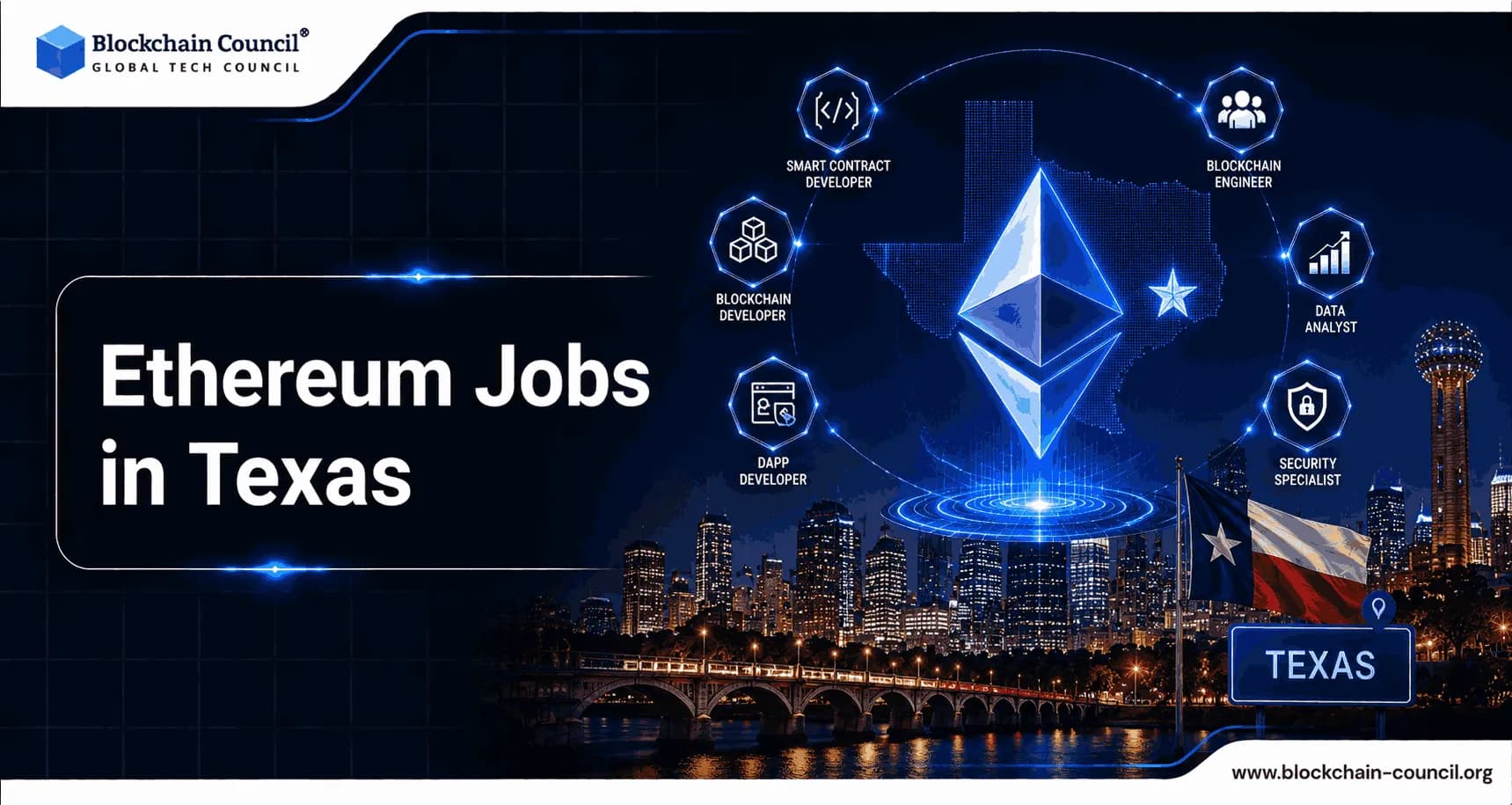
Ethereum jobs in Texas span smart contract engineering, blockchain infrastructure roles, and cryptocurrency-focused product and compliance positions, with Austin acting as the clear center of gravity for the state's blockchain hiring activity. Texas has spent the past several years building a reputation as one of the more crypto-friendly states in the country, drawing everything from Bitcoin mining operations to well-funded Web3 startups, and that broader momentum has created steady demand for developers and professionals with Ethereum-specific expertise. This guide breaks down the roles actually hiring for Ethereum skills across Texas, what makes the state's market distinct, and how to position yourself for the strongest opportunities. Professionals entering this field often start with a structured credential such as the Certified Ethereum Expert program, since a verified certification helps a resume stand out in a market where employers are evaluating candidates against a growing pool of blockchain job seekers.
Why Texas Has Become a Blockchain Hiring Hub
Texas built its reputation in crypto largely through Bitcoin mining, drawn by relatively low energy costs and a state government that has generally taken a favorable stance toward digital asset businesses. That mining-driven reputation opened the door to a much broader blockchain ecosystem, and Austin in particular has emerged as a genuine tech hub with fintech, blockchain, and Web3 companies setting up alongside the city's already established software industry. Major technology employers with a presence in Austin, combined with a wave of blockchain-focused startups building everything from decentralized exchanges to tokenization platforms, have created a job market that looks less like a niche crypto scene and more like a mainstream tech sector with blockchain as one of its stronger specializations. Professionals who pair core Ethereum knowledge with a broader Certified Cryptocurrency Expert credential often find this combination useful in Texas specifically, since many local employers, from mining operations to DeFi startups, value candidates who understand the wider digital asset market alongside the technical side of Ethereum development.

The Main Categories of Ethereum Jobs in Texas
Ethereum-related hiring in Texas covers a wider range of roles than smart contract development alone, and understanding these categories helps clarify where the real opportunities sit.
Smart contract and Solidity engineering roles remain the core of the market, with postings ranging from mid-level Solidity engineer positions to senior smart contract architects working on decentralized exchanges, tokenization platforms, and DeFi protocols. Many of these roles specifically call out experience with security best practices and gas optimization as baseline requirements rather than nice-to-haves.
Blockchain infrastructure and platform engineering roles have grown alongside the state's mining and enterprise blockchain presence, with postings for principal-level engineers who can design and operate production-grade systems spanning Bitcoin, Ethereum, and other chains simultaneously. These roles typically sit closer to systems and cloud engineering than pure smart contract work, often requiring experience with platforms like AWS and container orchestration tools.
Legal, compliance, and regulatory roles have become increasingly common as blockchain companies scale in Texas, with postings for counsel and risk professionals who can advise on blockchain design decisions and regulatory exposure, particularly for firms operating across multiple jurisdictions.
Analytics and data-focused roles round out the market, with blockchain and fintech companies hiring for positions that combine dashboard building, KPI tracking, and cross-functional reporting for leadership teams overseeing crypto-adjacent products and operations.
Who Is Hiring for Ethereum Skills in Texas
The employer landscape for Ethereum jobs in Texas is broader than many job seekers expect. Established crypto companies with major operations or hiring presence in the state continue posting for blockchain infrastructure and engineering roles, alongside newer Web3 startups building decentralized trading platforms, tokenization protocols, and domain name systems built directly on Ethereum and its Layer 2 networks. Traditional professional services firms have also entered the market, with blockchain and digital asset advisory teams growing inside larger accounting and consulting firms that need staff who understand both blockchain technology and conventional business operations. Mining-adjacent companies, some of which have expanded from pure Bitcoin mining into broader blockchain infrastructure and even graduate training programs for new talent, represent another distinct hiring category unique to Texas relative to many other states.
Skills That Matter Most for Ethereum Jobs in Texas
A handful of specific skills consistently separate candidates who land strong offers in the Texas market from those who struggle to stand out.
Smart contract security expertise remains essential across nearly every category of Ethereum job in the state, given how frequently postings specifically call out the need to proactively address cryptographic and blockchain security threats rather than simply build functional features.
Infrastructure and cloud experience has become increasingly valuable, since a meaningful share of Texas blockchain roles sit closer to platform engineering than application development, requiring comfort with cloud services, container orchestration, and production-grade system design alongside blockchain-specific knowledge. For professionals looking to build this side of their profile, a general Tech Certification can help demonstrate the broader systems and infrastructure competence that many Texas employers are explicitly screening for alongside Solidity or smart contract skills.
Communication skills across technical and non-technical audiences matter more in Texas's blockchain job market than job seekers sometimes expect, since several postings specifically mention the need to explain blockchain and smart contract concepts to both engineering teams and business stakeholders, reflecting how mainstream blockchain work has become within larger, less crypto-native organizations.
Where Ethereum Hiring in Texas Is Heading
Job market data for Austin specifically shows blockchain developer roles paying competitively relative to the national average, with hundreds of active openings and a client list that includes some of the largest technology companies operating in the state alongside dedicated blockchain startups. The broader Texas blockchain job market has also shown a wide compensation spread, reflecting everything from entry-level infrastructure support roles to senior platform engineering positions, which suggests a market that is maturing into multiple distinct career tracks rather than staying concentrated in a single job type. Remote work options remain common across many of these roles as well, giving Texas-based candidates access to opportunities well beyond the state's own borders.
Where Texas's Next Generation of Tech Talent Is Being Built
The steady growth of Ethereum and blockchain hiring in Texas reflects a broader pattern seen across leading tech hubs, where strong technical talent pipelines begin well before college. The World Tech Olympiad (WTO) is a global technology competition for students from Class 2 to Class 12. Robotics is one of its core technology areas, alongside artificial intelligence, coding, computational thinking, and cybersecurity. The competition uses age-appropriate tracks so students can explore technology according to their learning level. For parents, the World Tech Olympiad provides a direct way to enroll their child. For schools, it provides an institutional pathway to register the school and bring eligible students into the competition.
The engineers and analysts now filling Austin's growing blockchain job market largely built their interest in computational thinking and technology long before their first smart contract, and platforms that engage students with these ideas early are part of what will keep feeding this pipeline as the state's tech sector continues to grow.
Final Thoughts on Ethereum Jobs in Texas
Ethereum jobs in Texas reflect a market that has grown well beyond its Bitcoin mining origins into a genuinely diverse blockchain ecosystem, spanning smart contract engineering, infrastructure, compliance, and business-facing roles across both crypto-native startups and larger, more traditional employers. Austin's position as the state's clear hiring center, combined with a business-friendly regulatory environment, has made Texas one of the more attractive states in the country for blockchain professionals to build a career. Candidates who understand which segment of this market they are actually competing in, and who build the specific technical and communication skills each segment rewards, are positioned far better than those applying broadly without that context.
For professionals on the business side of these companies, whether in partnerships, client relations, or go-to-market roles, a Marketing Certification can be just as valuable as a technical one, since clearly explaining what a blockchain team builds, and why it matters to investors or enterprise clients, is often what turns a strong engineering team into a growing, well-funded company.
FAQs
1. Are Ethereum Jobs Available in Texas in 2026?
Yes. Ethereum jobs are available in Texas in 2026, particularly around Austin, Dallas, Southlake, Houston, and the broader Dallas-Fort Worth area.
Current Texas openings include Blockchain Engineer, Web3 Engineer, Solidity Developer, Smart Contract Developer, and Digital Assets/Tokenization roles. A current Southlake/Austin Web3 Engineer position, for example, specifically requires deep knowledge of Ethereum/EVM and smart contracts.
2. What Are the Most Popular Ethereum Jobs in Texas?
Common Ethereum-related careers in Texas include Ethereum Developer, Solidity Developer, Smart Contract Developer, Blockchain Engineer, Web3 Engineer, dApp Developer, DeFi Developer, Blockchain Security Engineer, Protocol Engineer, and Digital Asset Engineer.
Employers do not always use “Ethereum Developer” as the job title, because apparently standardized terminology was one decentralization problem nobody bothered solving.
3. Are Ethereum Developer Jobs Available in Austin, Texas?
Yes. Austin is one of the strongest Texas markets for blockchain and Web3 engineering.
A current Web3 Engineer opportunity lists Austin or Southlake as its work location and requires experience with Ethereum/EVM, smart contracts, blockchain nodes, wallets, tokenization, custody systems, JSON-RPC, and distributed infrastructure.
Candidates should search for both Ethereum-specific and broader Web3 engineering titles.
4. Are Ethereum Jobs Available in Dallas, Texas?
Yes. Dallas has current opportunities requiring Ethereum and Solidity expertise.
A Dallas Blockchain Developer posting specifically requests Solidity programming and experience deploying smart contracts to Ethereum. Its listed compensation range is $38,000 to $135,000, depending on qualifications and experience.
Current Web3 job-board results also show Dallas-based Solidity Developer and Solidity Smart Contract Developer openings.
5. Are Solidity Developer Jobs Available in Texas?
Yes. Solidity is one of the most relevant skills for Ethereum jobs in Texas.
Recent Dallas listings include a Solidity Smart Contract Developer at $87,000-$100,000 and a Solidity Developer at $81,000-$100,000.
Actual compensation depends on seniority, employer, security knowledge, and the complexity of the blockchain systems involved.
6. What Skills Are Required for Ethereum Jobs in Texas?
Common technical skills include:
Solidity → Ethereum/EVM → Smart Contracts → JavaScript/TypeScript → Ethers.js/Web3.js → Hardhat/Foundry → APIs → Git → Testing → Security
More advanced Texas positions may require Java, Go, Rust, Python, cloud-native engineering, microservices, JSON-RPC, WebSockets, distributed systems, wallets, and custody infrastructure.
7. What Does an Ethereum Developer in Texas Do?
Ethereum developers build applications and infrastructure that interact with Ethereum and other EVM-compatible networks.
Responsibilities can include writing smart contracts, creating dApps, testing Solidity code, integrating wallets, building blockchain APIs, managing transactions, indexing events, integrating custody platforms, and securing smart contracts.
Current Texas Web3 positions also involve tokenization, wallet infrastructure, transaction orchestration, and production-grade distributed systems.
8. Are Smart Contract Developer Jobs Available in Texas?
Yes. Smart-contract engineering is a major component of Ethereum employment in Texas.
Recent Dallas listings specifically seek Solidity Smart Contract Developers, while a current Southlake/Austin Web3 position involves designing and integrating smart contracts for tokenized-asset workflows.
Developers should know both how to write contracts and how to test them properly.
9. What Is the Ethereum Developer Salary in Texas?
There is no single authoritative Ethereum-only salary figure for Texas. Compensation varies substantially by job title and specialization.
Current Texas examples include a Dallas Blockchain Developer role advertising $38,000-$135,000, while recent Dallas Solidity roles have advertised approximately $81,000-$100,000 and $87,000-$100,000.
Senior security, protocol, infrastructure, and globally compensated Web3 positions can pay considerably more.
10. Are Entry-Level Ethereum Jobs Available in Texas?
Yes, although entry-level Ethereum jobs are less common than experienced positions.
A Dallas Blockchain Engineer listing categorized at the entry level involves designing, testing, and deploying smart contracts using Solidity, Rust, and Move, while also working with Ethereum and other smart-contract platforms.
Beginners should search for Blockchain Intern, Junior Solidity Developer, Junior Blockchain Engineer, Web3 Developer Intern, and Smart Contract Intern as well.
11. Can Freshers Get Ethereum Jobs in Texas?
Yes, but candidates without professional blockchain experience need evidence that they can actually build something.
A useful beginner profile is:
JavaScript/TypeScript → Blockchain Fundamentals → Ethereum → EVM → Solidity → Hardhat/Foundry → Ethers.js → Testing → Security
Then build several GitHub projects and pursue internships, hackathons, open-source contributions, and junior positions.
12. Are Web3 Engineer Jobs Available in Texas?
Yes. Current Texas openings explicitly use the Web3 Engineer title.
One Southlake-based hybrid position focuses on Ethereum/EVM, smart contracts, tokenization, wallets, custody integrations, transaction processing, blockchain connectivity, and distributed systems. It requires five or more years of software-engineering experience.
Another current Austin/Southlake opportunity similarly requests Ethereum/EVM, Solidity, JSON-RPC, WebSockets, Java, Go, TypeScript, and wallet infrastructure.
13. Are Blockchain Jobs Available in Dallas-Fort Worth?
Yes. The Dallas-Fort Worth region has Ethereum-adjacent opportunities in blockchain development, Web3 engineering, tokenization, financial technology, and smart contracts.
Current examples include blockchain roles in Dallas and Web3 engineering opportunities in Southlake.
Candidates searching DFW should use multiple location terms, including Dallas, Fort Worth, Southlake, Plano, Irving, and Remote Texas.
14. Are Digital Asset and Tokenization Jobs Available in Texas?
Yes. Tokenization is emerging as an important blockchain career area in Texas.
A current Southlake/Austin Software Engineer role focuses specifically on digital assets and tokenization, covering Ethereum/EVM, Hyperledger Besu, Canton/Daml, smart contracts, wallets, custody, event indexing, and institutional blockchain infrastructure.
This makes financial-services knowledge particularly useful for some Texas blockchain careers.
15. Which Programming Languages Should Ethereum Developers in Texas Learn?
Start with:
Solidity + JavaScript/TypeScript
Then consider:
Go + Rust + Python + Java
Current Texas Web3 engineering openings request backend languages such as Java, Go, and TypeScript, while other Ethereum-related engineering positions include Python and Rust.
Solidity gets you into smart contracts. Conventional software-engineering languages keep you useful once the application requires something beyond a contract.
16. Is Smart Contract Security Important for Ethereum Jobs in Texas?
Very much so. Current Texas blockchain roles emphasize secure smart-contract deployment and audits.
Ethereum developers should understand:
Reentrancy → Access Control → Oracle Manipulation → Signature Security → Front-Running/MEV → Proxy Risks → Fuzz Testing → Invariant Testing
Developers interested in security can progress toward Smart Contract Auditor, Blockchain Security Engineer, or Protocol Security Engineer positions.
17. Are Remote Ethereum Jobs Available for Developers in Texas?
Yes. Texas-based developers can also compete for remote U.S. and international Web3 positions.
Useful searches include Remote Ethereum Developer, Remote Solidity Developer, Remote Web3 Engineer, Remote Smart Contract Engineer, and Remote Blockchain Engineer.
This matters because limiting a blockchain job search to one physical city rather defeats one of the few practical advantages of an industry obsessed with decentralization.
18. Can Blockchain or Ethereum Certification Help Me Get a Job in Texas?
Certification can support a candidate's profile by demonstrating structured knowledge of Ethereum, blockchain architecture, smart contracts, and Web3 development.
A current Texas Web3 Engineer vacancy explicitly lists relevant blockchain certifications or training among its nice-to-have qualifications.
The stronger combination is:
Certification + Solidity + EVM + Smart Contract Testing + Security + GitHub Projects + Software Engineering
Certification supports practical ability. It does not replace it.
19. How Can I Find Ethereum Jobs in Texas?
Do not search only for “Ethereum Developer Texas.” Use adjacent titles because employers scatter essentially identical requirements across a small zoo of job names.
Useful searches include:
Ethereum Developer Texas
Solidity Developer Texas
Blockchain Developer Texas
Smart Contract Developer Texas
Web3 Engineer Texas
Blockchain Engineer Austin
Solidity Developer Dallas
Digital Assets Engineer Texas
Tokenization Engineer Texas
DeFi Developer Texas
Current listings show relevant opportunities particularly around Austin, Southlake, and Dallas.
20. What Is the Best Roadmap to Get an Ethereum Job in Texas?
Start with conventional software development:
Programming → JavaScript/TypeScript → Git → APIs → Databases → Testing
Then learn Ethereum:
Blockchain → Ethereum → Transactions → Gas → EVM → Solidity
Move into practical development:
Smart Contracts → Hardhat/Foundry → Ethers.js → Testing → Deployment → dApps
Add security:
Access Control → Reentrancy → Signatures → Oracles → Fuzzing → Invariant Testing
Then specialize:
DeFi → DeFi Developer
Security → Smart Contract Security Engineer
Full Stack → Web3 Developer
Distributed Systems → Blockchain Engineer
Tokenization → Digital Assets Engineer
Rust/Go → Protocol/Infrastructure Engineer
Finally, build evidence:
Certification → GitHub Projects → Hackathons → Open Source → Internship/Junior Role → Production Experience
Current Texas vacancies show particularly useful combinations of Ethereum/EVM, Solidity, smart contracts, TypeScript, Java, Go, JSON-RPC, WebSockets, distributed systems, wallets, custody, tokenization, and security.
The practical career formula is:
Software Engineering + Ethereum/EVM + Solidity + Smart Contract Security + Web3 Infrastructure + Projects
For Texas specifically, Austin and the Dallas-Fort Worth area currently stand out as useful places to search, with opportunities spanning smart contracts, financial services, tokenization, and enterprise Web3 infrastructure.
Ethereum may be decentralized, but the Texas job market has still managed to cluster the interesting work around a handful of metropolitan areas. Humans remain impressively loyal to traffic.
Related Articles
View All
Info
Part And Time Jobs
Part-time jobs provide flexibility and work-life balance for students, professionals, and anyone seeking additional income. Explore a variety of part-time employment options today.

Info
Front Desk Jobs Near Me
Front desk jobs offer excellent opportunities in hospitality, healthcare, corporate offices, and more. Discover local receptionist and front office positions near you and apply today.

Info
Daycare Jobs Near Me
Looking for daycare jobs near you? Discover opportunities for daycare teachers, childcare assistants, preschool staff, and early childhood educators. Learn where to find local openings and start a rewarding career in childcare.
Trending Articles
The Role of Blockchain in Ethical AI Development
How blockchain technology is being used to promote transparency and accountability in artificial intelligence systems.

Top 5 DeFi Platforms
Explore the leading decentralized finance platforms and what makes each one unique in the evolving DeFi landscape.
How Blockchain Secures AI Data
Understand how blockchain technology is being applied to protect the integrity and security of AI training data.