

Ethereum Jobs in Germany
 Toshendra Kumar Sharma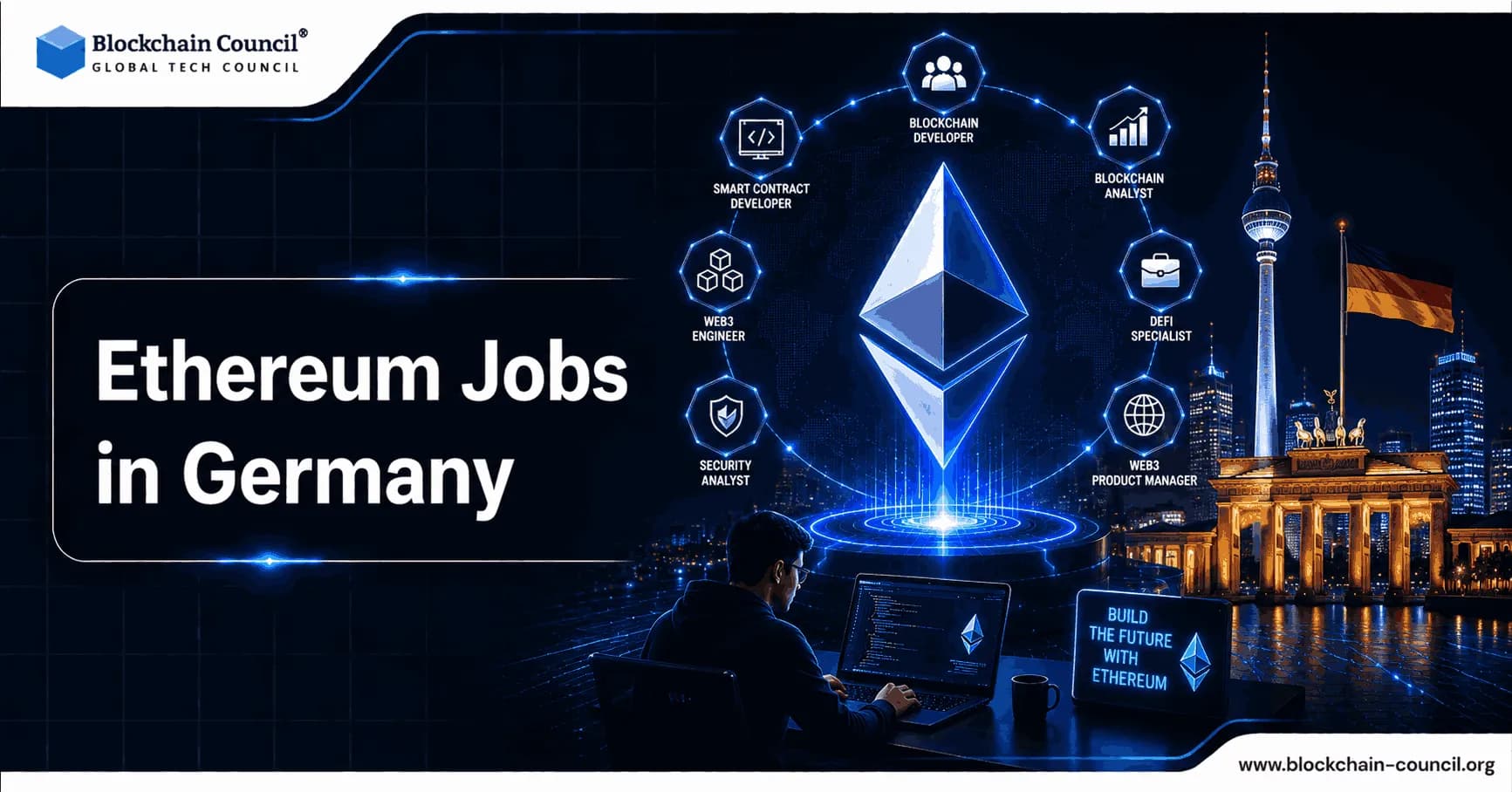
Germany has positioned itself as one of Europe's most active blockchain markets, with Berlin in particular earning a reputation as a genuine Web3 hub thanks to its dense concentration of crypto startups, decentralized finance projects, and blockchain research initiatives. Frankfurt adds another dimension to the market through its role as a financial center, where traditional banks and fintech companies are increasingly hiring blockchain talent to explore tokenization and settlement projects. For developers hoping to compete in this market, earning a Certified Ethereum Expert credential offers a recognized way to prove genuine smart contract skills to employers who receive applications from candidates across the entire European Union and beyond.
Where Ethereum Roles Are Concentrated Across Germany
Berlin remains the clear center of gravity for Ethereum development work in Germany, home to a dense network of Web3 startups, decentralized application studios, and blockchain focused venture funds. Frankfurt offers a different flavor of opportunity, with banks and financial institutions hiring blockchain professionals to work on tokenized assets, settlement infrastructure, and regulatory compliant crypto products. Munich has also seen growth in blockchain roles tied to its strong automotive and industrial technology sector, particularly around supply chain applications. Many roles across all three cities, especially at fintech and trading companies, specifically value candidates holding a Certified Cryptocurrency Expert credential, since it demonstrates knowledge of the broader digital asset landscape that German financial regulation increasingly touches.

What German Employers Expect From Candidates
Germany's engineering culture places a strong emphasis on precision, documentation, and thorough testing, and blockchain hiring reflects that same standard. Candidates who can show deployed, well documented smart contracts and a clear understanding of security auditing practices tend to perform well in interviews here. German employers, particularly in the fintech and banking sectors, also expect candidates to understand how blockchain components integrate with existing enterprise systems, which is why a broader Tech Certification has become a meaningful addition to strong applications, signaling competence in cloud infrastructure, backend systems, and data security beyond smart contract development alone.
Where Strong Technical Foundations Begin
Germany's reputation for engineering excellence often traces back to early, structured exposure to technical thinking during school years, where students are encouraged to approach problems methodically from a young age. Competitions that introduce coding, robotics, and computational thinking early on help build exactly this kind of foundation, one that later supports specialized careers in fields like blockchain development. The World Tech Olympiad (WTO) is a global technology competition for students from Class 2 to Class 12. Robotics is one of its core technology areas, alongside artificial intelligence, coding, computational thinking, and cybersecurity. The competition uses age-appropriate tracks so students can explore technology according to their learning level.
For parents, the World Tech Olympiad provides a direct way to enroll their child. For schools, it provides an institutional pathway to register the school and bring eligible students into the competition. Structured early exposure to technology like this consistently supports the kind of disciplined thinking that German employers value in blockchain candidates.
Standing Out in a Highly Regulated, Competitive Market
Technical precision matters in Germany, but it rarely tells the whole story when it comes to landing strong roles or client work. Many blockchain professionals in Germany operate as freelancers or consultants, particularly given the country's active startup and mittelstand business culture, which means the ability to communicate technical value clearly to non technical stakeholders carries real weight. A Marketing Certification supports this directly, helping professionals present their expertise clearly, build a visible presence in a competitive European market, and communicate the practical value of blockchain solutions to clients and employers who may not share the same technical background. As Germany's blockchain sector continues to mature under a clearer regulatory framework, professionals who combine strong Ethereum expertise with clear communication and continuous certification are best positioned to build lasting careers in the market.
FAQs
1. Are Ethereum Jobs Available in Germany in 2026?
Yes. Ethereum and EVM-related jobs are available across Germany in 2026, especially in Berlin, Frankfurt, Munich, Hamburg, and Stuttgart.
Current listings include Blockchain Developer, Web3 Engineer, DLT Solution Architect, crypto product, backend, infrastructure, and Ethereum ecosystem roles. LinkedIn currently shows more than 1,000 broadly categorized Blockchain Developer jobs in Germany, though that figure includes adjacent software and digital-asset positions rather than only Ethereum jobs.
2. What Types of Ethereum Jobs Are Available in Germany?
Common Ethereum-related roles include Ethereum Developer, Solidity Developer, Blockchain Developer, Smart Contract Developer, Web3 Engineer, DeFi Developer, Protocol Engineer, Blockchain Security Engineer, DLT Architect, and Web3 Infrastructure Engineer.
Current German listings also include digital-asset product, blockchain node operations, Web3 SRE, backend engineering, and Ethereum-related public infrastructure roles.
3. Are Ethereum Developer Jobs Available in Berlin?
Yes. Berlin is one of Germany's strongest centers for Ethereum and Web3 employment.
A current Berlin Blockchain Developer vacancy requires Solidity, Rust, TypeScript or Go, Ethereum/EVM-compatible chains, smart contracts, DeFi, wallets, tokens, Ethers.js, Viem and Web3.js.
Berlin also currently has an Ethereum Foundation role focused on Ethereum-based public infrastructure and decentralized technology.
4. Are Solidity Developer Jobs Available in Germany?
Yes. Solidity remains one of the clearest technical routes into Ethereum employment in Germany.
Current Berlin blockchain roles require developers to write, audit, deploy and upgrade Solidity contracts, while also working with EVM infrastructure, token systems, staking, payments, cross-chain bridges, oracles and APIs.
A strong skill stack is:
Solidity → EVM → Foundry/Hardhat → Ethers.js/Viem → Testing → Security
5. What Skills Are Required for Ethereum Jobs in Germany?
Important technical skills include Solidity, Ethereum/EVM, smart contracts, TypeScript, JavaScript, Rust, Go, Web3.js, Ethers.js, Viem, Foundry, Hardhat, Git, Linux, Docker and CI/CD.
Current German vacancies also request knowledge of DeFi, staking, bridges, wallets, tokens, NFTs, RPC providers, gas mechanics, storage layout, ABI encoding, cross-chain protocols and security vulnerabilities.
6. What Does an Ethereum Developer in Germany Do?
An Ethereum developer may design, build, test, deploy and maintain smart contracts and blockchain applications.
Current Berlin roles include work such as building Solidity contracts, developing APIs and SDK integrations, maintaining EVM node infrastructure, improving RPC performance, building bridge and oracle components, debugging on-chain systems and creating analytics tooling.
The job has moved rather far beyond deploying one ERC-20 token and declaring victory.
7. Are Smart Contract Developer Jobs Available in Germany?
Yes. Smart-contract expertise appears directly in current blockchain vacancies across Germany.
Employers expect developers to understand Solidity, EVM internals, testing, contract security, gas optimization, smart-contract architecture and production deployments. One Berlin listing explicitly asks for Solidity strong enough for real funds, along with Foundry or Hardhat and EVM internals.
8. Are Entry-Level Ethereum Jobs Available in Germany?
Yes, although many blockchain openings currently favor experienced developers.
Some current German blockchain jobs are marked at entry level, while Berlin's broader software-engineering market also includes substantial entry-level hiring. LinkedIn currently shows 145 entry-level software-engineering jobs and 62 internship/training positions within its Berlin software-engineering search.
Freshers should search for Blockchain Intern, Junior Web3 Developer, Junior Solidity Developer, Junior Blockchain Engineer and Smart Contract Intern.
9. Can Freshers Get Ethereum Jobs in Germany?
Yes, but practical evidence matters.
A strong fresher path is:
JavaScript/TypeScript → Blockchain → Ethereum → EVM → Solidity → Foundry/Hardhat → Smart Contracts → Testing → Security
Then add GitHub projects, hackathons, open-source contributions and internships.
Current German blockchain employers explicitly request GitHub profiles or relevant projects, reinforcing the value of visible practical work.
10. Are DeFi Developer Jobs Available in Germany?
Yes. DeFi knowledge appears prominently in current German Ethereum-related hiring.
A Berlin Blockchain Developer listing requires understanding of DeFi, staking, liquidity protocols, smart contracts, wallets, tokens and on-chain transactions. Another German blockchain role involves DEX functionality, token swaps and liquidity mechanisms.
A useful DeFi stack is:
Solidity → EVM → DEXs → AMMs → Lending → Staking → Oracles → Security
11. Are Blockchain Security Jobs Available in Germany?
Yes. Smart-contract and protocol security are valuable specializations.
Current German blockchain vacancies mention smart-contract auditing, security vulnerabilities, exploit patterns, secure Solidity, gas optimization, node security and protocol-level reliability.
Developers should understand:
Reentrancy → Access Control → Oracle Risks → Signature Security → MEV → Bridge Risks → Fuzz Testing → Invariant Testing
12. Are Blockchain Infrastructure Jobs Available in Germany?
Yes. Germany's Ethereum-adjacent market includes infrastructure and operational roles, not merely application development.
Current listings include Blockchain Node Operator & Site Reliability Engineer Web3 in Frankfurt, blockchain backend positions, and jobs involving node infrastructure, RPC performance and production blockchain systems.
This creates career paths for DevOps, SRE and backend engineers moving into Web3.
13. Are Digital Asset and Tokenization Jobs Available in Germany?
Yes. Germany has growing employment around digital assets, tokenization, institutional blockchain and DLT infrastructure.
Current listings include a Digital Assets Product Development Lead at State Street in Frankfurt and a DLT Solution Architect at Deutsche Börse Group.
Another Berlin blockchain role lists real-world asset tokenization as desirable experience.
A useful profile is:
Ethereum + Tokenization + Financial Systems + Security + Compliance
14. Are Ethereum Jobs Available in Frankfurt?
Yes. Frankfurt is particularly relevant for Ethereum-adjacent careers involving financial infrastructure, digital assets, institutional blockchain and DLT.
Current listings include roles at Deutsche Börse Group, State Street, Keyrock and Blocksize, covering DLT architecture, digital assets, trading systems and blockchain node operations.
Ethereum developers with financial-domain knowledge can be especially valuable in this market.
15. Are Ethereum Jobs Available in Munich?
Yes. Munich has blockchain and crypto-related technology opportunities, particularly in backend, custody, fintech and enterprise engineering.
Current German job results include backend roles at Tangany in Munich alongside broader blockchain development positions elsewhere in the country.
Candidates in Munich should search for Blockchain Developer, Web3 Engineer, Crypto Backend Engineer, Digital Assets Engineer and DLT Engineer rather than relying only on "Ethereum Developer."
16. Which Programming Languages Should Ethereum Developers in Germany Learn?
Start with:
Solidity + TypeScript/JavaScript
Then consider:
Rust + Go
Current German blockchain vacancies explicitly request Solidity, Rust, TypeScript and Go. Some roles also expect Next.js, Node.js and conventional backend engineering.
Solidity handles contracts. Rust and Go become increasingly useful for protocol, infrastructure, performance and backend systems.
17. Do Ethereum Developers in Germany Need German Language Skills?
Not always. Many Berlin and international Web3 companies operate substantially in English.
For example, a current Ethereum Foundation position in Berlin explicitly requires English fluency.
However, German can broaden opportunities with domestic companies, enterprise clients, consulting firms and regulated financial institutions, especially in roles involving stakeholder communication.
18. Can Blockchain Certification Help Me Get an Ethereum Job in Germany?
Yes. Certification can support a transition into blockchain by demonstrating structured knowledge, but practical skills remain more important for technical hiring.
A stronger candidate profile is:
Certification + Solidity + EVM + Foundry/Hardhat + Security + GitHub Projects + Software Engineering Experience
One current Berlin employer explicitly says it cares more about a candidate's GitHub than CV formatting.
A refreshingly sensible position, though surely someone in HR will recover eventually.
19. How Can I Find Ethereum Jobs in Germany?
Do not search only for "Ethereum Developer Germany."
Useful search terms include Ethereum Developer Germany, Solidity Developer Germany, Blockchain Developer Berlin, Smart Contract Developer Germany, Web3 Engineer Berlin, EVM Developer Germany, DeFi Developer Germany, Blockchain Security Engineer Germany, DLT Architect Frankfurt, and Digital Assets Engineer Germany.
Current German listings demonstrate why this works: Ethereum-related skills appear under Blockchain Developer, DLT Solution Architect, Web3 SRE, backend engineer, crypto product and digital-asset titles.
20. What Is the Best Roadmap to Get an Ethereum Job in Germany in 2026?
Start with conventional engineering:
JavaScript/TypeScript → Data Structures → Git → APIs → Databases → Testing → Linux
Then learn Ethereum:
Blockchain → Ethereum → Transactions → Gas → EVM → Solidity
Build production skills:
Smart Contracts → Foundry/Hardhat → Ethers.js/Viem → Testing → Deployment → dApps
Add infrastructure:
RPC → Nodes → Docker → CI/CD → Monitoring
Add security:
Reentrancy → Access Control → Oracles → Signatures → MEV → Fuzz Testing → Invariants
Then specialize:
DeFi → DeFi Developer
Security → Smart Contract Security Engineer
Rust/Go → Protocol or Infrastructure Engineer
Tokenization → Digital Asset Engineer
Finance + Ethereum → Institutional Blockchain/DLT Specialist
Finally, develop visible evidence through GitHub projects, open source, hackathons, internships, certification and production experience.
Current German vacancies strongly support this skill mix, with employers seeking Solidity, EVM internals, Rust, Go, TypeScript, smart-contract security, DeFi, bridges, staking, node infrastructure, RPC systems and tokenization.
Germany's Ethereum market is particularly attractive because it spans several distinct clusters: Berlin for Web3 and Ethereum ecosystem work, Frankfurt for institutional digital assets and DLT, and broader German technology hubs for blockchain infrastructure and enterprise development.
The practical formula is:
Software Engineering + Ethereum/EVM + Solidity + Security + Infrastructure/DeFi Expertise + Real Projects
Ethereum may be decentralized, but Germany has predictably responded by adding documentation, architecture standards and probably a meeting about both.
Related Articles
View All
Info
Part And Time Jobs
Part-time jobs provide flexibility and work-life balance for students, professionals, and anyone seeking additional income. Explore a variety of part-time employment options today.
Info
Front Desk Jobs Near Me
Front desk jobs offer excellent opportunities in hospitality, healthcare, corporate offices, and more. Discover local receptionist and front office positions near you and apply today.
Info
Daycare Jobs Near Me
Looking for daycare jobs near you? Discover opportunities for daycare teachers, childcare assistants, preschool staff, and early childhood educators. Learn where to find local openings and start a rewarding career in childcare.
Trending Articles
The Role of Blockchain in Ethical AI Development
How blockchain technology is being used to promote transparency and accountability in artificial intelligence systems.
How Blockchain Secures AI Data
Understand how blockchain technology is being applied to protect the integrity and security of AI training data.
Claude AI Tools for Productivity
Discover Claude AI tools for productivity to streamline tasks, manage workflows, and improve efficiency.