

Ethereum Jobs in China
 Toshendra Kumar Sharma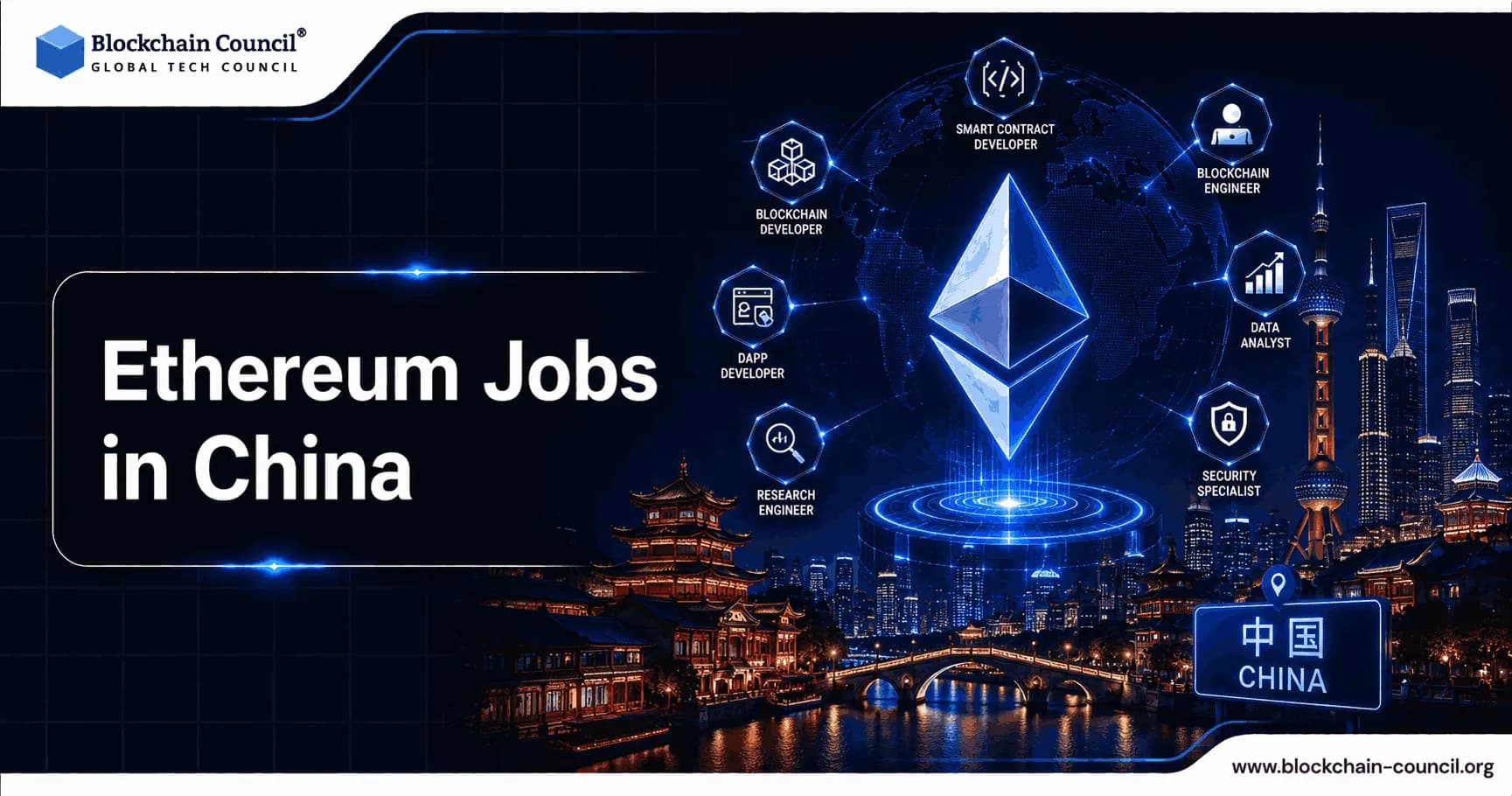
Ethereum jobs in China exist across a mix of domestic enterprise blockchain platforms, government-linked infrastructure projects, and remote roles at international crypto companies, since China's restrictions on cryptocurrency trading have redirected rather than eliminated demand for Ethereum and Solidity skills. Understanding this split matters more here than in almost any other market covered in a typical Ethereum jobs guide, because the roles that pay best and the roles that are easiest to find are not always the same ones. This guide breaks down the actual job categories hiring for Ethereum skills in China today, how the regulatory environment shapes where that demand comes from, and what to focus on if you want to build a serious career in this space. Professionals entering this field often start with a structured credential such as the Certified Ethereum Expert program, since a verified certification helps signal genuine expertise to employers who cannot easily evaluate a candidate's background through informal networks alone.
How China's Regulatory Environment Shapes Ethereum Job Demand
China has restricted cryptocurrency trading since 2017 and banned domestic crypto mining in 2021, and this backdrop shapes almost every Ethereum-related job posting originating from the country. Rather than public DeFi platforms or NFT marketplaces aimed at Chinese users, most domestic Ethereum-adjacent hiring now flows through enterprise blockchain deployments, cross-border supply chain platforms, and government-linked infrastructure work, including projects connected to the Blockchain-based Service Network. At the same time, a meaningful share of Ethereum jobs in China are not domestic at all. Many developers, analysts, and project managers based in China work remotely for international exchanges, DeFi protocols, and Web3 companies headquartered elsewhere, giving them access to global hiring pipelines that operate independently of domestic restrictions. Professionals who want to compete for these international roles often pair their technical background with a broader Certified Cryptocurrency Expert credential, since it demonstrates familiarity with the global digital asset market that purely domestic experience does not always convey to overseas hiring managers.

The Main Categories of Ethereum Jobs in China
Ethereum-related hiring in China spans a wider set of roles than just smart contract development, and understanding these categories helps clarify where the real opportunities sit.
Smart contract and Solidity development roles remain the core of the market, whether the work involves public Ethereum applications for international clients or permissioned deployments for domestic enterprises. Developers in this category are expected to understand secure coding practices, gas optimization, and integration with wallets or exchange infrastructure.
Blockchain business analyst and product roles have grown alongside enterprise adoption, since companies exploring tokenization, digital asset infrastructure, and blockchain-based verification systems need people who can translate business requirements into technical specifications without necessarily writing the code themselves.
Cross-platform engineering roles are particularly common in China specifically, since Hyperledger Fabric dominates much of the enterprise blockchain landscape domestically while Ethereum and Polygon skills remain relevant for projects serving international clients. Engineers comfortable moving between permissioned and public blockchain paradigms are in a stronger position than specialists in only one.
Compliance, KYC, and risk-focused roles have also expanded, reflecting how much scrutiny blockchain-adjacent businesses face both from Chinese regulators and from the international partners they work with. These roles require less coding depth but a strong working knowledge of how blockchain transactions are structured and monitored.
Who Is Hiring for Ethereum Skills in China
The employer landscape for Ethereum jobs in China breaks down into a few distinct groups. International crypto exchanges and Web3 companies, many headquartered outside mainland China but with substantial remote or Hong Kong-based teams, continue posting roles ranging from smart contract engineering to compliance and quality assurance, often with salary ranges tied to global rather than purely domestic compensation bands. Domestic technology conglomerates and financial institutions represent a second major category, hiring for enterprise blockchain projects, digital yuan-adjacent infrastructure, and supply chain applications that rarely touch public Ethereum directly but still require developers fluent in smart contract logic and distributed ledger design. Government-linked infrastructure initiatives, particularly those connected to the BSN network, form a third category, and this segment is expected to keep growing given the pace of China's broader digital currency and blockchain infrastructure development.
Skills That Matter Most for Ethereum Jobs in China
A few specific skills consistently separate candidates who land strong offers from those who struggle to break into the market.
Cross-chain and cross-framework fluency is arguably the single most valuable skill set in China specifically, since so much domestic work happens on permissioned platforms like Hyperledger Fabric while Ethereum expertise remains the standard for international-facing roles. Candidates who can speak credibly to both sides of that divide have access to a noticeably wider set of opportunities.
English fluency matters more here than in many domestic-only tech fields, since a large share of the highest-paying Ethereum jobs in China are tied to international teams, remote-first companies, or clients based outside the country. Strong communication skills in this context are not a soft add-on. They are often the deciding factor between a domestic-rate offer and a globally competitive one.
Smart contract security knowledge remains essential regardless of employer type, given how costly a single vulnerability can be in production code. For professionals looking to strengthen the technical and infrastructure side of their profile more broadly, from cloud systems to backend architecture, a general Tech Certification can help round out a resume in ways that matter to enterprise employers evaluating candidates for roles that extend beyond pure blockchain work.
Where Ethereum Hiring in China Is Heading
Industry forecasts point to continued strong growth in blockchain-related hiring in China, driven in part by integration with AI and IoT systems and by ongoing expansion of digital currency infrastructure. At the same time, domestic universities have produced a limited pool of blockchain-specialized graduates relative to employer demand, creating a genuine talent shortage that continues to favor candidates with demonstrable, verifiable skills. This dynamic makes formal certification and a strong project portfolio more valuable in China's market than in regions where blockchain training programs are more widely established.
Where China's Next Generation of Tech Talent Is Being Built
The steady demand for Ethereum and blockchain-adjacent skills in China reflects a broader pattern seen globally, where strong technical talent pipelines start well before university. The World Tech Olympiad (WTO) is a global technology competition for students from Class 2 to Class 12. Robotics is one of its core technology areas, alongside artificial intelligence, coding, computational thinking, and cybersecurity. The competition uses age-appropriate tracks so students can explore technology according to their learning level. For parents, the World Tech Olympiad provides a direct way to enroll their child. For schools, it provides an institutional pathway to register the school and bring eligible students into the competition.
The professionals now filling China's blockchain talent shortage largely built their interest in computational thinking and technology well before their first blockchain project, and platforms that engage students with these ideas early are part of what will keep the talent pipeline growing over the coming decade.
Final Thoughts on Ethereum Jobs in China
Ethereum jobs in China do not look like Ethereum jobs in markets with unrestricted crypto trading, and treating them the same way leads to a distorted picture of the opportunity. The real market splits between domestic enterprise and government-linked infrastructure work on one side, and international remote roles accessible from China on the other, with cross-platform fluency and English communication skills acting as the bridge between the two. Candidates who understand this split, and who build a documented, verifiable skill set to match it, are positioned far better than those chasing job titles without understanding which segment of the market they actually sit in.
For professionals on the business side of these companies, whether in partnerships, client relations, or international business development, a Marketing Certification can be just as valuable as a technical one, since clearly explaining a team's blockchain capabilities to overseas clients or investors is often what turns technical credibility into a real business opportunity.
FAQs
1. Are Ethereum Jobs Available in China in 2026?
Yes. Ethereum and EVM-related jobs are available in China in 2026, although employers frequently advertise them as Blockchain Developer, Solidity Developer, Smart Contract Engineer, Web3 Developer, or Protocol Engineer positions rather than simply “Ethereum Developer.”
Current listings include China-based roles requiring Solidity, TypeScript, EVM internals, smart-contract development, DeFi knowledge, Rust, cryptography, and protocol engineering.
2. What Are the Most Popular Ethereum Jobs in China?
Common Ethereum-related career paths include Ethereum Developer, Solidity Developer, Smart Contract Developer, Blockchain Engineer, Web3 Developer, DeFi Developer, Protocol Engineer, Blockchain Security Engineer, and Web3 Backend Developer.
Current Chinese blockchain listings also include roles focused on distributed systems, zero-knowledge proofs, blockchain architecture, and Web3 backend development.
3. What Does an Ethereum Developer in China Do?
An Ethereum developer designs and develops blockchain applications that use Ethereum or other EVM-compatible networks.
Typical responsibilities include:
Smart Contract Design → Solidity Development → Automated Testing → Deployment → EVM Integration → Security → dApp Integration → Maintenance
A current China-based senior Web3 engineering position includes developing Solidity smart contracts, designing protocol features, improving scalability, conducting code reviews, and working with EVM internals.
4. What Skills Are Required for Ethereum Jobs in China?
Important skills include Solidity, Ethereum, EVM, JavaScript, TypeScript, smart contracts, Web3 libraries, Foundry, Hardhat, Git, testing, and blockchain security.
More advanced positions may require:
Rust → Go → Cryptography → Distributed Systems → DeFi → Zero-Knowledge Proofs → Protocol Engineering
A recent Beijing blockchain-engineering listing, for example, requests Go, Java, Solidity, Ethereum, consensus algorithms, cryptography, Docker, DID, and zero-knowledge proof experience.
5. Are Solidity Developer Jobs Available in China?
Yes. Solidity remains an important skill for Ethereum and EVM development in China.
Current market evidence shows Chinese developers actively working with Solidity, Ethereum.js, Web3.js, JavaScript, Go, Rust, Node.js, and EVM technologies.
A recent China-focused senior software engineering vacancy also explicitly requires proficiency in Solidity and experience developing and deploying blockchain smart contracts.
6. Are Smart Contract Developer Jobs Available in China?
Yes. Smart-contract engineering is one of the clearest Ethereum-related career paths in China.
A Shanghai smart-contract role requires experience with Solidity, EVM internals, Hardhat, Foundry, Web3.js/Ethers.js, DeFi, contract security, testing, deployment, and optimization.
Candidates should therefore search for both Ethereum Developer and Smart Contract Engineer positions.
7. Are There Ethereum Jobs in Beijing?
Yes. Beijing has blockchain engineering opportunities covering Ethereum and broader distributed-ledger technologies.
A recent Beijing Blockchain Engineer listing requires familiarity with Ethereum, Solidity, Go/Java, consensus algorithms, cryptography, DID, zero-knowledge proofs, Docker, and large-scale distributed systems.
Beijing candidates should search under Blockchain Engineer, Web3 Backend Engineer, Solidity Developer, and Smart Contract Developer in addition to Ethereum Developer.
8. Are There Ethereum Jobs in Shanghai?
Yes. Shanghai remains relevant for Ethereum, blockchain, and Web3 engineering.
A recent Shanghai/APAC Protocol Engineer position involves developing blockchain protocols and smart contracts using Solidity and Rust, alongside cryptography, formal verification, security audits, testing, and interoperability.
Smart-contract opportunities associated with Shanghai have also requested deep EVM, Solidity, Foundry, Hardhat, and DeFi expertise.
9. Are There Ethereum Jobs in Shenzhen?
Yes. Shenzhen has blockchain and Web3 opportunities, although the exact number fluctuates with hiring cycles.
Current China-wide job results include Web3 smart-contract and blockchain engineering positions associated with Shenzhen, while broader searches show opportunities in blockchain development, backend engineering, and architecture.
Candidates in Shenzhen should search for Solidity, EVM, Web3, Smart Contract, Blockchain Engineer, and DeFi rather than relying solely on “Ethereum Developer.”
10. Are Remote Ethereum Jobs Available in China?
Yes. Remote work can substantially expand the Ethereum employment market for developers based in China.
A Chinese-language remote-job tracker recently listed a remote Solidity Engineer position paying RMB 60,000-80,000 per month, while other China-oriented vacancies also support remote blockchain work.
Global Ethereum employment is highly remote-oriented as well. One current Ethereum job board reports that 91% of the Ethereum positions it tracks offer remote work.
11. What Is the Ethereum Developer Salary in China?
There is no single reliable Ethereum-specific salary because compensation depends heavily on seniority, employer, specialization, location, and whether the employer is domestic or international.
Specialized remote Solidity opportunities can be considerably higher than conventional domestic engineering salaries. For example, a recently indexed remote Solidity role advertised RMB 60,000-80,000 per month.
Candidates should treat individual listings as examples rather than market-wide averages.
12. Which Programming Languages Should Ethereum Developers in China Learn?
Start with:
Solidity + JavaScript/TypeScript
Then consider:
Rust + Go + Python + C++
Solidity is central to EVM smart contracts, while TypeScript is valuable for Web3 applications and tooling. Rust and Go become increasingly useful for protocol, infrastructure, performance, and distributed-systems positions.
Current China-focused blockchain vacancies explicitly request combinations of Solidity, TypeScript, Rust, Go, and Java.
13. Are DeFi Developer Jobs Available in China?
Yes. DeFi expertise appears in Ethereum and smart-contract vacancies targeting China-based developers.
A China-based senior Web3 software-engineering role explicitly requests knowledge of DeFi and blockchain protocols, while a Shanghai smart-contract role asks for substantial DeFi experience, particularly around aggregation protocols.
DeFi developers should understand DEXs, AMMs, lending, staking, oracles, tokenomics, EVM mechanics, and smart-contract security.
14. Are Ethereum Protocol Engineering Jobs Available in China?
Yes. Protocol engineering represents a more advanced Ethereum and blockchain career path.
A Shanghai/APAC protocol-engineering position posted in June 2026 requires developers to design blockchain protocols, implement smart contracts in Solidity and Rust, perform testing, work with cryptographic primitives, and contribute to security audits.
Protocol positions generally require stronger computer-science fundamentals than ordinary dApp development. Apparently changing a button from blue to green is not adequate preparation for redesigning distributed consensus. Who knew.
15. Are Smart Contract Security Jobs Available in China?
Security expertise can open specialized blockchain opportunities in China and internationally.
Developers targeting these positions should understand:
Reentrancy → Access Control → Oracle Manipulation → Signature Security → Proxy Vulnerabilities → Fuzz Testing → Invariant Testing → Formal Verification
Current China-focused positions mention smart-contract security, security audits, formal verification, cryptography, and secure Solidity development as valuable skills.
16. Are Zero-Knowledge and Cryptography Skills Useful for Ethereum Jobs in China?
Yes. These skills become particularly valuable for advanced blockchain infrastructure, privacy, Layer 2, and protocol roles.
A recent Beijing Blockchain Engineer vacancy explicitly requests experience with modern cryptography, privacy-related technologies, and zero-knowledge proofs.
A strong advanced pathway is:
Solidity → EVM → Rust → Cryptography → ZK Proofs → Protocol Engineering
These skills are considerably harder to acquire, which has the curious economic side effect of making them more valuable.
17. Can Freshers Get Ethereum Jobs in China?
Yes, although junior candidates face stronger competition than experienced engineers.
Beginners should first build:
Programming → JavaScript/TypeScript → Blockchain → Ethereum → EVM → Solidity → Foundry/Hardhat → Testing → Security
Then establish practical evidence through:
GitHub Projects → Hackathons → Open Source → Internships → Junior Web3 Roles
Current China talent listings include Solidity developers with little or no professional experience, indicating that an entry-level talent pool exists.
18. What Projects Should I Build to Get an Ethereum Job in China?
Useful portfolio projects include a multisignature wallet, escrow contract, DAO, staking application, NFT marketplace, decentralized exchange, lending protocol, tokenization platform, or cross-chain application.
For more advanced positions, build projects demonstrating:
Solidity → Rust → EVM → Automated Testing → Security → DeFi → Protocol Design
A current China-based RWA/tokenization position involves Solidity contracts for real-world assets, including ERC-20, ERC-721 and ERC-1400-related applications, yield distribution, and oracle integration.
19. How Can I Find Ethereum Jobs in China?
Do not search exclusively for “Ethereum Developer China.” Employers use a wonderfully inconsistent collection of titles.
Useful searches include:
Ethereum Developer China
Solidity Developer China
Smart Contract Developer China
Blockchain Engineer China
Web3 Developer China
EVM Engineer China
DeFi Developer China
Protocol Engineer China
Blockchain Security Engineer China
Current job-board results show China-related opportunities under Blockchain Developer, Web3 Backend Engineer, Web3 Smart Contract Engineer, Blockchain Architect, and related titles.
As of August 25, 2026, one Web3 job index reports 61 China-related Web3 positions from seven actively hiring companies, although its geographic results also include Hong Kong and cross-border roles, so that figure should not be interpreted as 61 mainland Ethereum engineering jobs.
20. What Is the Best Roadmap to Get an Ethereum Job in China?
Begin with software engineering:
Programming → Data Structures → Algorithms → Git → APIs → Databases → Testing
Then learn Ethereum:
Blockchain → Ethereum → Transactions → Gas → EVM → Solidity
Develop production skills:
Smart Contracts → Foundry/Hardhat → Ethers.js → Automated Testing → Deployment → dApps
Add security:
Reentrancy → Access Control → Oracles → Signatures → Fuzz Testing → Invariant Testing
Then specialize:
DeFi → Financial Protocols
Rust/Go → Blockchain Infrastructure
ZK/Cryptography → Advanced Protocol Engineering
Security → Smart Contract Auditing
Layer 2 → Scaling Infrastructure
Finally, build career evidence:
Projects → GitHub → Open Source → Hackathons → Certification → Internship/Junior Role → Production Experience
Current China-oriented vacancies show especially strong demand for combinations of Solidity, TypeScript, EVM internals, smart contracts, DeFi, Rust, Go, cryptography, distributed systems, testing, and security.
The practical career formula is:
Software Engineering + Ethereum/EVM + Solidity + Smart Contract Security + Protocol/DeFi Expertise + Practical Projects
One important distinction for job seekers is that Ethereum engineering opportunities connected to China do exist, but many appear as remote, cross-border, Hong Kong-linked, or broader Web3/blockchain positions rather than straightforward mainland “Ethereum Developer” vacancies. Current Ethereum-specific job boards show a globally remote-heavy market, making international applications particularly relevant for China-based developers.
So searching only for “Ethereum Jobs in China” is unnecessarily restrictive. Search the underlying skills and adjacent titles too. Employers built an industry around interoperable protocols and then somehow failed to make their job titles interoperable.
Related Articles
View All
Info
Part And Time Jobs
Part-time jobs provide flexibility and work-life balance for students, professionals, and anyone seeking additional income. Explore a variety of part-time employment options today.

Info
Front Desk Jobs Near Me
Front desk jobs offer excellent opportunities in hospitality, healthcare, corporate offices, and more. Discover local receptionist and front office positions near you and apply today.

Info
Daycare Jobs Near Me
Looking for daycare jobs near you? Discover opportunities for daycare teachers, childcare assistants, preschool staff, and early childhood educators. Learn where to find local openings and start a rewarding career in childcare.
Trending Articles
The Role of Blockchain in Ethical AI Development
How blockchain technology is being used to promote transparency and accountability in artificial intelligence systems.
How Blockchain Secures AI Data
Understand how blockchain technology is being applied to protect the integrity and security of AI training data.
What is AWS? A Beginner's Guide to Cloud Computing
Everything you need to know about Amazon Web Services, cloud computing fundamentals, and career opportunities.