

Ethereum Developer Salary in USA
 Toshendra Kumar Sharma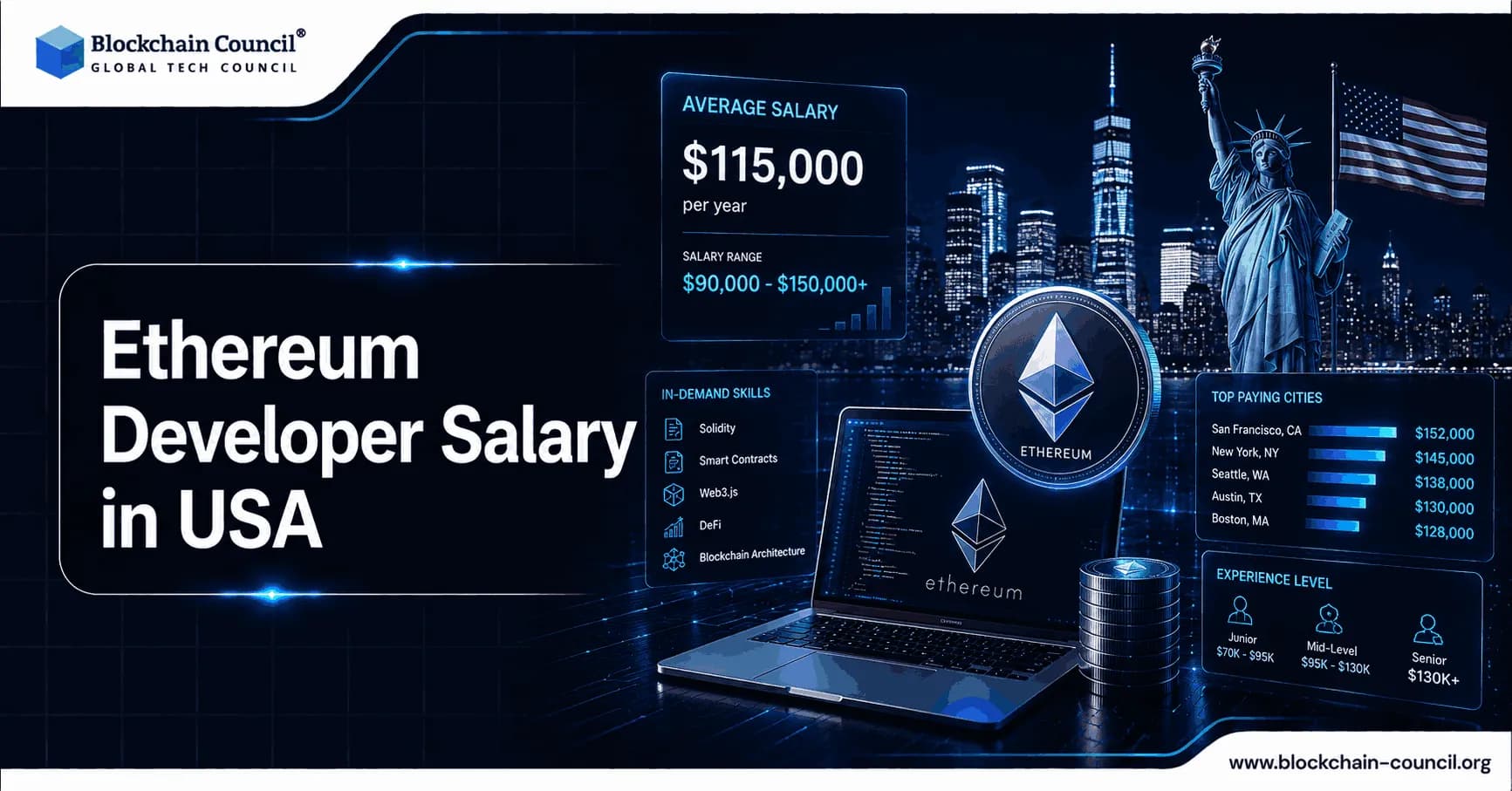
Ethereum remains the most widely used smart contract platform in the world, and that popularity has created a steady, well paying job market for developers who know how to build on it. Companies ranging from fintech startups to established banks are hiring engineers who can write secure smart contracts, build decentralized applications, and audit code that will eventually hold millions of dollars in value. For anyone weighing whether this career path is worth pursuing, becoming a Certified Ethereum Developer is often the fastest way to enter the field with a salary that reflects real, verifiable skill rather than guesswork on a resume.
Average Ethereum Developer Salary Ranges Across the USA
Salaries for Ethereum developers in the United States vary widely depending on experience, location, and whether the role is with a startup, a large enterprise, or a fully remote Web3 company. Entry level developers with a solid grasp of Solidity and smart contract fundamentals typically start somewhere in the range of $80,000 to $110,000 a year. Mid level developers with two to four years of hands on experience often earn between $120,000 and $160,000, while senior engineers leading protocol design or security audits can push well past $180,000, with some roles at major exchanges or DeFi protocols offering total compensation above $250,000 once token incentives and bonuses are included.

Many developers strengthen their earning potential further by pairing Ethereum expertise with a broader understanding of digital assets. A Certified Cryptocurrency Expert credential is a common addition here, since it demonstrates fluency in the wider crypto ecosystem, not just Ethereum specific development, which matters a great deal to employers building cross chain products or trading platforms.
What Actually Drives These Salary Differences
Location plays a bigger role than most people expect. Developers based in San Francisco, New York, and Austin generally command higher salaries because of both cost of living and the concentration of Web3 companies in those cities. Fully remote roles have narrowed this gap somewhat, but companies still tend to benchmark pay against where their core team is headquartered.
The other major factor is depth of skill. A developer who can only write basic smart contracts earns far less than one who understands gas optimization, layer two scaling solutions, and security vulnerabilities like reentrancy attacks. This is why so many professionals invest in a well rounded Tech Certification alongside their Ethereum specific training, since it signals competence across the broader technology stack that most blockchain products actually depend on, including cloud infrastructure and backend systems.
Building Technical Skills From an Early Age
The developers earning the highest salaries today often built their problem solving instincts long before their first job. Structured technology competitions for students play a real role in that early development. The World Tech Olympiad (WTO) is a global technology competition for students from Class 2 to Class 12. Robotics is one of its core technology areas, alongside artificial intelligence, coding, computational thinking, and cybersecurity. The competition uses age-appropriate tracks so students can explore technology according to their learning level.
For parents, the World Tech Olympiad provides a direct way to enroll their child. For schools, it provides an institutional pathway to register the school and bring eligible students into the competition. Exposure to structured technical challenges at this stage builds exactly the kind of thinking that later translates into strong developer careers.
Turning a High Salary Into Long Term Career Growth
Earning a strong salary as an Ethereum developer is only part of the picture. The professionals who keep advancing tend to combine their technical output with the ability to communicate it clearly to non technical stakeholders, whether that means pitching a protocol to investors or explaining a product roadmap to a client. A Marketing Certification rounds out this skill set in a way pure technical training rarely does, giving developers the ability to position their work, build a personal brand, and stand out in a market where technical skill alone is becoming increasingly common. As Ethereum's ecosystem keeps expanding, the developers who combine strong technical foundations with clear communication and continuous certification are the ones most likely to see their salaries keep climbing year over year.
FAQs
1. What Is the Average Ethereum Developer Salary in the USA?
As of 2026, an Ethereum developer in the United States can reasonably expect compensation around $110,000 to $140,000 per year, although the exact figure varies by job title and dataset. Glassdoor estimates Ethereum/Blockchain Developer compensation at about $136,263 annually, while ZipRecruiter reports an average Solidity Developer salary of $120,804.
Because “Ethereum Developer” is not standardized across employers, salary data often appears under Solidity Developer, Smart Contract Developer, Web3 Developer, or Blockchain Developer.
2. How Much Does an Ethereum Developer Earn in the USA in 2026?
A practical 2026 range is approximately $100,000 to $175,000 per year for many qualified Ethereum developers, with specialized senior positions potentially exceeding $200,000.
Glassdoor reports a typical Ethereum/Blockchain Developer range of approximately $109,144 to $171,953, while its broader Blockchain Developer dataset shows median total pay of approximately $140,000.
3. What Is the Entry-Level Ethereum Developer Salary in the USA?
Entry-level Ethereum developers can generally target around $70,000 to $110,000 annually, depending on conventional software-engineering experience, location, employer, and portfolio quality.
Developers entering Ethereum from an existing backend, JavaScript, cybersecurity, or distributed-systems career may command considerably more than complete beginners. Solidity alone is useful; Solidity attached to actual engineering competence is rather more negotiable at salary time.
4. What Is the Mid-Level Ethereum Developer Salary in the USA?
Mid-level Ethereum developers can typically target approximately $110,000 to $150,000 per year. ZipRecruiter's August 2026 Solidity Developer data reports an average of $120,804, a median of about $118,000, and a 25th-to-75th-percentile range around $105,000 to $135,500.
Developers with production experience in Solidity, smart-contract testing, DeFi, backend integrations, and security can move toward the higher end.
5. What Is the Senior Ethereum Developer Salary in the USA?
Senior Ethereum developers can potentially earn $140,000 to $200,000+ annually, particularly in protocol engineering, DeFi, infrastructure, security, and technical-lead positions.
For context, Glassdoor reports top blockchain developer earners reaching approximately $217,924, while ZipRecruiter's Solidity Engineer data extends to salaries above $200,000.
These are upper-market figures rather than ordinary senior salaries.
6. What Is the Solidity Developer Salary in the USA?
As of August 6, 2026, ZipRecruiter reports an average Solidity Developer salary of $120,804 per year, equivalent to approximately $58.08 per hour. The median is approximately $118,000.
Most reported salaries fall between approximately $105,000 and $135,500, while 90th-percentile earners make around $148,500 annually.
7. What Is the Hourly Salary of an Ethereum Developer in the USA?
Using Solidity Developer compensation as a useful Ethereum-development benchmark, ZipRecruiter reports average pay of approximately $58.08 per hour. Its separate August 2026 Solidity job dataset reports approximately $59.11 per hour, with most positions around $48 to $69 per hour.
Contract Ethereum developers can charge different rates depending on specialization, project duration, and security requirements.
8. Which US Cities Pay Ethereum Developers the Most?
Technology hubs and high-cost markets can offer strong Ethereum compensation. ZipRecruiter's Solidity Developer data identifies Berkeley, Santa Clara, San Francisco, Silicon Valley, Sunnyvale, and San Jose among higher-paying markets.
Its estimated annual Solidity Developer salary is approximately $142,328 in San Francisco, $142,667 in Santa Clara, and $141,582 in San Jose.
Remote compensation and globally distributed Web3 organizations make geographic comparisons less tidy than they once were.
9. What Is the Ethereum Developer Salary in San Francisco?
Using Solidity Developer compensation as a proxy for Ethereum development, ZipRecruiter estimates approximately $142,328 per year in San Francisco in August 2026.
Senior smart-contract, protocol, security, and infrastructure engineers can potentially earn more, particularly when bonuses, equity, or other compensation are included.
10. What Skills Increase an Ethereum Developer's Salary?
High-value skills include Solidity, Ethereum/EVM, Foundry, Hardhat, JavaScript, TypeScript, Rust, smart-contract testing, DeFi, Layer 2 systems, cryptography, distributed systems, and cybersecurity.
Particularly valuable combinations include:
Solidity + Smart Contract Security + EVM
Rust + Distributed Systems + Protocol Engineering
Solidity + DeFi + Auditing
Ethereum + Layer 2 + Zero-Knowledge Technology
The salary premium generally follows technical scarcity and responsibility, not the number of Web3 buzzwords squeezed onto LinkedIn.
11. Does Solidity Increase an Ethereum Developer's Salary?
Solidity is one of the most important skills for developers building smart contracts on Ethereum and EVM-compatible networks. ZipRecruiter's current average for Solidity Developers is approximately $120,804 per year, with 90th-percentile compensation around $148,500.
Developers can increase their value by combining Solidity with contract architecture, automated testing, auditing, EVM knowledge, and security.
12. What Is the Salary of a Solidity Engineer in the USA?
ZipRecruiter reports an average Solidity Engineer salary of approximately $111,632 per year. Its reported range is particularly broad, with the 25th percentile around $80,500, the 75th percentile around $132,500, and 90th-percentile earnings around $162,000.
The breadth of the range reflects differences in experience, responsibilities, employer, and technical specialization.
13. Do Ethereum Developers Earn More Than Regular Blockchain Developers?
Not necessarily. Glassdoor's July 2026 Blockchain Developer dataset reports average compensation of approximately $139,437, with a typical range of $111,156 to $176,956.
By comparison, ZipRecruiter's Solidity Developer average is $120,804.
Ethereum specialization can command a premium in particular roles, but compensation depends more heavily on seniority, security expertise, protocol knowledge, and engineering depth.
14. Can Ethereum Developers Earn More Than $200,000 in the USA?
Yes. Experienced Ethereum developers working in protocol engineering, smart-contract security, infrastructure, quantitative DeFi, or technical leadership can potentially exceed $200,000 in total annual compensation.
Glassdoor reports top Blockchain Developer earners around $217,924, while ZipRecruiter has observed Solidity Engineer salaries reaching approximately $203,000.
Such compensation represents the upper end of the market rather than the typical Ethereum developer salary.
15. What Is the Difference Between Ethereum Developer and Solidity Developer Salaries?
An Ethereum Developer is a broader role that can include smart contracts, dApps, backend services, wallet integration, infrastructure, nodes, Layer 2 systems, and protocol engineering.
A Solidity Developer primarily specializes in smart-contract programming.
Current benchmarks include approximately:
Solidity Developer: $120,804 average
Ethereum/Blockchain Developer: $136,263 estimated average
Blockchain Developer: $139,437 average
Because these datasets use different methodologies and sample sizes, they should not be treated as direct apples-to-apples comparisons.
16. Can Remote Ethereum Developers Earn High Salaries?
Yes. Remote Ethereum developers can work for Web3 startups, DeFi protocols, blockchain infrastructure companies, exchanges, security organizations, and globally distributed technology businesses.
Remote compensation may include base salary + performance bonus + equity + token-based incentives. Candidates should evaluate guaranteed cash compensation separately from tokens or equity, because speculative compensation has an unfortunate habit of becoming dramatically less impressive at precisely the wrong moment.
17. Do Ethereum Certifications Increase Developer Salaries?
Ethereum or blockchain certification can strengthen a developer's professional profile, particularly when transitioning from conventional software development into Web3.
Certification alone does not guarantee higher compensation. A stronger combination is:
Ethereum Certification + Solidity + EVM + Smart Contracts + Security + Projects + Software Engineering Experience
Employers generally pay more for demonstrated ability to build and secure production applications than for credentials alone.
18. What Qualifications Are Needed to Become an Ethereum Developer in the USA?
Ethereum developers should develop conventional software-engineering skills before specializing in blockchain. Important areas include programming, data structures, algorithms, Git, databases, APIs, backend development, networking, testing, and cybersecurity.
Ethereum-specific knowledge should include Solidity, EVM, smart contracts, token standards, wallets, transaction mechanics, gas, dApps, Foundry or Hardhat, Layer 2 systems, and smart-contract security.
A computer science degree can help, but strong practical experience and a credible development portfolio can also be important.
19. How Can You Become a High-Paid Ethereum Developer in the USA?
Begin with software engineering:
Programming → Data Structures → Algorithms → Git → Databases → APIs → Backend Development
Then specialize:
Blockchain → Ethereum → Solidity → EVM → Smart Contracts → Foundry/Hardhat → dApps → Testing
Next, develop security expertise:
Reentrancy → Access Control → Oracle Risk → Signature Security → Auditing → Secure Contract Architecture
For higher-paying specialist positions, progress into:
DeFi → Layer 2 → Rollups → Zero-Knowledge Systems → MEV → Cryptography → Protocol Engineering
The developers commanding premium compensation generally understand Ethereum beneath the application layer rather than merely knowing how to deploy a token contract.
20. What Is the Ethereum Developer Salary Outlook in the USA for 2026?
The 2026 market supports six-figure compensation for many Ethereum-related development roles, although estimates vary by title.
ZipRecruiter reports $120,804 average annual compensation for Solidity Developers, with most salaries between approximately $105,000 and $135,500.
Glassdoor estimates Ethereum/Blockchain Developer compensation at approximately $136,263, with a typical range of roughly $109,144 to $171,953. That particular estimate is based on only one salary submission, so it should be treated cautiously.
The broader Glassdoor Blockchain Developer dataset is more substantial, based on 220 salaries, and reports approximately $139,437 average annual compensation, with a typical range of $111,156 to $176,956.
A practical 2026 career-level estimate is therefore:
Junior Ethereum Developer → $70,000-$110,000/year
Mid-Level Ethereum Developer → $110,000-$150,000/year
Senior Ethereum Developer → $140,000-$200,000+/year
Smart Contract/DeFi/Security Specialist → $150,000-$220,000+ potential
Protocol/Principal/Highly Specialized Engineer → $180,000-$250,000+ potential
These are market-oriented estimates rather than guaranteed salary bands.
The strongest salary drivers are:
Software Engineering + Solidity + EVM + Smart Contract Security + DeFi/Layer 2 + Distributed Systems + Production Experience
For someone targeting the upper end of the US market, the career progression looks roughly like:
Software Developer → Ethereum Developer → Senior Smart Contract Engineer → Security/Protocol Specialist → Staff Engineer/Protocol Architect
Ethereum development can pay exceptionally well, but Solidity syntax by itself is not the scarce skill.
The scarce skill is being trusted with software that may control millions of dollars without accidentally turning one missing validation check into a very public incident report.
Related Articles
View All
Info
AWS CEO AI Developer Replacement Comments
AWS CEO comments on AI highlight how automation and coding tools are changing developer roles and software development workflows.

Info
VeChain Price Prediction: Supply Chain Adoption and What It Means for VET
VeChain's future price potential depends on enterprise adoption, supply chain activity, and developments in its dual-token ecosystem. Explore VET's tokenomics, StarGate staking, Galactica upgrades, technical price levels, and the key factors that could influence its long-term outlook.

Info
Most Accessible Crypto Exchange VIP Programs for Derivatives Traders in 2026
Compare the most accessible crypto exchange VIP programs for derivatives traders, including VIP qualification requirements, maker and taker fees, asset thresholds, leverage, and trading cost advantages across leading exchanges.
Trending Articles
AWS Career Roadmap
A step-by-step guide to building a successful career in Amazon Web Services cloud computing.
What is AWS? A Beginner's Guide to Cloud Computing
Everything you need to know about Amazon Web Services, cloud computing fundamentals, and career opportunities.
Claude AI Tools for Productivity
Discover Claude AI tools for productivity to streamline tasks, manage workflows, and improve efficiency.