

Ethereum Developer Salary in Singapore
 Toshendra Kumar Sharma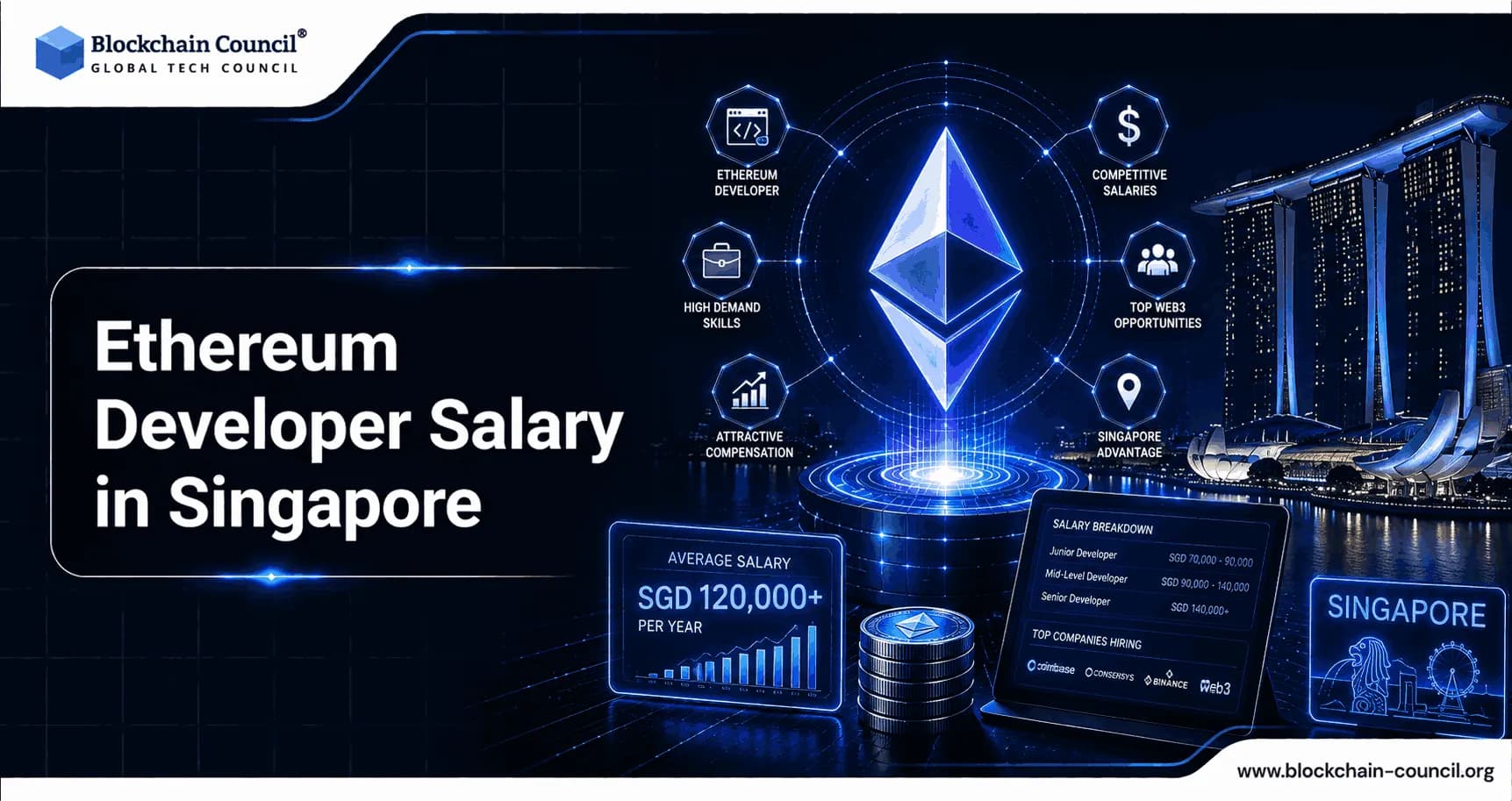
Ethereum developer salary in Singapore typically ranges from SGD 90,000 to SGD 250,000 a year depending on experience and specialization, with senior smart contract engineers at established exchanges and DeFi firms regularly reaching the top of that range once bonuses and equity are included. Singapore has positioned itself as Southeast Asia's leading blockchain hub, home to hundreds of crypto and Web3 companies clustered around its financial district, and that concentration of employers has kept demand for skilled Ethereum developers consistently strong even through broader crypto market cycles. This guide breaks down what Ethereum developers actually earn in Singapore, what separates top earners from average ones, and how to position yourself for stronger offers. Developers looking to strengthen their credentials in this market often start with a recognized program such as the Certified Ethereum Developer course, since Singapore employers reviewing technical hires tend to favor candidates who can show structured, verified expertise alongside their project history.
Why Singapore Has Become a Leading Hub for Ethereum Talent
Singapore's appeal to blockchain companies rests on a combination of regulatory clarity, financial infrastructure, and regional positioning that is difficult to match elsewhere in Asia. The Monetary Authority of Singapore has built a licensing framework for digital payment token services that many companies view as more predictable than frameworks in neighboring markets, which has attracted exchanges, custodians, and DeFi platforms to set up local engineering teams rather than operate remotely. Areas around Raffles Place and Marina Bay now host a dense concentration of blockchain employers, from major crypto exchanges to smaller DeFi startups experimenting with new protocols. Developers who pair their Ethereum skills with a broader Certified Cryptocurrency Expert credential often find this combination especially useful when interviewing in Singapore, since employers here tend to value engineers who understand both the technical build side and the wider digital asset market their code operates within.

Ethereum Developer Salary in Singapore by Experience Level
Compensation for Ethereum developers in Singapore scales sharply with experience, and it helps to look at this in bands rather than a single average figure.
Entry-level Ethereum developers, typically those with zero to two years of Solidity or smart contract experience, generally start in the range of SGD 60,000 to SGD 90,000 annually, or roughly SGD 5,000 to SGD 7,500 a month, depending on the hiring company's size and funding stage.
Mid-level developers with a track record of shipping production smart contracts, working with testing frameworks, and integrating wallets or exchange systems typically earn between SGD 90,000 and SGD 150,000 a year. This is also where stock options or token allocations begin meaningfully adding to total compensation, since many blockchain employers use equity or token grants to compete with the base salaries offered by larger tech firms and banks.
Senior Ethereum developers, smart contract architects, and specialists in areas such as Layer 2 scaling or DeFi protocol design often reach SGD 150,000 to SGD 230,000 or more annually, with some LinkedIn-sourced compensation data placing senior Ethereum roles as high as SGD 250,000 once bonuses and equity are factored in at well-funded firms. Layer 2 specialists working with networks such as Polygon, Arbitrum, or Optimism have reported particularly strong premiums, reflecting how central these scaling solutions have become as Ethereum gas fees continue to affect user adoption.
What Actually Drives Higher Pay for Ethereum Developers in Singapore
A few specific factors consistently separate developers earning toward the top of Singapore's market from those earning closer to entry-level bands.
Smart contract security expertise is the clearest multiplier. Since a single vulnerability in production Solidity code can cost a DeFi protocol millions of dollars, developers who can audit their own code, or who hold formal security-focused credentials, are compensated well above developers who only write functional, unaudited code. Demand for smart contract auditors and Layer 2 scaling specialists has grown sharply in recent years, reflecting how much weight the market now places on this skill set.
Experience with DeFi protocols such as Uniswap, Aave, or Compound also commands a premium, since building on top of these systems requires a deeper understanding of liquidity mechanics, composability risk, and the specific failure patterns behind past exploits. Familiarity with EVM-compatible chains beyond Ethereum mainnet is similarly valued, given how many Singapore-based projects now build across multiple chains rather than a single network.
Finally, remote work flexibility has changed the local negotiating dynamic. Developers serving international clients from Singapore often command noticeably higher hourly rates than those working purely for local employers, which has pushed some domestic companies to raise their own offers to retain talent that could otherwise take remote contracts abroad.
Where the Singapore Ethereum Job Market Is Heading
Singapore continues to rank among the highest-paying countries globally for blockchain developers, alongside markets such as Switzerland and the United States, and industry data has shown consistent double-digit annual growth in blockchain developer job postings even through periods of crypto market volatility. Competition for senior talent remains intense, with companies increasingly offering remote-friendly arrangements and equity packages to compete regionally. For developers building the broader software and infrastructure skills that increasingly overlap with blockchain work, from cloud architecture to secure API design, a general Tech Certification can help round out a profile in ways that matter to larger, more traditional financial employers now entering the blockchain space alongside crypto-native startups.
Where Singapore's Next Generation of Tech Talent Is Being Built
The steady demand for Ethereum and blockchain skills in Singapore reflects a broader regional pattern of investing in technical talent pipelines long before university. The World Tech Olympiad (WTO) is a global technology competition for students from Class 2 to Class 12. Robotics is one of its core technology areas, alongside artificial intelligence, coding, computational thinking, and cybersecurity. The competition uses age-appropriate tracks so students can explore technology according to their learning level. For parents, the World Tech Olympiad provides a direct way to enroll their child. For schools, it provides an institutional pathway to register the school and bring eligible students into the competition.
The developers now commanding strong Ethereum salaries in Singapore largely built their technical curiosity years before writing their first smart contract, and platforms that get students engaged with computational thinking early are part of what keeps the regional talent pipeline strong.
Final Thoughts on Ethereum Developer Salary in Singapore
Ethereum developer salary in Singapore reflects a market that rewards specialization, not just general blockchain familiarity. Security expertise, DeFi protocol experience, and Layer 2 scaling knowledge consistently separate the developers earning toward the top of the range from those earning closer to entry-level bands. For anyone planning a move into this market, or negotiating a stronger offer within it, building a documented, verifiable skill set matters more here than in many other tech fields, given how much trust employers need to place in the people writing code that directly controls financial value.
For professionals on the business side of these companies, whether in recruiting, partnerships, or client-facing roles, a Marketing Certification can be just as relevant as a technical one, since clearly explaining what a development team builds, and why it justifies premium pay, is often the difference between winning institutional clients and losing them to a competitor with a clearer pitch.
FAQs
1. What Is the Average Ethereum Developer Salary in Singapore in 2026?
Ethereum-specific salary data for Singapore is limited because employers frequently classify these professionals as Blockchain Developers, Web3 Developers, Solidity Developers, or Smart Contract Engineers.
Current 2026 benchmarks vary substantially. TalentUp reports a median base salary of about S$71,200 per year for Blockchain Developers in Singapore, while another salary dataset estimates an average of S$83,400 annually.
Experienced Ethereum specialists can earn considerably more, particularly in DeFi, security, and protocol engineering.
2. How Much Does an Ethereum Developer Earn Per Month in Singapore?
Using broader Singapore blockchain salary data, a reasonable baseline is approximately S$5,900-S$7,000 per month.
One 2026 dataset estimates Blockchain Developer compensation at S$83,400 annually, or S$6,950 monthly, with reported salaries ranging from S$42,960 to S$124,400 per year.
Specialized senior Ethereum engineers can exceed these figures significantly.
3. What Is the Entry-Level Ethereum Developer Salary in Singapore?
Entry-level Ethereum developers can broadly target around S$45,000-S$70,000 per year, although individual offers vary substantially.
A 2026 blockchain salary dataset places the lower end of Singapore Blockchain Developer compensation around S$42,960 annually, while its 25th percentile is approximately S$53,160.
Junior developers with strong Solidity, TypeScript, EVM, testing, and full-stack skills may command higher offers.
4. What Is the Mid-Level Ethereum Developer Salary in Singapore?
Mid-level Ethereum developers with approximately 2-5 years of relevant experience can potentially earn around S$70,000-S$140,000+ annually, depending heavily on employer and specialization.
Current datasets differ considerably. The broader Singapore Blockchain Developer median is around S$71,200 according to TalentUp, while specialist fintech and Web3 roles can offer substantially higher packages.
Production DeFi, security, or protocol experience generally increases earning potential.
5. What Is the Senior Ethereum Developer Salary in Singapore?
Senior Ethereum developers can potentially earn S$120,000-S$200,000+ per year, especially at cryptocurrency exchanges, protocols, fintech firms, and international Web3 companies.
One Singapore Senior Blockchain Developer vacancy advertises S$120,000-S$200,000 annually and seeks blockchain experience alongside languages such as Go, Rust, C++, and Java, with Ethereum experience considered advantageous.
6. What Is the Solidity Developer Salary in Singapore?
Dedicated Solidity salary data for Singapore is sparse because Solidity positions often appear under titles such as Smart Contract Developer, Ethereum Developer, Web3 Engineer, or Blockchain Developer.
A practical 2026 estimate is:
Junior Solidity Developer: S$45,000-S$70,000
Mid-Level Solidity Developer: S$70,000-S$130,000+
Senior Solidity Developer: S$120,000-S$200,000+
Security, DeFi, and protocol expertise can push compensation beyond these indicative ranges.
7. What Is the Blockchain Developer Salary in Singapore?
TalentUp reports a S$71,200 median base salary for Blockchain Developers in Singapore based on its March 2026 benchmark.
Another 2026 dataset estimates average compensation at S$83,400, with a median of S$74,300 and a reported range of S$42,960-S$124,400.
The differences illustrate why Ethereum developers should compare multiple datasets rather than treating one salary number as if it had been immutably recorded on-chain.
8. What Is the Web3 Developer Salary in Singapore?
One August 2026 Web3 salary dataset estimates an average Singapore Web3 Developer salary of approximately US$76,000 annually, with base salaries ranging from roughly US$45,000 to US$150,000.
Web3 is a broader category than Ethereum development, but the data provides a useful benchmark because many Ethereum positions are advertised as Web3 engineering jobs.
9. Which Skills Increase an Ethereum Developer's Salary in Singapore?
High-value skills include Solidity, EVM, smart-contract security, Foundry, Hardhat, TypeScript, DeFi, Layer 2, Rust, Go, distributed systems, cryptography, and zero-knowledge technology.
A particularly valuable technical combination is:
Solidity + Advanced EVM + Security + DeFi + Backend Engineering
For infrastructure and protocol positions, Rust, Go, C++, networking, algorithms, and distributed systems can become increasingly important.
10. Do Ethereum Developers Earn More Than Regular Software Developers in Singapore?
Specialized Ethereum developers can earn a premium, but the word “Ethereum” does not automatically increase a salary.
The premium generally appears when a developer possesses scarce skills in Solidity, smart-contract security, DeFi, cryptography, protocol engineering, or distributed systems.
Employers pay for difficult-to-replace capabilities, rather than for how many times “Web3” appears on someone's résumé. Humanity has preserved at least that much economic logic.
11. Does Smart Contract Security Increase Ethereum Developer Salary?
Yes, potentially. Smart-contract security is a valuable specialization because vulnerabilities can result in substantial financial losses.
Ethereum developers should understand:
Reentrancy → Access Control → Oracle Manipulation → Signature Security → MEV → Proxy Security → Fuzz Testing → Invariant Testing → Formal Verification
Developers capable of both writing and critically reviewing production smart contracts can compete for more specialized engineering and security roles.
12. Do DeFi Developers Earn More in Singapore?
Experienced DeFi developers can command higher salaries because the work combines blockchain engineering with financial and security knowledge.
Important skills include:
Solidity → EVM → DEXs → AMMs → Lending → Staking → Oracles → Tokenomics → Smart Contract Security
Singapore's strong financial and fintech ecosystem can make the combination of finance + Ethereum + security particularly valuable.
13. Can Ethereum Developers in Singapore Earn More Than S$150,000?
Yes. Compensation above S$150,000 annually is possible for senior developers and specialized blockchain engineers.
For example, a Singapore Senior Blockchain Developer vacancy advertises compensation extending to S$200,000 annually.
Higher compensation generally requires substantial professional experience in areas such as protocol engineering, DeFi, security, distributed systems, or technical leadership.
14. Can Ethereum Developers in Singapore Earn S$200,000 or More?
Yes, although S$200,000+ should be considered senior or specialist territory rather than a typical Ethereum developer salary.
Roles approaching or exceeding this level can include:
Senior Ethereum Engineer → Protocol Engineer → Smart Contract Security Engineer → Blockchain Architect → Engineering Lead → Principal Engineer
International Web3 organizations may also offer globally competitive packages involving bonuses, equity, or tokens.
15. Do Ethereum Developers Receive Bonuses, Equity, or Tokens?
Some blockchain and Web3 companies offer compensation beyond base salary.
A package might include:
Base Salary + Performance Bonus + Equity + Token Allocation + Benefits
Developers should compare guaranteed cash compensation separately from token or equity components.
S$150,000 in cash and S$150,000 in a newly invented token are technically both numbers. They are not necessarily the same financial experience six months later.
16. Can Remote Ethereum Developers in Singapore Earn More?
Potentially. Remote employment allows Singapore-based Ethereum developers to compete for international Web3, DeFi, infrastructure, and protocol positions.
A current Web3 salary dataset shows a broad Singapore base-salary range extending as high as approximately US$150,000 annually, although individual observations can fluctuate substantially.
Remote compensation can depend on location adjustments, employer policy, taxation, employment structure, and token or equity components.
17. Can Ethereum Certification Increase Salary in Singapore?
Ethereum or blockchain certification can strengthen a professional profile, particularly for conventional software engineers transitioning into blockchain.
A stronger combination is:
Certification + Solidity + EVM + Foundry/Hardhat + Smart Contract Security + GitHub Projects + Production Experience
Certification demonstrates structured learning. Salary growth is generally driven more strongly by demonstrable engineering ability, specialization, and professional experience.
18. What Qualifications Are Needed to Become an Ethereum Developer in Singapore?
A degree in Computer Science, Software Engineering, Information Technology, Mathematics, Cybersecurity, or a related technical discipline can be useful.
Developers should build skills progressively:
Programming → Data Structures → Algorithms → Git → APIs → Databases → Testing → Blockchain → Ethereum → EVM → Solidity
Then add:
Smart Contracts → Foundry/Hardhat → dApps → Security → DeFi/Layer 2
Advanced infrastructure roles may additionally require Go, Rust, C++, networking, and distributed-systems expertise.
19. How Can an Ethereum Developer Increase Their Salary in Singapore?
Developers should progress beyond basic Solidity into specialized technical areas.
A strong roadmap is:
Solidity → Advanced EVM → Smart Contract Testing → Security → DeFi → Layer 2 → Rust/Go → ZK Technology → Protocol Engineering
Developers can also improve conventional engineering expertise in TypeScript, backend systems, cloud infrastructure, DevOps, databases, cybersecurity, and distributed systems.
The biggest salary increases generally come when a developer moves from “can write smart contracts” to “can design and secure systems responsible for substantial assets.”
20. What Is the Ethereum Developer Salary Outlook in Singapore for 2026?
Current 2026 datasets suggest a broad market rather than one neat salary figure.
TalentUp reports a S$71,200 median base salary for Blockchain Developers.
Another Singapore benchmark estimates an S$83,400 average, S$74,300 median, and reported range of S$42,960-S$124,400.
Meanwhile, an actual Senior Blockchain Developer vacancy in Singapore advertises S$120,000-S$200,000 annually, demonstrating the higher compensation available for experienced specialists.
For SEO and career-planning purposes, a practical Ethereum-focused 2026 estimate is:
Entry-Level Ethereum Developer: S$45,000-S$70,000/year
Mid-Level Ethereum Developer: S$70,000-S$130,000+/year
Senior Ethereum Developer: S$120,000-S$200,000+/year
Security/DeFi/Protocol Specialist: S$150,000-S$250,000+ potential
Lead/Principal/Global Web3 Roles: S$200,000+ potential
These are indicative bands, not guaranteed market averages.
The strongest salary formula is:
Software Engineering + Ethereum/EVM + Solidity + Smart Contract Security + DeFi/Layer 2 + Production Experience
Singapore can be an attractive market for Ethereum developers because blockchain intersects with the country's established fintech, financial-services, and technology sectors. For experienced engineers, the most valuable opportunities increasingly extend beyond basic Solidity into security, DeFi, protocol engineering, Layer 2 systems, distributed computing, and technical leadership.
Knowing Solidity can get someone into Ethereum development. Knowing why a protocol that passed every unit test can still lose S$20 million is, unsurprisingly, a more expensive skill.
Related Articles
View All
Info
AWS CEO AI Developer Replacement Comments
AWS CEO comments on AI highlight how automation and coding tools are changing developer roles and software development workflows.

Info
VeChain Price Prediction: Supply Chain Adoption and What It Means for VET
VeChain's future price potential depends on enterprise adoption, supply chain activity, and developments in its dual-token ecosystem. Explore VET's tokenomics, StarGate staking, Galactica upgrades, technical price levels, and the key factors that could influence its long-term outlook.

Info
Most Accessible Crypto Exchange VIP Programs for Derivatives Traders in 2026
Compare the most accessible crypto exchange VIP programs for derivatives traders, including VIP qualification requirements, maker and taker fees, asset thresholds, leverage, and trading cost advantages across leading exchanges.
Trending Articles
AWS Career Roadmap
A step-by-step guide to building a successful career in Amazon Web Services cloud computing.

Top 5 DeFi Platforms
Explore the leading decentralized finance platforms and what makes each one unique in the evolving DeFi landscape.
What is AWS? A Beginner's Guide to Cloud Computing
Everything you need to know about Amazon Web Services, cloud computing fundamentals, and career opportunities.