

Ethereum Developer Salary in Japan
 Toshendra Kumar Sharma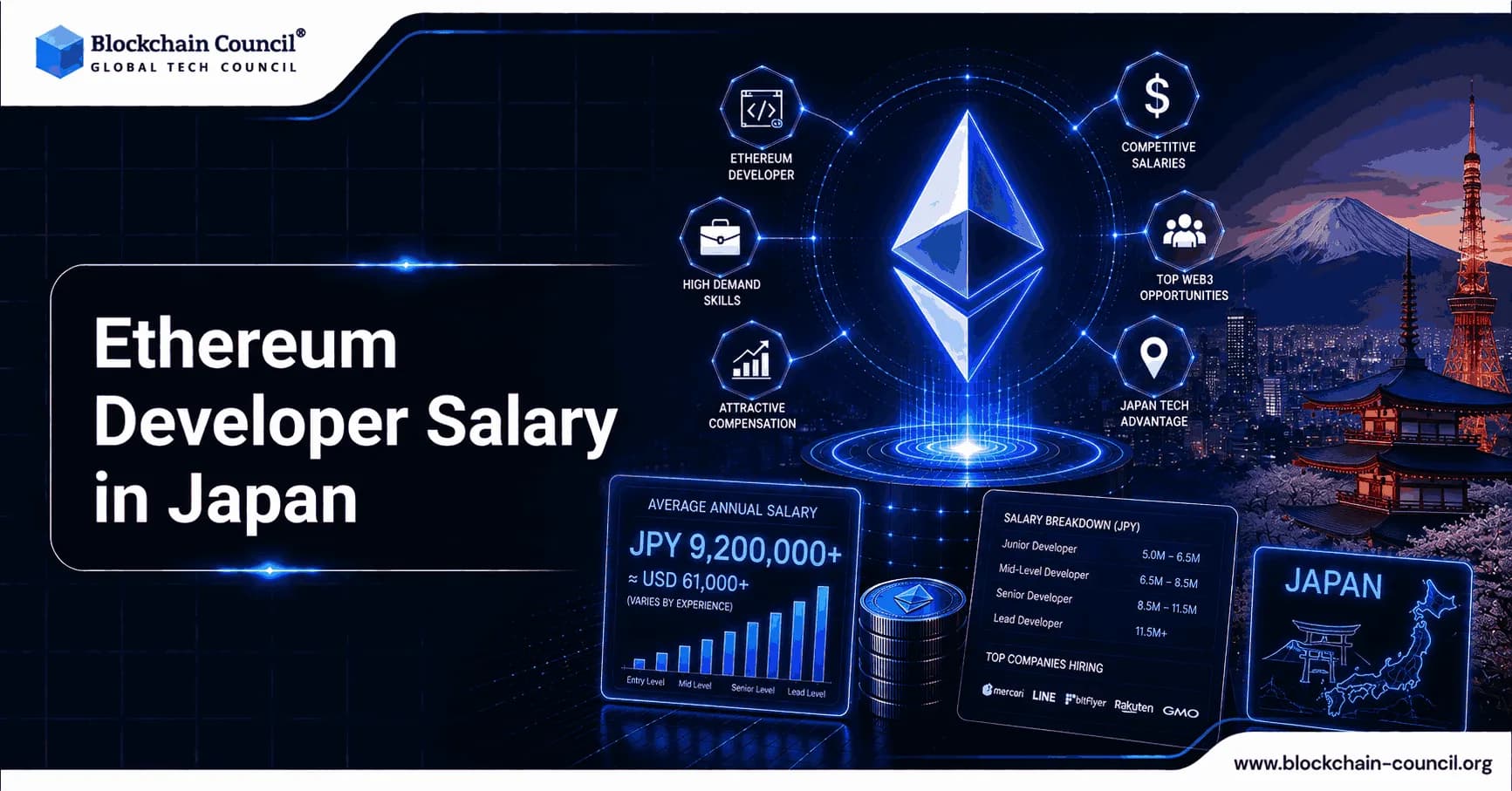
Ethereum developer salary in Japan typically ranges from around 5 million to 10 million yen a year depending on experience and specialization, with senior developers, project leads, and specialists working on institutional blockchain projects often reaching the top of that range or higher once bonuses are included. Japan has been one of the more proactive markets in Asia when it comes to blockchain adoption, with financial institutions, technology conglomerates, and a steady flow of new Ethereum-based projects all competing for a limited pool of skilled developers. This guide breaks down what Ethereum developers actually earn in Japan, what pushes compensation toward the higher bands, and how to position yourself for stronger offers. Developers looking to strengthen their standing in this market often start with a recognized program such as the Certified Ethereum Developer course, since Japanese employers reviewing technical hires, particularly at larger or more traditional firms, tend to place real weight on verified, structured credentials alongside project experience.
Why Japan Has Become a Strong Market for Ethereum Developers
Japan's blockchain job market benefits from a combination of early regulatory engagement and sustained corporate interest that has outlasted several crypto market cycles. The country has had a relatively established legal framework for cryptocurrency exchanges for years, which gave Japanese financial institutions more confidence to explore blockchain infrastructure earlier than some neighboring markets. Beyond exchanges themselves, large technology firms and financial services companies in Japan have continued funding blockchain-based projects, from payment infrastructure to digital asset custody, which keeps steady demand flowing for developers who understand Ethereum and Solidity specifically. Developers who pair their Ethereum skills with a broader Certified Cryptocurrency Expert credential often find this combination valuable in Japan, since many employers here want engineers who understand the wider digital asset market and regulatory landscape their code needs to operate within, not just the smart contract logic itself.

Ethereum Developer Salary in Japan by Experience Level
Compensation for Ethereum developers in Japan scales meaningfully with experience, and it is more useful to think in bands than a single national average.
Entry-level Ethereum developers, typically those with one to two years of Solidity experience or a solid portfolio of personal and open-source projects, generally start in the range of 4 million to 6 million yen annually. This is broadly in line with Japan's wider blockchain developer pay scale, where reported salaries commonly start in the mid single digits of millions of yen before rising with experience.
Mid-level developers, comfortable building and testing production smart contracts and integrating with wallets or exchange infrastructure, typically earn between 6 million and 8 million yen a year. International job boards focused on Web3 hiring in Japan have listed Solidity developer roles in this range and above, particularly at companies serving global clients rather than purely domestic ones.
Senior Ethereum developers, project leads, and technical architects working on institutional-grade blockchain deployments often reach 8 million to 10 million yen annually, with some reports placing senior compensation for skilled, certified developers even higher once bonuses, project incentives, and equity are factored in. Foreign developers working in Japan have also reported earning somewhat more than local counterparts at the same skill level, a pattern often attributed to the relative scarcity of foreign talent combined with the international nature of many blockchain-focused teams.
What Actually Drives Higher Pay for Ethereum Developers in Japan
A handful of specific factors consistently separate developers earning toward the top of the Japanese market from those earning closer to entry-level bands.
Smart contract security expertise remains the clearest differentiator, just as it is in most other markets. Given how costly a single vulnerability can be in production Solidity code, developers who can audit contracts and design defensively are paid a clear premium over those who write functional but unaudited code.
Fluency working across both Japanese and international teams also matters more in Japan than in many other markets, since a large share of blockchain hiring involves companies serving global clients or building products meant to compete internationally. Developers comfortable communicating in English, in addition to strong technical skills, tend to have access to a wider set of roles and correspondingly stronger offers. Experience with Rust, alongside Solidity, has also become increasingly valuable, since a number of Japan-based blockchain teams are now building across multiple ecosystems rather than staying limited to the Ethereum Virtual Machine alone.
Where the Japan Ethereum Job Market Is Heading
Japan's blockchain job postings have remained active across job boards focused specifically on Web3 hiring, with roles ranging from entry-level Solidity positions to senior Rust and cross-chain engineering work commanding some of the highest listed salaries in the region. Remote-friendly arrangements have also become more common, giving Japan-based developers access to international employers while giving Japanese companies access to talent beyond their immediate hiring radius. For developers building the broader software and infrastructure skills that increasingly overlap with blockchain roles, from cloud architecture to backend systems engineering, a general Tech Certification can help round out a profile in ways that matter to larger, more traditional Japanese employers now exploring blockchain alongside crypto-native startups.
Where Japan's Next Generation of Tech Talent Is Being Built
The steady demand for Ethereum and blockchain skills in Japan reflects a broader pattern seen across advanced economies, where strong technical talent pipelines begin well before university. The World Tech Olympiad (WTO) is a global technology competition for students from Class 2 to Class 12. Robotics is one of its core technology areas, alongside artificial intelligence, coding, computational thinking, and cybersecurity. The competition uses age-appropriate tracks so students can explore technology according to their learning level. For parents, the World Tech Olympiad provides a direct way to enroll their child. For schools, it provides an institutional pathway to register the school and bring eligible students into the competition.
The developers now commanding strong Ethereum salaries in Japan largely built their interest in computational thinking and problem-solving years before writing their first smart contract, and platforms that engage students with technology early are part of what keeps this talent pipeline growing.
Final Thoughts on Ethereum Developer Salary in Japan
Ethereum developer salary in Japan reflects a market that rewards both technical depth and the ability to work effectively across Japanese and international teams. Security expertise, cross-chain experience, and language fluency consistently separate developers earning toward the top of the range from those earning closer to entry-level pay. Anyone planning a move into this market, or negotiating a stronger offer within it, benefits from building a documented, verifiable skill set, since Japanese employers hiring for roles tied to financial infrastructure or institutional clients tend to place real weight on demonstrated, structured expertise over informal experience alone.
For professionals on the business side of these companies, whether in partnerships, recruiting, or client-facing roles, a Marketing Certification can be just as valuable as a technical one, since clearly explaining what a development team builds, and why it justifies premium compensation, is often what separates firms that win institutional trust from those that struggle to grow beyond early adopters.
FAQs
1. What Is the Average Ethereum Developer Salary in Japan in 2026?
Ethereum-specific salary data in Japan is relatively limited because employers frequently classify these positions as Blockchain Engineer, Blockchain Developer, Web3 Developer, Solidity Developer, or Smart Contract Engineer.
A strong 2026 benchmark comes from Robert Half Japan, which places Blockchain Engineer salaries at ¥5.2 million to ¥12.2 million per year, with a midpoint of approximately ¥8.2 million annually.
Ethereum specialists with advanced Solidity, EVM, DeFi, security, or protocol-engineering skills may earn above general blockchain benchmarks.
2. How Much Does an Ethereum Developer Earn Per Month in Japan?
Using Robert Half's 2026 Blockchain Engineer benchmark, monthly base compensation works out to approximately:
Entry/Limited Experience: ¥433,000/month
Midpoint: ¥683,000/month
Experienced/Specialized: ¥1.02 million/month
These figures are derived from annual salaries of ¥5.2 million, ¥8.2 million, and ¥12.2 million respectively, and exclude bonuses and benefits.
3. What Is the Entry-Level Ethereum Developer Salary in Japan?
An entry-level Ethereum developer can reasonably target around ¥4.5 million to ¥6.5 million per year, depending on programming ability, employer, city, and blockchain experience.
Robert Half's 25th-percentile benchmark for Blockchain Engineers is ¥5.2 million annually, representing professionals who are new to the role or still developing the necessary skills.
Candidates with Solidity projects, TypeScript, EVM knowledge, and testing experience can strengthen their negotiating position.
4. What Is the Mid-Level Ethereum Developer Salary in Japan?
Mid-level Ethereum developers can broadly target approximately ¥6.5 million to ¥10 million per year.
Robert Half's midpoint for Blockchain Engineers in Japan is ¥8.2 million annually, providing a useful 2026 benchmark for developers with moderate experience who meet most role requirements.
Production experience in DeFi, smart-contract security, or backend systems can push compensation higher.
5. What Is the Senior Ethereum Developer Salary in Japan?
Senior Ethereum developers can potentially earn around ¥10 million to ¥15 million+ per year, particularly in specialized engineering positions.
Robert Half places the 75th percentile for Blockchain Engineers at ¥12.2 million annually. Its Backend Engineer benchmark reaches ¥15 million at the 75th percentile, demonstrating the compensation available to experienced technical specialists in Japan.
6. What Is the Ethereum Developer Salary in Tokyo?
Tokyo is Japan's principal technology and financial center and an important location for blockchain and Web3 employment.
Glassdoor reports approximately ¥10 million per year for Blockchain Developers in Japan, although the dataset has very few submissions and is explicitly marked low confidence. One reported Tokyo Blockchain Developer salary for a professional with 1-3 years of experience was ¥12 million to ¥14 million annually.
That example should not be mistaken for a Tokyo-wide average. Two salary submissions do not constitute an economic census, despite salary websites occasionally behaving as though they might.
7. What Is the Solidity Developer Salary in Japan?
Dedicated Solidity salary data for Japan is sparse because employers frequently advertise Solidity positions under broader Ethereum, Web3, and blockchain engineering titles.
A practical 2026 estimate is:
Junior Solidity Developer: ¥4.5M-¥6.5M/year
Mid-Level Solidity Developer: ¥6.5M-¥10M/year
Senior Solidity Developer: ¥10M-¥15M+/year
Developers with security, DeFi, protocol, or EVM expertise can potentially move beyond these indicative ranges.
8. What Is the Blockchain Engineer Salary in Japan?
Robert Half Japan provides one of the clearest 2026 benchmarks:
25th Percentile: ¥5.2 million
50th Percentile: ¥8.2 million
75th Percentile: ¥12.2 million
These figures represent starting base salaries and exclude bonuses, benefits, and perks.
This range is particularly useful for benchmarking Ethereum engineering positions because many companies use “Blockchain Engineer” rather than “Ethereum Developer.”
9. What Is the Web3 Developer Salary in Japan?
Web3.career estimates the average Web3 Developer salary in Japan at approximately US$48,000 per year, with a reported base salary range of roughly US$36,000 to US$60,000 as of July 2026.
This dataset differs substantially from Robert Half's blockchain-engineering estimates, illustrating how employer type, job title, sample size, and methodology can produce dramatically different salary figures.
10. Which Skills Increase an Ethereum Developer's Salary in Japan?
High-value technical skills include:
Solidity → EVM → TypeScript → Foundry → Hardhat → Smart Contract Security → DeFi → Layer 2 → Rust → Go → Distributed Systems → ZK Technology
Developers should also strengthen conventional software-engineering abilities in backend development, databases, APIs, cloud infrastructure, DevOps, testing, and cybersecurity.
The strongest profile is usually Ethereum specialization built on solid software engineering, rather than Solidity floating alone in the résumé like an unsupervised island.
11. Does Smart Contract Security Increase Ethereum Developer Salaries in Japan?
Potentially, yes. Security expertise makes developers suitable for more specialized and higher-responsibility positions.
Important skills include:
Reentrancy → Access Control → Oracle Security → Signature Security → Proxy Security → MEV → Fuzz Testing → Invariant Testing → Formal Verification
Security specialists can pursue roles such as Smart Contract Auditor, Blockchain Security Engineer, Protocol Security Engineer, and Security Researcher.
12. Do DeFi Developers Earn More in Japan?
Experienced DeFi developers can potentially earn above general blockchain-development salaries because DeFi combines software engineering with financial and security expertise.
Valuable skills include:
Solidity + EVM + AMMs + DEXs + Lending + Staking + Oracles + Tokenomics + Smart Contract Security
Developers who understand both financial systems and blockchain engineering can be particularly valuable to fintech and digital-asset organizations.
13. Can Ethereum Developers in Japan Earn More Than ¥10 Million Per Year?
Yes. Salaries above ¥10 million annually are realistic for experienced blockchain engineers.
Robert Half's 75th-percentile Blockchain Engineer salary is ¥12.2 million per year, while its Backend Engineer benchmark reaches ¥15 million at the 75th percentile.
Glassdoor also contains Tokyo Blockchain Developer submissions in the ¥12 million to ¥14 million range, although its Japan blockchain dataset is extremely small.
14. Can Ethereum Developers in Japan Earn ¥15 Million or More?
Yes, but ¥15 million+ should generally be viewed as senior, lead, principal, or highly specialized territory, rather than a normal Ethereum developer salary.
Candidates at this level are more likely to possess expertise in areas such as:
Protocol Engineering → Smart Contract Security → Cryptography → Layer 2 → Zero-Knowledge Systems → Distributed Systems → Technical Leadership
Internationally compensated Web3 roles can also exceed conventional domestic salary bands.
15. Do Ethereum Developers Earn More Than Regular Developers in Japan?
Not automatically.
Robert Half's 2026 Japan guide puts Blockchain Engineers at a ¥8.2 million midpoint, compared with ¥9.5 million for Full Stack Engineers and ¥10.5 million for Backend Engineers.
This is an important reality check: adding “blockchain” to a job title does not magically create a salary premium.
Scarce specialization, security expertise, architecture skills, and production experience are what usually create the premium.
16. Can Remote Ethereum Developers in Japan Earn More?
Potentially. Japan-based developers working remotely for international Web3 organizations can access compensation structures that differ significantly from domestic Japanese salary bands.
International packages may include:
Base Salary + Bonus + Equity + Tokens + Benefits
Remote roles can be particularly attractive for developers specializing in Solidity, security, DeFi, Layer 2 infrastructure, and protocol engineering.
Candidates should compare guaranteed cash compensation separately from equity and token allocations, because tokens possess the charming habit of changing value while everyone is asleep.
17. Does Speaking Japanese Help Ethereum Developers Earn More?
Japanese-language ability can broaden access to domestic employers, enterprise technology companies, consulting firms, fintech businesses, and Japanese-speaking development teams.
However, some international blockchain and Web3 organizations operate primarily in English.
A strong combination for the Japanese market is:
Technical Skills + English + Japanese + Blockchain Domain Knowledge
Language proficiency becomes particularly useful for roles involving clients, product management, consulting, partnerships, or leadership.
18. Can Ethereum Certification Increase Salary in Japan?
Certification can strengthen a developer's profile, particularly when transitioning from conventional software engineering into blockchain.
A stronger professional combination is:
Certification + Solidity + EVM + Foundry/Hardhat + Security + GitHub Projects + Production Experience
Certification alone does not guarantee higher compensation. At senior levels, employers generally place considerably greater weight on demonstrated engineering depth, architecture, security expertise, and production experience.
19. How Can an Ethereum Developer Increase Their Salary in Japan?
Start with strong software engineering:
Programming → Data Structures → Algorithms → Git → APIs → Databases → Testing
Then specialize:
Ethereum → EVM → Solidity → Smart Contracts → Foundry/Hardhat → dApps
Add security:
Access Control → Reentrancy → Oracles → Signatures → Fuzzing → Invariant Testing → Auditing
Then move toward scarce skills:
DeFi → Layer 2 → Rust/Go → ZK Systems → Cryptography → Protocol Engineering
Finally, develop production and leadership experience:
Architecture → Code Reviews → Security → Mentoring → Technical Leadership
This progression is considerably more reliable than merely adding “Senior Web3 Ninja” to a profile and waiting for ¥15 million to materialize.
20. What Is the Ethereum Developer Salary Outlook in Japan for 2026?
Current salary sources vary considerably, so a range-based approach is more credible than pretending there is one magical Ethereum salary number.
Robert Half's 2026 Japan data places Blockchain Engineers at:
25th Percentile: ¥5.2 million/year
50th Percentile: ¥8.2 million/year
75th Percentile: ¥12.2 million/year
Glassdoor estimates approximately ¥10 million annually for Blockchain Developers in Japan, but explicitly labels the estimate low confidence because it is based on only two salary submissions.
Another 2026 salary aggregation estimates a considerably lower average of about ¥5.48 million per year, further demonstrating how inconsistent blockchain salary datasets can be.
For Ethereum-specific career planning, a reasonable 2026 estimate is:
Entry-Level Ethereum Developer: ¥4.5M-¥6.5M/year
Mid-Level Ethereum Developer: ¥6.5M-¥10M/year
Senior Ethereum Developer: ¥10M-¥15M+/year
Security/DeFi/Protocol Specialist: ¥12M-¥18M+ potential
Lead/Principal/International Roles: ¥15M-¥20M+ potential
These are indicative career bands, not guaranteed market averages.
The strongest salary formula is:
Software Engineering + Ethereum/EVM + Solidity + Smart Contract Security + DeFi/Layer 2 + Production Experience
Ethereum development can be a well-paid career path in Japan, but blockchain expertise alone does not guarantee a premium. The higher compensation generally goes to engineers who combine Ethereum knowledge with security, distributed systems, protocol engineering, financial-domain expertise, or technical leadership.
Apparently even decentralized technology has arrived at the painfully centralized conclusion that employers pay more for people who can solve harder problems.
Related Articles
View All
Info
AWS CEO AI Developer Replacement Comments
AWS CEO comments on AI highlight how automation and coding tools are changing developer roles and software development workflows.

Info
VeChain Price Prediction: Supply Chain Adoption and What It Means for VET
VeChain's future price potential depends on enterprise adoption, supply chain activity, and developments in its dual-token ecosystem. Explore VET's tokenomics, StarGate staking, Galactica upgrades, technical price levels, and the key factors that could influence its long-term outlook.

Info
Most Accessible Crypto Exchange VIP Programs for Derivatives Traders in 2026
Compare the most accessible crypto exchange VIP programs for derivatives traders, including VIP qualification requirements, maker and taker fees, asset thresholds, leverage, and trading cost advantages across leading exchanges.
Trending Articles
The Role of Blockchain in Ethical AI Development
How blockchain technology is being used to promote transparency and accountability in artificial intelligence systems.
AWS Career Roadmap
A step-by-step guide to building a successful career in Amazon Web Services cloud computing.
What is AWS? A Beginner's Guide to Cloud Computing
Everything you need to know about Amazon Web Services, cloud computing fundamentals, and career opportunities.