

Ethereum Developer Salary in Hong Kong
 Toshendra Kumar Sharma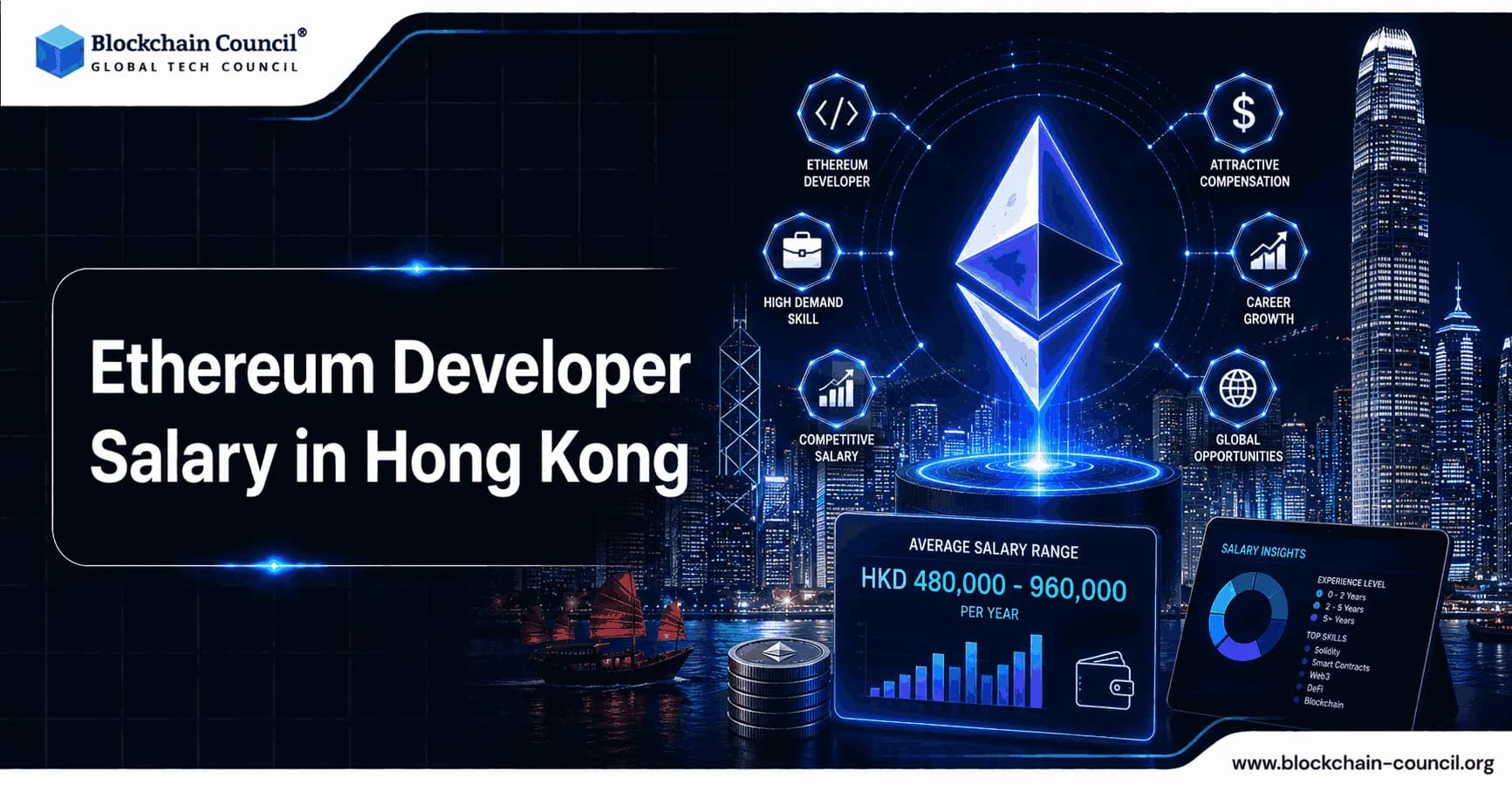
Ethereum developer salary in Hong Kong typically ranges from around HK$50,000 to HK$180,000 per month depending on experience, specialization, and the type of company hiring, with senior smart contract engineers and security specialists commanding the higher end of that range. Hong Kong has positioned itself as one of Asia's clearer regulatory environments for crypto and blockchain firms, and that clarity has translated into real hiring demand for developers who can build and secure Ethereum-based applications. This guide breaks down what Ethereum developers actually earn in Hong Kong, what pushes pay higher, and how to position yourself for the top end of the market. Developers looking to strengthen their standing in this market often start with a recognized credential such as the Certified Ethereum Developer program, since employers reviewing a stack of similar resumes tend to favor candidates who can show verified, structured expertise rather than self-taught claims alone.
Why Hong Kong Has Become a Hub for Ethereum Talent
Hong Kong's appeal to blockchain companies comes down to a mix of regulatory clarity, financial infrastructure, and geographic positioning. The city has built a licensing framework for virtual asset service providers that many companies view as more predictable than frameworks in neighboring markets, and that predictability has attracted exchanges, custodians, and fintech firms that need in-house Ethereum expertise rather than outsourced contractors. Districts such as Central, Cyberport, and Hong Kong Science Park now host a meaningful concentration of blockchain employers, ranging from established exchanges to smaller DeFi startups. Developers who round out their Ethereum skills with a Certified Cryptocurrency Expert credential often find this combination useful when interviewing with these firms, since employers in Hong Kong's crypto sector tend to value candidates who understand both the technical build side and the broader digital asset market their code will operate in.

Ethereum Developer Salary in Hong Kong by Experience Level
Pay for Ethereum developers in Hong Kong scales sharply with experience and specialization, and it helps to look at this in bands rather than a single average figure.
Entry-level and junior Ethereum developers, typically those with one to two years of Solidity or smart contract experience, generally start in the lower part of the monthly range, often closer to HK$50,000 to HK$80,000, though this varies with the hiring company's size and funding stage.
Mid-level developers with a track record of shipping production smart contracts, working with testing frameworks, and handling integrations with wallets or exchanges tend to land in the HK$80,000 to HK$130,000 monthly range. This is also where stock options or token allocations start to meaningfully add to total compensation, since many blockchain employers use equity or token grants to compete with larger tech salaries.
Senior Ethereum developers, smart contract architects, and specialists in areas such as Layer 2 scaling or cross-chain integrations often reach HK$130,000 to HK$180,000 monthly or more, particularly at firms serving institutional clients. Reports from job portals and recruiter data have also cited higher annualized figures, sometimes ranging up to the equivalent of HK$300,000 or more when stock options and bonuses are factored in for senior roles at well-funded companies.
Smart contract security auditors sit in their own category. Given how costly a single exploit can be for a DeFi protocol, auditing specialists in Hong Kong have reported monthly compensation in the HK$120,000 to HK$220,000 range, reflecting how scarce and high-stakes this skill set has become.
What Actually Drives Higher Pay for Ethereum Developers
Salary bands only tell part of the story. A few specific factors consistently separate average offers from top-of-market ones.
Smart contract security expertise is the single biggest multiplier. Companies are acutely aware that a bug in production Solidity code can cost millions of dollars in a single exploit, so developers who can audit their own code, or who hold formal security-focused credentials, are paid a clear premium over developers who only write functional code.
Experience with DeFi protocols, Layer 2 networks, and cross-chain bridges also commands higher pay, since these areas require a deeper understanding of gas optimization, transaction finality, and the specific failure modes that have caused high-profile hacks in the past. Enterprise blockchain experience matters too. Developers who can also work with permissioned frameworks such as Hyperledger Fabric or Corda, alongside public Ethereum development, are attractive to traditional financial institutions experimenting with private blockchain deployments, and that dual skill set often adds a meaningful premium to monthly pay.
Finally, regulatory compliance knowledge is increasingly valuable in Hong Kong specifically. As licensing requirements for virtual asset businesses have tightened, developers who understand how compliance requirements shape technical architecture, not just legal teams, are being compensated for that cross-functional understanding.
Where the Hong Kong Ethereum Job Market Is Heading
Competition for blockchain talent is not limited to Hong Kong. Singapore and Dubai are actively competing for the same pool of Ethereum developers, and that competition has pushed some Hong Kong employers toward retention bonuses in the range of 10 to 20 percent of annual salary, along with relocation packages and more flexible remote or hybrid arrangements than the market offered a few years ago. Global data on Ethereum developer compensation also shows salaries trending upward over the past two years, even accounting for volatility tied to crypto market cycles, which suggests the underlying demand for smart contract talent has outlasted individual market swings.
For developers building the general software and infrastructure skills that increasingly overlap with blockchain roles, from cloud deployment to API security, it is also worth looking at a broader Tech Certification to strengthen the parts of a resume that sit outside pure Solidity work but still influence hiring decisions at larger, more traditional employers entering the space.
Where Hong Kong's Next Generation of Tech Talent Is Being Built
The demand for Ethereum and blockchain skills in Hong Kong is not appearing out of nowhere. It reflects a broader regional push to build technical talent earlier, starting well before university or a first job. The World Tech Olympiad (WTO) is a global technology competition for students from Class 2 to Class 12. Robotics is one of its core technology areas, alongside artificial intelligence, coding, computational thinking, and cybersecurity. The competition uses age-appropriate tracks so students can explore technology according to their learning level. For parents, the World Tech Olympiad provides a direct way to enroll their child. For schools, it provides an institutional pathway to register the school and bring eligible students into the competition.
The developers commanding today's top Ethereum salaries in Hong Kong largely built their technical curiosity years before they ever wrote a smart contract, and platforms that get students engaged with computational thinking early are part of what keeps the regional talent pipeline strong.
Final Thoughts on Ethereum Developer Salary in Hong Kong
Ethereum developer salary in Hong Kong reflects a market that rewards specialization, not just general blockchain familiarity. Security expertise, DeFi and Layer 2 experience, and cross-functional regulatory knowledge consistently separate the developers earning toward the top of the range from those earning closer to the entry-level bands. For anyone planning a move into this market, or trying to negotiate a stronger offer within it, building a documented, verifiable skill set matters more here than in many other tech fields, given how much trust employers need to place in the people writing code that directly controls financial value.
For professionals on the business side of these companies, whether in recruiting, client relations, or go-to-market roles, a Marketing Certification can be just as relevant as a technical one, since explaining what a development team actually does, and why it justifies premium pay, is often the difference between winning institutional clients and losing them to a competitor with a clearer pitch.
FAQs
1. What Is the Average Ethereum Developer Salary in Hong Kong in 2026?
An Ethereum developer in Hong Kong can reasonably expect compensation within the broader blockchain and Web3 developer market, although there is no single authoritative Ethereum-only salary benchmark.
Hong Kong Talent Engage lists blockchain developers at approximately HK$35,000-HK$80,000 per month, equivalent to HK$420,000-HK$960,000 per year.
A 2026 Hong Kong technology salary guide places average base salary for Web3/blockchain developers around HK$963,000 annually, illustrating how experienced specialists can command substantially higher compensation.
2. How Much Does an Ethereum Developer Earn Per Month in Hong Kong?
A practical market range for blockchain developers is approximately HK$35,000-HK$80,000 per month, according to Hong Kong Talent Engage.
Specialized Web3 developers with strong Solidity, DeFi, security, or protocol expertise can earn more. A 2026 Hong Kong Web3 market analysis places some highly sought-after Solidity, Rust, and security professionals at roughly HK$80,000-HK$150,000 monthly.
3. What Is the Entry-Level Ethereum Developer Salary in Hong Kong?
Entry-level Ethereum salaries vary considerably because employers frequently advertise positions as Blockchain Developer, Web3 Developer, Solidity Developer, or Smart Contract Developer rather than Ethereum Developer.
Junior developers generally earn toward the lower end of Hong Kong's broader blockchain developer range. Skills in Solidity, TypeScript, smart-contract testing, and dApp development can help candidates move beyond generic junior software-engineering compensation.
4. What Is the Mid-Level Ethereum Developer Salary in Hong Kong?
Mid-level developers with approximately 2-5 years of relevant experience can potentially earn around HK$50,000-HK$100,000+ per month, depending on employer and specialization.
A 2026 blockchain compensation dataset places Hong Kong blockchain developer compensation around US$84,500 annually, with its reported range extending from roughly US$74,360 to US$105,625.
These figures should be treated as market indicators rather than guaranteed salary bands.
5. What Is the Senior Ethereum Developer Salary in Hong Kong?
Senior Ethereum developers can potentially command HK$80,000-HK$150,000+ per month, particularly when they have specialized experience in Solidity, DeFi, protocol engineering, smart-contract security, or Rust.
Compensation can rise further for technical leads, architects, security specialists, and globally recruited remote employees.
Senior Web3 compensation is wonderfully resistant to neat averages, partly because “senior blockchain developer” can describe everything from an application engineer to someone designing financial protocols controlling millions of dollars.
6. Which Skills Increase an Ethereum Developer's Salary in Hong Kong?
High-value technical skills include:
Solidity → EVM → Smart Contracts → Foundry/Hardhat → TypeScript → DeFi → Layer 2 → Smart Contract Security → Rust → Zero-Knowledge Technology
Hong Kong market data specifically identifies Solidity, Rust, Web3, DeFi, smart contracts, and Layer 2 expertise as skills associated with premium blockchain compensation.
7. How Much Can a Solidity Developer Earn in Hong Kong?
Solidity developers can command premium compensation because Solidity remains fundamental to Ethereum and EVM smart-contract development.
A 2026 Hong Kong crypto/Web3 market analysis reports that scarce technical professionals, including Solidity and Rust developers and security auditors, can reach approximately HK$80,000-HK$150,000 per month.
Actual compensation depends heavily on seniority, employer, security knowledge, and protocol experience.
8. What Is the Salary of a Smart Contract Developer in Hong Kong?
Smart Contract Developers generally fall within the broader blockchain/Web3 engineering market. Hong Kong's official talent platform places blockchain developers at approximately HK$35,000-HK$80,000 monthly.
Developers specializing in complex DeFi contracts, smart-contract security, protocol architecture, or auditing may earn substantially more.
9. What Is the Salary of a Web3 Developer in Hong Kong?
One August 2026 Web3 salary dataset estimates an average Hong Kong Web3 developer salary of approximately US$100,000 per year, with base salaries ranging from around US$50,000 to US$150,000.
Another Hong Kong 2026 salary guide puts average Web3/blockchain developer base compensation at approximately HK$963,000 annually.
Differences between datasets demonstrate why candidates should compare several sources rather than treating one salary website as sacred scripture.
10. Do Ethereum Developers Earn More Than Regular Software Developers in Hong Kong?
Experienced Ethereum and Web3 specialists can earn a premium over some conventional development roles.
One 2026 Hong Kong salary guide reports average base salaries of approximately HK$963,000 for Web3/blockchain developers, compared with HK$625,000 for full-stack developers and HK$505,000 for front-end developers.
However, specialization, industry, company size, and seniority can matter more than the blockchain label itself.
11. Why Are Ethereum Developer Salaries High in Hong Kong?
Several factors can support higher compensation:
Specialized Talent Demand + Fintech Industry + Digital-Asset Businesses + Smart Contract Complexity + Security Requirements + Global Competition
Hong Kong's official talent information categorizes blockchain development as a fintech capability involving distributed ledger technologies and advanced programming.
Scarcity of experienced Solidity, Rust, DeFi, and security professionals can further increase compensation.
12. What Industries Hire Ethereum Developers in Hong Kong?
Ethereum and blockchain developers can find opportunities across fintech, digital assets, cryptocurrency exchanges, Web3 startups, financial services, tokenization, DeFi, cybersecurity, and blockchain infrastructure.
Hong Kong's strong financial-services sector makes the intersection of finance + blockchain engineering particularly relevant.
Developers who understand both smart contracts and financial systems can therefore have an advantage over candidates whose knowledge ends approximately three minutes after deploying an ERC-20 token.
13. Do DeFi Developers Earn More in Hong Kong?
Potentially. DeFi development requires deeper knowledge of smart contracts, liquidity, automated market makers, lending protocols, oracles, token economics, and security.
Hong Kong compensation data identifies DeFi and smart-contract expertise among skills attracting premium blockchain salaries.
Developers working on financial protocols may also face greater security and architectural responsibilities, which can support higher compensation.
14. Does Smart Contract Security Increase Ethereum Developer Salary?
Yes. Smart-contract security is one of the most valuable specializations for Ethereum developers.
Developers should understand:
Reentrancy → Access Control → Oracle Manipulation → Signature Attacks → MEV → Proxy Security → Fuzz Testing → Invariant Testing → Formal Verification
Hong Kong's 2026 Web3 market analysis identifies security auditing alongside Solidity and Rust development as a particularly scarce technical skill category.
15. Can Remote Ethereum Developers in Hong Kong Earn More?
Potentially. Remote employment allows Hong Kong developers to compete for roles with international Web3 organizations rather than limiting themselves to local employers.
Global Web3 compensation can be substantial, especially for senior Solidity developers, protocol engineers, security researchers, and auditors. However, remote salaries may be adjusted according to location, employment structure, tax arrangements, and company compensation policy.
Candidates should compare base salary + bonus + equity + tokens + benefits, not salary alone.
16. Do Ethereum Developers in Hong Kong Receive Bonuses or Tokens?
Some cryptocurrency and Web3 companies offer compensation beyond base salary, potentially including performance bonuses, equity, token allocations, or other incentives.
Packages therefore may look like:
Base Salary + Annual Bonus + Equity + Tokens + Benefits
Candidates should evaluate token compensation carefully because its actual value can fluctuate dramatically.
Receiving part of one's compensation in an asset capable of changing price while you sleep certainly adds a little unnecessary suspense to payroll.
17. Can Ethereum Certification Increase Salary in Hong Kong?
Certification can strengthen a candidate's profile by demonstrating structured blockchain education, but it does not automatically increase salary.
The stronger professional combination is:
Certification + Solidity + EVM + Smart Contracts + Testing + Security + GitHub Projects + Professional Experience
For senior roles, employers generally place greater value on demonstrated production experience, protocol knowledge, architecture, and security expertise.
18. What Qualifications Do Ethereum Developers Need in Hong Kong?
A degree in computer science, software engineering, information technology, mathematics, cybersecurity, or a related discipline can be useful. Hong Kong Talent Engage identifies a bachelor's degree or higher in a relevant technical discipline among the minimum requirements in its blockchain developer profile.
Technical candidates should additionally develop:
Programming → Blockchain → Ethereum/EVM → Solidity → Testing → Security → dApp Development
Practical projects and professional experience can significantly strengthen employability.
19. How Can an Ethereum Developer Increase Their Salary in Hong Kong?
Developers should progress beyond basic Solidity development into higher-value specializations.
A useful progression is:
Solidity → Advanced EVM → Smart Contract Security → DeFi → Layer 2 → Rust → ZK Technology → Protocol Engineering
Developers can also strengthen conventional engineering skills in TypeScript, backend development, distributed systems, cloud infrastructure, DevOps, databases, and cybersecurity.
Hong Kong market data indicates premium demand for developers with DeFi, smart-contract, Layer 2, Solidity, and Rust expertise.
20. What Is the Ethereum Developer Salary Outlook in Hong Kong for 2026?
The available 2026 evidence suggests a strong but highly variable compensation market.
A useful benchmark is:
Broader Blockchain Developer: approximately HK$35,000-HK$80,000/month according to Hong Kong Talent Engage.
Web3/Blockchain Developer: around HK$963,000/year average base salary in one 2026 Hong Kong technology salary guide.
Specialized Solidity/Rust/Security Talent: potentially around HK$80,000-HK$150,000/month according to a 2026 Hong Kong crypto/Web3 market analysis.
The practical career formula is:
Software Engineering + Ethereum/EVM + Solidity + Smart Contract Security + DeFi/Layer 2 + Production Experience
For beginners, Solidity and full-stack Web3 development can provide an entry point. For experienced developers, security, protocol engineering, DeFi, Layer 2, Rust, and zero-knowledge technologies can provide pathways toward higher-paying roles.
Ethereum developers in Hong Kong therefore have the potential to earn strong compensation, but salary depends far more on technical depth, specialization, experience, and employer than simply putting “Ethereum Developer” beneath one's name.
The blockchain may be decentralized. Salary negotiation remains distressingly peer-to-manager.
Related Articles
View All
Info
AWS CEO AI Developer Replacement Comments
AWS CEO comments on AI highlight how automation and coding tools are changing developer roles and software development workflows.
Info
VeChain Price Prediction: Supply Chain Adoption and What It Means for VET
VeChain's future price potential depends on enterprise adoption, supply chain activity, and developments in its dual-token ecosystem. Explore VET's tokenomics, StarGate staking, Galactica upgrades, technical price levels, and the key factors that could influence its long-term outlook.

Info
Most Accessible Crypto Exchange VIP Programs for Derivatives Traders in 2026
Compare the most accessible crypto exchange VIP programs for derivatives traders, including VIP qualification requirements, maker and taker fees, asset thresholds, leverage, and trading cost advantages across leading exchanges.
Trending Articles
The Role of Blockchain in Ethical AI Development
How blockchain technology is being used to promote transparency and accountability in artificial intelligence systems.
AWS Career Roadmap
A step-by-step guide to building a successful career in Amazon Web Services cloud computing.
What is AWS? A Beginner's Guide to Cloud Computing
Everything you need to know about Amazon Web Services, cloud computing fundamentals, and career opportunities.