

Certified NEO Developer
 Toshendra Kumar Sharma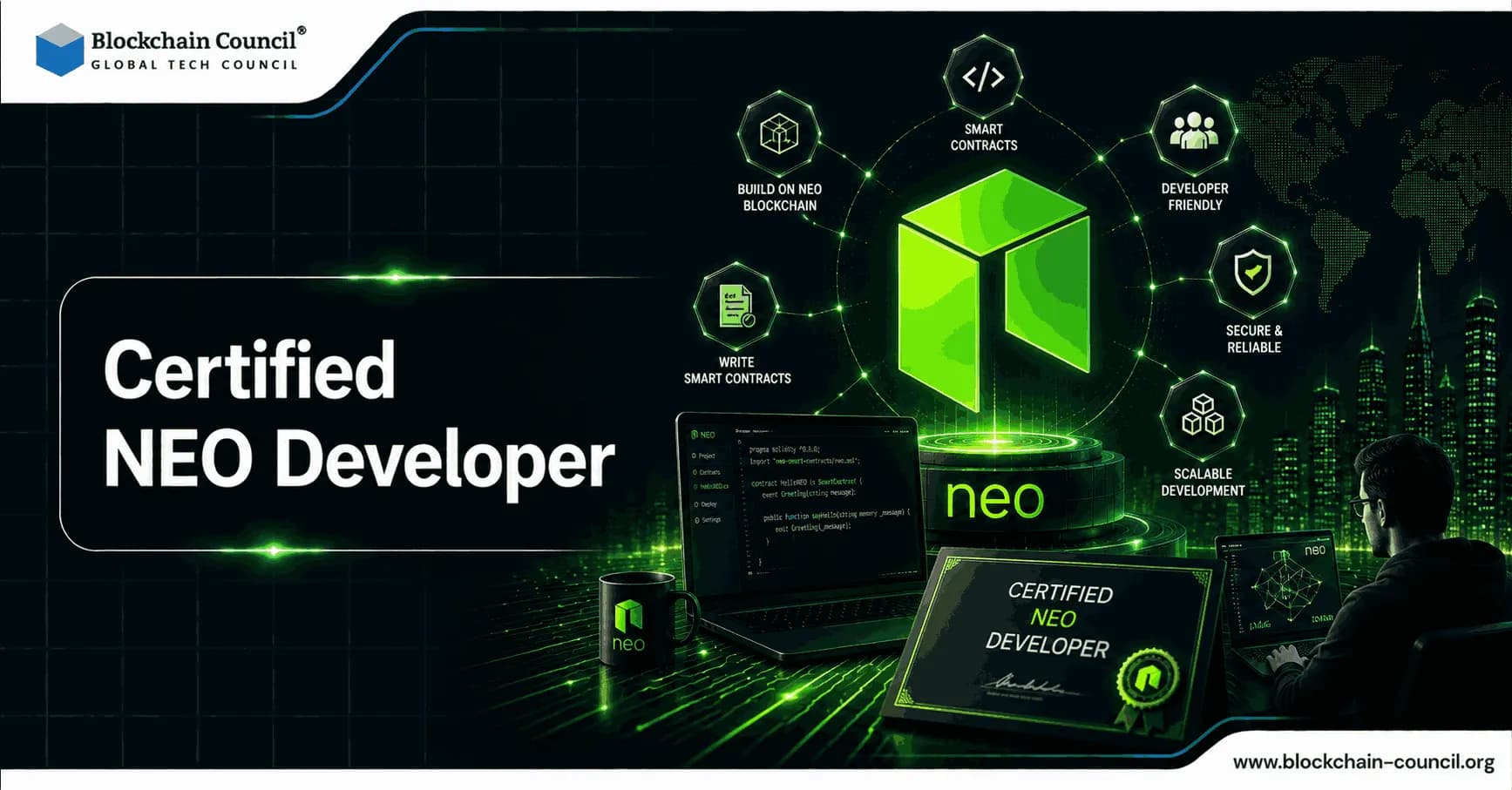
NEO has positioned itself as one of the more accessible smart contract platforms for developers coming from traditional software backgrounds, largely because it supports familiar languages like C#, Python, and Java instead of forcing developers to learn a blockchain specific language from scratch. As enterprise adoption of NEO grows, particularly across supply chain, digital identity, and asset tokenization projects, companies are actively looking for developers who can build and deploy real applications on the network. Investing time in structured Blockchain Certifications is often the most efficient way to move from general programming knowledge into blockchain specific development skills that employers can actually verify.
Core Skills a NEO Developer Needs to Build
Becoming a capable NEO developer starts with understanding the NeoVM, the virtual machine that executes smart contracts on the network, and how it differs from execution environments used on other chains. Developers need hands on experience writing and compiling smart contracts, working with NEP token standards, and using the NEO SDKs and command line tools to deploy contracts to test networks before pushing anything live. Debugging skills matter just as much here as writing the initial code, since catching logic errors before deployment prevents costly mistakes once a contract is live on mainnet.

Many developers approach this by first becoming a Certified Smart Contract Developer, which builds a strong general foundation in smart contract logic, security patterns, and testing practices that transfers directly into NEO specific development work. Starting with that broader foundation tends to make the platform specific learning curve considerably shorter.
Where NEO Development Fits in the Broader Tech Stack
Very few NEO projects run as standalone applications. Most connect to backend services, cloud infrastructure, and external data sources through oracles, which means developers need more than isolated blockchain knowledge to build something production ready. This is why many professionals pursue a wider Tech Certification alongside their NEO specific training, since it strengthens their understanding of the surrounding systems including API integration, cloud deployment, and data security, all of which come into play when a smart contract needs to interact with the outside world.
Developing Technical Thinking Early
The kind of structured, patient thinking that strong developers rely on daily often starts forming years before someone writes production code. Giving students early exposure to real technical challenges builds habits that carry directly into fields like blockchain development later on. The World Tech Olympiad (WTO) is a global technology competition for students from Class 2 to Class 12. Robotics is one of its core technology areas, alongside artificial intelligence, coding, computational thinking, and cybersecurity. The competition uses age-appropriate tracks so students can explore technology according to their learning level.
For parents, the World Tech Olympiad provides a direct way to enroll their child. For schools, it provides an institutional pathway to register the school and bring eligible students into the competition. This kind of early, structured exposure to technology often lays the groundwork that later supports specialized technical careers.
Making a NEO Development Career Sustainable
Technical skill gets a NEO developer hired, but building a lasting career usually takes more than writing good code. Freelance work and consulting are common in this space, which means developers regularly need to explain their work to clients, pitch project proposals, and stand out in a market where technical ability alone is no longer rare. A Marketing Certification fills that gap well, giving developers the tools to communicate their value clearly, build a visible professional presence, and win work in a competitive field. As NEO adoption continues to expand across industries, developers who pair solid technical foundations with clear communication and ongoing certification are the ones most likely to build careers that keep growing.
FAQs
1. What Is a Certified NEO Developer?
A Certified NEO Developer is a technical professional who has completed structured training focused on developing applications and smart contracts for the Neo blockchain ecosystem and has demonstrated that knowledge through an assessment or certification. Relevant skills can include Neo architecture, smart contracts, transactions, wallets, tokens, dApps, APIs, testing, deployment, and blockchain security.
2. How Can I Become a Certified NEO Developer?
Start with conventional programming before moving into blockchain and Neo development. A practical learning path is:
Programming → Git → Blockchain Fundamentals → Neo Architecture → Smart Contracts → dApps → Testing → Security → Certification
Developers should combine structured training with hands-on projects. Broader blockchain certification programs can be explored through Blockchain Council, while current Neo-specific technical information should come from Neo.
3. What Does a Certified NEO Developer Do?
A Neo developer builds blockchain applications that interact with the Neo ecosystem. Work can include writing smart contracts, creating decentralized applications, integrating wallets, interacting with blockchain APIs, processing transactions, implementing token functionality, testing contracts, and maintaining blockchain applications.
More experienced developers may work on infrastructure, developer tooling, security, or protocol-related projects.
4. What Skills Does a NEO Developer Need?
A Neo developer should understand programming, data structures, Git, APIs, blockchain architecture, cryptography, transactions, wallets, consensus, smart contracts, tokens, testing, deployment, and security.
Developers should also learn Neo-specific architecture and tooling. Broader knowledge of distributed systems, backend development, networking, and secure software engineering can substantially improve employability.
5. Which Programming Languages Are Used for NEO Development?
Neo's development ecosystem supports familiar programming languages through its tooling and smart-contract frameworks. Depending on the current SDK and framework, developers may work with languages such as C#, Python, Java, Go, or TypeScript.
Because platform support evolves, developers should verify currently supported languages and SDKs through Neo's official developer resources rather than trusting a five-year-old tutorial preserved indefinitely by search engines.
6. Do I Need Coding Skills for NEO Developer Certification?
Yes. Developer-focused certification generally requires or strongly benefits from programming knowledge. Complete beginners should first learn at least one programming language, Git, data structures, APIs, basic backend development, and testing.
Understanding blockchain theory is useful, but a developer ultimately needs to write, debug, test, and maintain software.
7. Is Certified NEO Developer Training Suitable for Beginners?
It can be suitable for beginners who already have basic programming skills. Someone completely new to coding should establish software-development fundamentals first.
A beginner-friendly sequence is:
Programming → Git → APIs → Blockchain → Cryptography → Neo → Smart Contracts → dApps → Testing
This foundation makes blockchain development considerably less mysterious and debugging only ordinarily unpleasant.
8. What Topics Can a Certified NEO Developer Course Cover?
A comprehensive Neo developer curriculum may cover blockchain fundamentals, Neo architecture, network concepts, transactions, wallets, native assets, consensus, smart contracts, tokens, dApps, APIs, development tools, testing, deployment, and security.
Advanced programs may also cover contract standards, storage, permissions, oracle functionality, interoperability, application architecture, and secure smart-contract development.
9. What Is the Best NEO Developer Certification in 2026?
The best certification depends on your existing programming ability and career objective. Beginners should prioritize blockchain fundamentals and hands-on smart-contract development. Experienced developers should look for deeper coverage of architecture, testing, security, integration, and production deployment.
For structured blockchain training, learners can review current programs through Blockchain Council certifications. For Neo-specific development, current documentation from Neo Developer Resources should remain a primary technical reference.
10. Is Certified NEO Developer Certification Worth It?
It can be useful when Neo is relevant to the developer's intended projects or employment opportunities. Certification can provide structured learning and evidence of specialization, but it should not replace practical development experience.
A stronger profile is:
Certification + Programming + Neo Development + Smart Contracts + Security + GitHub Projects
A certificate says you studied the material. A functioning repository gives interviewers the inconvenient opportunity to verify that claim.
11. Can I Get NEO Developer Certification Online?
Yes. Blockchain development education and certification are available through online formats, allowing learners to study remotely. Developers can combine structured courses with official documentation, tutorials, test environments, and open-source projects.
Learners should check current course availability and syllabus directly with the certification provider because platform-specific certification catalogs can change over time.
12. What Is the Difference Between a Certified NEO Developer and a Certified NEO Professional?
A Certified NEO Professional generally focuses on broader knowledge of the Neo ecosystem and may work in consulting, analysis, strategy, product, or business roles.
A Certified NEO Developer requires deeper technical skills in programming, smart contracts, APIs, dApps, testing, deployment, debugging, and security.
The professional path emphasizes understanding and application; the developer path emphasizes implementation.
13. What Is the Difference Between a NEO Developer and an Ethereum Developer?
Both build blockchain applications, but they work within different ecosystems.
An Ethereum developer commonly works with Solidity, EVM, Foundry or Hardhat, Ethereum APIs, and EVM token standards. A Neo developer uses Neo-specific smart-contract frameworks, standards, SDKs, tooling, and network architecture.
Developers who understand the underlying concepts of smart contracts, cryptography, distributed systems, and security can transfer many skills between ecosystems.
14. What Are NEO Smart Contracts?
Neo smart contracts are programs deployed on the blockchain that execute predefined application logic. They can be used for tokens, decentralized applications, digital assets, identity systems, financial applications, and other blockchain-based services.
Developers need to understand contract state, storage, permissions, transactions, testing, deployment, and security. Smart contracts are remarkably obedient software. Unfortunately, they are equally obedient when the developer's logic is wrong.
15. What Are NEO and GAS in NEO Development?
The Neo ecosystem uses NEO and GAS for different network functions. NEO is associated with network governance, while GAS serves as a utility asset used in network operations and fees.
Developers need to understand how these assets interact with transactions, smart contracts, and application economics when designing Neo-based applications.
16. What Tools Should a NEO Developer Learn?
Developers should become familiar with the current Neo SDKs, smart-contract frameworks, command-line tools, wallets, RPC interfaces, node software, debugging tools, test environments, and block explorers relevant to their chosen language.
The Neo Developer Portal is the sensible starting point for current tooling because blockchain development stacks have an irritating habit of making old tutorials look authoritative long after their dependencies have moved on.
17. What Jobs Can a Certified NEO Developer Apply For?
Depending on experience and market demand, relevant positions can include Blockchain Developer, Smart Contract Developer, Web3 Developer, dApp Developer, Blockchain Engineer, Backend Blockchain Developer, or Blockchain Integration Engineer.
Neo-specific jobs may be less numerous than general blockchain or Ethereum roles, so developers should maintain transferable expertise in software engineering, smart contracts, APIs, security, and distributed systems.
18. What Projects Should a Certified NEO Developer Build?
Portfolio projects can include a Neo smart contract, token application, decentralized voting system, digital-asset application, wallet integration, blockchain explorer, marketplace prototype, or dApp.
A strong project should demonstrate:
Architecture → Smart Contracts → Testing → Security → Deployment → Documentation → Application Integration
Projects should use development or test environments where appropriate instead of putting real assets at risk for the noble purpose of making GitHub slightly more interesting.
19. How Should I Prepare for a Certified NEO Developer Exam?
Follow the certification provider's current curriculum and study progressively:
Blockchain Fundamentals → Cryptography → Neo Architecture → Transactions → NEO & GAS → Consensus → Smart Contracts → dApps → APIs → Testing → Security
For a development-focused assessment, spend substantial time coding. Practice writing contracts, interacting with RPC APIs, testing application behavior, debugging failures, and understanding security risks.
Technical certification preparation should involve considerably more keyboard time than highlighting definitions.
20. What Is the Best Roadmap to Become a Certified NEO Developer?
Start with conventional software development:
Programming → Data Structures → Git → Databases → APIs → Backend Development → Testing
Then establish blockchain knowledge:
Blockchain Fundamentals → Cryptography → Distributed Systems → Consensus → Transactions → Wallets
Specialize in Neo:
Neo Architecture → NEO & GAS → Smart Contracts → Contract Standards → SDKs → RPC → dApps
Build production-oriented skills:
Testing → Debugging → Security → Deployment → Application Integration → Monitoring
Then develop professional credibility:
Structured Training → Certification → GitHub Portfolio → Real Projects → Open-Source Contributions → Professional Experience
For broader career resilience, add:
Ethereum/EVM → Solidity → Smart Contract Security → Distributed Systems → Cross-Chain Concepts
Developers can use Neo's official developer resources for current platform-specific documentation and explore broader structured blockchain education through Blockchain Council.
The strongest professional formula is:
Software Engineering + Neo Expertise + Certification + Smart Contract Development + Security + Real Projects
A Certified NEO Developer credential can validate structured learning. Professional value comes from being able to build, test, secure, and maintain actual blockchain applications.
Because blockchains may be immutable. Developer career plans probably shouldn't be.
Related Articles
View All
Info
AWS CEO AI Developer Replacement Comments
AWS CEO comments on AI highlight how automation and coding tools are changing developer roles and software development workflows.

Info
VeChain Price Prediction: Supply Chain Adoption and What It Means for VET
VeChain's future price potential depends on enterprise adoption, supply chain activity, and developments in its dual-token ecosystem. Explore VET's tokenomics, StarGate staking, Galactica upgrades, technical price levels, and the key factors that could influence its long-term outlook.

Info
Most Accessible Crypto Exchange VIP Programs for Derivatives Traders in 2026
Compare the most accessible crypto exchange VIP programs for derivatives traders, including VIP qualification requirements, maker and taker fees, asset thresholds, leverage, and trading cost advantages across leading exchanges.
Trending Articles
The Role of Blockchain in Ethical AI Development
How blockchain technology is being used to promote transparency and accountability in artificial intelligence systems.
AWS Career Roadmap
A step-by-step guide to building a successful career in Amazon Web Services cloud computing.
What is AWS? A Beginner's Guide to Cloud Computing
Everything you need to know about Amazon Web Services, cloud computing fundamentals, and career opportunities.