
Visa Backs Stablecoins for Emerging Markets Growth
 Michael Willson
Visa has started using stablecoins to improve cross-border payments, especially in emerging markets. In 2025, Visa processed over $225 million in stablecoin payments through its Visa Tokenized Asset Platform (VTAP). This move shows Visa’s commitment to using crypto in practical, everyday transactions where traditional systems fall short.
The goal is simple: make sending and receiving money easier, faster, and cheaper for people in countries with limited access to financial services.
Visa’s Approach to Stablecoins
Visa is not trying to replace currencies. Instead, it is adding stablecoins like USDC into its payment systems. The company’s VTAP platform handles stablecoin issuance, transfers, and redemption in a secure and efficient way.
Unlike pilot programs, Visa has already gone live with partners such as Circle, BBVA, Anchorage, Stripe Bridge, and Yellow Card. These firms help Visa offer stablecoin-based services like merchant payments and international payouts.
Visa’s focus is on stablecoins that are backed by fiat and compliant with regulations. The use of trusted tokens allows Visa to expand its services into regions where banking tools are outdated or unreliable.
To maximize your profits, first learn bitcoin mining strategies and best practices.
Why Emerging Markets Matter
Visa has made it clear that the biggest impact of stablecoins will be seen in emerging markets. In the U.S. and other developed regions, traditional payments are fast and efficient. But in countries with limited access to the dollar, stablecoins offer a reliable alternative.
Visa’s head of crypto, Cuy Sheffield, emphasized that stablecoins are helping to connect people to the global economy. They offer real-time settlement, lower fees, and avoid the need for pre-funded accounts.
Countries across Latin America, Africa, and Asia are key targets. These regions deal with high remittance fees and slow bank processing. Visa aims to solve these issues with a faster, blockchain-powered alternative.
What Makes Visa’s Strategy Work
Visa is not launching a new cryptocurrency. Instead, it uses its current infrastructure to integrate stablecoins. The VTAP platform acts as a bridge between banks, fintechs, and the blockchain.
Some of the practical features include:
- Stablecoin-linked Visa cards through partners like Stripe Bridge
- Direct remittance support through local fintechs like Yellow Card
- Token lifecycle management using Visa’s existing compliance protocols
- Settlement in real-time, avoiding the need for long delays or high costs
Before diving into hardware or software, it’s essential to understand how Bitcoin mining works.
Advantages Over Traditional Remittance Systems
Stablecoins remove many of the common barriers in sending money across borders. Here’s a breakdown of how Visa’s solution improves over legacy systems:
Remittance Comparison: Legacy Banks vs Visa’s Stablecoin System
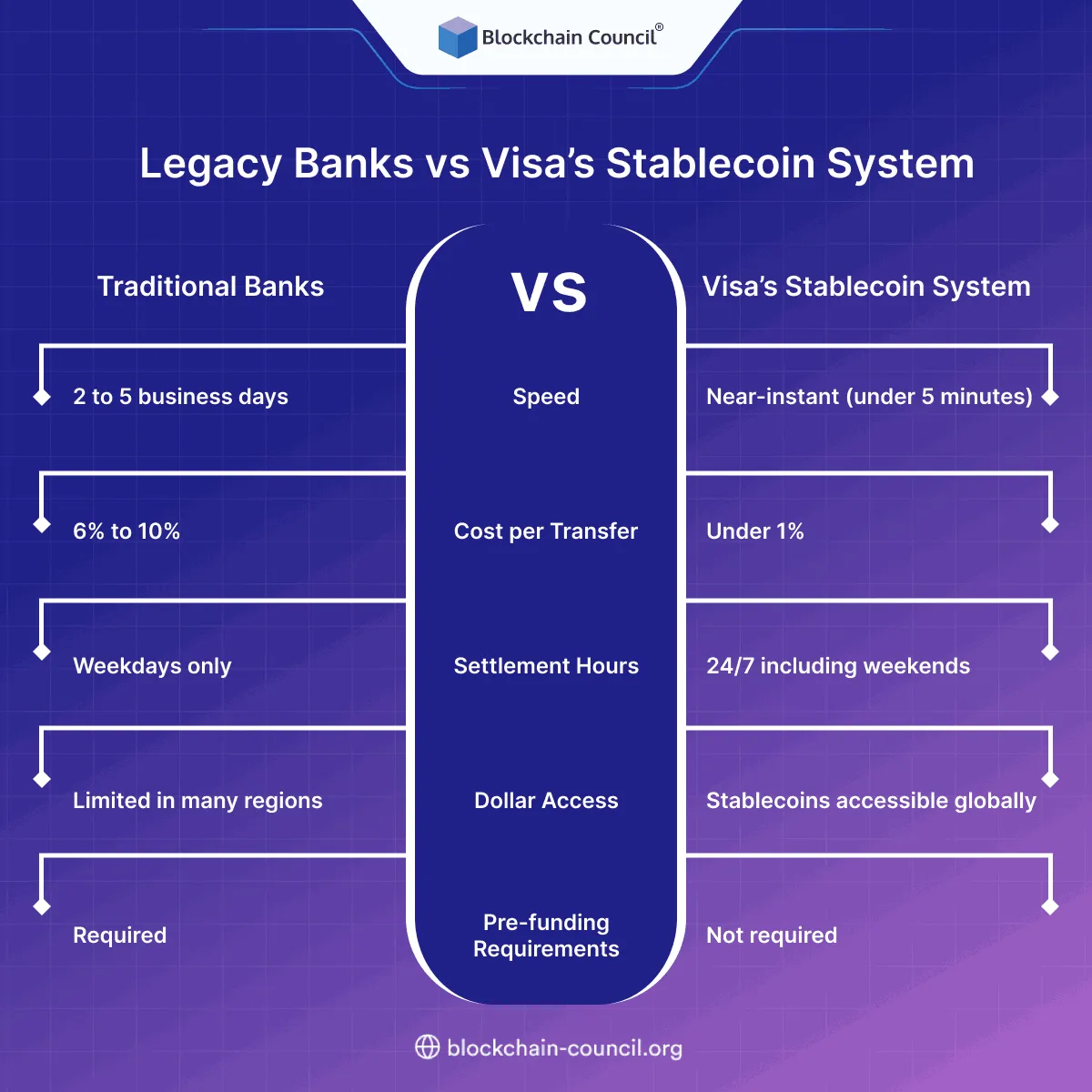
Visa’s stablecoin model offers a faster and more affordable option for everyday people and small businesses in underbanked areas.
Real-World Use Cases and Partners
Visa has already tested this system with real partners. For example, Yellow Card in Africa uses stablecoins to help users send and receive money across borders. BBVA in Latin America works with Visa to support digital wallets linked to stablecoins.
Bridge, a crypto–fintech backed by Stripe, allows users to top up stablecoin balances and spend through regular Visa cards. This kind of infrastructure blends blockchain and traditional systems in a way that feels familiar to consumers.
By 2025, Visa had already enabled $225 million worth of stablecoin transfers. These numbers show that the model is working at scale, not just in test environments.
Growing Global Interest in Stablecoins
The broader market for stablecoins has exploded. By mid-2025, the global stablecoin market passed $250 billion in value. Visa’s early entry gives it a strong position in this expanding field.
Regulations like the GENIUS Act in the U.S. and MiCA in Europe are helping to provide legal clarity. This allows major players like Visa to scale with confidence while staying compliant.
Key Roles in Visa’s Stablecoin Ecosystem
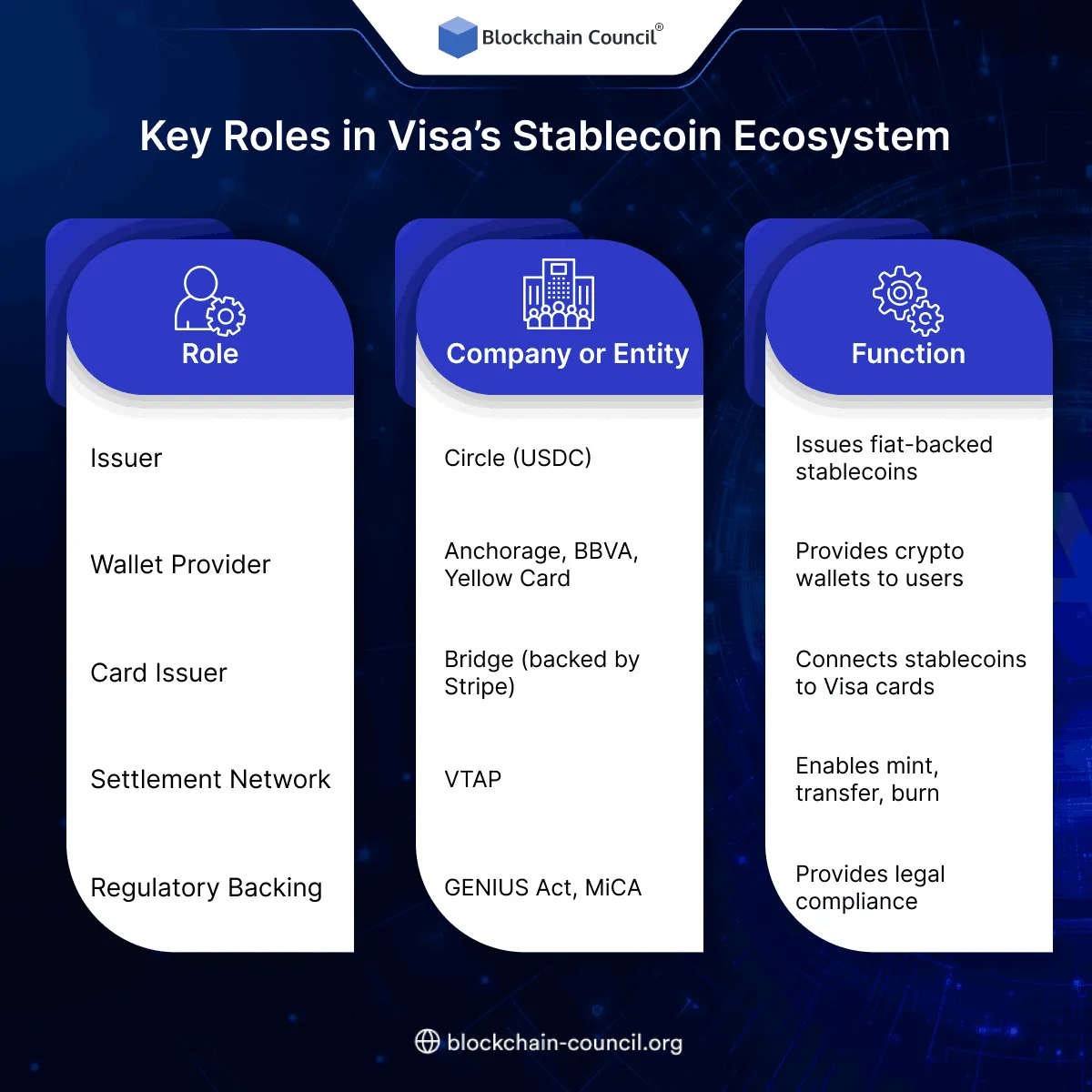
These collaborations show Visa’s plan is not a solo effort. It involves banks, fintechs, and stablecoin providers working together to change how money moves globally.
Why This Strategy Matters
Visa’s work with stablecoins is more than a technology experiment. It solves real problems for millions of people who rely on remittances, lack access to banks, or need faster business payments.
It also gives Visa a new revenue stream. Analysts estimate the company could generate over $40 billion in e-commerce value by expanding stablecoin use in emerging markets. With $18.7 billion in free cash flow, Visa has the resources to keep scaling this effort.
This approach aligns with industry trends. Other payment giants like Mastercard are now exploring stablecoins as well. But Visa’s head start and working partnerships put it ahead of the curve.
The Bigger Picture for Crypto and Finance
Visa’s expansion into stablecoins sends a clear message: crypto is not just for tech experts or traders. It’s becoming part of how global finance works.
This shift creates new opportunities for professionals and developers in blockchain, AI, and fintech. To prepare for these changes, consider exploring relevant training programs:
- Start with a Crypto certification to understand the foundations of digital assets
- Learn how Bitcoin mining supports the network and powers assets like stablecoins with a Bitcoin mining certification
- Use a Data Science Certification to analyze trends in stablecoin flows and adoption
- Lead fintech and payments innovation with a Marketing and Business Certification
Final Takeaway
Visa is proving that stablecoins are not just a crypto experiment. They are useful tools for everyday financial needs, especially in emerging markets where traditional systems fall short.
By building on its existing network and adding partners, Visa is creating a new way to move money—faster, cheaper, and more accessible to everyone.