
Crypto Regulation And Compliance Tools

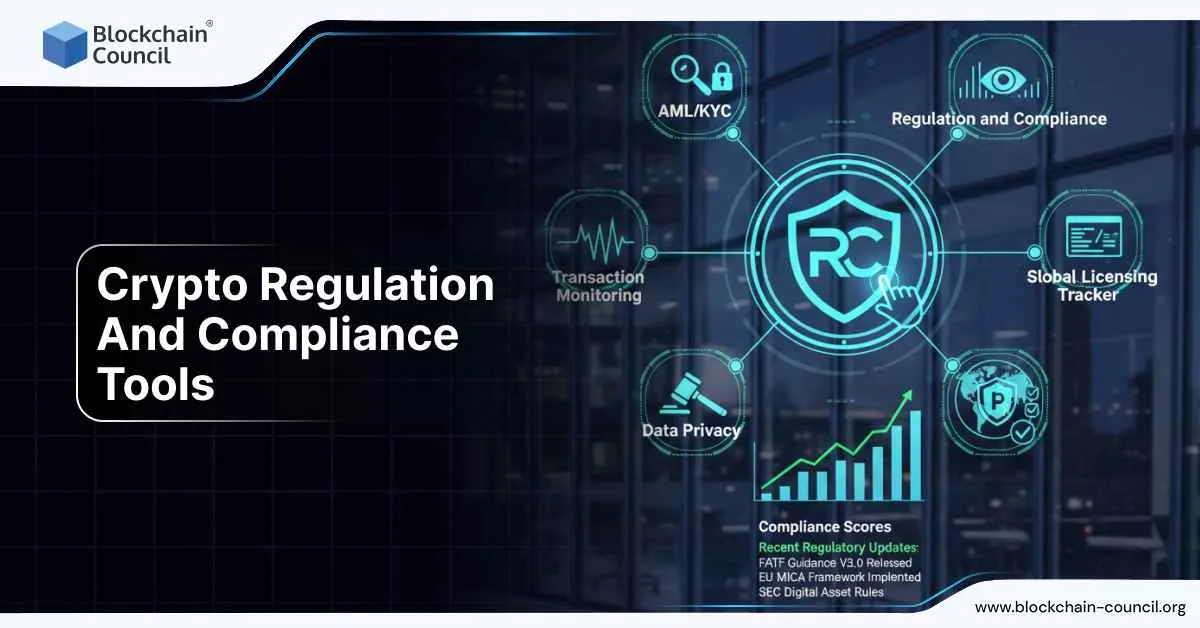
Crypto regulation and compliance tools are the operational layer that turns laws into workflows. Exchanges, wallets, issuers, brokers, OTC desks, payment firms, and even DeFi front-ends all end up mapping to the same core obligations: AML/CFT, sanctions, Travel Rule data exchange, fraud and market abuse monitoring, custody controls, and reporting. If you want structured grounding before drowning in vendor decks, start with a Crypto certification.
Regulatory Drivers
The tooling you need is dictated by regulators, not by product preference.
FATF sets the global AML/CFT baseline for Virtual Assets and VASPs. Its 2025 targeted update highlights implementation gaps, Travel Rule adoption issues, and supervisory expectations. FATF’s Travel Rule best practices document makes it clear regulators expect operational evidence, not policy PDFs.
In the EU, MiCA provides the harmonized crypto-asset framework, while Regulation (EU) 2023/1113 governs information accompanying certain crypto transfers. EBA guidelines operationalize this from December 30, 2024 onward. That means concrete tooling for originator and beneficiary data handling, missing-data logic, and recordkeeping.
In the US, SEC staff statements shape custody and tokenized security design. The December 17, 2025 custody statement addresses possession or control of crypto-asset securities. The January 2026 tokenized securities statement reinforces that securities law applies regardless of token format.
Sanctions expectations in the US are anchored in OFAC’s guidance for the virtual currency industry, which emphasizes risk-based screening, blocking, reporting, and escalation.
Hong Kong’s AML/CFT guideline for licensed stablecoin issuers shows how stablecoin regimes are translating general AML principles into issuer-specific system expectations.
Blockchain Analytics And Monitoring
This is the “know your transaction” layer.
Core capabilities typically include:
- Wallet screening before transactions
- Ongoing transaction monitoring after execution
- Entity attribution and clustering
- Risk scoring and typology detection
- Case management and audit trails
Vendors like TRM Labs position their tools around blockchain intelligence for sanctions evasion and illicit finance monitoring. Elliptic similarly focuses on sanctions exposure, multi-chain coverage, and investigative workflows.
The operational reality is simple: if you cannot demonstrate screening, alert triage, and escalation documentation, you do not have a defensible AML program.
Sanctions Controls
Sanctions compliance is its own discipline layered on top of AML.
Tooling generally covers:
- Screening against sanctions lists and watchlists
- Indirect exposure analysis through entity clustering
- Jurisdiction and geolocation risk signals
- Block and freeze workflows
- Reporting support for regulator notifications
OFAC’s guidance is explicit about risk-based programs and internal controls. The tools exist to implement those expectations in real time across public blockchain flows.
Travel Rule Systems
Travel Rule compliance forces regulated entities to exchange originator and beneficiary information for qualifying transfers.
In practice, firms deploy:
- Counterparty discovery mechanisms
- Secure messaging channels between VASPs or CASPs
- Validation of required data fields
- Workflows for incomplete or missing information
- Record retention and supervisory reporting
The EU’s EBA guidelines define operational handling standards. FATF’s supervisory best practices clarify what examiners expect to see. Providers like Notabene describe interoperable messaging approaches that integrate with analytics and sanctions tooling.
The key point is that on-chain settlement does not remove off-chain identity exchange obligations.
KYC And Customer Risk
Before transactions, there is onboarding.
Typical capabilities include:
- Identity document verification and liveness checks
- Beneficial ownership verification for businesses
- Sanctions and PEP screening
- Risk scoring and enhanced due diligence triggers
- Periodic review and re-verification workflows
These systems usually integrate with blockchain analytics so suspicious activity feeds back into customer risk ratings.
Without integration, compliance becomes a spreadsheet exercise that collapses under volume.
Custody And Policy Controls
Institutional compliance requires enforced movement rules.
Common elements include:
- Multi-approval workflows and dual control
- Segregated wallets and account structures
- Role-based access control
- Withdrawal limits and velocity rules
- Immutable logging and audit trails
This intersects directly with SEC custody guidance for broker-dealers dealing in crypto-asset securities. The ability to demonstrate control over asset movement on the relevant ledger is not optional.
Token-Level Controls
Some compliance is embedded in the asset itself.
Permissioned tokens and allowlists enforce:
- Eligibility gating
- Jurisdiction-based restrictions
- Lockups and investor-class limitations
- Administrative freeze or pause mechanisms
This is especially common in tokenized securities and regulated RWAs, aligning with the SEC’s framing that tokenization does not alter legal classification.
Proof Of Reserves
Proof-of-reserves and solvency tooling attempts to demonstrate that liabilities are backed by assets.
Approaches range from:
- Merkle-tree liability proofs
- On-chain asset attestations
- Third-party attestations and audits
- Limited use of privacy-preserving cryptography
This tooling supplements AML, custody, and governance controls. It does not replace them.
Assembling A Real Stack
Most regulated firms end up combining:
- Blockchain analytics and sanctions screening
- Travel Rule messaging and counterparty discovery
- KYC/KYB and customer risk scoring
- Case management and regulatory reporting
- Custody policy enforcement and approval controls
If one of those layers is missing, regulators will find it.
Conclusion
Crypto compliance tooling has shifted from vague “best efforts” to operationally specific, regulator-shaped systems. FATF pressures Travel Rule effectiveness. The EU has moved into detailed transfer-information requirements. US securities regulators are influencing custody architecture. Stablecoin regimes are publishing issuer-level AML/CFT expectations.
The result is predictable: compliance is becoming embedded in transaction flows, custody design, token logic, and monitoring systems. If you are building or evaluating these tools, technical implementation depth matters as much as regulatory interpretation. A solid Tech certification helps at the systems level, and a Marketing certification helps align compliance posture with customer trust and regulatory signaling. Without both execution and communication discipline, “compliance-ready” is just a slogan.