

Coinbase Forecasts $1T Stablecoin Market by 2028
 Michael Willson
Coinbase has forecasted that the global stablecoin market could grow to nearly $1.2 trillion by 2028. This bold projection is based on research and simulations that account for gradual adoption, regulatory clarity, and wider institutional acceptance. For professionals and investors, this kind of forecast shows why stablecoins are not just a niche tool but a core part of the financial system’s future. Learning the fundamentals through a Crypto Certification can help individuals prepare for this growth and understand its impact on global markets.
Why the Forecast Matters
Stablecoins are digital tokens pegged to stable assets like the U.S. dollar. They are widely used for trading, remittances, and payments in decentralized finance. Coinbase’s projection is significant because it goes beyond short-term hype and looks at long-term fundamentals. A $1 trillion market means stablecoins would no longer be side tools for crypto traders. Instead, they would be central infrastructure for global finance.

The projection also matters because it shows how stablecoins could affect traditional markets, particularly U.S. Treasury bills. With trillions in circulation, stablecoins would reshape liquidity, yields, and investment strategies across finance.
How Coinbase Reached Its Estimate
Coinbase’s research team used Monte Carlo simulations to model different adoption scenarios. They avoided extreme assumptions like sudden regulatory changes or massive shifts in interest rates. Instead, the analysis focused on gradual adoption driven by policy clarity and market demand.
Based on these models, stablecoin growth could require issuers to buy around $5.3 billion in Treasury bills every week. This demand would slightly lower short-term yields, a manageable impact but one that shows the scale of stablecoins’ integration into mainstream finance.
The Role of Policy
Coinbase highlights regulation as a key factor in reaching the $1 trillion milestone. Clear frameworks like the GENIUS Act, which seeks to provide guidelines for stablecoin issuance and reserve management, are expected to accelerate adoption. With stronger legal foundations, institutions can use stablecoins more confidently for cross-border payments, settlements, and reserves.
Key Drivers of Stablecoin Market Growth
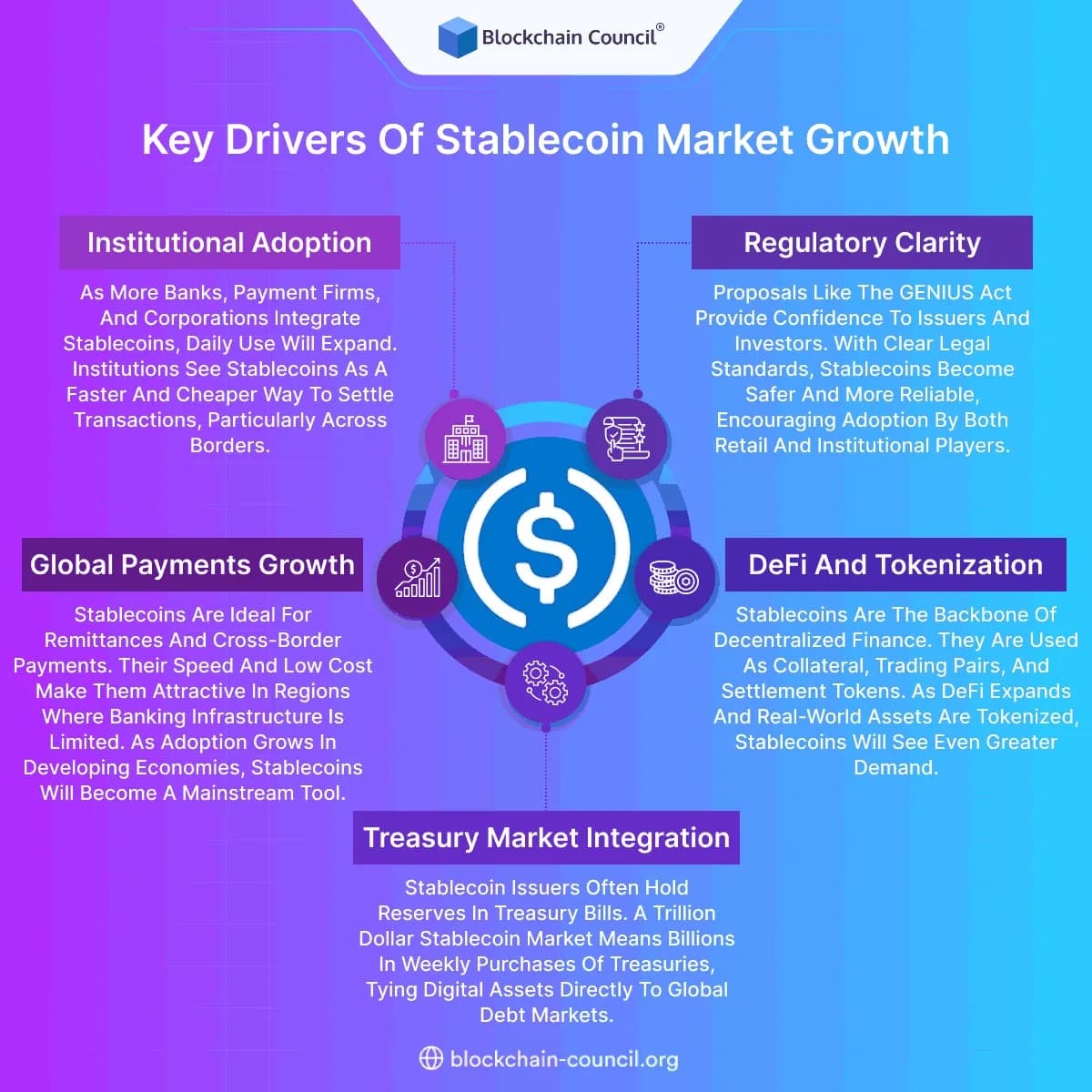
Institutional Adoption
As more banks, payment firms, and corporations integrate stablecoins, daily use will expand. Institutions see stablecoins as a faster and cheaper way to settle transactions, particularly across borders.
Regulatory Clarity
Proposals like the GENIUS Act provide confidence to issuers and investors. With clear legal standards, stablecoins become safer and more reliable, encouraging adoption by both retail and institutional players.
Treasury Market Integration
Stablecoin issuers often hold reserves in Treasury bills. A trillion-dollar stablecoin market means billions in weekly purchases of Treasuries, tying digital assets directly to global debt markets.
Global Payments Growth
Stablecoins are ideal for remittances and cross-border payments. Their speed and low cost make them attractive in regions where banking infrastructure is limited. As adoption grows in developing economies, stablecoins will become a mainstream tool.
DeFi and Tokenization
Stablecoins are the backbone of decentralized finance. They are used as collateral, trading pairs, and settlement tokens. As DeFi expands and real-world assets are tokenized, stablecoins will see even greater demand.
Impact on Treasury Yields
One of the most important consequences of stablecoin growth is its effect on U.S. Treasuries. As issuers buy billions of dollars in short-term Treasury bills each week, demand could put downward pressure on yields. This would slightly lower borrowing costs for the government while giving issuers a stable return on reserves.
While some analysts worry about distortions, Coinbase’s report suggests the effect would be modest and manageable. Instead, it could strengthen the link between digital assets and traditional finance.
The Bigger Picture for Global Finance
Stablecoins are no longer just a tool for crypto exchanges. They are being integrated into payment systems, cross-border trade, and corporate finance. A trillion-dollar stablecoin market would mean they are part of everyday life, from international remittances to settlement between institutions.
This shift also signals a blending of traditional and digital finance. As issuers hold reserves in government securities, stablecoins create a bridge between crypto markets and established monetary systems.
What Professionals Can Learn
The growth of stablecoins highlights the need for professionals to upskill. Understanding how stablecoins affect markets, how they are regulated, and how they connect to Treasury bills is critical for anyone in finance or technology.
- Analysts need to evaluate how stablecoin growth impacts yields and liquidity.
- Developers must understand the technical frameworks behind tokenization and payments.
- Business leaders should plan for a world where stablecoins are part of mainstream finance.
Educational programs can help build these skills. A Data Science Certification helps professionals work with payment data and financial modeling. A Marketing and Business Certification prepares leaders to adapt strategies in markets shaped by digital assets.
Why Stablecoins Are Becoming Essential
Stablecoins solve several pain points in finance. They make payments faster, reduce fees, and simplify cross-border transfers. They also provide a digital alternative to holding cash, with the added security of being backed by reserves.
As decentralized finance and tokenization expand, stablecoins will play a bigger role as the settlement layer of choice. Their flexibility and security make them attractive not just for traders but also for institutions seeking efficient ways to move money globally.
Conclusion
Coinbase’s forecast of a $1.2 trillion stablecoin market by 2028 shows just how central these assets are becoming to global finance. With policy clarity, institutional adoption, and integration into Treasury markets, stablecoins are set to move from niche tools to core infrastructure.
For professionals and investors, this is a call to action. The best way to prepare for a future where stablecoins are everywhere is to learn about them now.
Related Articles
View All
Cryptocurrency
Understanding the Crypto Market: Prices, Volatility & What Moves Crypto
Understanding the Crypto Market made simple. Learn how crypto prices are set, what market cap and liquidity mean, why volatility happens, and which factors move prices.

Cryptocurrency
Spot Trading in Crypto Explained: How Immediate Market Trades Work
Spot trading in crypto means buying or selling actual digital assets at current market prices with near immediate settlement and ownership transfer.

Cryptocurrency
The Future of AI Tokens: Opportunities, Risks, and Market Trends in Crypto
AI tokens link crypto assets with AI compute, model access, data markets, and agents. Learn the opportunities, risks, trends, and evaluation steps.
Trending Articles
AWS Career Roadmap
A step-by-step guide to building a successful career in Amazon Web Services cloud computing.
How Blockchain Secures AI Data
Understand how blockchain technology is being applied to protect the integrity and security of AI training data.

Can DeFi 2.0 Bridge the Gap Between Traditional and Decentralized Finance?
The next generation of DeFi protocols aims to connect traditional banking with decentralized finance ecosystems.