
Is AI the Secret Weapon for Investors?
 Michael Willson
Investing has always been about finding an edge—some way to see the market more clearly, react more quickly, or make decisions more confidently than everyone else. Today, many are asking if Artificial intelligence is that edge. AI is being pitched as a game-changer for Wall Street and Main Street alike, capable of reading markets faster than any human, uncovering hidden patterns, and even predicting future risks. But is it really the secret weapon for investors, or just another shiny tool surrounded by hype? That’s the question we’re exploring here. For those eager to get ahead of this curve professionally, an AI powered investing certification can be an excellent step to understand how technology and finance intersect.
Why Investors Are Turning to AI
Markets are noisy. Every day, millions of data points pour in—earnings reports, news headlines, social media posts, global events, and consumer sentiment. Traditional methods struggle to process this flood of information in real time. AI, by contrast, thrives in such environments.

Investment firms are using AI to:
- Analyze news and earnings call transcripts instantly.
- Run sentiment analysis on social media to gauge investor mood.
- Optimize portfolios by balancing risk and return dynamically.
- Predict market volatility and risk using time-series models.
The promise is simple: AI can process more information, faster, and supposedly more accurately than human analysts.
AI in Action: Examples From the Industry
BlackRock, the world’s largest asset manager, has openly discussed its use of large language models to sift through unstructured data like analyst notes and macroeconomic commentary. These insights help inform portfolio managers about potential risks and opportunities.
Hedge funds are experimenting with reinforcement learning models to guide trading strategies. These systems test millions of potential moves across simulated markets, looking for approaches that deliver alpha—the holy grail of returns above the market average.
Even retail investors are feeling the shift. Brokerage platforms are starting to integrate AI-driven assistants that suggest investments, flag risks, or provide education in plain language. What once felt like futuristic technology is now creeping into everyday investing.
Portfolio Optimization and Dynamic Allocation
One of AI’s strongest applications is in portfolio management. Traditionally, asset allocation models rely on historical correlations between asset classes. But correlations shift in real markets, often when investors need stability most.
AI systems can adapt more quickly, rebalancing portfolios in response to real-time data. They can test countless scenarios—what happens if oil prices spike, if a new regulation is introduced, or if a tech bubble bursts—and adjust strategies accordingly.
This doesn’t make portfolios “risk-free,” but it allows managers to move from reactive to proactive. For long-term investors, it means potentially smoother returns in turbulent markets.
Steps to Optimize an Investment Portfolio Using AI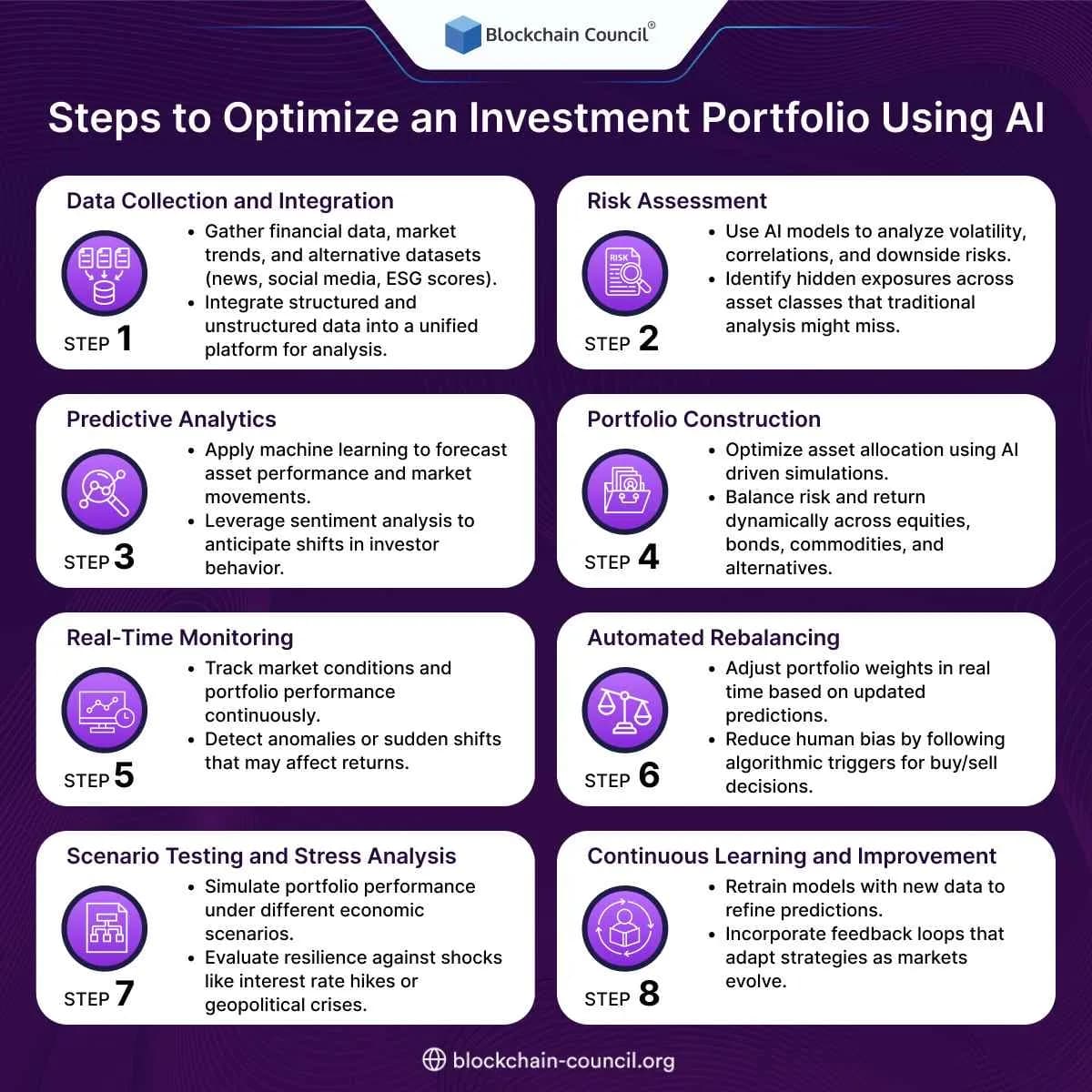
Step 1: Data Collection and Integration
- Gather financial data, market trends, and alternative datasets (news, social media, ESG scores).
- Integrate structured and unstructured data into a unified platform for analysis.
Step 2: Risk Assessment
- Use AI models to analyze volatility, correlations, and downside risks.
- Identify hidden exposures across asset classes that traditional analysis might miss.
Step 3: Predictive Analytics
- Apply machine learning to forecast asset performance and market movements.
- Leverage sentiment analysis to anticipate shifts in investor behavior.
Step 4: Portfolio Construction
- Optimize asset allocation using AI-driven simulations.
- Balance risk and return dynamically across equities, bonds, commodities, and alternatives.
Step 5: Real-Time Monitoring
- Track market conditions and portfolio performance continuously.
- Detect anomalies or sudden shifts that may affect returns.
Step 6: Automated Rebalancing
- Adjust portfolio weights in real time based on updated predictions.
- Reduce human bias by following algorithmic triggers for buy/sell decisions.
Step 7: Scenario Testing and Stress Analysis
- Simulate portfolio performance under different economic scenarios.
- Evaluate resilience against shocks like interest rate hikes or geopolitical crises.
Step 8: Continuous Learning and Improvement
- Retrain models with new data to refine predictions.
- Incorporate feedback loops that adapt strategies as markets evolve.
Sentiment Analysis: Reading the Market’s Mood
Markets run on psychology as much as fundamentals. That’s why sentiment analysis has become such a powerful use case for AI.
By scraping headlines, tweets, Reddit forums, and even Google search trends, AI models build real-time gauges of investor mood. A sudden spike in negative sentiment can foreshadow a sell-off. A surge in positive chatter might signal momentum.
Researchers at the University of Chicago recently demonstrated how AI can reveal what investors really think about stocks by analyzing the language in financial commentary. These insights go beyond traditional indicators, offering a new lens into the forces that drive markets day to day.
Of course, sentiment can be fickle. Markets often swing on emotion rather than logic, and AI may amplify false signals if it leans too heavily on noisy data.
Risk Prediction and Management
AI isn’t just about spotting opportunities; it’s also about protecting against downside. RiskLabs, for example, developed models that combine news, time-series, and textual data to predict volatility. Tools like these help investors prepare for turbulence before it arrives.
Banks and insurers are also exploring AI-driven risk assessments, particularly for credit portfolios and loan markets. By analyzing vast amounts of borrower data, AI can highlight risks that traditional credit scores miss.
But here again, the promise is tempered by caution. If the training data reflects past biases, AI models may reinforce them. Risk predictions could unfairly penalize certain groups or overlook new, emerging threats not present in historical data.
The Scale of Adoption
AI in investing is not a niche experiment anymore. A 2024 survey revealed that over 90% of investment managers are already using or planning to deploy AI tools in their strategies. Most expect moderate to substantial returns from these tools over the next three to five years.
Yet there’s a reality check: adoption doesn’t guarantee success. A study from MIT found that while many firms are investing heavily in AI, about 95% have yet to see meaningful returns. Building and maintaining AI systems is expensive, and translating their predictions into actual profits remains challenging.
This disconnect raises a hard question: is AI truly a secret weapon, or is it another case where the hype runs ahead of the results?
The Regulatory Spotlight
Regulators are paying close attention to AI in finance. The U.S. Securities and Exchange Commission has already charged firms for exaggerating their use of AI—what some call “AI washing.” In Europe, watchdogs warn that banks must take full responsibility for AI-driven decisions, even if the systems are complex or opaque.
This scrutiny highlights a key issue: investors need transparency. If AI is making or influencing financial decisions, both firms and clients must understand the assumptions and risks involved. Without that, trust in both the technology and the markets could erode.
The Hype vs Reality Gap
There’s no question that AI can improve speed, efficiency, and scale in investing. But calling it a secret weapon may be premature. Markets are notoriously unpredictable, shaped not just by data but by politics, psychology, and unexpected events. AI can highlight patterns, but it cannot eliminate uncertainty.
This doesn’t mean AI is useless. It means investors must treat it as one tool among many. Used wisely, it can enhance strategies. Used blindly, it can create overconfidence and amplify risks.
Investor Psychology and the “AI Edge”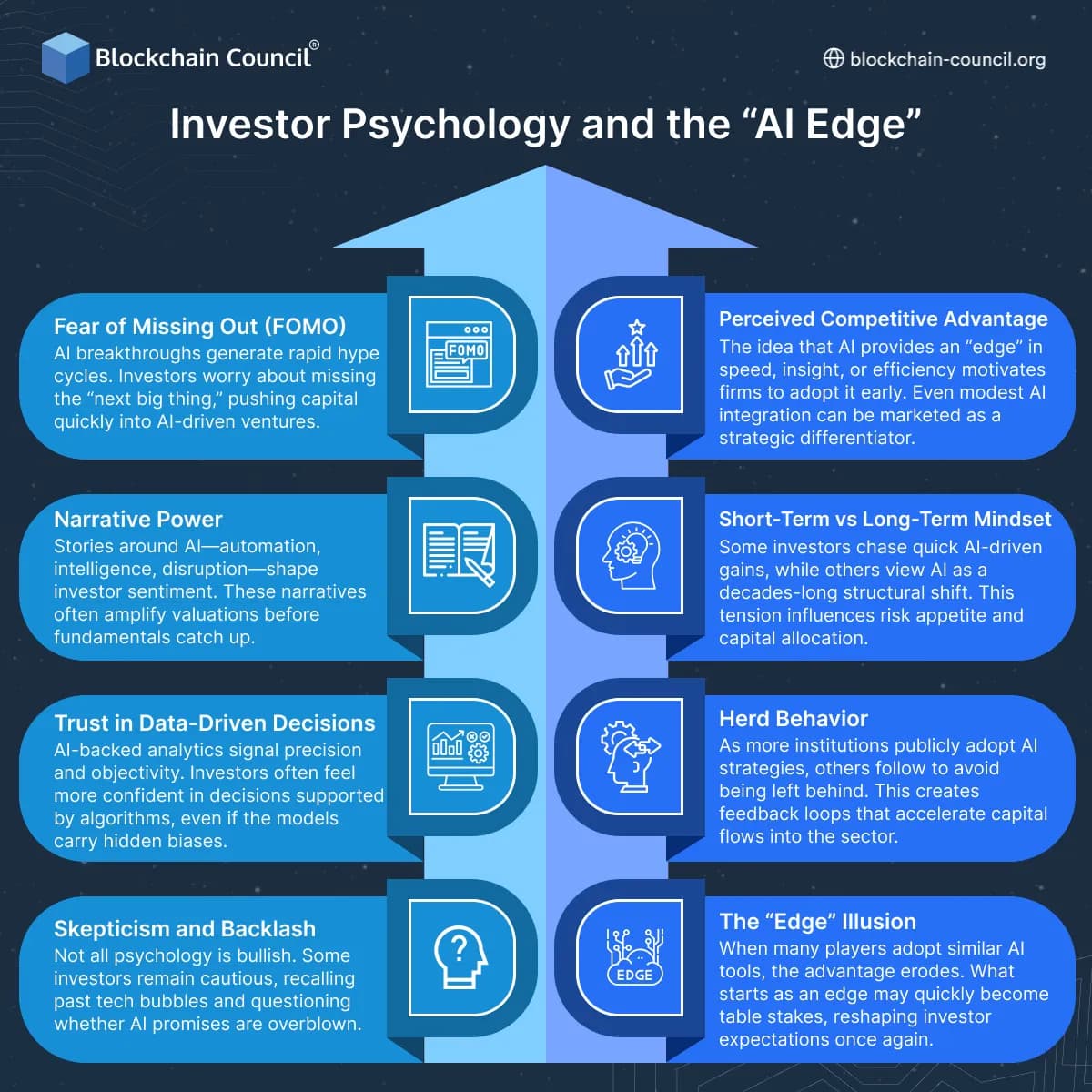
Fear of Missing Out (FOMO)
AI breakthroughs generate rapid hype cycles. Investors worry about missing the “next big thing,” pushing capital quickly into AI-driven ventures.
Perceived Competitive Advantage
The idea that AI provides an “edge” in speed, insight, or efficiency motivates firms to adopt it early. Even modest AI integration can be marketed as a strategic differentiator.
Narrative Power
Stories around AI—automation, intelligence, disruption—shape investor sentiment. These narratives often amplify valuations before fundamentals catch up.
Short-Term vs. Long-Term Mindset
Some investors chase quick AI-driven gains, while others view AI as a decades-long structural shift. This tension influences risk appetite and capital allocation.
Trust in Data-Driven Decisions
AI-backed analytics signal precision and objectivity. Investors often feel more confident in decisions supported by algorithms, even if the models carry hidden biases.
Herd Behavior
As more institutions publicly adopt AI strategies, others follow to avoid being left behind. This creates feedback loops that accelerate capital flows into the sector.
Skepticism and Backlash
Not all psychology is bullish. Some investors remain cautious, recalling past tech bubbles and questioning whether AI promises are overblown.
The “Edge” Illusion
When many players adopt similar AI tools, the advantage erodes. What starts as an edge may quickly become table stakes, reshaping investor expectations once again.
Investors are always chasing an edge. From insider tips in the early stock exchanges to quantitative trading models in the 1990s, each generation has searched for a method that separates winners from losers. Today, AI is being marketed as that next edge. The very phrase “secret weapon” suggests exclusivity—something that only a few have, something that guarantees an advantage.
This psychology matters. When investors believe AI gives them an edge, they behave differently. They may take bolder bets, trust automated models more than their own judgment, or assume markets can be “beaten” with enough computing power. This mindset can fuel both enthusiasm and disappointment.
The reality is more nuanced. AI can provide insights that humans alone cannot, but it is not magic. It can process vast datasets, but it cannot foresee black swan events like pandemics, wars, or sudden regulatory shocks. The danger lies not in using AI, but in believing it replaces judgment entirely.
Case Studies: Successes and Failures
Success Stories
Some hedge funds and asset managers have reported tangible benefits from integrating AI into their workflows. By applying machine learning to alternative datasets—like satellite imagery of parking lots, shipping traffic, or crop yields—they’ve gained early signals about company performance or economic trends.
Sentiment analysis has also paid off in certain cases. Funds using AI to parse millions of financial news articles and social posts have occasionally spotted shifts in market mood before prices adjusted. For short-term trading strategies, this can translate into real profits.
Retail investors, too, are beginning to see AI in action. Brokerage apps now include AI-driven assistants that explain market news, suggest trades, or warn of excessive risk exposure. For individuals without deep financial backgrounds, these tools can improve confidence and decision-making.
Failure Stories
Not all attempts end in victory. A number of firms have invested heavily in AI infrastructure only to find that returns didn’t improve. A 2025 MIT study revealed that roughly 95% of companies exploring AI for financial purposes had not seen measurable gains from their investments.
One common pitfall is overfitting. AI models trained on historical data may perform brilliantly in backtests but fail in real markets. Markets evolve quickly, and patterns that existed yesterday may vanish tomorrow.
Another failure mode comes from “AI washing.” Firms eager to ride the hype have exaggerated their use of AI in marketing materials. The SEC has already charged investment advisers for making misleading claims about AI capabilities, underscoring the risks of overpromising.
Herd Behavior and Systemic Risk
AI promises individual advantages, but what happens when everyone uses it? If most investment managers rely on similar AI-driven models, markets could become more synchronized and potentially more fragile.
Imagine dozens of funds using similar sentiment analysis models. If negative sentiment suddenly spikes on social media, many models may generate sell signals at once. This collective action could amplify volatility, triggering sharper declines than would otherwise occur.
Regulators are concerned about this possibility. Systemic risk—the chance that many institutions fail together—is not new in finance. But AI could accelerate it by creating highly correlated behaviors across firms. Herd behavior, once a human trait, may become an algorithmic one.
The Ethical Dimension
AI is only as good as the data it learns from. If training datasets reflect biases, those biases will shape investment decisions. For example, if historical credit data undervalued certain groups, AI risk models might continue to assign them higher risk scores. This is not just unfair; it can also be financially misleading by excluding profitable opportunities.
Fairness is therefore not just an ethical issue but an economic one. Investors who ignore bias risk making flawed decisions.
Transparency is another challenge. Many AI models, especially deep learning systems, operate as “black boxes.” Investors may receive a recommendation without understanding why. This lack of explainability makes it harder to evaluate risk or comply with regulations.
Compliance teams must also grapple with how to audit AI-driven decisions. Regulators increasingly require firms to demonstrate how AI tools operate, but technical opacity complicates this. Until explainable AI becomes more practical, firms face a tension between performance and accountability.
The Role of Regulation
Regulators are not standing still.
- In the U.S., the Securities and Exchange Commission has warned against false claims and required firms to take responsibility for AI-driven investment advice.
- In Europe, banking regulators insist that institutions remain accountable for outcomes, regardless of how complex their AI systems are.
- Globally, watchdogs are exploring new rules to prevent AI from being used in ways that could destabilize markets.
The message is consistent: AI may be powerful, but responsibility remains human. Firms cannot hide behind algorithms when things go wrong.
Beyond Alpha: Risk Management and Efficiency
While the “secret weapon” narrative often focuses on beating the market, AI’s most reliable contributions may lie in risk management and operational efficiency.
- Risk Forecasting: AI can detect early signs of volatility, giving managers a chance to hedge positions before losses mount.
- Fraud Detection: AI systems are being used to identify suspicious trading patterns and prevent financial crimes.
- Operational Efficiency: Automating back-office tasks like compliance checks or trade reconciliation saves firms time and money.
These applications may not generate headlines, but they are practical, measurable benefits. They also carry less systemic risk compared to speculative trading strategies.
Investor Education in the Age of AI
As AI tools spread, education becomes vital. Investors need to know how these systems work, what their limitations are, and how to use them wisely. Blind trust is dangerous, but informed use can be empowering.
For professionals entering finance today, AI literacy is no longer optional. Those who understand how to guide and critique AI systems will be better positioned to thrive. This is why AI certs are gaining traction as a pathway for professionals who want to stay competitive in a tech-driven investment landscape.
The Bigger Picture
AI is reshaping how capital moves, but it is not rewriting the fundamental truths of investing. Risk still exists. Uncertainty still dominates. Human judgment, shaped by experience and context, remains essential.
What AI offers is scale and speed. It can widen the lens through which investors view markets. It can sharpen the tools used to manage portfolios. But whether it becomes a true “secret weapon” depends less on the algorithms themselves and more on how wisely humans wield them.
The Long-Term Outlook for AI in Investing
The long-term outlook for AI in investing is shaped by two competing forces: technological advancement and market unpredictability. On one hand, AI is improving rapidly. Models that once took weeks to train now run in hours. Natural language processing has reached a point where earnings call transcripts, analyst reports, and social media chatter can be parsed in real time for trading signals. Predictive analytics, when applied carefully, can highlight patterns humans miss.
On the other hand, markets are inherently uncertain. No algorithm can foresee sudden geopolitical crises, natural disasters, or political decisions that upend markets overnight. AI may be able to model risk probabilities, but it cannot guarantee outcomes. This is why many experts argue that AI will not eliminate risk—it will redistribute it. Investors who lean heavily on AI may gain an edge in normal conditions but remain vulnerable during black swan events.
Another trend shaping the future is accessibility. What was once exclusive to hedge funds and large asset managers is gradually trickling down to individual investors. Retail brokerages are experimenting with AI assistants that explain trades, generate summaries of company performance, and even warn against risky behavior. If democratized properly, AI could level the playing field for smaller investors. If misused, it could expose inexperienced users to greater risks.
Overreliance and the Dangers of “AI Washing”
One of the most pressing risks in this landscape is overreliance. Investors may come to treat AI recommendations as infallible, assuming that computational power equals accuracy. In reality, AI models are only as good as the data they are trained on. Data can be biased, incomplete, or outdated. A model that works perfectly during one market cycle may fail in the next.
The problem is not just in usage but also in perception. Financial firms, eager to market themselves as innovative, sometimes exaggerate their use of AI. This practice, known as “AI washing,” has already attracted regulatory attention. The U.S. Securities and Exchange Commission has charged investment advisers with making false or misleading statements about their AI-driven services. This shows how hype can quickly turn into legal liability.
Overreliance also risks creating herd behavior. If multiple funds adopt similar AI models, they may act in sync—buying and selling the same assets at the same time. This could increase volatility and trigger systemic risks, particularly in times of stress. The irony is that a technology marketed as a competitive edge could end up making markets more fragile if everyone uses it the same way.
Practical Benefits Beyond Hype
Despite the risks, AI has already proven valuable in several practical areas.
- Portfolio rebalancing: AI systems can monitor portfolios continuously, adjusting allocations in real time as conditions change.
- Fraud detection: AI models excel at spotting anomalies in transaction data, helping prevent insider trading, money laundering, and fraudulent activity.
- Back-office automation: Tasks like compliance checks, reconciliation, and reporting can be streamlined with AI, saving time and reducing human error.
- Risk stress testing: By simulating thousands of potential market scenarios, AI helps investors understand how portfolios might behave under different conditions.
These applications may not make headlines, but they are reliable contributors to efficiency and safety in financial markets. For most firms, these benefits are the foundation of AI adoption—more practical than chasing elusive alpha.
Skills Investors Need in the Age of AI
The rise of AI in investing does not eliminate the need for human expertise—it transforms it. Professionals now need to understand not only financial fundamentals but also how AI systems work, what their outputs mean, and where they fall short.
This is where structured education becomes essential. AI certs are one way professionals are building literacy in this new environment. These programs teach both technical foundations and ethical considerations, preparing learners to use AI responsibly in finance. Investors who want a structured path into digital assets can pursue a crypto certification to learn token economics, on-chain analysis, custody risks, and compliance basics.
For those working directly with financial data, a Tech Certification provides the skills to handle complex datasets, design models, and validate results. These abilities are critical for ensuring that AI-driven insights are reliable and free from bias.
Business leaders, meanwhile, may find value in a Marketing and Business Certification. As financial institutions roll out AI-driven products, leaders must understand not just the technical side but also how to communicate responsibly with clients. Clear messaging prevents misunderstandings and builds trust in an era when skepticism about AI runs high.
Finally, blockchain technology courses are increasingly relevant to investors. Blockchain can complement AI by adding transparency and security to financial transactions. For example, AI models can analyze blockchain-based transaction flows for market insights, while blockchain ensures that data integrity is preserved. The convergence of AI and blockchain could reshape trust mechanisms in financial markets.
Together, these certifications build a skill set that blends technology with ethics, ensuring professionals are not just using AI but guiding it responsibly.
Ethics and Accountability in AI-Driven Finance
The question of accountability looms large. If an AI system makes a faulty recommendation that leads to financial loss, who is responsible? The developer, the financial adviser, or the institution that deployed it? Regulators are increasingly clear: humans remain accountable.
This principle ensures that investors have recourse when things go wrong, but it also creates pressure on firms to ensure AI models are transparent and auditable. Explainability is becoming a critical requirement. Clients need to know why an AI recommended a trade, not just what the recommendation is.
Ethics extend beyond compliance. Investors must also consider fairness. If AI systems systematically disadvantage certain groups—say, by flagging them as higher risk due to biased training data—then markets become less equitable. Responsible investors have both a moral and economic incentive to demand fairness in AI-driven finance.
Is AI Truly a “Secret Weapon”?
The phrase “secret weapon” implies exclusivity and overwhelming advantage. But AI is rapidly becoming mainstream in investing. Nearly every large firm is exploring or deploying it, and retail platforms are beginning to make AI available to individual investors. Once widely available, AI is no longer secret—it is table stakes.
Does that mean it offers no edge? Not exactly. The edge will not come from having AI, but from using it better than others. This includes curating higher-quality data, building more robust models, and integrating human judgment in ways competitors do not. AI may not guarantee victory, but it can be a differentiator if wielded wisely.
Conclusion: A Tool, Not a Silver Bullet
AI is reshaping the investment landscape. It can process mountains of data, detect sentiment shifts, optimize portfolios, and manage risks with unprecedented speed. It is a powerful tool—but it is not infallible.
Investors who treat AI as a silver bullet risk disappointment, or worse, financial loss. Those who treat it as one tool among many, combining its strengths with human expertise, are more likely to thrive. The real secret weapon is not AI itself but the balance between technology, judgment, and ethics.
For professionals, the message is clear: learn the tools, understand their limits, and guide their use responsibly. For investors, the takeaway is equally simple: AI is here to stay, but success still requires discipline, skepticism, and strategy.
So, is AI the secret weapon for investors? Not in the Hollywood sense of an unstoppable force. But it may well be the next great instrument in the toolkit—one that, used wisely, can sharpen decisions, expand access, and make markets a little more predictable, even in a world that never stops surprising us.
Related Articles
View All
Cryptocurrency
Crypto Regulation 2026: The Biggest Global Law Changes and How They Affect Investors
Crypto Regulation 2026 is reshaping investing with MiCA deadlines, US market structure progress, Asia-Pacific divergence, stricter licensing, and rising tax transparency.

Cryptocurrency
Crypto Taxes in 2026: New Reporting Rules, Capital Gains Updates, and How to Stay Compliant
Crypto taxes in 2026 bring Form 1099-DA, new cost basis reporting, and wallet-level tracking. Learn taxable events, rates, and steps to stay compliant.

Cryptocurrency
MiCA, SEC, and Beyond: A 2026 Guide to US vs EU Crypto Regulation for Traders and Exchanges
A 2026 guide to US vs EU crypto regulation: MiCA enforcement, SEC-CFTC commodity clarity, stablecoin rules, and what traders and exchanges must do now.
Trending Articles

The Role of Blockchain in Ethical AI Development
How blockchain technology is being used to promote transparency and accountability in artificial intelligence systems.

AWS Career Roadmap
A step-by-step guide to building a successful career in Amazon Web Services cloud computing.

Top 5 DeFi Platforms
Explore the leading decentralized finance platforms and what makes each one unique in the evolving DeFi landscape.