
Can AI Make You a Smarter Investor?
 Michael Willson
Yes, AI can make you a smarter investor. It can scan thousands of financial reports, news articles, and market signals in minutes. It can spot trends and risks that most people would miss. It can even suggest strategies tailored to your goals and risk appetite. But AI is not flawless. It can make mistakes, and it cannot fully replace human judgment. If you want to get the most out of it, you need to understand what AI can do well, where it falls short, and how you can combine it with your own decisions. That’s why tools and courses like the AI powered investing program are gaining attention. They show you how to use AI responsibly in real investing scenarios.
What Is AI in Investing?
AI in investing means using machine learning models, natural language processing, and automation to analyze financial data. Instead of relying only on human analysts, investors can lean on algorithms to sort through vast amounts of information. This includes stock prices, quarterly reports, macroeconomic indicators, and even posts from social media.
The goal is simple: use data and pattern recognition to make better financial choices. AI does not guess. It calculates probabilities. For example, an AI system can compare thirty years of stock market records and identify situations where companies with certain patterns often perform well. That information helps investors act with more confidence.
Researchers at Stanford tested an AI “stock analyst” against thousands of fund managers. The AI outperformed 93 percent of them over decades. That does not mean humans are obsolete. It does mean AI has become a powerful assistant for anyone serious about investing.
Why AI Makes Investing Smarter
Speed and Scale
Humans cannot read everything. Every day, markets generate millions of data points. AI can scan and summarize them in seconds. That means you do not miss important signals hidden in long documents or complex reports.
Risk Management
AI can measure volatility and highlight unusual patterns in a company’s financials. It can also alert investors to potential market downturns before they hit. That makes it easier to protect portfolios from sudden losses.
Personalized Advice
AI is not just for big funds. Many apps now offer AI-driven recommendations for regular people. They look at your risk appetite, financial goals, and time horizon. Then they suggest the right mix of stocks, bonds, or ETFs for you. This personal touch makes investing more accessible.
Cost Efficiency
Large investors like Norway’s sovereign wealth fund are using AI to cut millions in trading costs. For everyday investors, AI-powered apps can lower fees by automating portfolio management tasks. Over time, this can add up to big savings.
Can AI Beat Human Investors?
The evidence suggests that in many cases, it can. AI can identify patterns that humans overlook and can do it across decades of data. The Stanford study showed massive outperformance against mutual fund managers.
But AI is not always right. It struggles in unusual situations where history does not provide clear guidance. Human investors still play a role by adding context, judgment, and intuition. That is why the future of investing is likely to be a partnership: AI for analysis and scale, humans for strategy and decision-making.
The Risks of Relying on AI
Overreliance
If you depend too much on AI, you risk ignoring factors it cannot measure, like political shifts, sudden regulation changes, or even human behavior in markets. AI is powerful, but it cannot understand emotions like fear or greed that drive many investors.
Misleading Advice
Not all AI tools are trustworthy. Surveys show that one in five people who followed AI investment advice lost money. Some advice was outdated. Some was too generic. That is why you should never follow AI blindly.
AI Washing
Some companies market themselves as “AI-powered” when they are not. Regulators have already punished firms for making false AI claims. This shows that investors need to be cautious. Always check if a product really uses AI or if it is just a marketing trick.
Data and Bias
AI is trained on data. If that data is biased or incomplete, the results will also be flawed. Models that look great in backtests can fail in real markets when something unexpected happens.
How Everyday Investors Can Use AI
AI is no longer just for Wall Street. Many tools are now available for retail investors.
- Portfolio Apps: These apps rebalance your investments automatically.
- Trading Signals: Some services alert you when a stock looks ready to move.
- Market Insights: AI systems summarize thousands of news articles so you know which sectors are gaining attention.
- Risk Alerts: If a company shows unusual patterns, AI can flag it before you invest.
But using AI wisely requires some knowledge of how data works. A good way to build this foundation is through a Tech Certification. It helps you understand how algorithms are trained, how bias can creep in, and how to interpret AI-driven insights.
How Institutions Are Leveraging AI
Institutions are leading the way in using AI for smarter investing.
- BlackRock is applying AI to read text from company filings and build investment themes.
- Norway’s Sovereign Wealth Fund is saving hundreds of millions of dollars by using AI to reduce trading inefficiencies.
- Consultancies like McKinsey predict that AI will transform not only investment research but also compliance, client service, and even marketing.
This shows that AI is not just a short-term trend. It is becoming part of the backbone of the financial system. For professionals who want to enter this space, studying blockchain technology courses can also help. AI and blockchain are increasingly used together in areas like digital assets and transaction monitoring.
Comparing AI Investing Tools
Investors today can choose from a range of AI-driven platforms. These tools vary in complexity, target audience, and the type of insights they provide. Some are designed for institutional investors with access to massive data sets, while others are built for individuals looking for simple guidance.
Institutional AI Tools
Big asset managers and hedge funds have access to custom-built AI systems that go beyond the basics. These tools scan earnings reports, government filings, analyst calls, and even social media sentiment. For example, an institutional system might measure the tone and pace of a CEO’s voice in an earnings call to detect hidden stress. These subtle indicators, combined with financial data, give large investors an edge in predicting company performance.
Retail AI Tools
Retail investors don’t need Wall Street budgets to benefit from AI anymore. Robo-advisors such as Betterment and Wealthfront use machine learning to recommend portfolios based on age, income, and goals. Trading apps are also starting to offer AI-powered alerts and summaries. For example, an app might notify you when your portfolio drifts away from your risk tolerance and suggest how to rebalance it.
The Distinctive Edge of AI Tools
The unique strength of AI in investing lies in its adaptability. Traditional software follows fixed rules. AI, however, learns from patterns in data and improves over time. This means that when market conditions shift, AI has the ability to adjust more quickly than rigid models.
Stepwise Process of AI Filtering Market Data for Investing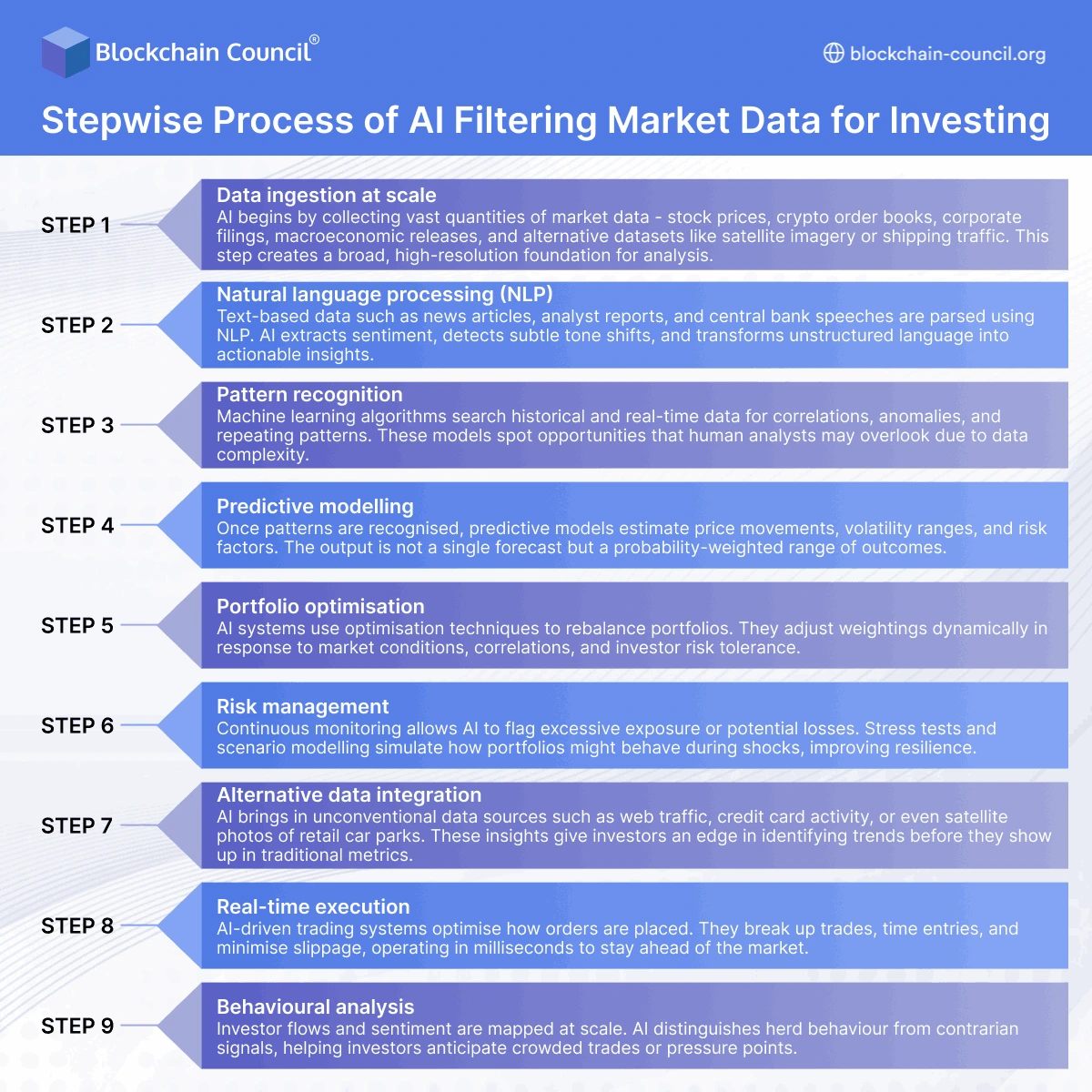
Step 1: Data ingestion at scale
AI begins by collecting vast quantities of market data — stock prices, crypto order books, corporate filings, macroeconomic releases, and alternative datasets like satellite imagery or shipping traffic. This step creates a broad, high-resolution foundation for analysis.
Step 2: Natural language processing (NLP)
Text-based data such as news articles, analyst reports, and central bank speeches are parsed using NLP. AI extracts sentiment, detects subtle tone shifts, and transforms unstructured language into actionable insights.
Step 3: Pattern recognition
Machine learning algorithms search historical and real-time data for correlations, anomalies, and repeating patterns. These models spot opportunities that human analysts may overlook due to data complexity.
Step 4: Predictive modelling
Once patterns are recognised, predictive models estimate price movements, volatility ranges, and risk factors. The output is not a single forecast but a probability-weighted range of outcomes.
Step 5: Portfolio optimisation
AI systems use optimisation techniques to rebalance portfolios. They adjust weightings dynamically in response to market conditions, correlations, and investor risk tolerance.
Step 6: Risk management
Continuous monitoring allows AI to flag excessive exposure or potential losses. Stress tests and scenario modelling simulate how portfolios might behave during shocks, improving resilience.
Step 7: Alternative data integration
AI brings in unconventional data sources such as web traffic, credit card activity, or even satellite photos of retail car parks. These insights give investors an edge in identifying trends before they show up in traditional metrics.
Step 8: Real-time execution
AI-driven trading systems optimise how orders are placed. They break up trades, time entries, and minimise slippage, operating in milliseconds to stay ahead of the market.
Step 9: Behavioural analysis
Investor flows and sentiment are mapped at scale. AI distinguishes herd behaviour from contrarian signals, helping investors anticipate crowded trades or pressure points.
Step 10: Continuous learning loop
AI systems evolve by recalibrating models with fresh data. This adaptability makes them effective in shifting environments, from rate hikes to geopolitical tensions.
Step 11: Compliance and explainability
Finally, AI integrates safeguards for transparency. Explainable AI tools allow investors and regulators to understand the rationale behind recommendations, ensuring trust and regulatory alignment.
One of the most common questions is: How exactly does AI read the markets? The answer is simpler than it sounds.
- Natural Language Processing (NLP): AI reads text from reports, filings, and news. For example, it can summarize hundreds of pages of a quarterly filing into a short insight like “Revenue up, but margins shrinking.”
- Machine Learning Models: AI uses past price data to identify trends and predict possible future movements. This does not mean it can see the future, but it can highlight scenarios that are more likely based on historical patterns.
- Sentiment Analysis: AI measures public mood by analyzing articles, tweets, or even Reddit discussions. When sentiment spikes positive or negative, AI can flag it as a potential market mover.
- Risk Models: AI calculates the probability of losses under different scenarios, helping investors make safer decisions.
This combination of text analysis, pattern recognition, and probability makes AI much faster and more consistent than human-only research.
AI vs Traditional Investment Strategies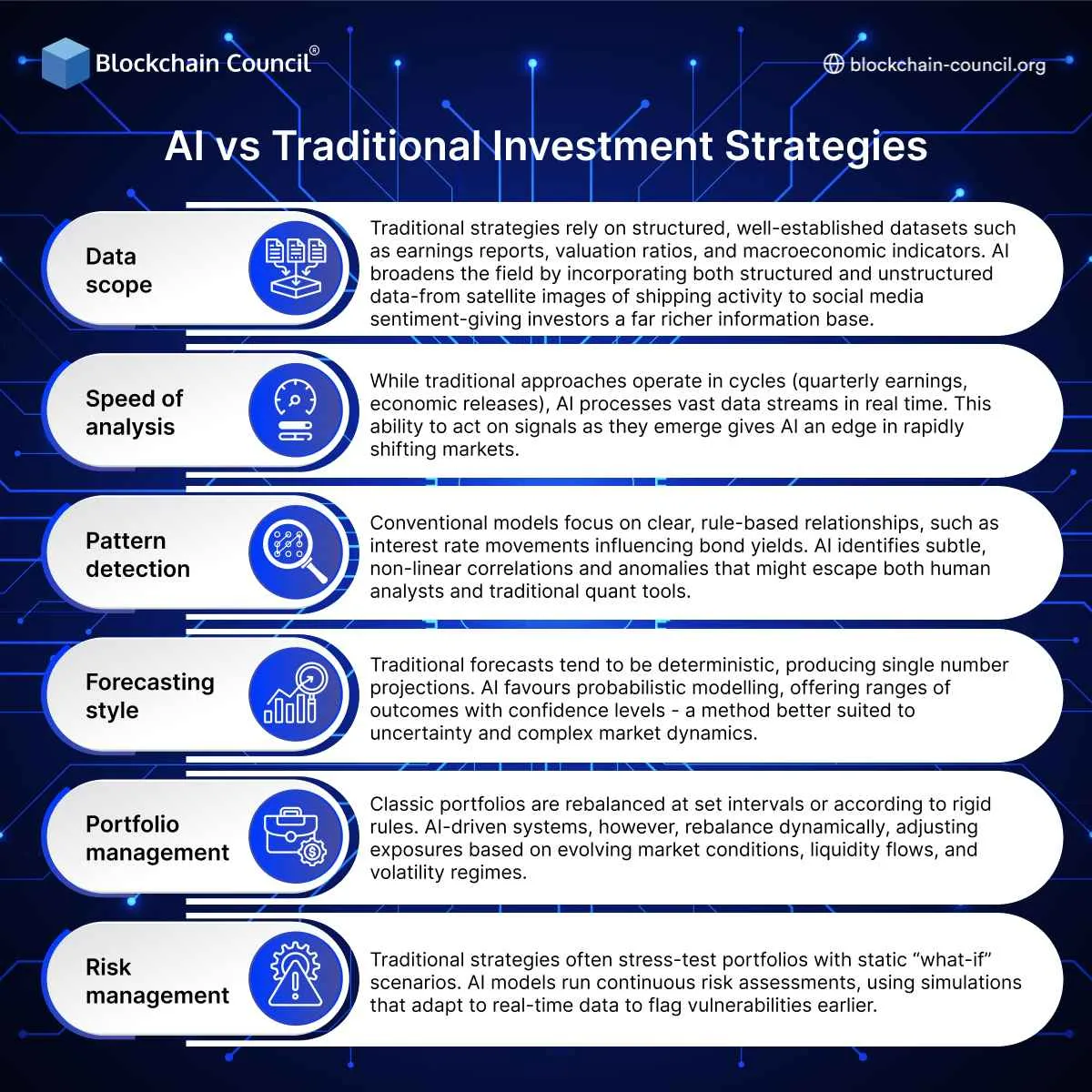
Data scope
Traditional strategies rely on structured, well-established datasets such as earnings reports, valuation ratios, and macroeconomic indicators. AI broadens the field by incorporating both structured and unstructured data — from satellite images of shipping activity to social media sentiment — giving investors a far richer information base.
Speed of analysis
While traditional approaches operate in cycles (quarterly earnings, economic releases), AI processes vast data streams in real time. This ability to act on signals as they emerge gives AI an edge in rapidly shifting markets.
Pattern detection
Conventional models focus on clear, rule-based relationships, such as interest rate movements influencing bond yields. AI identifies subtle, non-linear correlations and anomalies that might escape both human analysts and traditional quant tools.
Forecasting style
Traditional forecasts tend to be deterministic, producing single-number projections. AI favours probabilistic modelling, offering ranges of outcomes with confidence levels — a method better suited to uncertainty and complex market dynamics.
Portfolio management
Classic portfolios are rebalanced at set intervals or according to rigid rules. AI-driven systems, however, rebalance dynamically, adjusting exposures based on evolving market conditions, liquidity flows, and volatility regimes.
Risk management
Traditional strategies often stress-test portfolios with static “what-if” scenarios. AI models run continuous risk assessments, using simulations that adapt to real-time data to flag vulnerabilities earlier.
Behavioural insight
Human-led strategies usually interpret investor sentiment through surveys or market proxies. AI analyses behaviour at scale — parsing trading flows, retail positioning, and even social buzz — to anticipate herd movements or contrarian opportunities.
Transparency and trust
Traditional approaches are easier to explain, which reassures many investors and regulators. AI, by contrast, faces scrutiny over “black box” decision-making, though explainable AI is narrowing this gap by clarifying why models act the way they do.
Investors often ask how AI compares with older strategies like fundamental analysis and technical analysis.
Fundamental Analysis
Traditional analysts look at revenue, profits, balance sheets, and industry trends. AI can do the same thing, but on a much larger scale. Instead of reading ten reports, it can read ten thousand. It does not replace fundamental analysis—it automates and scales it.
Technical Analysis
Technical traders use charts and indicators like moving averages or RSI. AI can process those same indicators but also combine them with other inputs such as sentiment or macroeconomic data. This multi-layered approach makes AI potentially more powerful than classic technical analysis.
The Blend
The most successful investors often use a blend of strategies. AI adds speed and scale, while human investors bring judgment and creativity. Together, they create a stronger approach than either could alone.
Human Emotions vs AI Logic
Markets are not only about numbers. They are also driven by human emotion. Fear, greed, and herd behavior often push prices in ways that don’t align with logic.
AI helps balance this out. It doesn’t panic during a crash or become overconfident during a rally. It sticks to the data. For investors, this objectivity is valuable. It acts like a second opinion that keeps emotions in check.
That said, AI is not immune to problems. If it’s trained on biased or incomplete data, it can amplify mistakes. This is why combining AI with human oversight remains important.
Case Studies: Success and Failure
Looking at real-world examples shows how AI can deliver value—and where it can fail.
Success Story: Stanford’s AI Analyst
Stanford researchers built an AI analyst trained only on public data. Over thirty years, this system outperformed 93 percent of mutual fund managers. It proved that AI could rival even the best-paid human experts in stock picking.
Success Story: Norway’s Sovereign Wealth Fund
Norway’s trillion-dollar fund adopted AI to cut trading costs. By reducing inefficiencies, it saved hundreds of millions. This demonstrates that AI isn’t just about returns—it can also improve efficiency at scale.
Failure Story: Retail Investor Losses
Surveys reveal that nearly one in five retail investors lost money following AI-generated financial advice. Some tools gave outdated tips, while others offered one-size-fits-all strategies that didn’t suit individual goals.
Failure Story: AI Washing
Regulators have punished firms for making false claims about their AI usage. Some promoted products as “AI-driven” without having real AI models behind them. This highlights the need for investors to remain cautious and verify such claims.
Best Practices for Using AI in Investing
To get the most out of AI, investors need to follow practical guidelines.
Use AI as a Partner
AI should not replace human judgment. It is best seen as a partner that handles heavy data analysis while you make the final decision.
Verify Tools Before Trusting Them
Look for transparency. Good AI tools explain their methodology in simple terms. Avoid platforms that only make vague promises about “predicting the market.”
Build Knowledge
The more you understand about AI and data, the better you can evaluate its output. A Crypto certification is one way to understand how AI intersects with digital assets and crypto markets.
Avoid Overtrading
AI can generate many signals, but acting on all of them can hurt performance. Stick to a disciplined strategy.
Stay Informed
AI evolves quickly. Investors who keep up with new tools, updates, and regulatory changes are better positioned to succeed.
Can AI Predict Stock Market Crashes?
One of the most common hopes placed on AI is its ability to predict market crashes. AI can certainly scan for early warning signs. It can detect unusual spikes in volatility, negative sentiment in news and social media, or unusual trading patterns across sectors. These signals often appear before human analysts have time to notice.
But it is important to be realistic. No AI can guarantee the exact timing or scale of a crash. Markets are influenced by politics, sudden global events, and human emotion, which are difficult for any system to capture perfectly. AI can make investors more prepared, but it cannot fully remove uncertainty.
Can AI Replace Financial Advisors?
Financial advisors do more than crunch numbers. They listen to goals, understand personal situations, and guide people through emotional decisions. AI tools can handle the technical side of portfolio balancing, risk analysis, and generating investment ideas.
However, AI lacks the human touch that many investors still value. It cannot empathize when clients panic during downturns or offer tailored life advice. The future is more likely to involve collaboration: AI handling the data and calculations, while human advisors focus on relationships and context.
Is AI Investing Safe for Beginners?
For new investors, AI can actually make investing easier. Robo-advisors and AI-powered apps create simple, diversified portfolios that match a beginner’s risk tolerance. They automate tasks like rebalancing and reduce the need for constant monitoring.
Still, beginners should avoid seeing AI as a shortcut to quick profits. The risk of losses is real if users treat AI signals as guaranteed success. Beginners who combine AI tools with basic financial education are more likely to see long-term benefits.
Will AI Make All Investors Equal?
AI reduces the gap between professional and retail investors. Tools once available only to hedge funds are now accessible through mobile apps. Retail investors can get summaries of financial news, portfolio suggestions, and even risk alerts in seconds.
But equality has limits. Institutions still have access to larger data sets, advanced infrastructure, and teams of experts who know how to interpret AI outputs. While AI helps level the playing field, it will not eliminate the advantages of scale and expertise enjoyed by big players.
The Importance of Education in AI-Driven Investing
AI is powerful, but it is not a replacement for financial knowledge. To use it wisely, investors need to understand how data works, how models are trained, and how to evaluate risks. Without this foundation, there is a risk of overtrusting AI or misinterpreting its outputs.
Building this foundation does not mean becoming a full-time data scientist. It means gaining enough knowledge to know what questions to ask and how to check whether an AI tool is reliable. For example, if an app says it uses AI to predict trends, investors should know how to verify if that claim makes sense or if it is simply marketing.
One way to gain this knowledge is by pursuing certifications. A Marketing and Business Certification can help professionals understand how AI is reshaping financial products, customer engagement, and growth strategies. It shows how AI is applied not just in investment decisions but across the broader business environment.
How AI Fits into Broader Financial Skills
Investing is rarely about just one skill. AI is now part of a bigger toolkit that includes finance, economics, technology, and psychology. For example, understanding behavioral finance helps investors know when human emotion is likely to clash with AI-driven signals. Knowing economics helps interpret macro data that AI highlights.
By combining AI literacy with traditional financial skills, investors build resilience. They can benefit from AI’s speed and power without losing the context that comes from human experience.
The Future of AI in Investing
The future of AI in investing is not a distant concept. It is already unfolding in several directions.
AI-Powered Research Assistants
In the near future, investors will be able to interact with AI research assistants through natural language. Instead of digging through documents, they will ask, “What risks does this company face?” and receive a clear, data-backed summary.
Integration with Everyday Apps
More trading platforms are adding AI chat features. Brokerage apps will soon combine financial advice, portfolio management, and risk alerts in a single place, powered by AI. This makes advanced tools accessible to millions of retail investors.
Stronger Regulation and Oversight
Regulators are becoming more active. They are pushing firms to prove their AI models are explainable and not misleading. This means future AI tools will need to provide clearer transparency. Investors will be able to see not just the recommendation but also the reasoning behind it.
AI and Content Creation in Finance
AI will also change how investment information is shared. For example, platforms like YouTube Shorts could let investors turn financial insights into short, animated videos with AI. This makes financial education more engaging and accessible.
Human-AI Teams as the Standard
The long-term vision is not AI replacing investors but enhancing them. Analysts will rely on AI for heavy data crunching, while human judgment and strategy guide final decisions. This partnership model will define the future of smart investing.
Looking Ahead
The question “Can AI make you a smarter investor?” is no longer theoretical. Evidence shows that it can. From beating fund managers in long-term studies to saving institutions millions, AI is already proving its value. But the real measure of success lies in how investors use it.
Those who rely on AI blindly risk falling into traps of bias, bad advice, or misleading tools. Those who combine AI insights with education, judgment, and strategy will gain a powerful advantage.
Conclusion
AI has moved from research labs to the hands of everyday investors. It brings speed, precision, and personalization that were once impossible. It can highlight risks, spot opportunities, and streamline decision-making. But it is not magic. It cannot guarantee profits or predict every market move.
The smartest path forward is partnership. Let AI handle the heavy data work. Let humans apply context, creativity, and long-term vision. Together, they form a balance that makes investors not only smarter but also more resilient.
AI is not here to replace investors. It is here to empower them. The sooner you learn to use it wisely, the sooner you will find yourself making smarter, faster, and more informed financial decisions.