
Few-Shot vs. Zero-Shot in Claude: Token Cost Tradeoffs and Best Practices
 Michael Willson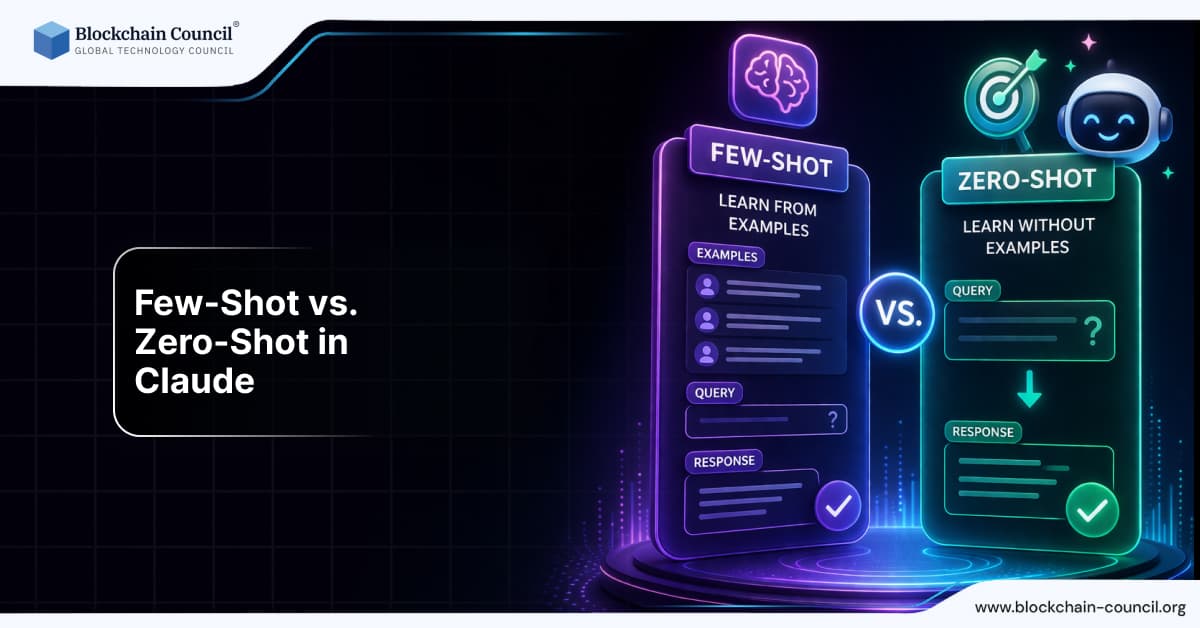
Few-shot vs. zero-shot in Claude is often a practical decision about reliability versus cost. Zero-shot prompting uses instructions only, keeping input tokens low and workflows fast. Few-shot prompting adds a small set of curated examples (commonly 2-10) to improve precision, but token costs rise linearly with each example and returns often diminish after the first few.
This guide explains the token cost tradeoffs, where each approach performs best, and best practices for using Claude models in production systems without unnecessary prompt bloat.

Balance performance and token cost by selecting between few-shot and zero-shot prompting strategies through an AI certification, implementing experiments using a machine learning course, and positioning AI solutions with a Digital marketing course.
What is zero-shot prompting in Claude?
Zero-shot prompting asks Claude to perform a task using only instructions, constraints, and possibly a schema or rubric - no worked examples. It is the lowest token-cost option because you only pay for the instruction text plus the user input and Claude output.
Why zero-shot is popular in production
Lowest token cost: no examples means minimal input tokens.
Minimal setup: you do not need labeled data or prompt datasets.
Fast iteration: ideal for prototyping and frequent prompt changes.
Zero-shot is commonly used for broad tasks such as initial query routing, intent detection, summarization, and first-pass drafting where occasional errors are acceptable or a human reviewer is present.
What is few-shot prompting in Claude?
Few-shot prompting includes a small number of examples that demonstrate the desired input-output behavior. In Claude, few-shot prompts are typically formatted as pairs (Input -> Output), or as structured messages that show the model exactly how to respond.
Why few-shot improves accuracy
Clarifies edge cases: examples remove ambiguity that instructions alone cannot resolve.
Enforces style and structure: consistent formatting becomes easier to reproduce.
Boosts domain precision: especially useful in finance, compliance, and specialized support contexts.
Industry evaluations have shown that few-shot prompting can produce outputs comparable to fine-tuned models for certain business tasks, such as generating earnings-call style scripts when provided with representative transcript examples.
Token cost tradeoffs: why examples get expensive quickly
In Claude deployments, token pricing is based on input tokens and output tokens. Few-shot increases input tokens directly because each example adds extra text. This cost increase is generally linear - doubling the number of examples roughly doubles the example portion of the prompt.
Key cost dynamics to understand
Linear input growth: each example is additional input context you pay for on every request.
Opportunity cost: longer prompts can reduce available budget for the model to generate a full, high-quality output within a fixed token limit.
Diminishing returns: accuracy gains often plateau after 2-3 good examples, while going from 2 to 10 examples can cost roughly 5x more without proportional improvement.
For most teams, the best strategy is not to maximize example count but to maximize example quality and relevance, then validate whether 2-5 examples already achieve the required performance.
Few-shot vs. zero-shot in Claude: when to use which
Choosing between few-shot and zero-shot prompting is best treated as an engineering decision tied to error tolerance, domain risk, and budget constraints.
Choose zero-shot when
You need speed and low cost: high-volume routing, broad summarization, simple extraction.
You have limited or no examples: new product launches and new market contexts.
Errors are tolerable: a reviewer exists, or the task is exploratory.
Choose few-shot when
Accuracy is critical: regulated workflows, finance, healthcare-adjacent content, contractual language.
The task has many edge cases: nuanced classification, policy enforcement, structured output with strict rules.
You require consistent style: brand voice, templated outputs, standardized reporting.
Practical consensus across prompt engineering guidance is clear: use zero-shot for prototyping and broad generalization, then add few-shot examples only where doing so measurably reduces risk or rework.
Best practices to reduce token cost while keeping accuracy
The goal is to get few-shot benefits without paying for irrelevant context. The following practices are particularly effective with Claude models.
1) Start with zero-shot plus a strict output schema
Before adding examples, tighten the instruction. Many failures attributed to zero-shot are actually caused by vague requirements. Use:
Explicit constraints: what to do and what not to do.
Output format: JSON keys, bullet style, length bounds, or an evaluation rubric.
Acceptance criteria: what constitutes a correct answer.
2) Add 2 high-signal examples before adding 10 average ones
Because gains often plateau after the first few examples, prioritize representative cases:
One typical example that matches the most common inputs.
One hard example that covers a frequent failure mode - ambiguous wording, exceptions, or tricky formatting.
Then measure whether a third example improves results. If not, stop. This is one of the simplest ways to control recurring inference costs.
3) Use adaptive example selection instead of static prompts
Static few-shot prompts waste tokens when examples do not match the incoming request. A more scalable approach is adaptive selection:
Store a library of candidate exemplars.
Select 2-5 examples based on similarity to the user input.
Send only those examples to Claude.
Research on exemplar selection for code synthesis has explored metric-based and data-driven selection methods that respect token budgets. While those studies are often run on coding benchmarks, the underlying principle transfers well to Claude prompting for classification, extraction, and structured generation.
4) Combine few-shot with chain-of-thought style guidance (carefully)
Reasoning-focused tasks often benefit from prompting patterns that guide the model to work through a problem step-by-step. Two cost-aware options exist:
Short reasoning policy: request brief reasoning or a checklist of steps rather than long explanations.
Concise justification: ask for the final answer plus a short rationale, keeping outputs compact.
Few-shot examples that demonstrate the desired reasoning structure can improve performance on complex tasks, but the examples should remain short and aligned with the output requirements.
5) Keep prompts compact to preserve output headroom
Long prompts do not just increase input costs. They can also constrain output quality when you run close to model context limits. Practical steps include:
Remove redundant instructions repeated in every example.
Use consistent, minimal example formatting.
Prefer short examples that still capture the rule clearly.
Real-world use cases
Customer experience routing and support
Zero-shot works well for rapid intent routing during new launches, when categories and user language are still evolving. Once patterns stabilize, few-shot examples can refine important subcategories - hardware vs. software defects, warranty exceptions, escalation triggers - to reduce misroutes and handle policy-sensitive replies consistently.
Earnings scripts and financial narrative generation
Few-shot prompting can produce earnings-style scripts that closely match real transcripts when provided with a small set of past examples, helping maintain tone, structure, and common phrasing. This approach can rival fine-tuned alternatives for some scripting tasks while keeping iteration faster than a full training cycle.
Code synthesis under token constraints
In code generation, curated exemplars can materially improve correctness on benchmark-style problems. The operational lesson for Claude users is straightforward: select the most relevant examples under a fixed token budget rather than sending a long, generic set.
Few-shot vs. fine-tuning: where prompting fits economically
Fine-tuning typically involves an upfront training cost, plus operational considerations such as model management. Few-shot is purely inference-time cost, paid on every request via additional input tokens. Economically:
Few-shot is attractive when you need flexibility, fast iteration, and moderate reliability improvements.
Fine-tuning makes sense when you have stable requirements, large volumes, and sufficient training data to justify the fixed investment.
In current production settings, many teams prefer efficient prompting with adaptive exemplars over static long prompts or heavy fine-tuning, particularly when requirements evolve frequently.
Implementation checklist for production Claude prompts
Baseline: build a strong zero-shot prompt with a schema and clear constraints.
Measure: evaluate accuracy, rework rate, and failure modes on a representative test set.
Add 2 examples: one typical, one hard edge case.
Re-measure: stop if improvement is marginal.
Scale safely: implement adaptive example selection for diverse inputs.
Control costs: enforce token budgets and keep examples short.
Conclusion
Few-shot vs. zero-shot in Claude is primarily a token economics decision guided by risk tolerance. Zero-shot prompting minimizes token cost and setup effort, making it well-suited for routing, prototyping, and broad tasks. Few-shot prompting improves precision and consistency for complex or high-stakes workflows, but token costs rise linearly with examples and accuracy gains commonly plateau after the first few.
For most teams, best practice is to start zero-shot, add 2-5 high-quality examples only when needed, and adopt adaptive example selection to avoid paying for irrelevant context. Teams looking to formalize these skills can explore structured learning paths - such as Blockchain Council's prompt engineering, generative AI, and AI architect certification programs - as a foundation for standardizing prompting practices across the organization.
Optimize prompt efficiency and model accuracy by understanding tradeoffs in context examples through an Agentic AI Course, building test pipelines via a Python Course, and scaling use cases with an AI powered marketing course.
FAQs
1. What is Few-Shot vs. Zero-Shot in Claude: Token Cost Tradeoffs and Best Practices?
Few-Shot vs. Zero-Shot in Claude: Token Cost Tradeoffs and Best Practices compares two prompting methods. It focuses on balancing cost and performance.
2. What is few-shot learning in Few-Shot vs. Zero-Shot in Claude: Token Cost Tradeoffs and Best Practices?
Few-shot learning uses examples in prompts. It improves accuracy but increases token usage.
3. What is zero-shot learning in Few-Shot vs. Zero-Shot in Claude: Token Cost Tradeoffs and Best Practices?
Zero-shot learning relies on instructions without examples. It reduces tokens but may affect accuracy.
4. Why is Few-Shot vs. Zero-Shot in Claude: Token Cost Tradeoffs and Best Practices important?
Few-Shot vs. Zero-Shot in Claude: Token Cost Tradeoffs and Best Practices helps optimize costs. It balances accuracy and efficiency.
5. When should you use few-shot in Few-Shot vs. Zero-Shot in Claude: Token Cost Tradeoffs and Best Practices?
Use few-shot when accuracy is critical. It improves output quality.
6. When should you use zero-shot in Few-Shot vs. Zero-Shot in Claude: Token Cost Tradeoffs and Best Practices?
Use zero-shot for simple tasks. It reduces token usage.
7. Does Few-Shot vs. Zero-Shot in Claude: Token Cost Tradeoffs and Best Practices affect cost?
Yes, few-shot increases cost due to more tokens. Zero-shot is more cost-efficient.
8. Can Few-Shot vs. Zero-Shot in Claude: Token Cost Tradeoffs and Best Practices improve performance?
Few-shot improves performance for complex tasks. Zero-shot works well for basic tasks.
9. Is Few-Shot vs. Zero-Shot in Claude: Token Cost Tradeoffs and Best Practices beginner-friendly?
Yes, both methods are easy to understand. Beginners can experiment with both.
10. What are benefits of Few-Shot vs. Zero-Shot in Claude: Token Cost Tradeoffs and Best Practices?
Few-Shot vs. Zero-Shot in Claude: Token Cost Tradeoffs and Best Practices provides flexibility. It helps choose the right approach.
11. Can Few-Shot vs. Zero-Shot in Claude: Token Cost Tradeoffs and Best Practices be automated?
Yes, systems can switch between methods. Automation improves efficiency.
12. What are challenges in Few-Shot vs. Zero-Shot in Claude: Token Cost Tradeoffs and Best Practices?
Few-shot increases tokens while zero-shot may reduce accuracy. Balancing both is key.
13. Can Few-Shot vs. Zero-Shot in Claude: Token Cost Tradeoffs and Best Practices improve scalability?
Yes, choosing the right method supports scalability. It optimizes resource usage.
14. Does Few-Shot vs. Zero-Shot in Claude: Token Cost Tradeoffs and Best Practices affect latency?
Few-shot may increase latency. Zero-shot is faster.
15. Can Few-Shot vs. Zero-Shot in Claude: Token Cost Tradeoffs and Best Practices be customized?
Yes, prompts can be tailored. This improves relevance.
16. What industries use Few-Shot vs. Zero-Shot in Claude: Token Cost Tradeoffs and Best Practices?
AI, SaaS, and analytics industries use these methods. They optimize performance.
17. Can Few-Shot vs. Zero-Shot in Claude: Token Cost Tradeoffs and Best Practices improve UX?
Yes, selecting the right method improves user experience. It ensures better outputs.
18. Does Few-Shot vs. Zero-Shot in Claude: Token Cost Tradeoffs and Best Practices require testing?
Yes, testing determines the best approach. It ensures optimal results.
19. What is the best practice in Few-Shot vs. Zero-Shot in Claude: Token Cost Tradeoffs and Best Practices?
Start with zero-shot and move to few-shot if needed. This balances cost and accuracy.
20. What is the future of Few-Shot vs. Zero-Shot in Claude: Token Cost Tradeoffs and Best Practices?
Future systems will optimize prompts automatically. Efficiency will improve further.
Related Articles
View All
Claude Ai
15 Practical Hacks to Cut Claude Token Usage Without Losing Answer Quality
Learn 15 practical hacks to cut Claude token usage without losing quality, including context hygiene, tool-output filtering, MCP audits, and model routing.

Claude Ai
No Image with Claude: What It Means, Workarounds, and Best Alternatives (2026)
No image with Claude is a key 2026 limitation: Claude cannot generate or edit images. Learn what Claude can do with vision input, SVG outputs, and best alternatives.

Claude Ai
Claude Free Alternatives: Best Free Options for Chat, Coding, and Privacy
Explore Claude free alternatives for 2026, including open-source BYOK tools, local LLM apps, and generous free tiers for chat, coding, and privacy-first workflows.
Trending Articles

The Role of Blockchain in Ethical AI Development
How blockchain technology is being used to promote transparency and accountability in artificial intelligence systems.

AWS Career Roadmap
A step-by-step guide to building a successful career in Amazon Web Services cloud computing.

Top 5 DeFi Platforms
Explore the leading decentralized finance platforms and what makes each one unique in the evolving DeFi landscape.