

What is Bitcoin or Cryptocurrency or Virtual Currency?
 Michael Willson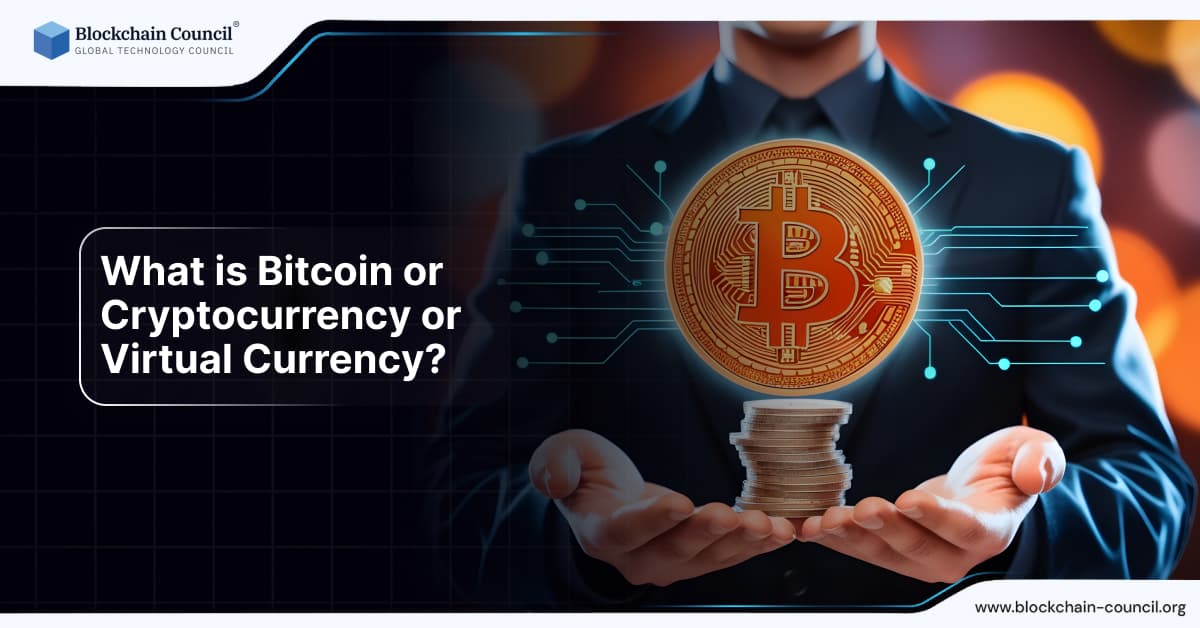
Bitcoin is a form of digital currency that exists and operates entirely online. It is decentralized, meaning no single authority controls it.
Unlike traditional currencies, Bitcoin is not printed. Instead, it is created through a process called mining, where computers solve complex mathematical problems. This makes Bitcoin a leading example of a cryptocurrency.

https://www.slideshare.net/BlockchainCouncil/what-is-bitcoin-or-cryptocurrency-or-virtual-money
Bitcoin is E-money, therefore we can buy things electronically. This coin is similar to that of conventional dollars or other currencies traded digitally.
This digital currency is different from conventional money because of the decentralization. It came to us from the software developer known as Satoshi Nakamoto. It is an electronic payment on the basis of mathematical proof. The idea was an independent and electronic transaction with low fees. This currency isn't printed as it is in the digital form. A group that can join and processes these transactions in a distributed network (mining of coins) produces it. This network processes the transaction made with virtual currency. Therefore, making Bitcoin it's own network for payment.
The term conventional currency has always been on the basis of gold or silver. If you give money to the bank, you can get gold instead. Bitcoin doesn't stand for gold, it stands on mathematics. Following mathematical formulas of software programs produces it because it is an open source software.
Features that stand out Bitcoin from government-backed currencies:
Decentralized System: The control to Bitcoin is not under one central authority. The machines work together to mine this currency and process transactions which make up a part of the network, without causing a fiasco by any central authority.
Simple Setup Process: Regular banks make you go through a whole lot of processes to open an account. However, the setup process of Cryptocurrency is simple and free.
Anonymous and Transparent Usage: Users with many Bitcoin addresses aren't linked to any personal identifying info. However, records every transaction in a huge ledger format called Blockchain.
Meager Transaction Fee: Bitcoin charges a minimal fee for International transfers.
Fast Network Process: The payment process is quick in Bitcoin network.
Non-Refundable: Once sent, Bitcoins are never refunded back.
Thus this virtual currency changes our digital economy, as we know it, globally. This process can be a major beneficiary to the respondents who become a big part of it.
Related Articles
View All
Blockchain
Beyond Cryptocurrency: How Blockchain Is Transforming Real-World Industries
Explore how blockchain works beyond cryptocurrency in banking, supply chains, healthcare, tokenisation, CBDCs, and government, plus key challenges and career paths.

Blockchain
How Blockchain Was Introduced: Bitcoin and the Birth of Decentralized Ledgers
Learn how blockchain was introduced through Bitcoin, from timestamping research and digital cash to proof-of-work, mining, and decentralized ledgers.
Blockchain
The History of Blockchain: From Bitcoin to Web3 Innovation
A clear history of blockchain, from cryptographic research and Bitcoin to Ethereum, Web3, DeFi, NFTs, enterprise adoption, and future skills.
Trending Articles

Top 5 DeFi Platforms
Explore the leading decentralized finance platforms and what makes each one unique in the evolving DeFi landscape.
What is AWS? A Beginner's Guide to Cloud Computing
Everything you need to know about Amazon Web Services, cloud computing fundamentals, and career opportunities.

Can DeFi 2.0 Bridge the Gap Between Traditional and Decentralized Finance?
The next generation of DeFi protocols aims to connect traditional banking with decentralized finance ecosystems.