
Single-Ledger vs Multi-Ledger Blockchain Settlement
 Michael Willson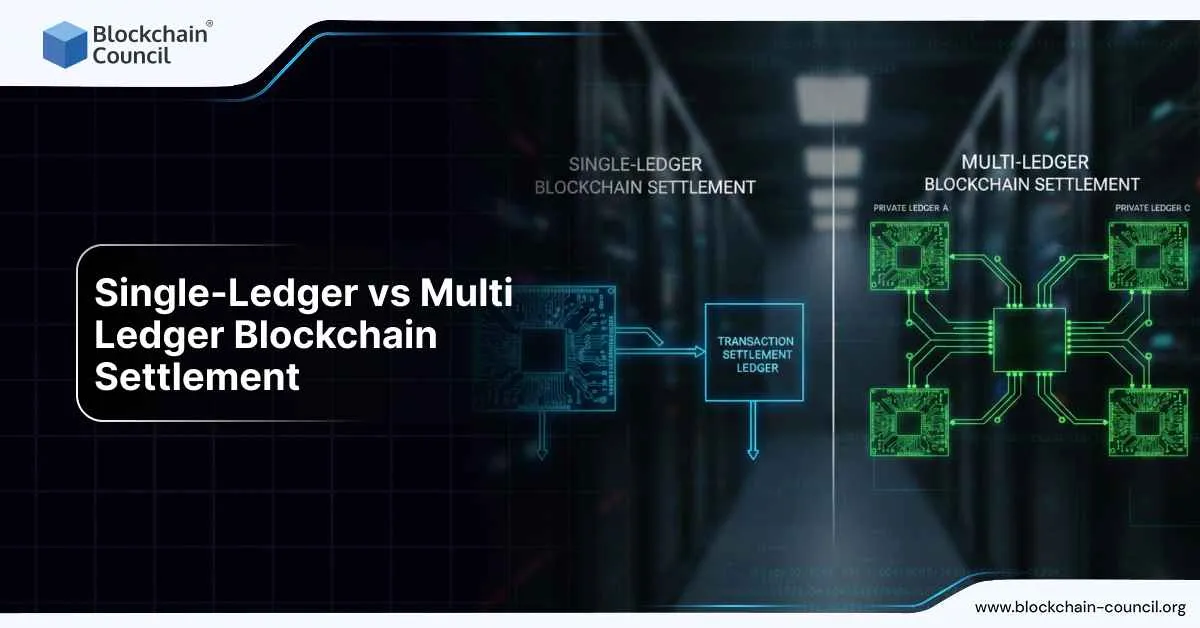
Introduction
Single-ledger vs multi-ledger settlement is not a theoretical architecture debate. It is a structural choice about where the asset leg and the money leg live, and how delivery-versus-payment actually executes under regulatory and operational constraints. If you are evaluating tokenized capital markets infrastructure, a Blockchain course is useful because this decision directly determines atomicity, risk concentration, interoperability complexity, and scalability.
At its core, the distinction is simple:
- Single-ledger: put the asset and the settlement asset on one programmable platform.
- Multi-ledger: keep them on separate ledgers and coordinate them.
The consequences are anything but simple.
Single-Ledger Settlement
What it is
In a single-ledger model, the components required to complete settlement live on one shared programmable platform. The asset token and the settlement asset, such as tokenized deposits or tokenized central bank money, exist within the same execution environment.
The Bank for International Settlements uses the term “unified ledger” to describe this family of designs. Importantly, unified does not mean one monolithic owner. The ledger can have separate partitions operated by different entities under a shared governance framework.
Why it matters technically
Direct atomic DvP
Because both legs exist in the same environment, atomic delivery-versus-payment can be implemented directly. A single execution call can transfer the asset token and the cash token simultaneously under one deterministic rule set.
There is no need for cross-network messaging to coordinate two separate systems.
Easier programmability and composability
Smart contracts can reference both the asset and the settlement asset natively. This simplifies collateralization, margin logic, repo-style transactions, and structured workflows.
No cross-ledger adapters are required just to read state.
Reduced synchronization risk
When authoritative records and settlement logic execute on one platform, reconciliation complexity falls. Even with partitioned governance, there is one canonical state machine rather than two or three independent ones attempting to stay aligned.
Tradeoffs and constraints
Governance alignment
All participants must agree on shared technical standards, rulebooks, access models, and dispute resolution frameworks. In markets with multiple incumbents and regulators, this is politically and operationally difficult.
Concentration and systemic dependency
A single programmable platform can become systemically important. Resilience, cybersecurity, access controls, and governance are no longer abstract issues. They are systemic risk factors.
If the unified ledger fails or is compromised, settlement halts.
Real-world direction
BIS describes the unified ledger as a blueprint for a future monetary system where tokenized money and tokenized assets coexist on a common programmable platform.
Project Agorá builds on that logic by combining tokenized commercial bank money and tokenized central bank money within the same programmable environment for wholesale settlement.
The objective is clear: native atomic settlement with fewer coordination points.
Multi-Ledger Settlement
What it is
In a multi-ledger model, the asset and the money leg live on separate systems. One may be on a blockchain and the other in traditional infrastructure. Or both may be on different blockchains.
Settlement is achieved through interoperability links such as messaging layers, orchestration services, cryptographic swaps, notaries, or synchronized updates across systems.
Why it matters technically
Institutional continuity
Markets can preserve existing infrastructures and legal arrangements while tokenizing selected lifecycle elements. This is attractive because most financial systems are not being rebuilt from scratch.
IOSCO explicitly notes that many tokenization efforts still rely on traditional trading and post-trade infrastructure.
Network-of-networks flexibility
A multi-ledger approach supports a fragmented world where multiple blockchains and legacy systems coexist. Interoperability becomes the design target rather than uniformity.
DTCC’s tokenization messaging emphasizes multi-blockchain interoperability, reflecting this reality.
Where it breaks in production
Interoperability bottlenecks
Interoperability is not just a technical problem. It is a governance, standards, and legal problem. IOSCO repeatedly flags interoperability as a core barrier to scaling tokenization beyond pilots.
Different consensus models, finality rules, and data standards complicate synchronization.
Execution and settlement risk
Cross-ledger settlement typically requires orchestration. The IMF notes that multi-ledger programmability may require an orchestrating entity, along with standards, messaging protocols, and legal agreements to manage failed executions.
Time lags, timeout logic, and coordination errors introduce new failure modes that do not exist in single-ledger atomic execution.
The money leg problem
Both IOSCO and the Financial Stability Board emphasize that the lack of high-quality tokenized settlement assets limits scalability. If the payment leg is weak, off-chain, or credit-based, multi-ledger settlement inherits additional risk.
Without a credible settlement asset, coordination does not equal finality.
Concrete policy examples
Eurosystem discussions have explored interoperability links between DLT-based transactions and TARGET Services for central bank money settlement. This is a classic multi-ledger model: blockchain for assets, traditional central bank rails for settlement.
Industry experiments, including those coordinated through global messaging networks, focus on connecting different tokenization platforms rather than forcing convergence on one platform.
The strategy is coexistence plus coordination.
Core Structural Differences
1. Atomic DvP Execution
Single-ledger designs make atomic DvP structurally straightforward because both legs execute in one environment.
Multi-ledger designs rely on orchestration, synchronization, or conditional mechanisms, which introduce additional execution risk.
2. Settlement Asset Credibility
Both models depend on the quality of the settlement asset.
However, single-ledger systems can embed tokenized deposits or central bank money directly in the same environment. Multi-ledger systems must coordinate settlement across rails, increasing complexity.
3. Governance Location
Single-ledger pushes governance debates into one shared environment.
Multi-ledger distributes governance across multiple infrastructures and standard-setting bodies.
In practice, neither eliminates governance friction. They simply move it.
4. Legal Finality
Where does authoritative legal title reside?
If legal finality does not align with on-chain finality, reconciliation and record divergence become operational and legal risks.
IOSCO highlights settlement-process and operational vulnerabilities in tokenized setups, especially when authoritative records are not fully aligned with blockchain state.
How to Evaluate a Design
If you are assessing a settlement architecture, these questions clarify whether single-ledger or multi-ledger is an advantage or a liability.
- Can it perform true DvP, and where does that logic execute? Single-ledger models structurally simplify atomic execution. Multi-ledger designs must prove coordination robustness.
- What is the settlement asset? Tokenized assets without a credible money leg rarely scale beyond controlled pilots.
- Who governs the rails? Single-ledger centralizes governance under a shared framework. Multi-ledger spreads governance across infrastructure providers and standard-setting bodies.
- Where does legal finality live? If authoritative ownership is not fully aligned with the settlement platform, reconciliation risk persists.
If you are engineering these systems, a Tech certification is valuable because settlement architecture is a systems integration problem across consensus, messaging, custody, and legal frameworks.
If you are positioning tokenization infrastructure to clients or policymakers, a Marketing certification helps because the distinction between atomic settlement and coordinated settlement must be explained clearly and accurately.
Bottom Line
Single-ledger designs aim to make settlement natively programmable by placing tokenized assets and tokenized money on one common platform, enabling direct atomic DvP and reducing synchronization risk. The tradeoff is governance complexity and systemic concentration.
Multi-ledger designs reflect institutional reality by connecting multiple blockchain and legacy systems. They preserve flexibility but inherit interoperability, orchestration, and settlement-asset challenges that currently limit tokenization at scale.
The real question is not which model sounds cleaner. It is whether the chosen structure can deliver credible settlement finality, robust DvP, and scalable interoperability under real-world regulatory and operational constraints.