
What Is the Difference Between Public, Private, and Hybrid Blockchains?

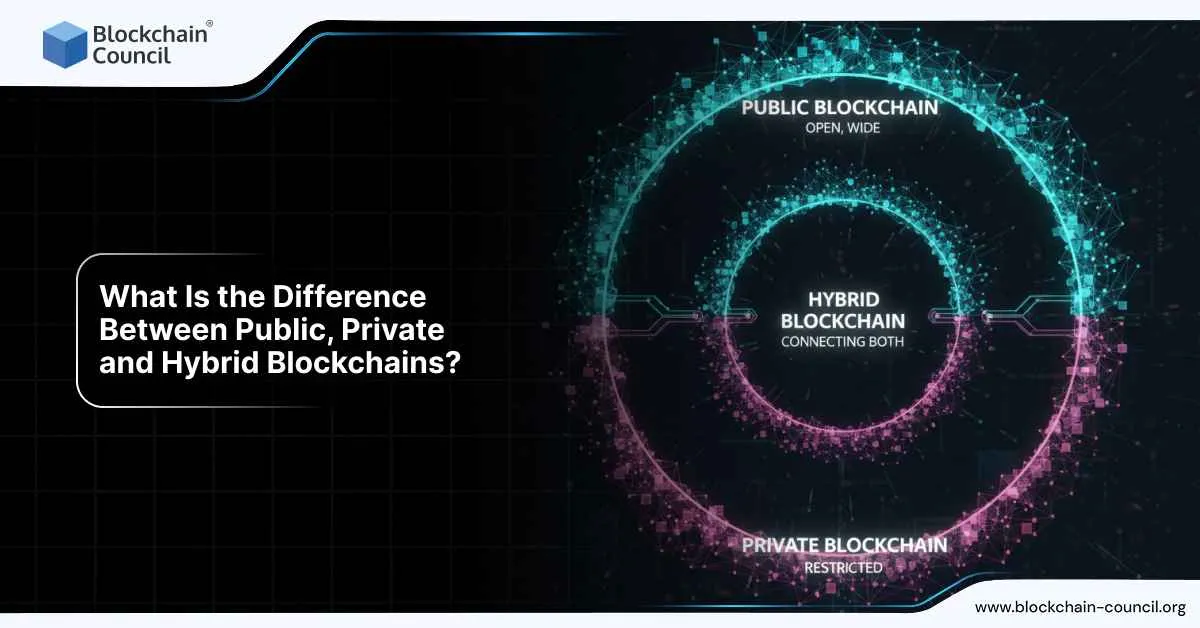
Blockchains are not all built the same. Some are fully open to anyone, others are tightly controlled, and some mix both models. These three categories are known as public, private, and hybrid blockchains. Each has its own design, rules, and uses. To understand them clearly, think about how information is shared: wide open like a public park, closed off like a private office, or a mix of both. Anyone who wants to go deeper into the technical and business side of this can build skills through blockchain technology courses, which explain these models in structured ways.
Public Blockchains
Public blockchains are open systems. Anyone can join, send transactions, or help validate them. These networks rely on decentralization, meaning no single group controls the data. Bitcoin and Ethereum are two of the best-known examples. Every transaction is transparent, viewable by all, and nearly impossible to change.
The strength of public blockchains is their security and openness. They are trusted because many computers check the data at the same time. But this also makes them slower. With thousands of participants, reaching agreement on transactions can take time. Public systems are common in cryptocurrencies, decentralized finance platforms, and any project that values transparency above speed.
Private Blockchains
Private blockchains are controlled environments. Access is given only to approved participants. A single company or a selected group decides who can read, write, or validate data. These networks move faster because fewer nodes are involved. They also provide better privacy, which is useful in industries where sensitive data cannot be fully exposed.
Enterprises often use Private blockchains to manage supply chains, track internal financial operations, or secure healthcare records. The trade-off is trust. Since one or a few organizations control the system, it is less Decentralized and may be open to manipulation if those in charge act unfairly.
Hybrid Blockchains
Hybrid blockchains blend the two approaches. Some data is open to the public, while other parts remain private. This mix allows organizations to keep sensitive information restricted but still show proof of activity to outsiders. For example, a hospital could use a hybrid blockchain to keep patient records private but make audit logs public for regulators.
This flexibility makes hybrid blockchains appealing in government, logistics, and regulated industries. They combine speed and privacy with the option for public verification. However, designing a hybrid system can be complex, since rules about what is public and private need to be managed carefully.
Performance and Scalability
One key difference between the three models is how they handle performance. Public blockchains usually have slower transaction speeds because of the number of validators involved. Private blockchains, on the other hand, are faster since only a few participants are verifying data. Hybrid blockchains fall somewhere in between, depending on how much of the system is public and how much is private.
Security and Trust
Public systems are highly secure thanks to their decentralization. Attacking them would require controlling most of the network, which is nearly impossible on large chains. Private blockchains rely on trust in the organization running them. They can be secure if managed well, but are more vulnerable to insider risks. Hybrid systems try to capture the best of both worlds, offering private controls with some public checks for transparency.
Transparency Versus Privacy
Another major difference lies in how data is shared. Public blockchains maximize transparency. Everyone can see every transaction, which creates accountability. Private blockchains focus on privacy, keeping data visible only to chosen participants. Hybrid systems offer balance, letting organizations decide what to reveal and what to keep private.
Real-World Applications
Public blockchains power cryptocurrencies, token systems, and open digital markets. Private blockchains serve enterprises that need speed, privacy, and compliance, such as banks, hospitals, and global retailers. Hybrid blockchains are gaining traction in regulated industries where audits are necessary but full transparency is not practical.
For professionals aiming to analyze how these systems handle information, a Data Science Certification adds skills that pair well with blockchain technology. And for those linking blockchain adoption with business growth, a Marketing and Business Certification helps in shaping strategies for industries that are embracing these systems.
Comparison of Blockchain Types
| Blockchain Type | Key Features |
| Public | Open to all, highly decentralized, secure but slower |
| Private | Permissioned, controlled by one or few entities, faster but less transparent |
| Hybrid | Combines public and private elements, flexible but more complex |
| Governance | Public: community driven; Private: centralized; Hybrid: shared or mixed |
| Transparency | Public: full visibility; Private: restricted; Hybrid: partial by choice |
| Privacy | Public: limited; Private: strong; Hybrid: balanced |
| Speed | Public: slower; Private: faster; Hybrid: moderate |
| Security | Public: very strong through decentralization; Private: depends on trust; Hybrid: mix of both |
| Use Cases | Public: cryptocurrency, DeFi, records; Private: supply chain, healthcare, finance; Hybrid: government, logistics, compliance |
| Adoption Trend | Public: broad global use; Private: enterprise adoption; Hybrid: growing in regulated industries |
Conclusion
Public, private, and hybrid blockchains each serve different needs. Public systems focus on openness and security, private systems focus on control and efficiency, and hybrid systems offer flexibility by blending both. The choice depends on whether the priority is transparency, privacy, speed, or regulation. As industries continue to explore blockchain, these models will shape how information is stored, shared, and trusted in the digital world.