
Native vs Non-Native Tokenization on Blockchain

Intro
“Native vs non-native tokenization” gets used inconsistently, so the only useful move is to define it cleanly and stick to the practical differences that show up in real projects. As of Feb 11, 2026, the industry-common split is about where the asset truly exists and where the “source of truth” lives. A Blockchain course helps here because most tokenization mistakes are not technical. They are misunderstandings about legal title, custody, redemption, and failure modes.
What native tokenization means
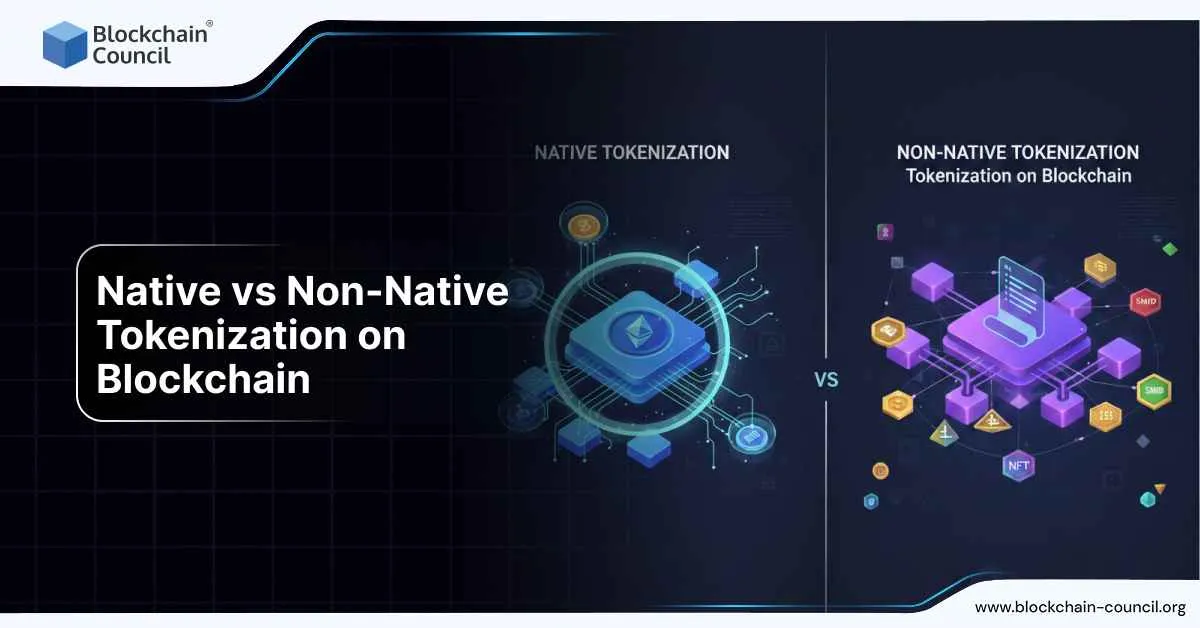
Native tokenization, also called direct tokenization or native issuance, is when the asset is created and exists primarily on a blockchain. The blockchain record is the source of truth. It is not a mirror of something sitting in a traditional registry or custodian ledger.
In capital-markets terms, the token is intended to be the asset. Think “the token is the share,” not “the token points to a share somewhere else.” Compliance and transfer rules can be embedded in smart contracts or on-chain registry logic.
Native tokenization examples
Crypto-native assets like BTC or ETH originate on their own chains. They are native by definition.
Native-issued securities or funds are the regulated-world analogue. In these designs, issuance, ownership record, and settlement happen on-chain. This remains rare today and is mostly seen in pilots because it collides with existing legal and market infrastructure.
Native tokenization properties
Primary registry is on-chain, meaning ownership and transfer live there.
Settlement can be atomic and programmable, especially for delivery-versus-payment when both the asset leg and money leg are on-chain.
The main risk profile shifts away from custodian default and toward smart contract risk, key management, chain governance, and operational controls.
What non-native tokenization means
Non-native tokenization is also called wrapped, intermediated, tokenized representation, and sometimes security entitlement token. The shared idea is simple: the token is a representation of an asset that primarily exists off-chain.
That off-chain asset might be a stock held at a broker, gold in vaults, or fiat in bank accounts. The token’s value depends on off-chain custody, legal agreements, and redemption mechanics. The token is a claim. The backbone is off-chain.
Non-native tokenization examples
Wrapped crypto like WBTC is the canonical example. A custodian holds BTC and issues a token on another chain.
Tokenized stocks as wrapped tokens can be structured as tokens backed by shares held with a regulated custodian or broker-dealer.
Many tokenized real-world assets follow this pattern. The underlying stays in traditional systems and the blockchain token is a tradable proxy.
Non-native tokenization properties
The unit of account is the off-chain asset. The token tracks it via custody plus redemption.
Core risks include custodian solvency, legal enforceability of the claim, redemption gating, and sometimes oracle or pricing dependencies depending on structure.
Regulators often treat these as traditional instruments wearing a blockchain costume. Existing securities, broker-dealer, custody, and market-structure rules still apply. The SEC has explicitly discussed issues such as how custody rules fit wrapped tokenized securities and it distinguishes cases where the underlying security remains held by a custodian and the token is merely an ownership recording mechanism.
A separate bucket people confuse with non-native: synthetic tokenization
Synthetic tokenization is not a claim on an underlying asset at all. It is an on-chain derivative that provides exposure using price feeds without custody of the real asset.
People casually lump this into “non-native” because it is also “not the real thing,” but structurally it is different. Non-native is a claim on something held off-chain. Synthetic is exposure without holding the underlying.
How to tell what you are looking at
A quick checklist usually reveals the truth.
Where does legal title live
Native means title and ownership are intended to be the on-chain record.
Non-native means title is off-chain and the token is a claim or entitlement.
What guarantees convertibility
Non-native requires explicit redemption rights and credible custody proof such as audits, attestations, and regulated custody structures.
Native generally has no redemption into an off-chain thing unless there is a bridged variant involved.
What is the main failure mode
Native failure modes include smart contract bugs, chain outages, governance failures, and key compromise.
Non-native failure modes include custodian default, seizure, frozen redemptions, mismatched liabilities, and legal disputes over claim priority.
What is the compliance surface
Native issuance can embed rules on-chain, but regulated assets still must map to real-world legal frameworks.
Non-native tokenization almost always depends on traditional compliance and regulated intermediaries because the underlying sits inside traditional rails.
The “native vs wrapped” meaning in multi-chain discussions
There is a separate meaning that causes confusion. In cross-chain and DeFi contexts, native vs wrapped can refer to how a token exists across multiple chains.
Native multichain deployment means the issuer deploys the canonical token on multiple chains and moves value via interoperability, without relying on a third-party custodian issuing a wrapped version.
Wrapped bridging means a bridge or custodian locks the canonical token on chain A and mints a wrapped representation on chain B.
This is different from real-world asset tokenization, but the risk logic is similar. Native approaches tend to reduce custodial wrapping risk, while wrapped approaches tend to increase it.
Why institutions care about the distinction
Policy bodies define tokenization broadly as issuing or representing assets in token form. The debate that matters for regulation and financial stability is whether tokenization is mostly a representational layer on top of existing market plumbing, or whether markets migrate to natively digital issuance and settlement stacks.
That distinction affects everything: custody rules, settlement finality, systemic risk, and who is responsible when something fails.
If you build tokenization platforms or settlement systems, a Tech certification helps because these distinctions drive architecture choices around custody, interoperability, identity, and settlement assets.
If you are communicating tokenized products to users, a Marketing certification helps because the fastest way to destroy trust is to blur “owning the asset” with “owning a token that references the asset.”
Conclusion
Native tokenization means the asset is born and lives on-chain as the primary record of ownership and transfer. Non-native tokenization means the token is a blockchain representation of something that lives off-chain, where custody, legal title, and redemption are the real backbone. A third category, synthetic tokenization, offers exposure without holding the underlying and should not be confused with representational wrapping. If you cannot identify where legal title lives, what guarantees convertibility, and what the main failure mode is, you do not yet understand what the token actually represents.