
AI-Powered Project Management
 Blockchain Council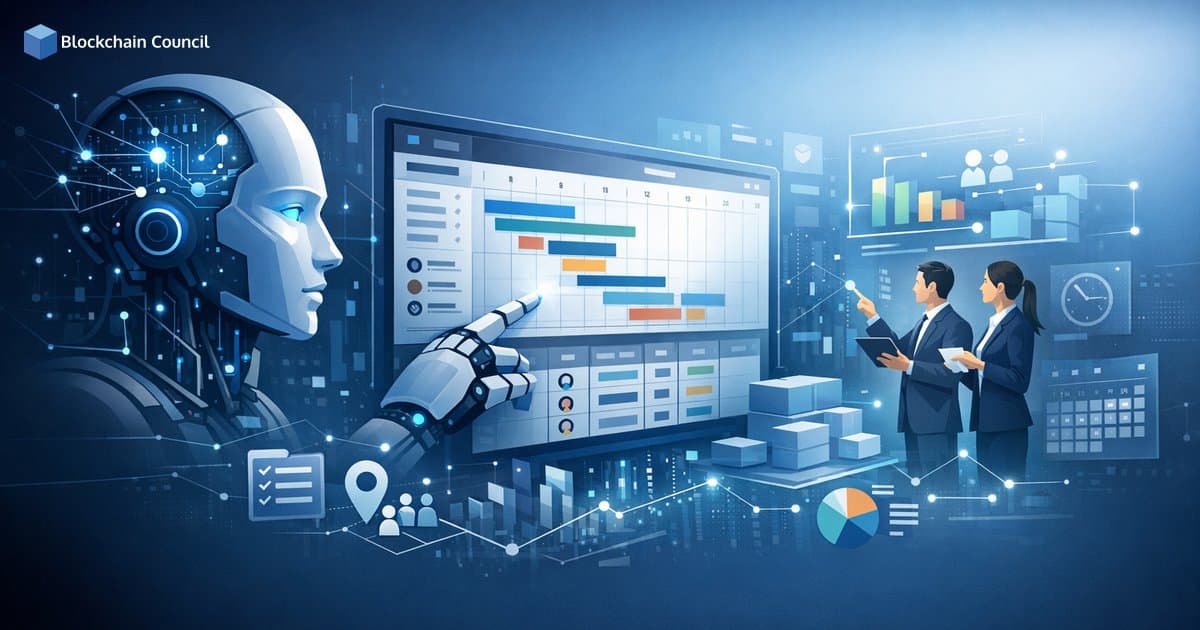
AI-powered project management is reshaping how teams plan work, build schedules, and allocate people and budgets. Instead of relying on static Gantt charts and manual status updates, modern platforms use predictive analytics, intelligent automation, and real-time optimization to recommend next best actions. The result is higher delivery confidence, faster decision-making, and fewer surprises - while project leaders still provide oversight, context, and accountability.
Tools such as Epicflow and Celoxis exemplify this shift by forecasting risks, dynamically prioritizing tasks, and simulating scenarios to support data-driven choices. Platforms are also adding natural language features that convert project data into summaries, insights, and automated updates across connected ecosystems such as CRM and PSA stacks.

If you are learning through an Agentic AI Course, a Python Course, or an AI powered marketing course, this guide will help you understand AI-driven project workflows.
What is AI-powered project management?
AI-powered project management applies machine learning, forecasting models, and automation to core PM activities such as:
Planning (scope decomposition, work breakdown structuring, estimation support)
Scheduling (timeline creation, dependency handling, dynamic reprioritization)
Resource allocation (capacity planning, skill matching, load balancing)
Risk management (early warning signals, mitigation suggestions)
Reporting (auto-generated health summaries, variance insights)
AI does not replace project managers. Industry perspectives consistently position AI as a collaborative tool that improves foresight and reduces administrative burden, freeing managers to focus on stakeholder alignment, trade-offs, and delivery leadership.
How AI Automates Planning and Scope Definition
Planning is where small errors compound into major delays. AI improves planning by using historical data, templates, and live execution signals to produce more realistic plans.
1) Estimation and Timeline Generation from Historical Patterns
When teams have prior project data, AI can detect patterns in effort, cycle time, and variance across similar work types. This supports better initial estimates and more realistic timeline proposals. Even when quantitative benchmarks are limited, AI features commonly reduce manual effort in estimation and reporting, improving speed and consistency of planning outputs.
2) Intelligent Work Breakdown and Task Routing
As AI becomes more embedded in PM platforms, it automates routine workflow management tasks - assigning items to queues, routing tasks to the right owners, and linking tasks to milestones. This reduces the coordination overhead that often slows delivery, particularly in multi-team environments.
3) Natural Language Summaries for Planning Clarity
Many current tools use natural language processing to convert complex project states into readable summaries. This helps leadership review scope changes, understand what moved and why, and make informed decisions without hours of manual status compilation.
AI-Driven Scheduling: Dynamic Prioritization and Real-Time Optimization
Traditional schedules are fragile because they assume stable priorities and predictable execution. AI improves scheduling by treating the schedule as a living system that reacts to progress, dependencies, and capacity changes.
1) Predictive Schedule Forecasting
Modern platforms forecast schedule slippage by monitoring variables such as task completion rates, dependency pressure, and workload saturation. These models help teams anticipate delays earlier, allowing intervention before a slip becomes irreversible.
2) Automatic Reprioritization and Constraint Handling
In multi-project portfolios, AI can auto-prioritize tasks to reduce overload and keep critical work moving. Epicflow is widely recognized for using predictive analytics in multi-project environments to detect bottlenecks and dynamically prioritize work to avoid resource contention.
3) Dependency Mapping Beyond the Obvious
A notable trend is identifying hidden dependencies - not just those explicitly recorded in a schedule. Some tools infer dependency signals through work patterns and communication flows, helping teams spot coordination risks earlier than manual dependency reviews allow.
AI for Resource Allocation: From Capacity Planning to Skill-Based Matching
Resource allocation optimization is one of the strongest consensus value areas in AI project management. When AI can assess workload, skills, and delivery targets across a portfolio, it can recommend better staffing decisions than ad-hoc manual planning.
1) Capacity Forecasting and Overload Detection
AI-driven systems predict future staffing needs based on current project pipelines and velocity patterns. They also flag over-allocation risk, identify capacity shortages, and suggest rebalancing actions. This matters because many delivery failures originate from invisible overload that surfaces too late to address effectively.
2) Skill-to-Task Matching
Resource engines match work requirements to skill profiles, improving assignment quality. In professional services contexts, platforms like Mission Control for Salesforce PSA combine automated matching with delivery signals to reduce estimation risk and improve utilization without requiring manual matching for every assignment.
3) What-If Scenario Simulation
Scenario simulation supports better decision-making under constraints. Epicflow, for example, is associated with scenario planning that lets teams model staffing and priority changes, then evaluate how timelines and workloads might shift. This enables more transparent trade-off conversations with stakeholders.
Risk Forecasting and Proactive Mitigation
AI is shifting project delivery from reactive to proactive by surfacing risk signals early. Common risk inputs include budget burn trends, task slippage indicators, dependency congestion, and resource availability changes.
Platforms such as Celoxis highlight predictive roadblock detection and resource optimization as central ways AI reshapes delivery practice. The practical benefit extends beyond identifying risk - AI can also suggest mitigation options such as resequencing tasks, shifting resources, or adjusting scope milestones.
Real-World Examples: What AI Project Management Looks Like in Practice
AI capabilities vary by platform, but several consistent use cases are emerging across industries.
Epicflow in Multi-Project Delivery
Predicts delays and bottlenecks by learning from historical and real-time data.
Auto-prioritizes tasks to reduce overload and keep constrained resources focused.
Simulates staffing scenarios to evaluate timeline and workload impacts before making changes.
Mission Control (Salesforce PSA) for Services Organizations
Automated resource matching aligned to delivery needs.
Risk scanning for signals such as scope changes and velocity drops.
Executive reporting that can be generated with minimal manual input, depending on configuration and data quality.
Cross-Platform Testing Signals
Broader reviews testing AI tools across extended hands-on periods indicate that many platforms improve task prioritization and risk handling, though results vary based on the quality of connected data, the maturity of workflows, and how well teams act on recommendations.
Implementation Guidance: How to Adopt AI-Powered Project Management Responsibly
To generate genuine value, focus on operational readiness and measurable outcomes rather than adopting AI for its own sake.
1) Start with High-Friction Workflows
Good starting points include:
Status reporting and weekly updates
Resource load balancing
Schedule variance tracking and early warning
Portfolio prioritization across competing initiatives
2) Improve Data Hygiene Before Expecting Accurate Predictions
AI forecasting depends on consistent task states, time tracking or throughput signals, and accurate resource calendars. If the underlying data is noisy, predictions will be unreliable. Establish basic governance for naming conventions, status definitions, and dependency recording before deploying predictive features.
3) Keep Humans in the Loop
AI should recommend, not unilaterally decide - especially when trade-offs affect cost, compliance, or customer commitments. Encourage managers to treat AI outputs as decision support that must be validated against business context.
4) Build Team Capability with the Right Skills
Organizations implementing AI in delivery operations benefit from upskilling across AI fundamentals, data literacy, and automation. Structured learning pathways - such as a Certified AI Professional (CAIP) designation or a Certified Project Manager credential - provide a foundation for teams navigating this transition. For organizations working on decentralized audit trails or secure data sharing, exploring blockchain-focused credentials such as Certified Blockchain Expert can also be relevant as part of broader digital transformation planning.
If you are learning through an Agentic AI Course, a Python Course, or an AI powered marketing course, this approach explains how AI improves efficiency and decision-making.
Future Outlook: Where AI Project Management Is Heading
AI in project management is expected to become more customizable and industry-specific in the coming years. Key directions include:
Deeper execution automation, such as AI-created action items from meetings and automatic schedule updates based on decisions and progress signals.
Enhanced prediction including more realistic timeline forecasts, bandwidth prediction based on velocity patterns, and better detection of hidden dependencies.
Decision intelligence as default, where auto-reports, health scoring, and financial commentary become standard features rather than optional add-ons.
Secure data sharing with potential blockchain integration for verifiable project records and controlled collaboration across organizations, particularly in regulated or multi-vendor environments.
The strongest consensus across tools and expert perspectives is that practical value comes from predictive allocation, dependency mapping, and real-time optimization - not feature demonstrations. Teams that operationalize these capabilities with solid data and governance will see the most significant delivery gains.
Conclusion
AI-powered project management is rapidly becoming a core capability for teams that need to deliver faster with fewer resources and tighter constraints. By automating planning tasks, optimizing schedules in real time, and improving resource allocation through capacity forecasting and scenario simulation, AI helps organizations move from reactive firefighting to proactive delivery management.
The most effective approach is pragmatic: start with measurable workflow automation, strengthen data quality, and keep human judgment central. With that foundation, AI becomes a reliable tool for project leaders - enabling clearer decisions, healthier portfolios, and more predictable outcomes.
Related Articles
View All
Blockchain
Predictive Project Management with AI
Predictive project management with AI forecasts risks, delays, and budget overruns using historical and real-time data, enabling proactive planning and better delivery control.

Blockchain
How Blockchain Supply Chain Systems Are Transforming Supply Chain Management in 2026
In 2026, blockchain supply chain systems boost transparency, traceability, and automation with DLT, smart contracts, and real-time data sharing across partners.

Blockchain
Crypto30x.com
Crypto30x.com is an emerging platform in the blockchain space. It offers a comprehensive suite of services tailored to meet the needs of cryptocurrency enthusiasts, traders, and developers. The platform aims to simplify blockchain interactions, making them accessible to both beginners and seasoned professionals.
Trending Articles
The Role of Blockchain in Ethical AI Development
How blockchain technology is being used to promote transparency and accountability in artificial intelligence systems.

AWS Career Roadmap
A step-by-step guide to building a successful career in Amazon Web Services cloud computing.

Top 5 DeFi Platforms
Explore the leading decentralized finance platforms and what makes each one unique in the evolving DeFi landscape.