

How Long Does It Take to Mine One Bitcoin?
 Michael Willson
BTC
On average, it takes about 10 minutes to mine a single block of Bitcoin, and each block currently rewards miners with 3.125 BTC. Therefore, on average, it would take around 30 minutes to mine one Bitcoin under ideal conditions. However, the time it takes to mine one Bitcoin varies significantly depending on factors such as the mining hardware, the network’s hash rate, and the Bitcoin price.
However, this estimate fluctuates based on mining hardware, network difficulty, and other variables. For most individual miners, mining one Bitcoin can take months due to network competition and mining difficulty. Here, we’ll break down how Bitcoin is mined, the factors influencing mining time, and how the price of Bitcoin plays into the process.

How Is Bitcoin Mined?
Bitcoin mining is the process by which new transactions are validated and added to the Bitcoin blockchain. Miners use specialized ASIC hardware (Application-Specific Integrated Circuits) to solve cryptographic puzzles and add blocks to the blockchain. Once a miner successfully solves the puzzle, they are rewarded with newly minted Bitcoins and transaction fees associated with the transactions in the block.
The block reward-the number of new Bitcoins a miner receives-is halved every four years in an event known as the Bitcoin halving. In 2024, the most recent halving event brought the block reward down to 3.125 BTC per block. As the block reward decreases over time, the total number of Bitcoin ever mined is capped at 21 million BTC.
A trusted bitcoin mining certification can help you land freelance gigs or full-time roles.
How Long to Mine 1 Bitcoin?
Bitcoin’s protocol is designed to ensure that new blocks are mined approximately every 10 minutes, regardless of how much computational power is being applied. Each block currently rewards miners with 3.125 BTC, so under ideal conditions, it would take about 30 minutes to mine one full Bitcoin, since 3.125 BTC per block × 3.2 blocks per hour = 10 BTC per hour. However, mining 1 Bitcoin can take significantly longer depending on several factors.
For most individual miners, mining 1 Bitcoin could take several months with average hardware. This is why many miners join mining pools, which increase their chances of earning rewards more consistently.
Key Factors
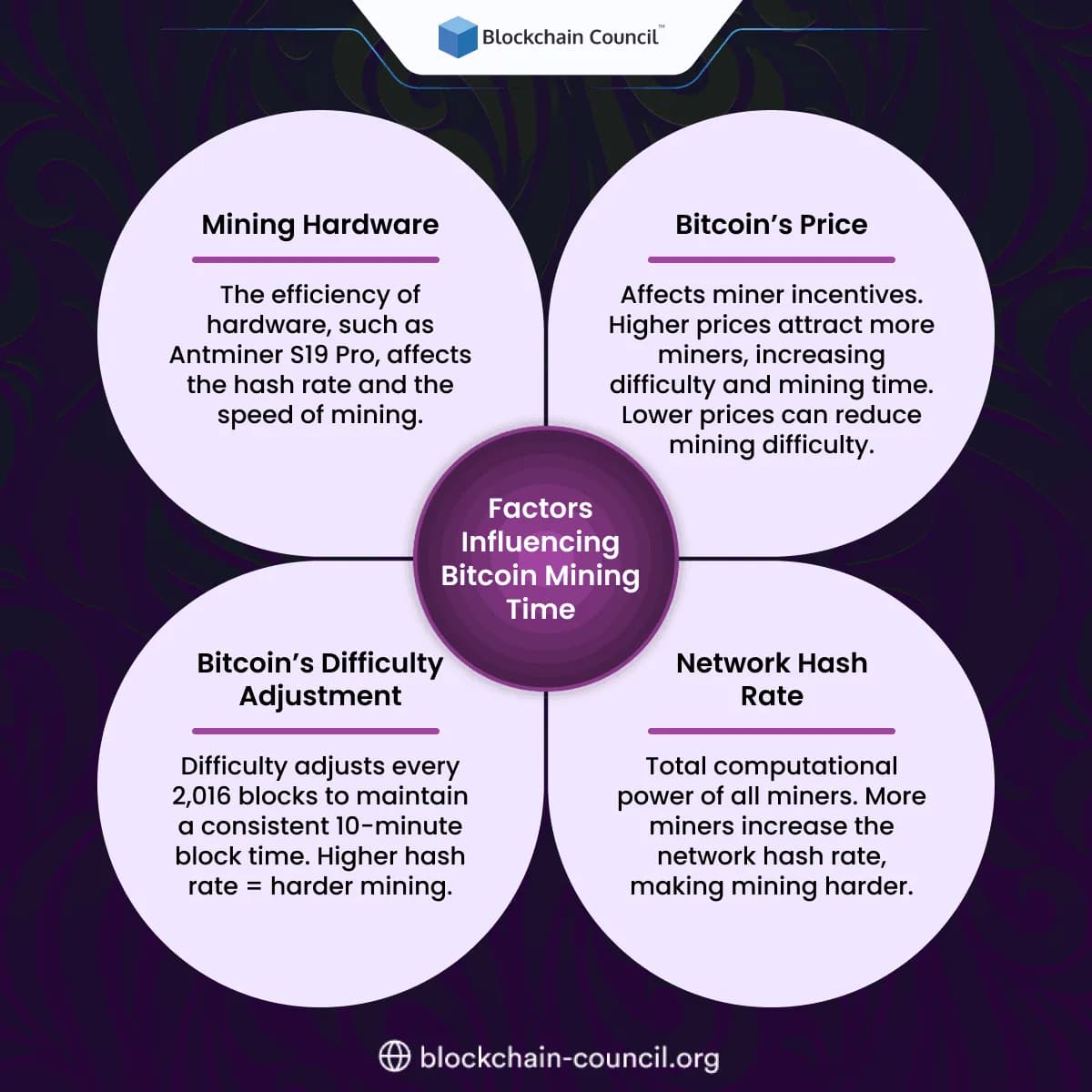
The time it takes to mine 1 Bitcoin is determined by several factors, including:
1. Mining Hardware
The efficiency of the mining hardware used is one of the most significant factors in how long it takes to mine Bitcoin. The most efficient mining hardware, such as the Antminer S19 Pro, has a hash rate of 110 TH/s (terahashes per second). This high hash rate allows the miner to process more calculations per second, thus increasing the chances of successfully solving the cryptographic puzzle and earning Bitcoin rewards.
Older or less efficient hardware, on the other hand, will have much slower hash rates and will take significantly longer to mine Bitcoin.
2. Network Hash Rate
The network hash rate represents the total computational power of all miners on the Bitcoin network. As more miners join the network, the total hash rate increases, which makes it harder to solve blocks. This means that the time to mine one Bitcoin increases as more competition is added.
As of 2025, the Bitcoin network hash rate is approximately 600 EH/s (exahashes per second). The higher the hash rate, the greater the competition, which increases the mining difficulty.
3. Bitcoin’s Difficulty Adjustment
Bitcoin’s mining difficulty adjusts approximately every 2,016 blocks (roughly every two weeks) to ensure that blocks are mined at a consistent rate of one every 10 minutes. If the hash rate of the network increases, the difficulty increases, making it harder to mine Bitcoin. Conversely, if the hash rate decreases, the difficulty decreases, allowing for easier mining.
The difficulty adjustment ensures that Bitcoin’s block time remains stable and predictable, despite fluctuations in the network’s mining power.
4. Bitcoin’s Price
The price of Bitcoin has a significant effect on mining time. When the price of Bitcoin increases, more miners are incentivized to join the network, which raises the hash rate and mining difficulty. This makes it more difficult to mine Bitcoin, as miners now have to compete against more powerful hardware.
On the other hand, if the price of Bitcoin drops, some miners may find it unprofitable to continue mining, especially if electricity costs are high. This can reduce the network hash rate and make mining easier. In this case, the time to mine 1 Bitcoin could decrease temporarily as mining difficulty is adjusted downward.
Bitcoin Mining Profitability
Mining Bitcoin is not just about the time it takes-it’s also about profitability. Miners must account for various costs:
Electricity: Mining Bitcoin requires a significant amount of energy. Depending on the efficiency of the mining hardware, electricity costs can represent a large portion of mining expenses.
Hardware costs: Purchasing and maintaining mining hardware can be expensive, and new hardware must be replaced periodically to stay competitive.
Bitcoin price: As mentioned earlier, the price of Bitcoin directly affects mining profitability. When Bitcoin prices are high, mining is more profitable, as the block rewards and transaction fees are worth more.
Given these variables, the cost of mining 1 Bitcoin can range from $15,000 to $25,000 as of early 2025, depending on the electricity rates and mining hardware used.
Conclusion
Mining Bitcoin is a time- and resource-intensive process that depends on multiple factors. On average, it takes about 10 minutes to mine a block, and since each block rewards miners with 3.125 BTC, mining one Bitcoin under ideal conditions could take approximately 30 minutes. However, in reality, most miners join mining pools to increase their chances of earning Bitcoin more regularly, as solo mining can take months or even years.
If you’re interested in learning more about the technical and economic aspects of Bitcoin mining, you can explore further with the following certifications:
Learn to analyze data in cryptocurrency markets through the Data Science Certification.
If you’re working in business, consider the Marketing and Business Certification for insights into integrating Bitcoin and crypto into business strategies.
For those interested in trading or mining Bitcoin, the Crypto Certification will enhance your skills.
Related Articles
View All
Bitcoin
Mine Bitcoin Using Cloud Mining
Want to mine Bitcoin without setting up your own machine? Cloud mining makes it possible. This guide will show you how cloud mining works, the best platforms in 2025, the risks to consider, and how to get started easily. If you’re looking for a hands-off way to earn crypto, this is your path.…
Bitcoin
Mine Bitcoin Without a Mining Farm
You can mine Bitcoin without owning a mining farm. No expensive equipment. No massive electricity bills. Today, cloud tools, USB devices, and hash marketplaces let beginners and budget users mine Bitcoin from anywhere. This guide explains exactly how to do it, what tools you need, and how to get…

Bitcoin
Mine Bitcoin on a Budget
You don’t need thousands of dollars to start mining bitcoin. With the right tools and platforms, anyone can begin mining on a tight budget. This guide will show how to mine Bitcoin without spending a fortune, which platforms to trust, and what risks to watch out for. Whether you’re just…
Trending Articles
The Role of Blockchain in Ethical AI Development
How blockchain technology is being used to promote transparency and accountability in artificial intelligence systems.
AWS Career Roadmap
A step-by-step guide to building a successful career in Amazon Web Services cloud computing.
How Blockchain Secures AI Data
Understand how blockchain technology is being applied to protect the integrity and security of AI training data.