
YouTube Allows PYUSD Stablecoin Payouts for US Creators

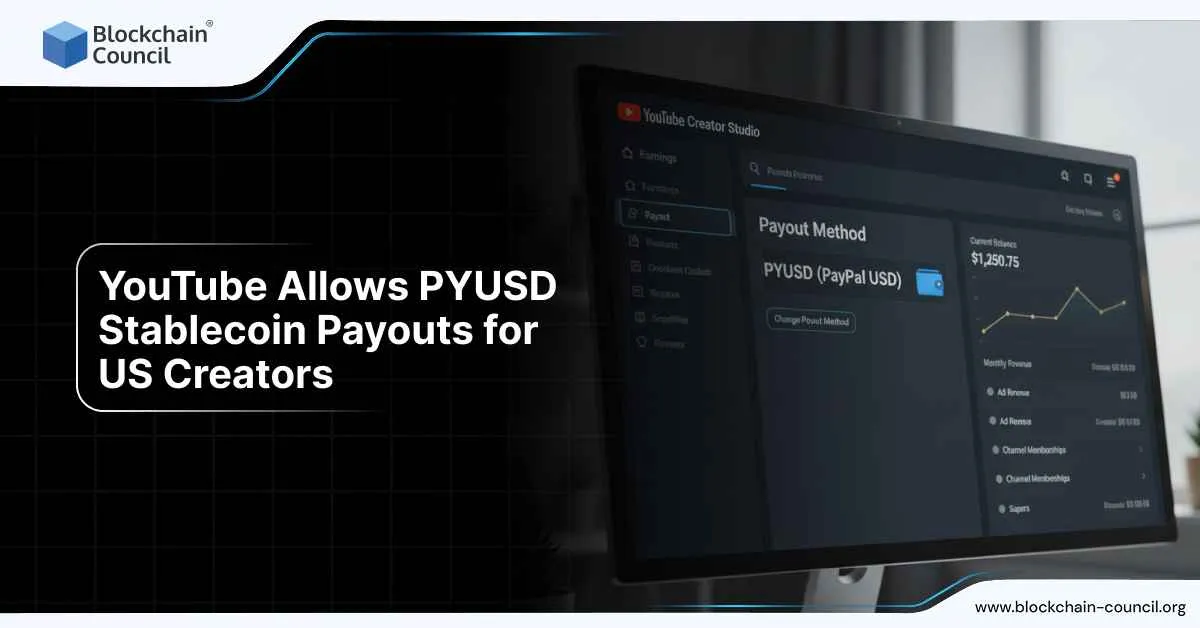
On 11 December 2025, YouTube quietly introduced one of its most consequential monetization changes in years. Creators in the United States can now choose to receive payouts in PayPal USD (PYUSD), a dollar-backed stablecoin, instead of traditional fiat transfers. The rollout was confirmed by May Zabaneh, Head of Crypto at PayPal, and separately acknowledged by a Google spokesperson. While the update did not come with a major press event, its implications for the creator economy, payments infrastructure, and stablecoin adoption are significant.
This move places YouTube among the first major consumer platforms to integrate a stablecoin payout option at scale, signaling that crypto rails are moving from experimentation into everyday income flows. For professionals tracking how digital assets are becoming embedded in mainstream platforms, this shift underscores why structured learning around crypto markets and settlement systems, such as a Crypto Certification, is no longer limited to trading desks.

What Exactly Changed for Creators
Under the new system, eligible US creators can opt to receive their YouTube earnings in PYUSD, PayPal’s dollar-pegged stablecoin. Importantly, YouTube itself does not touch crypto. The platform continues to process creator payouts in fiat through PayPal, which already handles YouTube’s mass payout infrastructure. Once funds reach PayPal, creators who opt in can have those funds converted into PYUSD.
Creators can then:
- Hold PYUSD within PayPal’s wallet
- Use PYUSD across supported PayPal and Venmo features
- Convert PYUSD back to US dollars
- Transfer PYUSD within supported crypto environments
This structure allows YouTube to avoid custody, compliance, and on-chain complexity, while still giving creators access to stablecoin settlement.
Why PYUSD and Not Another Stablecoin
PYUSD is issued by Paxos Trust Company and launched by PayPal on 7 August 2023. It is fully backed by US dollar deposits and short-term US Treasuries and is redeemable 1:1 for dollars. Unlike many crypto-native stablecoins, PYUSD is tightly integrated into a regulated payments company with deep relationships across merchants, platforms, and financial institutions.
That regulatory posture matters. PayPal has positioned PYUSD not as a speculative crypto product, but as payments infrastructure. YouTube’s adoption reinforces that framing and differentiates PYUSD from stablecoins that remain largely confined to trading platforms.
The Strategic Motivation Behind YouTube’s Decision
From YouTube’s perspective, this move is less about crypto enthusiasm and more about creator flexibility and payout efficiency. Stablecoins offer faster settlement and fewer banking intermediaries, especially compared to traditional ACH transfers. For creators with global audiences and complex financial lives, holding earnings in digital dollars provides optionality.
The rollout also aligns with YouTube CEO Neal Mohan’s broader push to modernize creator monetization without disrupting the platform’s core business. By routing everything through PayPal, YouTube avoids regulatory exposure while still benefiting from innovation at the payments layer.
Competitive Context in the Creator Economy
YouTube’s decision does not exist in isolation. Other platforms have explored crypto payouts, but most efforts have been limited in scope or tied to experimental Web3 initiatives. What makes YouTube’s move different is scale. YouTube pays millions of creators regularly, making this one of the largest real-world stablecoin payout implementations to date.
It also puts pressure on competitors:
- TikTok and Instagram still rely primarily on traditional fiat payout rails
- Twitch has experimented with crypto features but has not rolled out stablecoin payouts at this level
- Web3-native platforms offer token payouts, but lack YouTube’s reach and stability
In contrast, YouTube’s approach integrates stablecoins without changing creator behavior or onboarding flows.
Why This Matters for Stablecoins More Broadly
Stablecoins have long been promoted as a better way to move money, but adoption outside crypto trading has been slow. YouTube’s PYUSD rollout provides a clear example of stablecoins being used for earned income, not speculation.
This also comes at a time when US regulatory clarity around stablecoins has improved. By late 2025, stablecoins backed by regulated issuers and transparent reserves had gained broader acceptance among policymakers. PayPal’s ability to offer PYUSD at scale is a direct result of that shift.
For those working on payment systems, fintech platforms, or digital infrastructure, understanding how stablecoins fit into existing systems is increasingly important. That is why many professionals look to foundations like the Tech Certification to understand how payment rails, compliance layers, and scalability interact in real deployments.
The Business Case for PayPal
For PayPal, YouTube’s adoption is a validation moment. PYUSD was never meant to compete with volatile crypto assets. It was designed to sit alongside PayPal’s core payments business and extend it onto blockchain rails.
By powering payouts for a platform as large as YouTube, PayPal strengthens PYUSD’s credibility as a neutral digital dollar, not a niche crypto token. This also creates a flywheel:
- More platforms integrate PYUSD
- More users hold and transact in PYUSD
- PYUSD becomes more useful as a settlement layer
That strategy positions PayPal as a bridge between traditional finance and digital assets, rather than a disruptor fighting the system.
Limitations and Open Questions
Despite its significance, the rollout has clear limits:
- PYUSD payouts are only available to US creators at launch
- YouTube has not announced a timeline for international expansion
- Creators still rely on PayPal as an intermediary
- There is no direct on-chain payout to external wallets yet
These constraints suggest a cautious approach. YouTube and PayPal are testing adoption before scaling globally.
What This Signals for the Creator Economy
The creator economy is increasingly professionalized. Many creators now operate like small businesses, managing cash flow, taxes, and international payments. Stablecoin payouts give them another tool, particularly in a world where banking access and fees vary widely.
From a strategic standpoint, this move also shows how blockchain technology is entering consumer platforms quietly, through infrastructure upgrades rather than loud Web3 branding. For marketers, platform strategists, and business leaders, understanding these shifts is less about crypto hype and more about distribution and monetization. That broader perspective is why frameworks like the Marketing and Business Certification remain relevant even in highly technical payment discussions.
Final Takeaway
YouTube’s decision to allow PYUSD payouts is not a gimmick. It is a measured step toward modernizing how creators get paid, using stablecoins as plumbing rather than a headline feature. By leaning on PayPal’s regulated infrastructure, YouTube avoids risk while giving creators more control.
If adoption grows, this could mark a turning point where stablecoins become a normal part of earning income online, not just trading assets. That is why this update matters far beyond YouTube itself.
Related Articles
View All
Cryptocurrency
Stablecoin Design Models
What is Stablecoin Design Models Stablecoins are crypto assets built to maintain a relatively stable value, usually by tracking a fiat currency like the US dollar. They matter because they combine blockchain transfer speed with price stability, making them useful for trading, payments, remittances,…

Cryptocurrency
Binance Holds 65% of CEX Stablecoin Reserves
The claim that Binance holds 65% of centralized-exchange stablecoin reserves is not a vibes-based talking point. It is a specific measurement coming from CryptoQuant’s exchange-reserve tracking for USDT and USDC held on centralized exchanges, published in a February 2026 update. If you want to…

Cryptocurrency
US Lawmakers Propose Tax Break for Small Stablecoin Payments
A bipartisan group of U.S. House lawmakers has released a discussion draft called the Digital Asset PARITY Act that would reduce tax friction for everyday stablecoin spending. The headline idea is simple. Small purchases made with qualifying U.S. dollar stablecoins could be exempt from capital…
Trending Articles

The Role of Blockchain in Ethical AI Development
How blockchain technology is being used to promote transparency and accountability in artificial intelligence systems.

AWS Career Roadmap
A step-by-step guide to building a successful career in Amazon Web Services cloud computing.

Top 5 DeFi Platforms
Explore the leading decentralized finance platforms and what makes each one unique in the evolving DeFi landscape.