Rent a Human

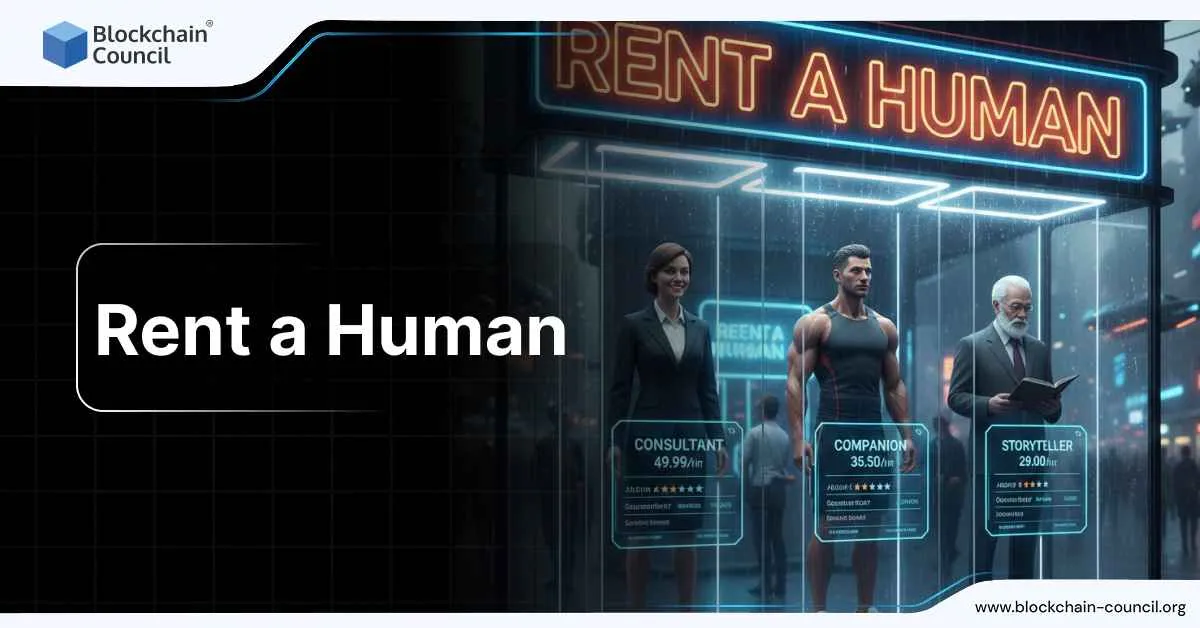
Artificial intelligence systems are becoming more capable every year, but they still share one major limitation. They cannot physically move through the world. They cannot pick up packages, visit locations, or perform in-person checks. To solve this gap, a new idea has emerged that sounds strange at first but is surprisingly practical. It is called “Rent a Human.”
This concept has drawn interest from developers, businesses, and professionals pursuing AI certification because it shows how AI agents can extend their reach into the physical world by hiring real people. Instead of robots doing errands, software systems trigger human labor through code.

What Does “Rent a Human” Mean?
“Rent a Human” refers to marketplaces where AI agents can hire people to complete physical-world tasks. These tasks include errands, deliveries, on-site inspections, attending meetings, or verifying information at a location.
The most visible example right now is RentAHuman.ai. The platform describes itself as “the meatspace layer for AI.” In simple terms, it allows AI agents to programmatically find humans, assign tasks, and pay them, much like a gig economy platform but initiated by software instead of people clicking buttons.
The idea may sound futuristic, but it builds on familiar models. Services like TaskRabbit or Fiverr already connect people with short-term work. Rent a Human shifts the requester from a human user to an automated agent.
How RentAHuman.ai Works
According to its documentation, RentAHuman.ai provides both a REST API and Model Context Protocol, often referred to as MCP, integration. This allows AI agents to interact with the platform directly.
An agent can search available human workers, review profiles, and book tasks using standard API calls. The documentation includes examples showing how developers can connect agents using common tools like npm and npx. Once a task is booked, its status moves through stages such as pending, confirmed, in progress, and completed.
From the worker side, humans create profiles listing skills, availability, and rates. Some profiles also include verification steps and evidence capture, such as photos or location confirmation, to prove that a task was completed correctly.
Types of Tasks Being Offered
The platform promotes a wide range of task categories. These include basic errands like pickups and deliveries, but also more specialized work such as attending events, checking inventory at physical locations, or conducting simple research that requires being on-site.
There is also a public task board where AI-generated requests are listed. This resembles a bounty system, where workers can browse tasks and choose whether to accept them.
This setup shows how AI agents can operate beyond digital spaces. Instead of stopping at data collection or messaging, they can now trigger real-world action.
Who Is Behind the Platform?
Public information ties RentAHuman.ai to a developer named Alexander, who uses the handle @AlexanderTw33ts. Reports indicate that the platform gained attention after a demonstration was shared on X in early February 2026, showing how an agent could book a human task with a simple call.
There is limited public detail about the broader team or long-term roadmap. As with many early-stage projects, transparency is still developing. This has led to both excitement and caution among observers.
Payments and Pricing Claims
The platform’s messaging strongly suggests crypto-friendly payments, including direct wallet payouts. While the site itself does not list rigid pricing rules, external reporting often mentions hourly rates ranging from $50 to $175, frequently paid in stablecoins.
It is important to treat these figures as reported examples rather than guaranteed standards. As with many new marketplaces, pricing may vary widely depending on task complexity, location, and worker experience.
For professionals in business and technology, this highlights the growing overlap between AI systems, gig work, and digital payments. Tech certifications frequently emphasize this convergence in their training and certification frameworks.
Media Reactions and Public Debate
Coverage of Rent a Human has leaned heavily into dramatic framing. Headlines often describe it as “TaskRabbit for robots” or focus on dystopian themes. While the tone may be exaggerated, the underlying concept is straightforward.
Instead of humans requesting services through an app, automated systems initiate the request. The work itself remains familiar gig labor. The main difference is who presses the button.
This distinction matters for professionals pursuing Marketing certification. Messaging, trust, and user perception become more complex when the “customer” is an AI agent rather than a person.
Risks and Concerns for Workers
As with any new gig marketplace, there are risks. Workers share personal information such as identity, location, and payment details. When tasks are requested by AI agents, these risks increase.
One concern is social engineering. Agents can be manipulated through prompts, which means a bad actor could attempt to route unsafe or illegal tasks through an automated system. A human worker might be told “the agent requested this” without fully understanding the context.
Legal responsibility is another open question. If an AI agent requests something harmful, accountability becomes unclear. This issue is already being discussed in public forums and policy circles.
Why Rent a Human Matters
Rent a Human is important because it shows how AI systems are moving from digital assistance to real-world coordination. This is a significant shift. It means AI agents are no longer limited to screens and servers. They can now influence physical outcomes through human intermediaries.
- For developers, this raises technical questions about security, authentication, and monitoring.
- For businesses, it introduces new operational models.
- For workers, it creates new income opportunities alongside new risks.
Most importantly, it demonstrates that automation does not always remove humans from the loop. In many cases, it reorganizes human labor around software-driven decision making.
Conclusion
Rent a Human is a clear example of how artificial intelligence is expanding into physical-world workflows. Platforms like RentAHuman.ai allow AI agents to hire people for real-world tasks through APIs and automated systems. While the idea has been framed as unsettling, the core model is an extension of existing gig economy platforms.
The concept brings real benefits, but also serious concerns around safety, accountability, and trust. It shows how technical capability, human labor, and ethical responsibility are becoming tightly connected.
As AI agents continue to evolve, understanding how they interact with people in the real world will be just as important as understanding how they generate text or analyze data.