OpenAI’s In-house Data Agent

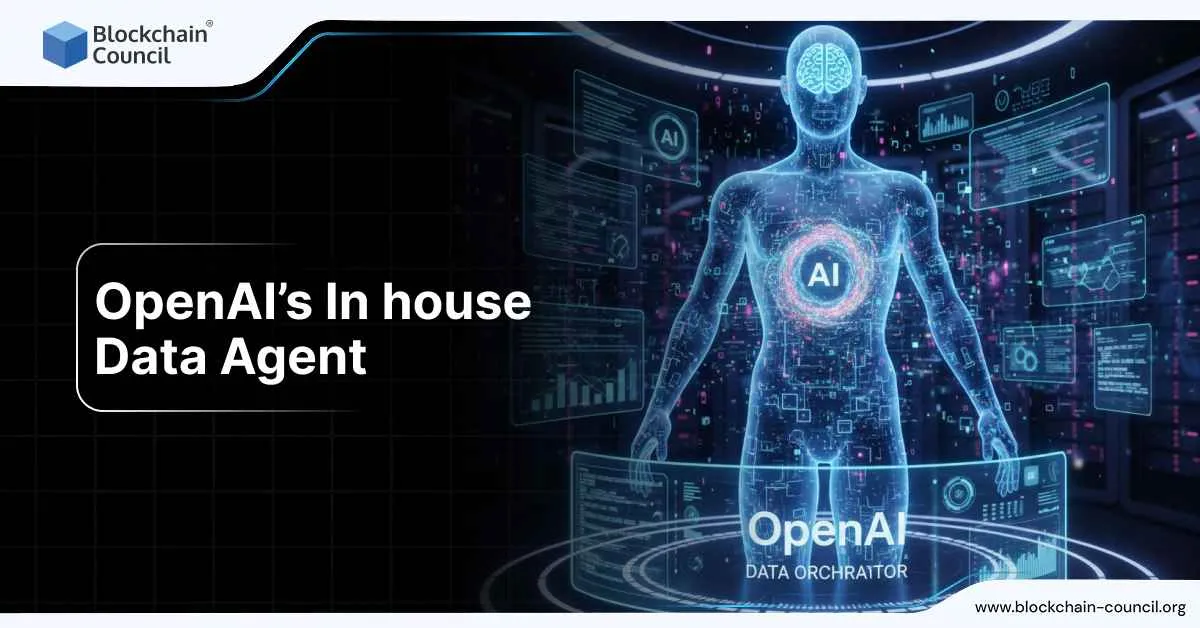
OpenAI’s in-house data agent is not a chatbot doing party tricks with SQL. It’s an internal system built to solve a very boring, very real problem: how do thousands of employees get reliable answers from hundreds of petabytes of data without breaking things or trusting hallucinations.
If you want to understand modern AI systems beyond surface-level demos, this is exactly the kind of system that separates “AI as a toy” from “AI as infrastructure.” That’s also why people studying applied AI systems often start with something structured like an AI certification to understand how agents, permissions, data, and evaluation actually fit together.

What OpenAI’s is in-house data agent?
OpenAI’s in-house data agent is an internal-only AI agent designed to help employees go from a natural language question to a validated data answer.
It is used across:
- Engineering
- Data Science
- Finance
- Go-To-Market
- Research
The scale matters. OpenAI says its internal data platform includes:
- 600+ petabytes of data
- 70,000+ datasets
- 3,500+ internal users
At that scale, the hardest problem is not writing SQL. It’s knowing:
- which table is correct
- what the table actually means
- whether the metric is still valid
- what assumptions apply
The data agent exists to compress that entire loop into minutes instead of days.
What problem it actually solves
Before the agent, the workflow looked like this:
- Ask a data team
- Wait for context
- Find the right tables
- Reverse-engineer schemas
- Write SQL
- Debug joins
- Re-run queries
- Explain results
The agent’s job is to remove the archaeology.
It lets a non-specialist ask:
“How did feature X affect retention last quarter?”
And then:
- finds relevant datasets
- inspects schemas
- writes SQL
- runs it
- fixes errors
- summarizes results
- explains assumptions
This is not about dashboards. It’s about decision speed.
How it’s delivered internally
The agent shows up wherever employees already work:
- Slack agent
- Web UI
- IDE integrations
- Codex CLI via MCP
- Internal ChatGPT app via MCP connector
This matters because adoption comes from convenience, not capability.
If you are interested in how this kind of system plugs into developer workflows and internal tooling, that’s squarely in systems and platform territory, which is where a broad tech certification becomes useful for context.
How it works
The most important design choice is that OpenAI treats context as a system, not a prompt.
The agent uses 6 structured context layers:
- Table usage and lineage
- Human annotations on datasets
- Code-level enrichment via Codex
- Institutional knowledge from Slack, Docs, Notion
- Memory of past corrections and constraints
- Live runtime inspection of the warehouse and pipelines
This prevents the classic failure mode where an AI confidently queries the wrong table and never realizes it.
The trace-based execution loop
Every query follows the same loop:
- Interpret the natural language question
- Retrieve relevant context via embeddings
- Inspect schemas and lineage
- Generate SQL
- Execute the query
- Detect errors or anomalies
- Fix joins or filters
- Re-run
- Summarize results with assumptions
Crucially, it shows its work. Users can inspect the SQL and results instead of trusting a magic answer.
Two design choices worth stealing
These are the most reusable ideas from the system.
Offline context normalization
Instead of scanning logs and metadata at query time, OpenAI:
- preprocesses context offline
- embeds it
- retrieves only what’s relevant
This keeps latency low and hallucinations down.
Continuous evaluation with “golden” queries
They assume quality will drift.
So they built an evaluation harness:
- natural language question
- agent-generated SQL
- executed result
- compared against manually authored “golden” SQL outputs
This is basically unit testing for analytics agents, not string matching.
Security and permissions
The agent does not bypass access control.
Key rules:
- pass-through permissions only
- you can only query what you already have access to
- missing permissions are flagged
- authorized alternatives are suggested
This avoids the nightmare scenario of an AI becoming a shadow data access layer.
What OpenAI learned building it
OpenAI openly shared lessons that matter:
- Too many tools confuse agents
- Fewer, well-defined tools work better
- Overly prescriptive prompts reduce quality
- High-level guidance beats micromanaging steps
- The meaning of data lives in the code that produces it
This last point is why Codex is used to crawl pipelines and jobs, not just tables.
What users are saying
This is where it gets interesting.
Hacker News themes
- “BI is already wrong half the time, so automating SQL is not scary”
- “The hard part is trust, not query generation”
- Strong push for canonical metrics and semantic layers
Reddit reactions
- Seen as a decision-speed tool, not a replacement for people
- Praise for combining context, memory, and permissions
- Skepticism about non-technical users trusting results blindly
The consensus is clear: the agent is useful, but only with guardrails.
Why this matters beyond OpenAI
This agent is not a product you can buy. There is:
- no pricing
- no public access
- no signup
But it’s a blueprint for enterprise data agents.
If you’re building something similar, OpenAI’s public stack already points the way:
- Agents
- MCP connectors
- Tool calling
- Vector stores
- Evaluations
This pattern is relevant to anyone building internal analytics, growth, or ops tooling. That’s also why professionals in analytics, product, and growth often pair technical understanding with business context through a marketing and business certification.
Key risks and limitations
No system like this is magic.
Real risks include:
- metric drift without governance
- false confidence from fluent summaries
- lack of shared definitions across teams
- overuse by users who don’t validate outputs
OpenAI explicitly addresses this by forcing transparency and evaluation, but the risk never goes to zero.
Conclusion
OpenAI’s in-house data agent is not impressive because it writes SQL. Plenty of tools can do that.
It’s impressive because:
- it treats context as infrastructure
- it respects permissions
- it shows its work
- it assumes errors will happen
- it defends trust with evaluation
This is what “AI at scale” actually looks like. Not flashy demos. Not chat UIs pretending to be analysts. Just fewer bad decisions made faster.
And that’s the point.