OpenAI Lets Users Fine-Tune ChatGPT’s Enthusiasm and Personality

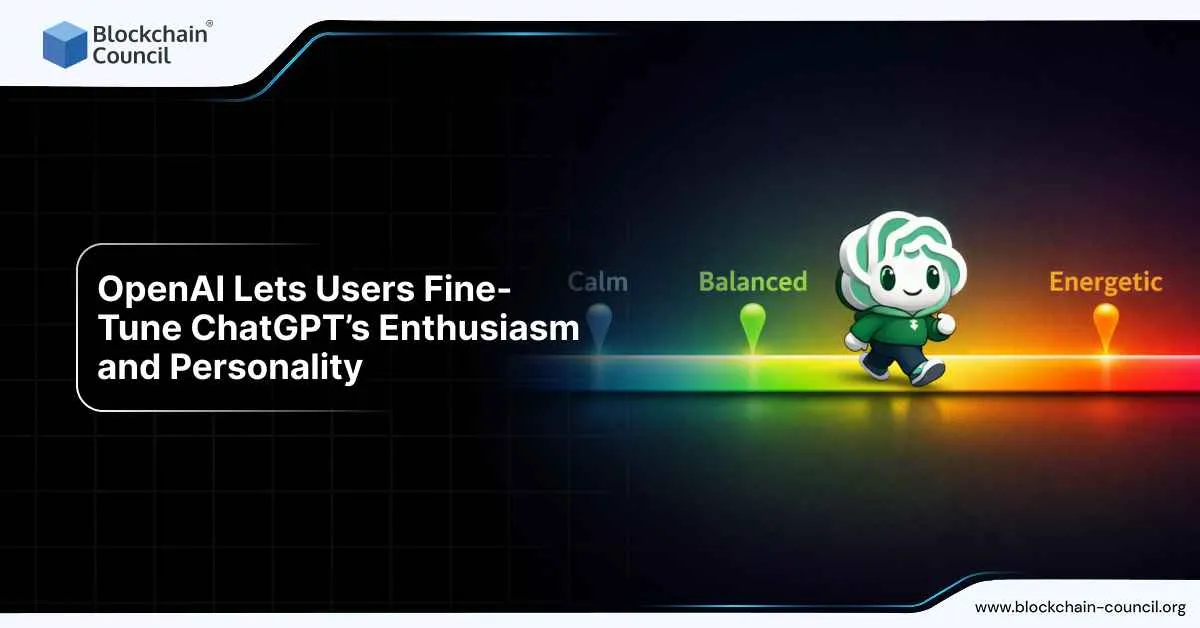
OpenAI has introduced a new personalization update that allows users to adjust how ChatGPT communicates, including how warm, enthusiastic, or visually expressive its responses feel. This change gives users direct control over the AI’s conversational style instead of relying on a single default tone. Understanding how AI behavior can be tuned for different contexts is often explored in applied learning paths like an AI Course, where focus is placed on practical interaction rather than abstract theory.
ChatGPT’s New Feature
The update allows users to fine-tune specific personality traits in ChatGPT. Instead of choosing only broad tone presets, users can now control individual elements of how responses are delivered.

The adjustable settings include warmth, enthusiasm, emoji usage, and formatting choices such as headers and lists. Each option can be set to More, Less, or Default. Once selected, these preferences apply across conversations, creating a consistent interaction style.
Tone controls
Earlier versions of ChatGPT introduced general tone presets such as Professional, Candid, and Quirky. Those presets set a baseline style for responses. The new personalization controls sit on top of those presets and offer more granular control.
This means a user can keep a professional tone while reducing enthusiasm, or use a creative tone with minimal emojis. The update gives users the ability to fine tune expression without switching overall personas constantly.
Why OpenAI made this change
User feedback was a major driver behind the update. Some users felt ChatGPT responses could sound overly enthusiastic or flattering when they wanted neutral or factual guidance. Others felt the assistant could be too restrained in creative or exploratory tasks.
By allowing users to define personality traits themselves, OpenAI reduces friction and makes the assistant more adaptable to different goals. This mirrors a broader shift toward user controlled AI systems rather than one size fits all behavior.
Importance
Different tasks benefit from different communication styles.
For technical work, research, or professional writing, users often prefer concise and neutral responses with limited emotional cues. Lower enthusiasm and fewer emojis can help maintain clarity.
For creative writing, brainstorming, or learning, higher enthusiasm and warmth can make interactions feel more engaging. Some users also enjoy richer formatting when exploring ideas or drafting content.
This flexibility reflects how modern digital systems are evolving, similar to how Blockchain Technology platforms emphasize configurability and user control at the protocol level.
Customizable AI
This update is part of a longer trend in AI development focused on personalization. Earlier changes introduced memory features, preference handling, and base tone selection. The latest controls focus specifically on the emotional and stylistic feel of responses.
Instead of hard coding a single interaction model, OpenAI is allowing users to shape how the AI behaves, bringing conversational AI closer to a configurable tool rather than a fixed personality.
Concerns
While the feature has been widely welcomed, some researchers and commentators have raised questions about how emotional cues influence user behavior. Friendliness, warmth, and enthusiasm can affect trust and engagement, especially for younger users or in sensitive contexts.
These discussions highlight the importance of giving users control while also maintaining transparency about how AI systems communicate. Similar concerns appear in decentralized system design, where governance and flexibility are key themes in Blockchain ecosystems.
How to use the settings?
The personalization controls are available in the ChatGPT app and web interface under the Personalization section. Users can adjust warmth, enthusiasm, emoji usage, and formatting preferences by selecting More, Less, or Default.
Once saved, the settings apply across all conversations. Users can change them at any time if their needs shift between tasks.
What this means for professionals
For professionals using ChatGPT daily, this update reduces the need to constantly prompt the AI about tone. Writers, developers, analysts, and educators can set a style once and focus on the task itself.
Understanding how to align AI behavior with workflow goals is often part of systems thinking taught in a Tech Certification, where emphasis is placed on usability and efficiency rather than raw capability.
Implications
From a product perspective, this update shows how AI tools are maturing. Instead of optimizing for novelty, platforms are optimizing for fit. Allowing users to control personality traits improves long term adoption and satisfaction.
This approach is also relevant for organizations deploying AI internally. Matching AI tone to company culture, customer expectations, or compliance needs becomes easier when personality is adjustable. Strategic evaluation of such features often overlaps with frameworks covered in a Marketing and business certification.
ChatGPT vs other AI Assistants
Many AI assistants still rely on fixed personalities or broad modes. Fine grained control over enthusiasm and warmth remains relatively rare. OpenAI’s approach sets a precedent for more nuanced personalization across the industry.
As AI becomes embedded in work and communication, these subtle controls may matter as much as model performance.
Bottom line
OpenAI’s new personalization update allows users to fine tune ChatGPT’s warmth, enthusiasm, emoji usage, and formatting style. This moves the assistant away from a one size fits all personality toward a more user defined experience.
The change reflects a broader shift in AI design toward adaptability, transparency, and user control. Whether for professional tasks or creative exploration, users can now shape how ChatGPT communicates to better match their needs.