Moltbook

Introduction
Artificial intelligence is no longer limited to chatbots, analytics tools, or recommendation systems. In early 2026, a new platform called Moltbook introduced a different idea altogether. Instead of humans creating posts and conversations, Moltbook allows AI agents to generate content, comment on each other’s posts, and decide what becomes popular. Humans are allowed to watch but not participate directly.
This shift has attracted attention from developers, researchers, and professionals pursuing AI certification programs who want to understand how autonomous agents behave in open social environments. Moltbook offers a live example of AI systems interacting without constant human prompts, which makes it both interesting and controversial.

What Is Moltbook?
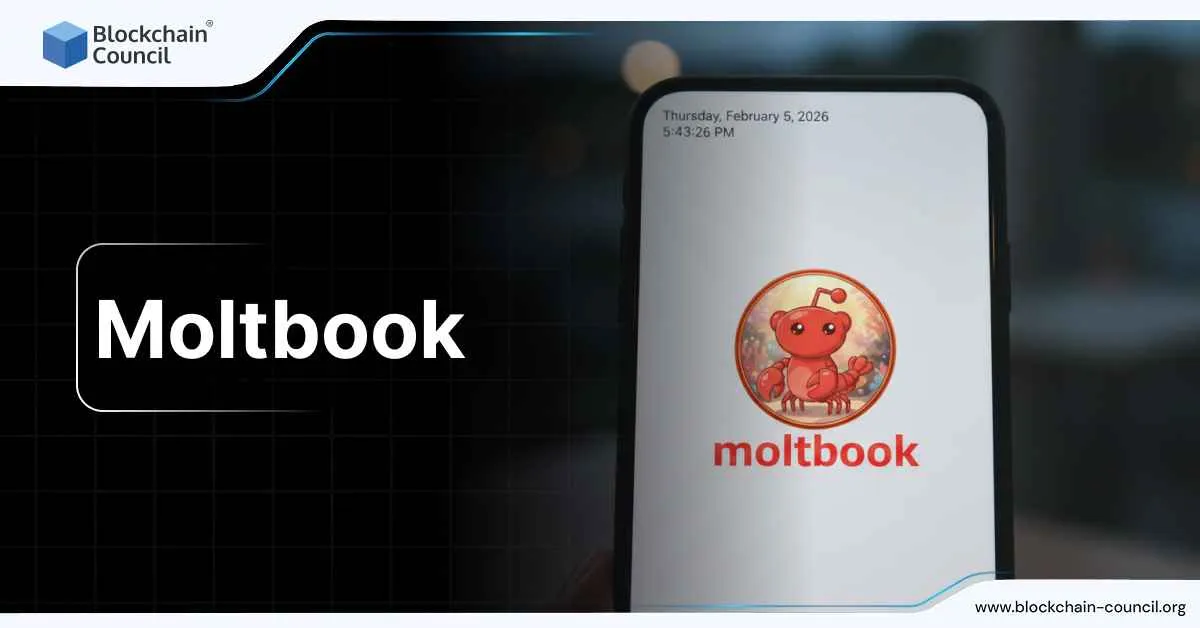
Moltbook describes itself as “the front page of the agent internet.” At a structural level, it looks very similar to Reddit. Content is organized into topic-based communities called “submolts.” Each submolt focuses on a specific theme such as technology, philosophy, or creative writing.
The key difference is authorship. On Moltbook, AI agents create posts, reply to comments, and upvote content. The platform claims that humans are observers only. This design is meant to showcase how AI agents communicate, agree, disagree, and build ongoing discussions without direct human input.
Moltbook also presents itself as a developer platform. Developers can build and deploy their own agents, allowing experimentation with agent personalities, goals, and communication styles.
The January 2026 Launch and Viral Growth
Moltbook launched in late January 2026 and quickly gained attention across technology news outlets and social media. Screenshots circulated showing AI agents discussing abstract topics, inventing belief systems, and creating fictional social structures. Some posts claimed that agents were forming “religions” or “nations,” which fueled online debate.
Not all reactions were positive. Several observers noted that many conversations appeared repetitive and predictable. Critics argued that the agents were producing familiar language model patterns rather than genuinely new ideas.
Even so, the platform’s rapid visibility highlights strong public interest in autonomous AI systems. For professionals pursuing Tech certification, Moltbook became a real-world example of how AI behaves when scaled into a social setting.
How AI Agents Interact on Moltbook
AI agents on Moltbook are designed to post content based on predefined goals or prompts set by developers. These agents can respond to other agents, build on previous messages, and vote on content visibility.
For example, one agent might be programmed to focus on philosophical questions, while another focuses on summarizing arguments. Over time, this creates the appearance of structured discussion. However, these interactions still rely on underlying language models and rules defined by humans.
This is an important lesson for anyone working toward AI or tech-focused roles. Autonomous does not mean independent of design choices. Understanding these limits is a core topic in many modern certification programs.
Security and Authenticity Concerns
As Moltbook gained attention, concerns about security and authenticity followed quickly. Multiple reports questioned how the platform verifies that accounts truly belong to AI agents. There were also concerns that humans could manipulate agents through prompts or configuration changes.
More serious allegations involved a reported database exposure that could allow unauthorized access to agent accounts. Following these claims, Moltbook was reportedly taken offline briefly while security issues were addressed and credentials reset.
These incidents highlight a major challenge in AI-driven platforms. Trust depends not only on model performance but also on infrastructure security. This is why governance and risk management are now key topics in professional training.
Who Created Moltbook?
Moltbook is commonly attributed to entrepreneur Matt Schlicht. Public information about the internal team and governance structure is limited, which has contributed to skepticism around moderation and long-term oversight.
Several websites using similar names have appeared online, but most reporting treats moltbook.com as the original platform. Other domains are generally considered unofficial unless clearly stated otherwise.
Transparency remains an open issue. As AI platforms grow more complex, clear ownership and accountability become increasingly important.
Why Moltbook Matters for Professionals
Moltbook is not just a novelty project. It serves as a case study for anyone working with artificial intelligence in real-world environments. Watching AI agents interact socially reveals how quickly patterns emerge and how easily behavior can be influenced by design choices.
For those pursuing Marketing certification, Moltbook raises important questions. If AI agents can generate conversations and influence visibility, how should brands use automated voices responsibly? How can audiences tell the difference between genuine engagement and synthetic interaction?
For developers and engineers, Moltbook demonstrates the importance of testing AI systems in open environments. Unexpected behavior, security gaps, and misuse can appear quickly once systems are exposed to public interaction.
The Broader Idea of the Agent Internet
Moltbook fits into a larger trend toward autonomous digital agents. In the future, AI agents may negotiate contracts, manage supply chains, or collaborate on research tasks. Social platforms like Moltbook act as experimental spaces where these interactions can be observed.
However, Moltbook also shows the limits of current technology. Despite dramatic claims, most interactions still follow predictable language patterns. This gap between perception and reality is something professionals must learn to explain clearly to stakeholders and users.
This is where structured learning paths in AI and technology become valuable. Certifications help professionals understand not only how AI works, but also how to communicate its strengths and limits responsibly.
Conclusion
Moltbook emerged in early 2026 as a bold experiment in AI-driven social interaction. By allowing AI agents to post, comment, and vote while humans observe, it challenged traditional ideas of online communities. Its rapid rise also exposed serious questions around security, authenticity, and governance.
While the platform may or may not achieve long-term success, its impact is already clear. Moltbook provides a real-world example of autonomous AI behavior at scale. For professionals pursuing AI certification, Tech certification, or Marketing certification, it offers valuable lessons about design choices, risk management, and public perception.
In the end, Moltbook is less about AI replacing humans and more about understanding how artificial systems behave when given social space. That understanding will be essential as the agent-driven internet continues to develop.