Vitalik Buterin Says Ethereum Solves the Blockchain Trilemma
 Michael Willson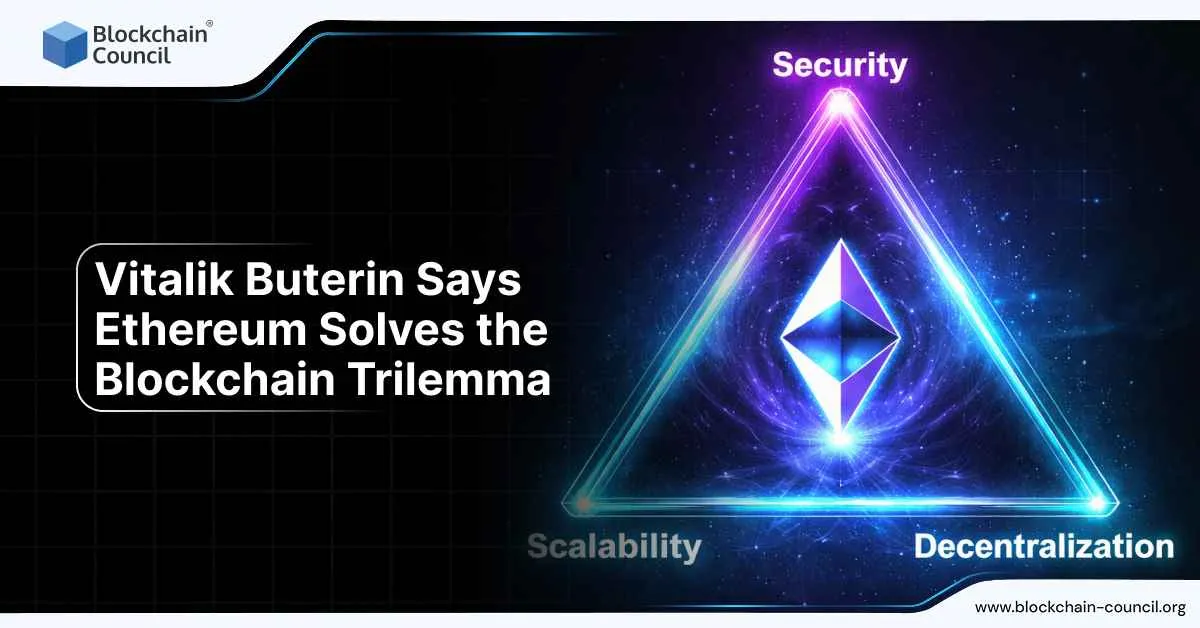
On 03 January 2026, Vitalik Buterin stated that Ethereum has effectively solved the long-debated blockchain trilemma. The claim did not come from a whitepaper or a future proposal. It came from a public post explaining that the solution already exists in live, running code, with some parts active on mainnet and others operating at production-level performance.
This article explains exactly what Vitalik meant, what parts are already live, what is still unfinished, and why his statement is both bold and carefully qualified.

For readers tracking protocol-level shifts and crypto market structure, grounding in a Crypto Course helps put these claims into context, especially when infrastructure upgrades affect long-term network economics.
Where the claim came from
The statement traces back to a 03 January 2026 post by Vitalik on X. Coverage quoting the post reproduced a key line that quickly became the headline.
He said that the trilemma has been solved with live running code, explaining that:
- One half of the solution is already on Ethereum mainnet
- The other half is running at production-quality performance
- Safety is the remaining area of work
This framing matters. Vitalik was not claiming a theoretical breakthrough. He was pointing to deployed systems and active roadmap components, while clearly stating that full safety hardening is still ongoing.
What “the blockchain trilemma” means here
The blockchain trilemma refers to the difficulty of achieving scalability, security, and decentralization at the same time.
The idea is commonly associated with Vitalik himself, dating back to around 2015, when Ethereum developers began openly discussing the tradeoffs between throughput, validator accessibility, and trust assumptions.
When Vitalik says Ethereum solves the trilemma, he is using this classical definition. The claim is that Ethereum no longer has to sacrifice one of the three pillars to strengthen the others.
Understanding how this balance works is foundational to modern Blockchain design.
The two components Vitalik points to
Vitalik’s statement hinges on two technical systems working together, not one single upgrade.
PeerDAS and data availability
The first component is PeerDAS, short for peer data availability sampling.
PeerDAS addresses scalability at the data layer. It allows the network to handle far more data without forcing every node to download everything. Instead, nodes sample data availability in a probabilistic way that preserves security while lowering per-node bandwidth requirements.
In Vitalik’s framing, PeerDAS represents the data availability sampling half of the solution. Importantly, he described this part as already live on Ethereum mainnet.
PeerDAS is closely associated with the Fusaka upgrade, which developer and industry coverage in late 2025 tied to Ethereum’s next major scaling phase. Fusaka was targeted for early December 2025, aligning with Vitalik’s January 2026 statement that this half of the solution is already deployed.
zkEVMs and scalable validation
The second component is zkEVMs, or zero-knowledge Ethereum Virtual Machines.
zkEVMs allow Ethereum blocks to be validated using zero-knowledge proofs. Instead of every node re-executing every transaction, nodes can verify cryptographic proofs that the execution was correct.
Vitalik described zkEVMs as being in an alpha stage, but with production-quality performance. That distinction is important. Performance is there. Safety, tooling, and long-term hardening are still in progress.
In the trilemma context:
- Scalability improves because validation becomes far more efficient
- Decentralization improves because nodes can validate without massive hardware requirements
- Security is preserved through cryptographic proofs, once fully hardened
This combination is why Vitalik treats zkEVMs as the second half of the solution.
These ideas are central to how modern Blockchain Technology systems are evolving beyond simple execution models.
Why “solved” does not mean “finished”
One of the most misunderstood parts of Vitalik’s statement is the word “solved.”
He explicitly said safety remains. That is not a footnote. It is a core qualifier.
In Ethereum’s roadmap, solving the trilemma means the architecture exists to achieve all three goals together. It does not mean every component is finalized, battle-tested, and rolled out network-wide.
Vitalik’s framing is closer to saying:
- The design problem is resolved
- The implementation is underway
- The remaining work is execution, hardening, and gradual rollout
This distinction separates marketing claims from engineering reality.
The roadmap Vitalik outlined
The coverage that reproduced Vitalik’s comments also included a staged timeline that shows how Ethereum expects this architecture to mature.
What to expect in 2026
In 2026, only small portions of the network are expected to use zkEVM-based validation.
Other changes are planned in parallel, including gas limit increases that do not depend on zkEVMs. Developers will also begin getting early opportunities to run zkEVM nodes.
This phase is about experimentation and limited deployment, not full replacement.
The 2026 to 2028 transition phase
Between 2026 and 2028, Ethereum plans additional changes to make higher gas limits safe.
These include:
- Gas repricing
- State structure adjustments
- Further refinement of execution and validation paths
This is the period where scalability gains must be balanced carefully against network stability.
The 2027 to 2030 milestone
The long-term target places zkEVMs as the primary way to validate blocks sometime between 2027 and 2030.
This timeline reinforces that Vitalik’s “solved” claim is about direction and architecture, not immediate completion.
Learning how to read and interpret such roadmaps is often covered in a structured Blockchain Course, where protocol evolution is treated as a multi-year process rather than a single upgrade.
Why this matters beyond Ethereum
Ethereum is not just another blockchain. Its design choices influence the broader ecosystem.
If Ethereum can scale while maintaining decentralization and security, it challenges long-held assumptions across the industry. Many newer chains explicitly trade decentralization for throughput. Vitalik’s claim suggests that tradeoff is no longer necessary at the base layer.
- For developers, this shifts how applications can be designed.
- For investors, it affects how long-term network value is assessed.
- For institutions, it changes the calculus around infrastructure risk.
These strategic implications are often discussed alongside governance, adoption, and messaging frameworks found in a Marketing and business certification, especially when explaining complex protocol changes to non-technical stakeholders.
Putting the statement in proper context
Vitalik’s January 2026 comment should be read as a status update from the lead architect, not a victory lap.
He is saying:
- The trilemma no longer blocks Ethereum’s path
- The core mechanisms are live or near-live
- The remaining work is known, scoped, and multi-year
That is a strong claim, but also a measured one.
Bottom line
Vitalik Buterin’s statement that Ethereum has solved the blockchain trilemma refers to a concrete architectural milestone, not a finished product. He points to PeerDAS as the live data availability layer and zkEVMs as the emerging validation layer that together allow scalability, security, and decentralization to coexist.
While safety hardening and full rollout will take years, the core design is now implemented in real systems. In Vitalik’s framing, that is what it means for the trilemma to be solved in practice rather than theory.