
Is AI Making Humans Lazy or Smarter?

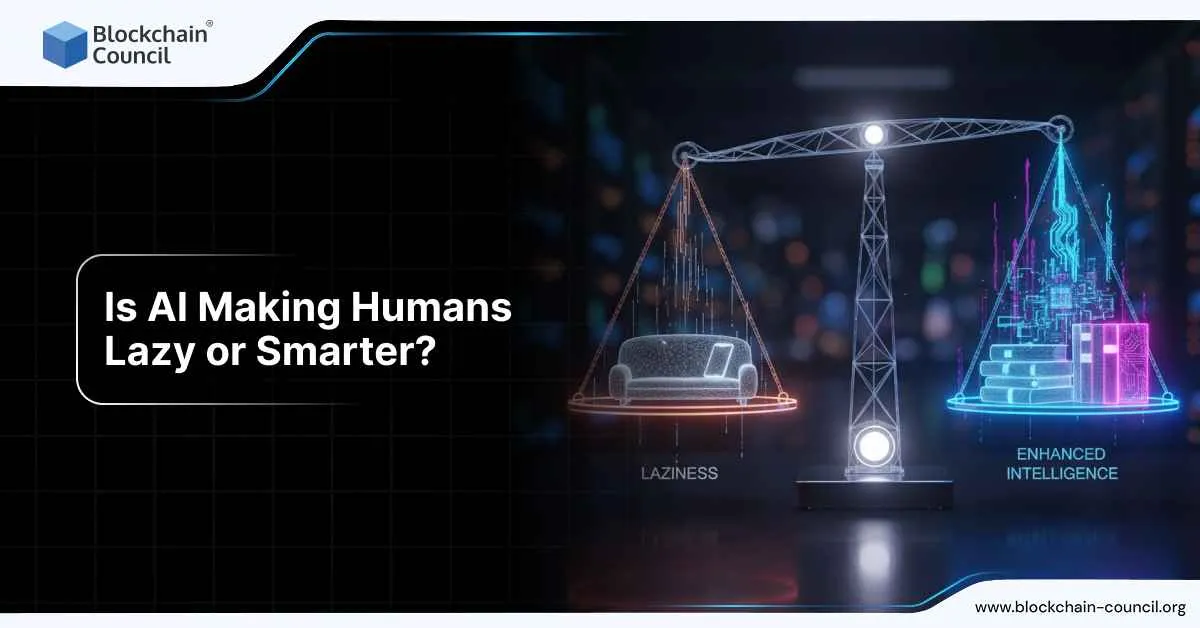
The big question many people are asking today is simple: does AI make humans lazier or smarter? On one hand, AI helps us work faster, learn better, and handle complex tasks with ease. On the other, it may reduce motivation, critical thinking, and originality. The truth is not black and white — it depends on how AI is used.
If you want to explore this debate while preparing for the future, earning an AI certification can give you the knowledge and practical skills to understand both the opportunities and risks.

How AI May Be Making Us Smarter
Better Learning Outcomes
Research shows students using AI learning platforms score significantly higher than those with traditional instruction. AI tutors can explain complex concepts, adjust to different learning speeds, and provide instant feedback. Studies even report a 15% boost in test performance with AI-powered support.
Boost in Productivity
In workplaces, AI reduces the time spent on routine tasks like drafting documents or searching for information. Employees save hours each week, leaving more energy for strategy, problem-solving, and creativity. AI works as a “cognitive extension,” allowing humans to focus on higher-value thinking.
Stronger Support for Complex Tasks
AI can process huge amounts of data that humans cannot easily handle. In medicine, for example, it helps doctors analyze imaging scans quickly. In business, it spots patterns in customer behavior. These are tasks where AI makes professionals not just faster but more accurate.
To take advantage of these gains, professionals often invest in a Data Science Certification to understand how AI models work with data in practical settings.
How AI Might Be Making Us Lazy
Decline in Critical Thinking
Studies have found that frequent AI use correlates with weaker critical thinking scores. Because AI provides ready-made answers, people may be less inclined to question information or reason through problems themselves.
Reduced Motivation
Some researchers argue that AI can lower mental effort. When answers are easy to generate, users may not engage deeply. Students in particular risk becoming passive learners rather than active thinkers.
Loss of Decision-Making Skills
In surveys across Pakistan and China, around 69% of students admitted that AI tools contribute to laziness or loss of decision-making skills. Instead of building their own arguments, many just rely on AI-generated content.
Risks to Creativity
Teachers and employers warn that overuse of AI templates may reduce originality. If people simply accept AI outputs without questioning them, independent creativity suffers.
What the Research Shows
Statistics on AI’s Impact
| Finding | Detail |
| Performance boost | Students using AI tools scored ~15% higher on tests |
| Critical thinking decline | Frequent AI use linked to weaker reasoning scores |
| Laziness factor | 68–69% of surveyed students felt AI increased laziness |
| Productivity effect | Workers save hours weekly with AI drafting tools |
| Dependency risks | Reports of reduced decision-making and lower motivation |
| Creativity concern | Heavy reliance on AI lowers originality and self-initiation |
| Stress outcomes | Students relying too much on AI reported higher academic stress |
| Context matters | When AI is used as a support, results improve; when over-relied upon, risks grow |
Balancing Smarter and Lazier Outcomes
The real answer may be about balance. Used thoughtfully, AI makes people smarter by enhancing learning, productivity, and accuracy. Used passively, it makes people lazier by discouraging independent thought. The outcome depends on user habits, educational design, and workplace practices.
Leaders adapting to these changes often explore a Marketing and Business Certification to understand how to encourage productive use of AI in organizations while avoiding overreliance.
At the same time, tech professionals can benefit from blockchain technology courses to learn how emerging technologies integrate with AI, building resilience in fast-changing industries. Many learners also explore AI certs as part of their career path.
Conclusion
So, is AI making us lazy or smarter? The answer is: both, depending on how we use it. AI can be a powerful tutor, assistant, and productivity booster. But it can also create habits of over-reliance, reducing critical thinking and creativity.
The smartest approach is intentional use. Let AI handle routine tasks, but keep engaging your own brain for judgment, originality, and deeper problem-solving. That way, AI becomes a partner in intelligence, not a shortcut to laziness.
Related Articles
View All
AI & ML
AWS Career Roadmap
Cloud computing has transformed the way businesses build and deliver digital products. Today, companies no longer need to invest in expensive physical servers to run their applications. Instead, they rely on cloud platforms that provide scalable computing power over the internet. One of the most…

AI & ML
What is AWS? A Beginner’s Guide to Cloud Computing and Career Opportunities
Cloud computing has become the backbone of modern technology. From streaming services and online shopping platforms to AI applications and mobile apps, most digital services today run on cloud infrastructure. One of the most powerful platforms leading this transformation is Amazon Web Services…

AI & ML
How to Start an AWS Career Using AI: A Modern Beginner’s Guide
Cloud computing has become one of the most important technologies powering the digital world. From streaming platforms and mobile apps to artificial intelligence systems and large-scale business applications, most modern services rely on cloud infrastructure. Among the many cloud platforms…
Trending Articles
The Role of Blockchain in Ethical AI Development
How blockchain technology is being used to promote transparency and accountability in artificial intelligence systems.
AWS Career Roadmap
A step-by-step guide to building a successful career in Amazon Web Services cloud computing.

Top 5 DeFi Platforms
Explore the leading decentralized finance platforms and what makes each one unique in the evolving DeFi landscape.