AI at Work in 2026

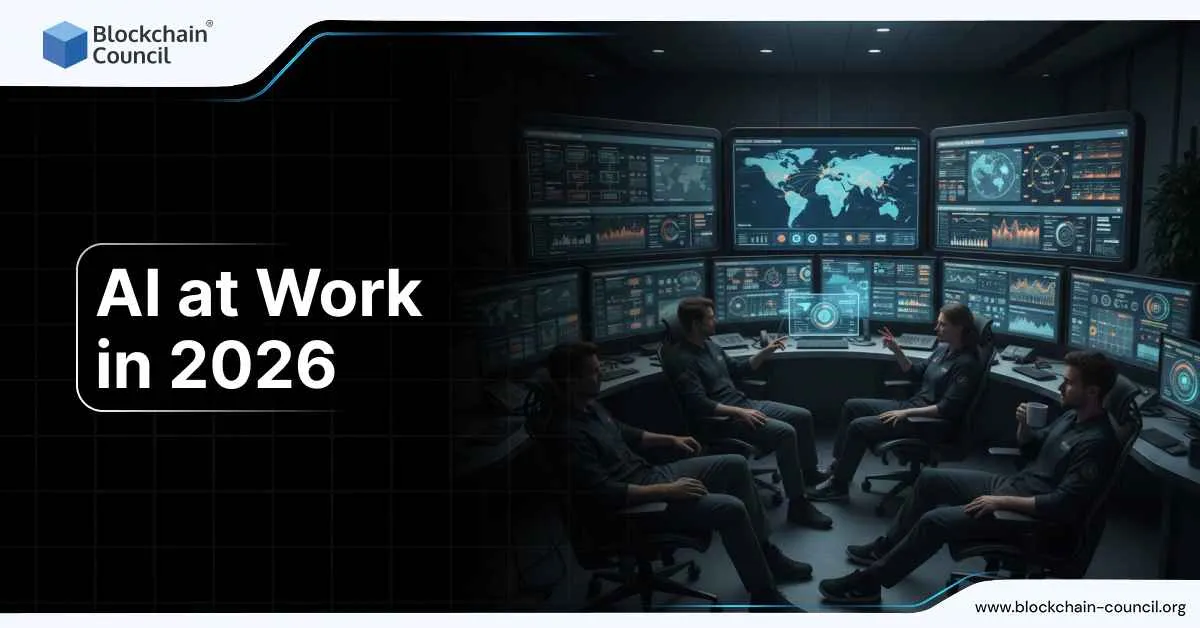
Work in 2026 changes in a very practical, visible way. AI stops behaving like a search box and starts behaving like a worker. Tasks move forward without someone staring at a blank page. First drafts appear quickly. Follow ups tighten because context is remembered while humans focus on decisions. This is not hype or theory. It shows up in daily workflows across teams.
To stay effective in this shift, people first need a solid understanding of how modern AI systems actually behave at work, which is why many professionals start with an AI Certification to build clarity before adopting tools blindly.

Delegate and review becomes the new default
In 2025, AI answered questions. In 2026, AI completes work.
The new rhythm looks like this:
- A human defines the objective and constraints
- AI produces a structured output
- A human reviews and adjusts
- The output is shipped as real work
Time shifts away from creating rough drafts and toward judgment, prioritization, and approval. This single change quietly alters how days are planned.
Job titles stay the same, but the work changes
Roles rarely get renamed. Responsibilities change instead.
Across teams, the pattern is consistent:
- Marketing shifts from writing everything to directing, refining, and publishing
- Analysts shift from building charts to validating and explaining insights
- Operations shifts from chasing updates to designing systems that stay updated
- Customer teams shift from typing replies to reviewing and personalizing drafts
In 2026, the most valuable employees are the ones who define quality clearly and move fast through iterations.
Quality beats raw speed
Speed matters, but quality on the first pass matters more.
When AI outputs arrive close to final, workflows improve naturally:
- Fewer revisions
- Less back and forth
- Faster approvals
- Cleaner handoffs
Instruction clarity becomes critical. Tone, format, length, and structure matter because consistency builds trust. Trust is what turns AI into something teams rely on daily.
Tool building spreads beyond engineering
A defining shift in 2026 is that non engineers build useful tools.
This shows up everywhere:
- Sales operations creates a lead scoring helper
- Recruiting builds consistent screening workflows
- Finance builds monthly close checklists
- Team leads build dashboards that update themselves
People are not becoming developers. They are solving small, real problems. Once that habit starts, it spreads quickly.
The internal tinkerer becomes a multiplier
Every organization has someone who enjoys testing tools and connecting systems. In 2026, that person becomes a force multiplier.
They usually do three things well:
- Describe problems clearly
- Stay patient with iteration
- Turn repetitive pain into automation
Organizations that support this role gain speed without adding headcount.
AI becomes a workflow layer, not a feature
Adding AI to an existing workflow is not the same as redesigning the workflow around AI.
The difference is clear:
- AI as a feature answers questions
- AI as a workflow layer drafts work, routes approvals, tracks decisions, and records outcomes
The second approach produces measurable ROI because it targets daily friction, not novelty.
Context becomes the real bottleneck
When output feels weak, context is usually the issue.
Winning teams fix context by improving:
- Data definitions
- Naming conventions
- Documentation
- Permission layers
- Tool integrations
Clean context makes AI feel capable. Messy context makes it feel like extra work.
Work shifts into complete packets
AI works best with complete chunks of work.
A work packet includes:
- A clear goal
- Required inputs
- A defined output format
- A review step
- A handoff
Examples include summarizing customer calls, drafting QBR outlines, building project plans, or proposing messaging directions. Reviewing finished sections works better than micromanaging sentences.
Meetings finally improve execution
AI changes meetings in two ways.
Preparation improves with pre drafted agendas, background notes, and risks. Follow through improves with clear action items, owners, and summaries. This improves execution, which is where most teams struggle.
Managers stop chasing status
In many workplaces, status chasing consumes time. In 2026, teams reduce this with automated summaries, surfaced blockers, and clear audit trails. Managers focus more on unblocking than monitoring.
Human review stays central
Most professionals want control over high stakes work.
The common setup is:
- AI drafts
- Humans approve
- AI executes small actions after approval
- Humans remain accountable
Trust grows through consistent performance, not promises.
Autonomy becomes adjustable
The autonomy debate becomes practical.
Teams decide how autonomous AI should be per workflow:
- Low autonomy for sensitive communication
- Medium autonomy for planning and drafting
- Higher autonomy for routine back office steps
This is an operational decision, not a philosophical one.
Structure increases even in creative work
AI encourages structure. Creative teams adopt briefs, tone guides, checklists, and review rubrics because structured inputs produce aligned outputs. This reduces revision cycles and helps creativity scale.
Hiring favors AI fluent operators
In 2026, AI fluency is about how someone works, not what tools they know.
Employers value:
- Clear delegation
- Comfort with iteration
- Strong review judgment
- Ability to design processes
This is also why many professionals complement AI skills with foundational systems knowledge through a Tech Certification.
ROI becomes visible and harder to fake
AI impact is measured clearly in 2026.
Teams are judged on:
- Time saved
- Quality improvement
- Customer experience
- Risk reduction
Workflow redesign delivers results. Tool adoption alone does not.
Fear shifts from replacement to stagnation
The real anxiety becomes falling behind peers who move faster with better workflows. The response is not panic. It is training, structure, and disciplined adoption.
How leaders should plan for 2026
Strong leaders treat AI as an operating model change.
A grounded plan includes:
- Selecting a few wasteful workflows
- Defining success metrics
- Keeping humans in review loops
- Fixing context and permissions
- Expanding only after reliability
Business alignment matters at this stage, which is why programs like Marketing and Business Certification often surface when organizations scale beyond pilots.
What individuals can do now
No dramatic career change is required. Better habits matter more.
A practical checklist:
- Practice clear objectives with constraints
- Ask for structured, reviewable outputs
- Automate one recurring weekly task
- Use a personal review checklist
- Track where AI saves or wastes time
Conclusion
AI at work in 2026 is not about novelty. It is about reliability. The advantage goes to teams that redesign workflows around delegation, context, and review. AI becomes valuable when it carries real work across the finish line, while humans focus on judgment where it matters most.