
Will AI Take Over Human Creativity Completely?

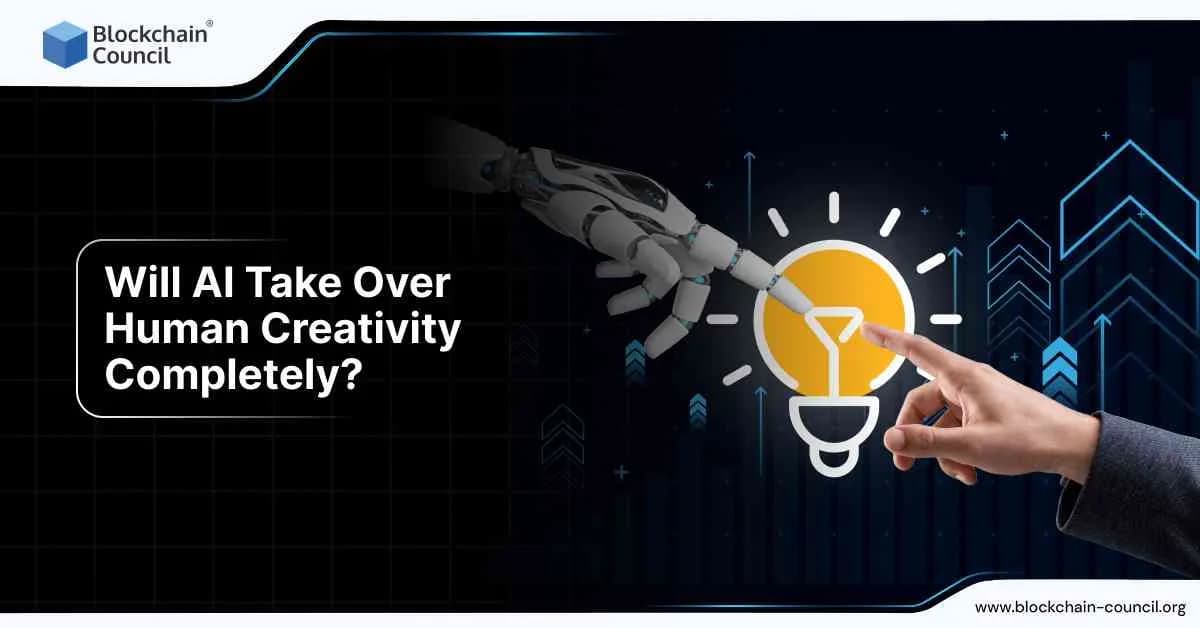
Artificial intelligence is becoming more advanced every day. It can now write stories, compose music, and even create art that looks human-made. But will AI actually take over human creativity completely? The clear answer is no. While AI can mimic patterns and generate impressive results, it cannot feel emotions, live experiences, or bring personal meaning into creative work. Human creativity comes from passion, culture, and lived reality—things no machine can fully replicate.
If you want to understand how AI is reshaping industries while still relying on human imagination, you can start with an AI certification that explains how humans and AI can work together responsibly.

What Makes Human Creativity Unique
Human creativity is deeply tied to emotion. A song written by a person often carries heartbreak, joy, or nostalgia from lived experience. AI can generate lyrics that sound similar, but they don’t come from real feeling.
Creativity also connects with intent. A novel or painting is not just about the output—it is about what the creator wanted to express. Machines can copy styles and patterns, but they cannot assign personal purpose or meaning.
Can AI Be Creative on Its Own?
Recent studies show AI can produce outputs that score similarly to human work in creativity tests. Large language models are good at generating many ideas quickly, which can help with brainstorming. However, originality remains rare. AI is strongest when guided by human direction rather than working alone.
In fact, experiments reveal that while AI can boost idea diversity, it often struggles with true novelty. People exposed only to AI-generated ideas may actually become less imaginative over time.
The Impact on Creative Professions
AI is already reshaping industries like music, design, and media. Reports warn that musicians and audiovisual creators could lose up to a quarter of their income to AI-generated content by 2028. Artists like Katy Perry and Nicki Minaj have spoken out against the risk of devaluing human artistry.
At the same time, copyright laws make it clear: works created entirely by AI cannot be copyrighted. Only when there is meaningful human input do these creations qualify for legal protection. This ensures that human contribution remains central to creativity.
AI and Human Creativity in Action
One of the best examples of the human edge is competitive coding. In a world championship, a human programmer defeated a custom AI in a 10-hour contest. The win came from intuition and creative problem-solving—skills that go beyond patterns and predictions.
This shows that even in highly technical fields, human creativity still plays a decisive role. AI can enhance performance, but it cannot replace the spark of human originality.
Main Differences Between AI and Human Creativity
Here’s a quick comparison to make the contrasts clear:
AI vs Human Creativity
| Aspect | AI | Human Creativity |
| Emotional depth | Mimics feelings but doesn’t experience them | Rooted in lived emotions |
| Originality | Reuses patterns from training data | Builds on unique personal insights |
| Diversity of ideas | Can generate many but often formulaic | Produces varied, imaginative outputs |
| Copyright | Only valid with human input | Always protected |
| Impact on jobs | May disrupt incomes in creative fields | Remains essential for originality |
| Problem-solving | Excels in structured tasks | Strong in intuition and complex thinking |
What This Means for Your Career
Instead of replacing creativity, AI is changing how creative work is done. People who learn how to use these tools effectively will have a clear advantage.
If you’re interested in working with data and AI models, a Data Science Certification can help you gain practical skills.
If you want to apply AI tools to grow businesses and reach audiences, a Marketing and Business Certification will prepare you to use creativity and AI side by side.
There are also multiple AI certs that focus on blending human imagination with technical expertise. These give professionals the right mix of knowledge to succeed in a world where AI supports, but doesn’t replace, creativity.
Conclusion
AI has made incredible progress in generating text, music, and art. It is already part of creative industries and will continue to expand. But it cannot take over human creativity completely. True originality comes from human emotions, intentions, and lived experiences—things no machine can fully imitate.
The future of creativity is not humans versus AI. It is humans using AI as a powerful partner. By combining human imagination with AI’s efficiency, we can create more, faster, and in new ways. The key is to keep human originality at the heart of every creation.
Related Articles
View All
AI & ML
Gemma 4 vs Gemini: Rise of Local AI for Privacy-First, Offline Deployment
Gemma 4 vs Gemini compares local open-weight AI with cloud-only Gemini. Learn the differences in privacy, cost, performance, and how to run Gemma 4 locally in 2026.

AI & ML
Running Gemma 4 LLMs on Mobile
Learn how to run Gemma 4 LLMs on mobile with on-device inference tips, memory and latency benchmarks, quantization options, and deployment guidance for Android and edge devices.

AI & ML
Gemma 4 vs LLaMA vs Mistral
Compare Gemma 4 vs LLaMA vs Mistral for edge AI, latency, and cost. Learn which lightweight LLM fits on-device privacy, long context, or low-cost scaling.
Trending Articles
The Role of Blockchain in Ethical AI Development
How blockchain technology is being used to promote transparency and accountability in artificial intelligence systems.

AWS Career Roadmap
A step-by-step guide to building a successful career in Amazon Web Services cloud computing.

Top 5 DeFi Platforms
Explore the leading decentralized finance platforms and what makes each one unique in the evolving DeFi landscape.