
Top 10 Trends in AI Skills
 Michael Willson
Artificial intelligence is changing how we work, learn, and create. To stay ahead in this fast-moving space, it is important to know the skills that are shaping the future of AI careers. These skills are not only technical but also ethical, creative, and strategic. If you want to prepare yourself for the opportunities ahead, the best way to begin is through an AI certification that builds both knowledge and credibility.
Top 10 Trends in AI Skills
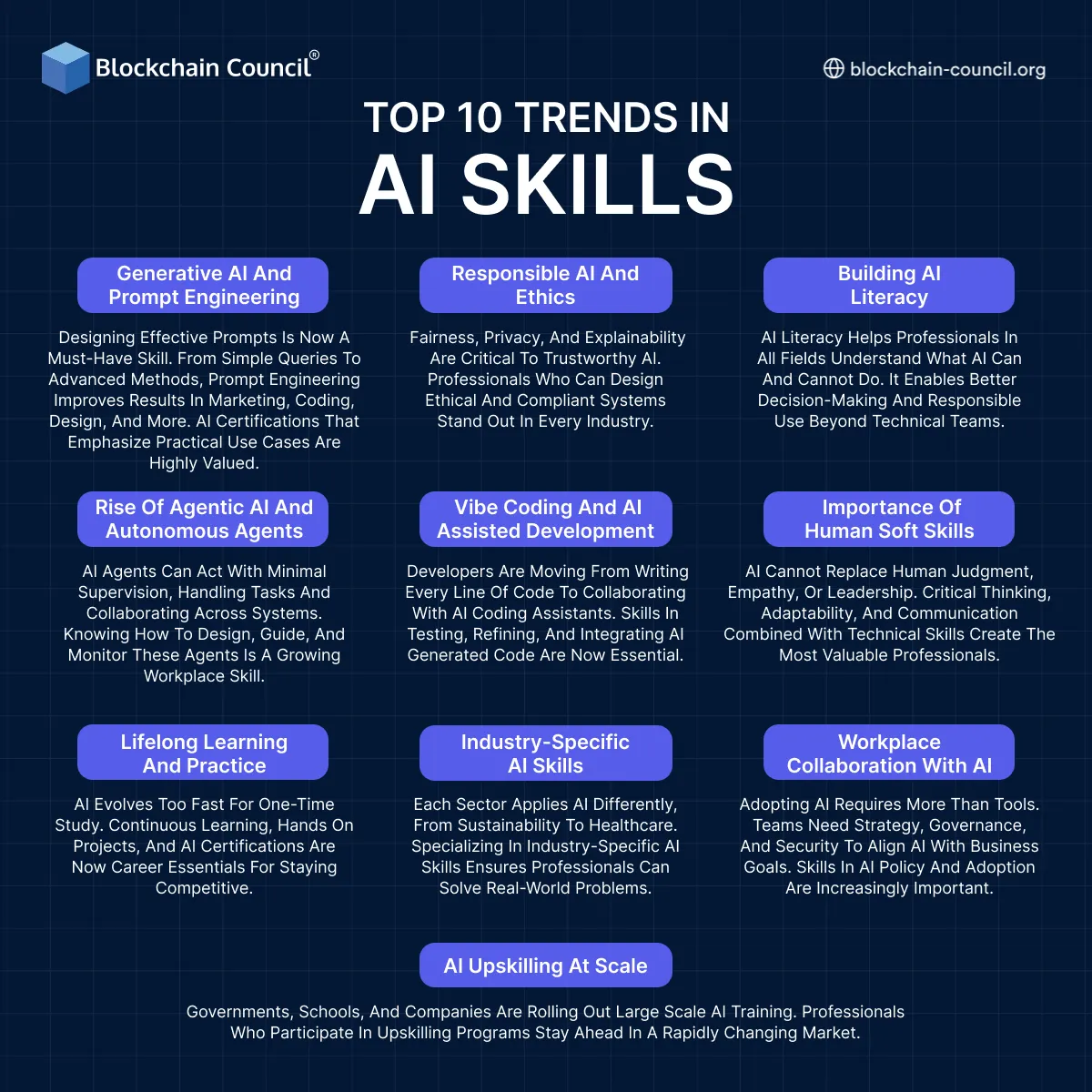
- Generative AI and Prompt Engineering
Designing effective prompts is now a must-have skill. From simple queries to advanced methods, prompt engineering improves results in marketing, coding, design, and more. AI certifications that emphasize practical use cases are highly valued. - Responsible AI and Ethics
Fairness, privacy, and explainability are critical to trustworthy AI. Professionals who can design ethical and compliant systems stand out in every industry. - Building AI Literacy
AI literacy helps professionals in all fields understand what AI can and cannot do. It enables better decision-making and responsible use beyond technical teams. - Rise of Agentic AI and Autonomous Agents
AI agents can act with minimal supervision, handling tasks and collaborating across systems. Knowing how to design, guide, and monitor these agents is a growing workplace skill. - Vibe Coding and AI-Assisted Development
Developers are moving from writing every line of code to collaborating with AI coding assistants. Skills in testing, refining, and integrating AI-generated code are now essential. - Importance of Human Soft Skills
AI cannot replace human judgment, empathy, or leadership. Critical thinking, adaptability, and communication combined with technical skills create the most valuable professionals. - Lifelong Learning and Practice
AI evolves too fast for one-time study. Continuous learning, hands-on projects, and AI certifications are now career essentials for staying competitive. - Industry-Specific AI Skills
Each sector applies AI differently, from sustainability to healthcare. Specializing in industry-specific AI skills ensures professionals can solve real-world problems. - Workplace Collaboration with AI
Adopting AI requires more than tools. Teams need strategy, governance, and security to align AI with business goals. Skills in AI policy and adoption are increasingly important. - AI Upskilling at Scale
Governments, schools, and companies are rolling out large-scale AI training. Professionals who participate in upskilling programs stay ahead in a rapidly changing market.
Generative AI and Prompt Engineering
Generative AI is at the center of today’s AI boom. Knowing how to design prompts is becoming a must-have skill. Prompt engineering teaches how to guide models with the right instructions so they produce useful results. From simple commands to advanced methods like chain of thought reasoning, this skill helps people in marketing, coding, design, and more. AI certs that focus on practical use cases are now highly valued.
Responsible AI and Ethics
Companies want AI that is safe and trustworthy. This makes AI ethics and responsibility key skills. Fairness, privacy, transparency, and explainability are all part of this field. Professionals who can design systems that are ethical and compliant will stand out.
Building AI Literacy
AI literacy means knowing what AI can and cannot do. This is not just for developers. Teachers, managers, and everyday professionals need this skill. It helps people ask better questions, understand AI’s limits, and use it responsibly.
Rise of Agentic AI and Autonomous Agents
Agentic AI is about systems that can act on their own with little guidance. They handle tasks, make decisions, and even collaborate with other tools. Learning how to design, monitor, and use AI agents will soon become a core workplace skill.
Vibe Coding and AI-Assisted Development
Instead of writing every line of code, developers now guide AI to generate and improve code. This style is often called vibe coding. It makes software development faster and more accessible. Skills in testing, refining, and working alongside AI coding assistants are becoming just as important as traditional coding.
Importance of Human Soft Skills
AI cannot replace human judgment, empathy, or leadership. Skills like critical thinking, adaptability, and systems thinking remain in high demand. Professionals who combine strong technical knowledge with human skills will be the most valuable.
Lifelong Learning and Practice
The pace of AI innovation means that learning never stops. Academic degrees alone are no longer enough. Employers look for people who can learn continuously and apply skills in real projects. Hands-on experience, certifications, and regular upskilling are now career essentials. For those managing data for AI systems, a Data Science Certification provides a strong foundation.
Industry-Specific AI Skills
AI is not one-size-fits-all. Each industry has its own needs. For example, sustainability and environmental technology now demand specialized AI solutions. Developing industry-specific expertise ensures professionals can apply AI in ways that solve real-world challenges.
Workplace Collaboration with AI
AI adoption is not just about tools. It also depends on strategy. Teams need to align AI with business goals and ensure proper governance. Skills in AI policy, security, and adoption strategies will continue to grow in demand.
AI Upskilling at Scale
Governments, schools, and companies are investing in large-scale AI training programs. This reflects how important it is for entire populations to adapt. Upskilling at scale ensures both professionals and businesses remain competitive in a world led by AI.
Conclusion
AI is changing careers at every level, from developers to managers. The most in-demand AI skills combine technical knowledge with human judgment and lifelong learning. From prompt engineering to ethics, literacy, and strategy, each skill builds resilience in the job market.